LAKEVILLE, Conn. — The Hotchkiss School will appeal the $41.7 million verdict awarded to a former student March 27 at U.S. District Court in Bridgeport by Judge Stefan Underhill. The private boarding high school was found guilty of negligence in a suit filed by Cara Munn, 20, of New York City. Munn was accepted to the Hotchkiss class of 2010. Following her freshman year at the school, she went on a five-week school-sponsored trip to China that began in June and was to have ended in July.In June, the group went to Mount Panshan, which according to www.chinatravelguide.com is on the North China Plain, about 55 miles from Beijing, and is a popular holiday destination for city dwellers. According to Linda Grossberg, who is a paralegal at the law firm that represented Munn, the Hotchkiss group traveled up Mount Panshan in a gondola. Munn and three or four other students asked for (and received) permission to walk down the mountain instead of taking the gondola. No bug spray containing DEET was provided to the students, according to the lawsuit, even though the walk was through a wooded area and even though the Centers for Disease Control (CDC) warns that tick-borne diseases are a danger in China. Malaria is a particularly grave danger for visitors to China, the CDC website states, adding that “dengue, chikungunya,filariasis, Japanese encephalitis, leishmaniasis and plague are diseases carried by insects that also occur in East Asia. Tickborne encephalitis occurs in forested regions in northeastern China and in South Korea.”About 10 days after that excursion, Munn began to experience severe headaches and high temperatures. She was admitted to a hospital in Tianjin, a city with a population that is close to 13 million. When she continued to get worse, she was transferred to a hospital in Beijing and then evacuated back to the United States. She was diagnosed with encephalitis and has what her lawsuit contends is likely to be permanent damage to her brain.Grossberg said the student’s executive functioning skills were compromised. She can’t speak and has difficulty organizing and planning. She has trouble with small motor skills and can communicate only by texting and typing.“She testified using her speech assistance device, which is like an iPad or iPhone,” Grossberg said. “She types into it and it ‘speaks,’ in a robotic voice. She has a lot of difficulty writing and her typing is slow.”Munn’s attorney was Antonio Ponvert III of the law firm of Koskoff, Koskoff and Bieder in Bridgeport, which specializes in malpractice suits and significant personal injury suits. Hotchkiss was represented by Dawn Seaman of the law firm Wiggin and Dana in New Haven. Seaman did not return a call seeking comment.Hotchkiss offered Munn $750,000 in a pretrial mediation, Grossberg said, but she turned it down.The court case began March 6. The jury began deliberations on the eighth day and discussed the case for eight hours. The $41.7 million award covers economic and noneconomic damages, Grossberg said. Past economic damages include the cost of medical care and evacuation from China. Future economic damages take into account her lost earning capacity and the cost of future medical care. Part of the award also covers noneconomic damages such as “the loss of enjoyment of life’s activities,” Grossberg said. It is unclear whether she will ever recover from the brain injury. “Five years have gone by since the injury and she is still unable to speak, after many therapies and many different approaches,” Grossberg said. She added, “she is a very persistent young woman and she hasn’t given up. She is hopeful she will speak again someday. But there are no doctors or experts who are now saying that is likely.”However, Munn managed to complete high school in New York City and is now a sophomore in college. Grossberg declined to share the names of the schools or to share additional information on the family, other than that Munn has two siblings.The suit found Hotchkiss negligent in not sufficiently warning students of the danger of tick-borne diseases in China, where even Lyme disease is common; and of not providing a repellant, like a product containing DEET.Plan to appealHotchkiss plans to appeal the case. On March 29, Head of School Malcolm McKenzie sent a letter to parents and alumni that said, “The case is based on the following incident: At the end of her freshman year at Hotchkiss, Cara Munn went on a Hotchkiss trip to China in June and July of 2007. During the trip she became ill with a tick-borne form of encephalitis (TBE) and continues to suffer the effects of this illness. According to the CDC, she was the first reported U.S. traveler to China to be diagnosed with TBE. It had not happened before the 2007 trip in question, and it has not happened since then.“As part of our due diligence prior to this trip, we checked the CDC website for medical advice and asked parents to do the same. We also requested that families seek advice from a travel medical specialist. There was no indication at all that this was a potential risk.“I would like to take this opportunity once again to assure the Hotchkiss community that our first commitment is, and has always been, to protect and care for our students. We take this duty extremely seriously.“We have been working closely with our insurance carrier. We have appropriate coverage for this matter. An appeal is being planned, and we are optimistic that further review of the facts will lead to a more favorable ruling.”In a statement released March 28, the school said, “We care deeply about all our students. We make every effort to protect them, whether they are here or participating in a school-sponsored activity off-campus. We put great care and thought into planning and administering off-campus programs, and we extend the same care to students on these trips as to students on campus. “Historically, our students have undertaken study, service projects and travel in the United States and throughout the world and have derived great benefit from these opportunities. We remain very saddened by this student’s illness. “We continue to hope for improvements to her health. While we will not comment on specific elements of the case, we plan to appeal this verdict.”When students left for the China trip, Robert “Skip” Mattoon was head of school. He was replaced on July 1, 2007, by McKenzie. McKenzie will leave the school this summer and found a new school in Beijing. His replacement will be Kevin Hicks, who had been the school’s dean of faculty.A spokesman for Hotchkiss said the school has an endowment of $380 million. It is one of the largest endowments of any private high school in the United States, according to www.boardingschoolreview.com. Another travel disaster occured this year, when students and teachers were on a ship in the Antarctic on a trip sponsored by alumnus Forrest Mars Jr. The ship was hit by a 30-foot wave that knocked the captain unconscious and shattered the glass of the ship’s bridge, leaving many crew members with cuts and injuries. None of the students or faculty was harmed.As for future student travel, McKenzie said, “We anticipate no change in our foreign study, service and travel plans. These are an integral part of the global education that is so important to our students.”Housatonic’s China tripInternational travel is becoming increasingly common for high school students, at public and private high schools. Housatonic Valley Regional High School sponsors an annual trip to China; students and faculty are departing for this year’s trip on April 6. Assistant Principal Ian Strever, who is traveling with the group, said, “We are not going to a part of China that is rural and where students will be exposed to ticks, and we limit the exposure by wearing long pants and shirts. “We do look at the CDC website, and share that with parents before we go.“We carry with us hand sanitizer. We stick with the same tour company we’ve been using for a number of years. We limit exposure on all fronts as much as we can.“Our concern is more about the pollution in Beijing; we may need to wear masks, which we will provide to students.”
Latest News
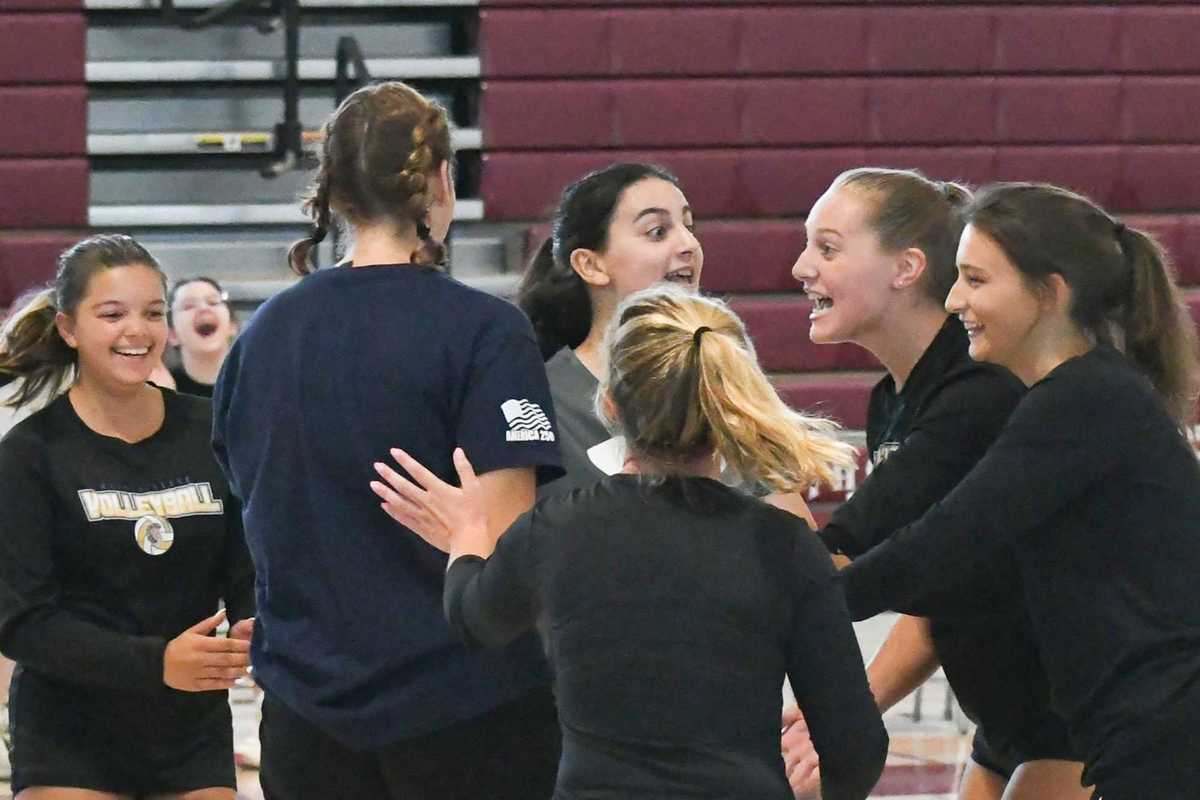
The HVRHS varsity team celebrates a point.
Riley Klein
The opening JV sets served as an introduction to the sport for some of the younger players. With the guidance of their coaches and the referees, both teams learned essential volleyball protocols including how to sub on and off the court, how to rotate after a side‑out and the correct positioning rules during serves.
Torrington’s passionate fans fueled momentum in long scoring runs and propelled the home team to 25-15, 25-11 wins in the two JV sets.
The varsity teams then took the court. Both squads featured a core of four seniors:Sydney Howe, Kenzsi Watson, Lydia Fleming and Kellie Esiermann for HVRHS, and Aaliyah Quintero, Jasmile Ruiz, Fiona Ramadani and Kailyn Castillo for Torrington.
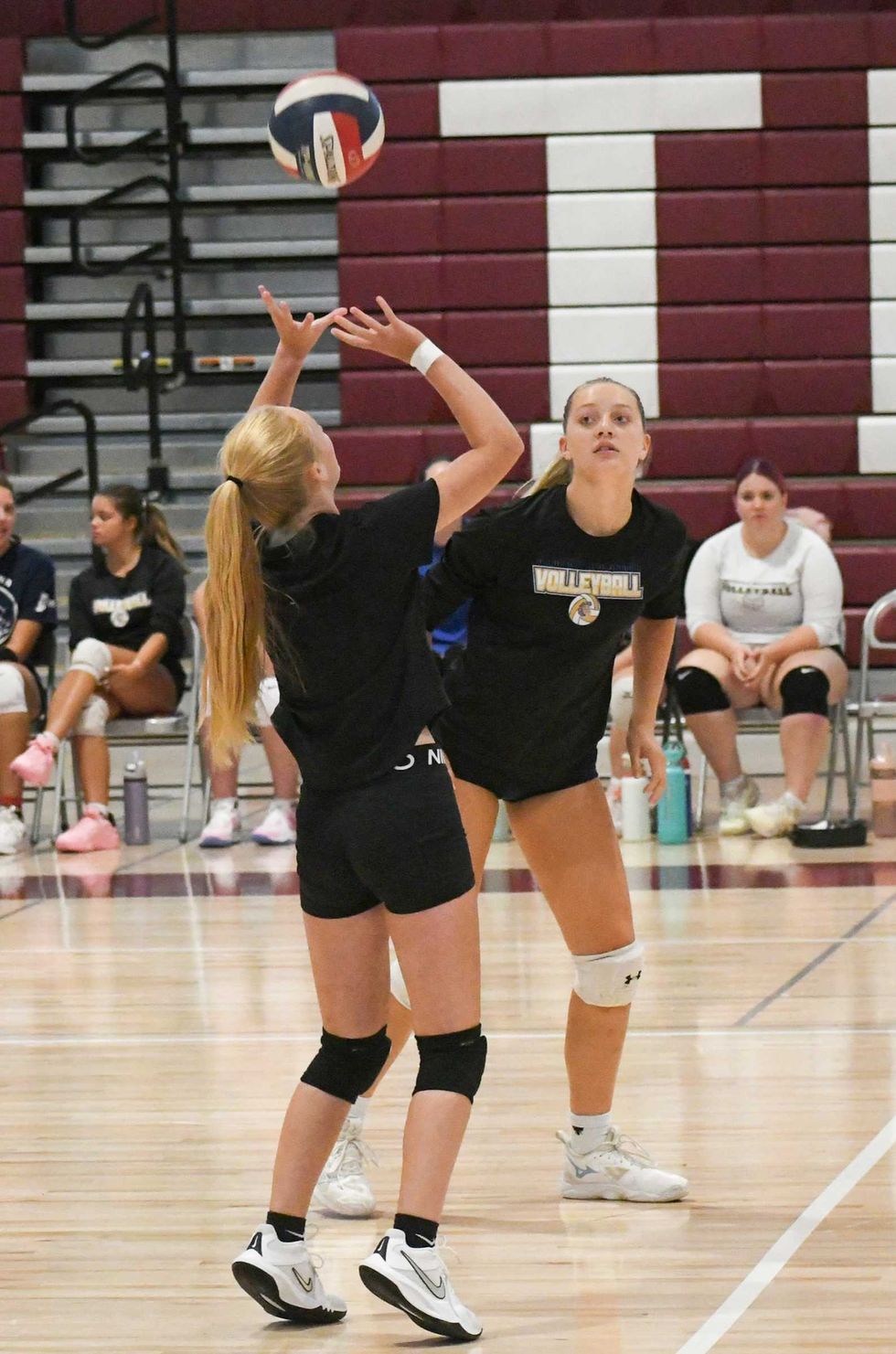 Taylen Leonard puts up a set for Sydney Howe.Riley Klein
HVRHS opened the first varsity set with an 8-3 lead behind a serving run from Howe. Torrington answered when Quintero took over as the server, pushing ahead 15-11. The set tightened at 15, then swung back and forth through seven ties and six lead changes before Torrington edged out a 26-24 win.
Torrington’s football team filed into the stands after concluding an afternoon practice, providing a boost to the crowd.
With the noise behind them, Torrington raced out to a 12-2 lead. Watson steadied HVRHS with a strong serving stretch, but Torrington maintained control and closed out the set 25-11.
The final set was shortened to 15 points, but it still produced a handful of sharp, extended rallies. HVRHS kept pace early, yet Torrington remained consistent and closed out the match with a 15-8 win.
HVRHS was scheduled to start the regular season with a three-stop road stretch in Waterbury Sept. 8, Woodbury Sept. 15 and Terryville Sept. 18. The team’s home opener has been scheduled for Monday, Sept. 21, at 5:15 p.m. against Lakeview High School.


Want more of our stories on Google? Click here to make us a Preferred Source.