

Good news! Plans are afoot to do something with the Lakeville Train Station. As per the selectmen’s letter of Feb. 2, 2022, a grant is being applied for to determine what is needed to rehabilitate the station’s physical plant and the nearby dam and pond. The application provides more specifics. This a federal grant being applied for, of up to $20,000, and the eventual preferred use of the station is by “a local not-for-profit organization whose purpose involves public benefit with a historical factor.”
As readers know, the Lakeville Train Station was part of the subject of my initial column in this series. I consider that to have been mostly serendipitous, a reflection of community concerns, and am delighted at any progress on it.
My column generated a few responses from readers, most of them agreeing with my second contention in the article, that we need a small-business incubator, wherever one might be situated.
A more intriguing response was a bitter complaint that there are too many newcomers buying homes from lifetime residents who can no longer afford to stay in them due to high taxes, and that as a result, the Northwest Corner is losing the very attributes that made it wonderful to live in. So stay away, you future would-be weekenders, and even you new entrepreneurs who want to live here full-time!
I don’t agree that they should stay away, but do agree that the complaint highlights an important problem. There have been too many instances of long-term residents having to sell homes they grew up in because high property taxes make the homes impossible to maintain on modest incomes, and so we very much need to find ways to assist our school personnel, town workers, nurses, small business-owners and retirees who have lived here forever, to remain in their family homes.
Sales of such long-held homes have already changed the character of the Twin Lakes area and of other, highly desirable residential sections of our towns, bringing in people who also have residences elsewhere and who, ipso facto, do not have as much of a commitment to this area as fulltime residents do.
Let me point out that Salisbury’s mill rate is one of the lowest in Connecticut, and was made even lower in a recent town budget. I am not certain that lowering it was the best idea but that’s a matter for another day.
Part of the problem is varying assessments of the homes. In our area, as in many others, municipal taxes for desirable-section homes are usually higher than for in-town homes. I think that there are two reasons. (Caution: I may be wrong on these.) The first is that assessed valuations of outlying homes are higher because they usually come with more acreage around them; and the second, that assessments appear to take into account the desirability of the home, and one factor in what is the home’s distance from the town center. I was once told by a town official that if my home was not within walking distance of town, if it was sited elsewhere and having the same acreage, it would be valued higher and so owe more in taxes.
Few of us — I almost wrote none of us — want the Northwest Corner to come to resemble The Hamptons on Long Island, an area that has gone so upscale that for several decades now it has been unaffordable for most Americans.
But can we as a community find ways to keep residences in the hands of families that have lived in them for generations, and thereby prevent drastic change to the area?
I propose that we re-structure our pattern of assessments and consequent tax burdens so that in individual cases they can be lowered by a factor that varies with the length of time that a family has resided in a home. If your parents lived there before you, you’ll get a nice discount on the usual rate.
If this means preferential treatment for a certain group of the citizenry, so what? We already give tax breaks to residents who volunteer for our fire and ambulance services, as we should.
I also summon our local banks to the task, asking them to work harder and be more imaginative and flexible in the structuring and restructuring of the home-owner loans that they make, to assure that these are more attuned to the needs and resources of long-term residents of properties that have become more valuable (and more tax-laden) than the occupants can sustain with their current home financing.
I welcome your ideas on this subject, and your suggestions for other subjects that we should be discussing. My email address is shachtmantom@gmail.com, and my snail-mail, Box 630 in Salisbury.
Tom Shachtman is the author of more than a dozen American and world histories and of documentaries seen on all the major networks. He lives in Salisbury.

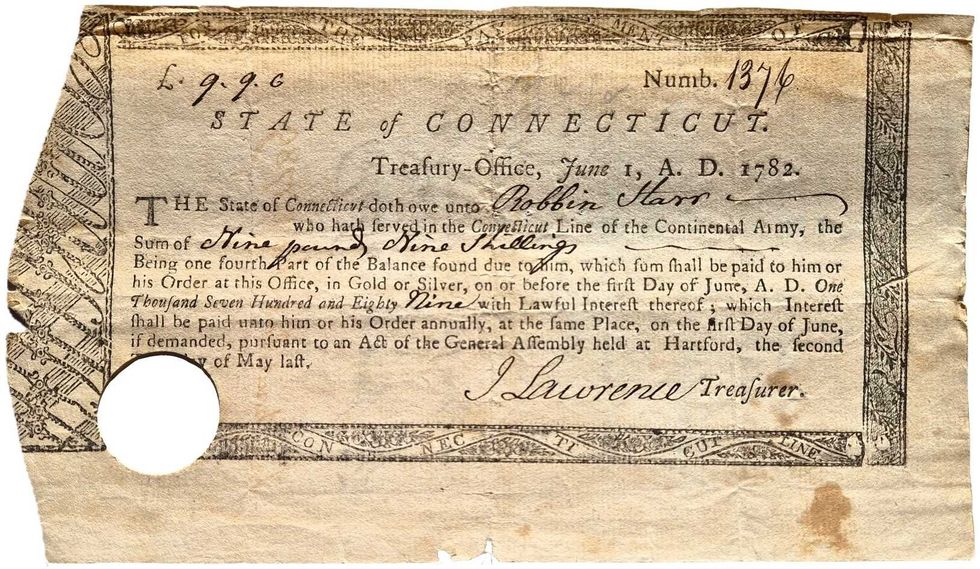 Pay Bill for Robin Starr’s service in the Continental Army.Courtesy the Alex Breanne Corporation
 John Mills speaking at Quinnipiac University.Courtesy the Alex Breanne Corporation
 Stephanie Saetta,with her rescue dog George and Blue (left), a shepherd mix awaiting his forever home.Madi Long
 Blue, a 7 year-old Shepard mix, is waiting for his forever home. Madi Long





Your ideas wanted: Some thinking on Salisbury’s taxes