AI tax targets the wrong signal

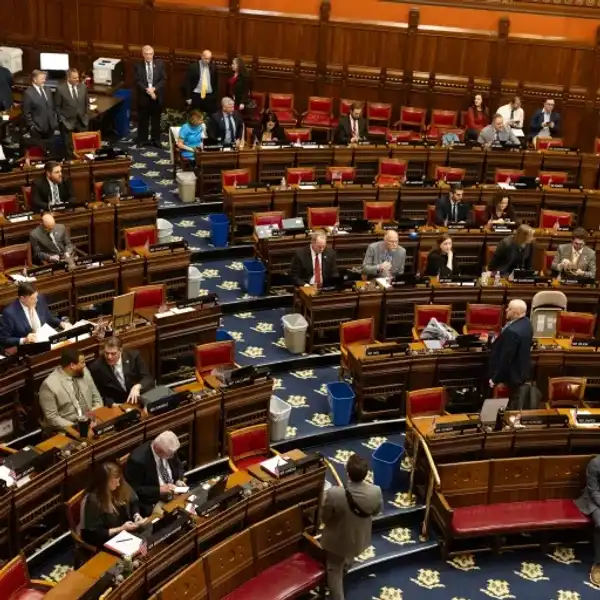
As Connecticut lawmakers debate Senate Bill 515, they are asking a question more states will soon face: As artificial intelligence changes work, what happens to workers whose jobs change or disappear?

The bill would create a “workforce and productivity gap” surcharge. If a company’s payroll falls while each remaining worker appears to produce more, the state could impose a new tax. Companies that keep staffing steady and use “collaborative technology” meant to help workers rather than replace them would be exempt.

That sounds like a way to protect workers. But it would likely do more harm than good for Connecticut workers over time. The bill directs the state to design a surcharge around a “productivity gap,” meaning firms could be taxed if they appear more productive while employing fewer workers.

The bill does not specify how this would be measured, but in practice such approaches rely on some version of falling payroll alongside steady or rising revenue. Those figures move for many reasons other than technology replacing workers, including reorganization, shifts in product mix, or higher prices. The result is a policy that risks taxing adjustment rather than harm, discouraging investment and slowing the wage growth that usually comes with a more productive economy.

A drop in payroll does not have one meaning. It can reflect weaker demand for a company’s product, a shift toward different lines of business, work moving to contractors or other locations, or better internal organization. In all of those cases, measured output per worker can rise. The bill treats those very different situations as if they were the same.

Technology usually reshapes tasks before it eliminates entire jobs. Despite common claims, firms do not typically replace an occupation all at once. They change pieces of work. Some tasks disappear, some become more valuable, and new ones emerge. The real question is not whether a firm has fewer workers than it did three years ago. It is whether workers are moving into more valuable roles as the work itself changes.

The bill tries to account for that by rewarding “collaborative technology,” meaning technology that helps workers do their jobs instead of simply replacing them. The instinct is sound. The trouble is that the line is hard to observe from the outside. The same software can reduce the need for some roles while raising the value of others. A payroll statistic cannot tell you which is happening.

What the policy can do is change behavior. If firms need to stay close to an old staffing baseline to avoid a surcharge, many will manage to that line. They may delay layoffs, change hiring plans, or move work outside payroll. That may make the numbers look better without leaving workers better off.

There is a second problem, and it goes straight to workers’ pocketbooks. When firms face unclear rules around new technology, they hold back on investment. That means less experimentation, slower adoption, and weaker productivity growth. Over time, weaker productivity growth usually means weaker wage growth.

There is also a broader economic point. When technology makes a service cheaper, people often use more of it. Economists call this Jevons paradox. Lower-cost AI legal research, for example, can reduce the time spent on each task while expanding demand for legal services overall. A tax built around preserving current payroll pushes in the opposite direction. It nudges firms to hold onto existing roles instead of helping workers move into higher-value work, often in different roles, firms, or sectors.

A functioning labor market depends on exactly this kind of movement. Workers change jobs. Firms expand and contract. New tasks show up in places the old jobs did not. A policy that tries to hold the labor market still ends up reducing opportunity.

None of this diminishes the concern that motivates the proposal. If the goal is to support workers through these changes, the most direct tools remain the most reliable. Strengthening training and career mobility does more than penalizing firms based on imperfect signals. It helps workers move into the new roles that technology creates. Policy can also do more to align incentives. Today, it is often easier to expense investment in machines than investment in people. Allowing immediate expensing of employer-provided training would put worker skill development on similar footing. Connecticut largely follows federal rules here, so progress would require action at both levels.

Connecticut’s proposal recognizes a real challenge. But treating lower payroll as clear evidence of harmful displacement is too blunt for a dynamic economy. The goal should not be to freeze today’s jobs in place. It should be to help workers move into better ones over time.

Revana Sharfuddin is a research fellow at the Mercatus Center’s Labor Policy Project at George Mason University.


The views expressed here are not necessarily those of The Lakeville Journal and The Journal does not support or oppose candidates for public office.

Latest News

‘Vulnerable Earth’ opens at the Tremaine Gallery

Tremaine Gallery exhibit ‘Vulnerable Earth’ explores climate change in the High Arctic.

Photo by Greg Lock

“Vulnerable Earth,” on view through June 14 at the Tremaine Gallery at Hotchkiss, brings together artists who have traveled to one of the most remote regions on Earth and returned with work shaped by first-hand experience of a fragile, rapidly shifting planet, inviting viewers to sit with the tension between awe and loss, beauty and vulnerability.

Curated by Greg Lock, director of the Photography, Film and Related Media program at The Hotchkiss School, the exhibition centers on participants in The Arctic Circle, an expeditionary residency that sends artists and scientists into the High Arctic aboard a research vessel twice a year. The result is a show documenting their lived experience and what it means to stand in a place where climate change is not theoretical but visible, immediate and accelerating.

Keep ReadingShow less
Beyond Hammertown: Joan Osofsky designs what comes next

Joan Osofsky and Sharon Marston

Provided

Joan Osofsky is closing the doors on Hammertown, one of the region’s most beloved home furnishings and lifestyle destinations, after 40 years, but she is not calling it an ending.

“I put my baby to bed,” she said, describing the decision with clarity and calm. “It felt like the right time.”

Keep ReadingShow less
A celebratory season of American classics and new works at Barrington Stage Company
Playwright Keelay Gipson’s “Estate Sale” will have its world premier this summer at Barrington Stage Company.
Provided

Amid the many cultural attractions in the region, the Barrington Stage Company in Pittsfield, Massachusetts, stands out for its award-winning productions and comprehensive educational and community-based programming. The theater’s 2026 season is one of its most ambitious; it includes two Pulitzer Prize-winning modern classics, one of the greatest theatrical farces ever written, and new works that speak directly to who we are right now as a society.

“Our 2026 season is a celebration of extraordinary storytelling in all its forms — timeless, uproarious and boldly new,” said Artistic Director Alan Paul. “This season features works that have shaped the American theater, as well as world premieres that reflect the company’s deep commitment to developing new voices and new stories. Together, these productions embody what BSC does best: entertain, challenge and connect our audiences through theater that feels both essential and alive.”

Keep ReadingShow less
google preferred source

Want more of our stories on Google? Click here to make us a Preferred Source.

Hotchkiss Film Festival celebrates 15th year of emerging filmmakers

Student festival directors Trey Ramirez (at the mic) and Leon Li introducing the Hotchkiss Film Festival.

Brian Gersten

The 15th annual Hotchkiss Film Festival took place Saturday, April 25, marking a milestone year for a student-driven event that continues to grow in ambition, reach and artistic scope. The festival was founded in 2012 by Hotchkiss alumnus and Emmy-nominated filmmaker Brian Ryu. Ryu served as a festival juror for this year’s installment, which showcased a selection of emerging filmmakers from around the region. The audience was treated to 17 films spanning drama, horror, comedy, documentary and experimental forms — each reflecting a distinct voice and perspective.

This year’s program was curated by student festival directors Trey Ramirez and Leon Li, working alongside faculty adviser Ann Villano. With more than 52 submissions received, the selection process was both rigorous and rewarding. The final lineup included six films from Hotchkiss students.

Keep ReadingShow less
Artist Maira Kalman curates ‘Shaker Outpost’ in Chatham

The Laundry Room, a painting by Maira Kalman from the exhibition “Shaker Outpost: Design, Commerce, and Culture” at the Shaker Museum’s pop-up space in Chatham.

Photo by Maira Kalman; Courtesy of the artist and Mary Ryan Gallery, New York

With “Shaker Outpost: Design, Commerce, and Culture,” opening May 2, the Shaker Museum in Chatham invites artist and writer Maira Kalman to pair her own new paintings with objects from the museum’s vast holdings, and, in the process, reintroduce the Shakers not as relic, but as a living argument for clarity, usefulness and grace.

Born in Tel Aviv, Maira Kalman is a New York–based artist and writer known for her illustrated books, wide-ranging collaborations and distinctive work spanning publishing, design and fine art.

Keep ReadingShow less

Ticking Tent spring market returns

Ticking Tent spring market returns

The Ticking Tent Spring Market returns to Spring Hill Vineyards in New Preston on May 2.

Jennifer Almquist

The Ticking Tent Spring Market returns to New Preston Saturday, May 2, bringing more than 60 antiques dealers, artisans and design brands to Spring Hill Vineyards for a one-day, brocante-style shopping event from 9 a.m. to 4 p.m.

Co-founders Christina Juarez and Benjamin Reynaert invite visitors to the outdoor market at 292 Bee Brook Road, where curated vendors will offer home goods, fashion, tabletop and collectible design. Guests can browse while enjoying Spring Hill Vineyards’ wines and seasonal fare.

Keep ReadingShow less
google preferred source

Want more of our stories on Google? Click here to make us a Preferred Source.

google preferred source

Want more of our stories on Google? Click here to make us a Preferred Source.