Tangled Lines tackles the hard questions

Tangled Lines tackles the hard questions
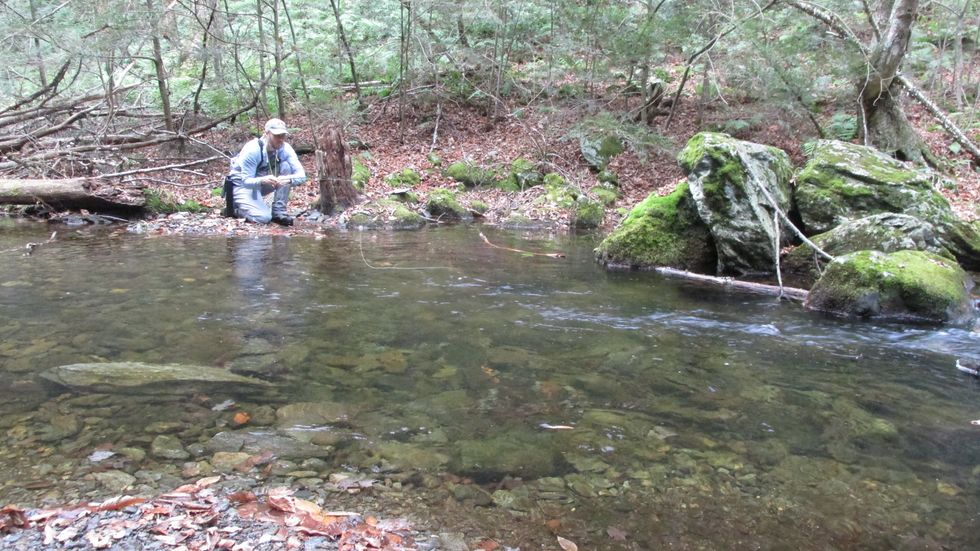
Andrew Corrigan shows how to keep a low profile on a brook trout stream. 
Photo by Patrick L. Sullivan

Let us open the Tangled Lines mail bag and see what’s on offer.

It’s been so cold and rainy that instead of fishing I am watching documentaries about secret societies. I even joined an order of guys who call themselves Templars. Am I going crazy?  Linus J. Scrimshaw, Perth Amboy, N.J.

Be of good cheer, Linus. Or at least as cheerful as a guy named Linus can be. Yes, the Housatonic has been too high to wade lately. And yes, that was the case for much of 2022. But bear in mind that the state put 18,000 trout in the upper Housatonic Trout Management Area (between Cornwall Bridge and the Salisbury/Falls Village line) last year, and another 9,000 recently, and none of these fish have experienced the standard Housatonic summer doldrums of high water temperatures and low flows. At some point the flow is going to come down, and there will be a LOT of active trout going after the same food, and flies. So tell your fellow Templars about this at the next meeting, and maybe they’ll lighten up. P.S. Never mind the drain in the floor of the secret chamber.

I really like the idea of fishing little blue lines for wild brookies, but every time I try I spend all of my time getting hung up in the trees.  Plus I can’t find the streams you talk about. What should I do? Melvin Potzrebie, East Quahog, N.Y.

Melvin, part of your problem is you are treating the small stream the same way you approach a river. Think in terms of visiting neighborhoods. Start with a nice-looking plunge pool. Fish it hard and fast, and if nothing happens, move on.

In close quarters, get out of the habit of rearing back with a full backcast. Instead approach the stream from the sides, rarely getting out into the water at all. Keep the rod in front of you, and learn to execute sidearm, backhand and snap casts. And keep a low profile. Wild brook trout are almost suicidally eager to take flies, and equally skittish when they get a glimpse of an angler.

You don’t necessarily need a short rod for this, although anything over 8 feet is going to be a pain. You do need a rod with a little heft to it — a 4 or 5 weight that can turn over a weighted fly and still land softly enough to fish a dry without a fuss.

As far as finding the streams, get a De Lorme atlas for your state and pore over it. See those little blue lines? That’s why we call this kind of fishing “blue-lining.”

Exploring the streams is hit-or-miss, emphasis on the latter. But when you find one, and catch a couple of wild beauties, while noting the absence of beer cans and styrofoam bait cups, you will be happy. And don’t tell anyone.

Latest News

Living art takes center stage in the Berkshires

Contemporary chamber musicians, HUB, performing at The Clark.

D.H. Callahan

Northwestern Massachusetts may sometimes feel remote, but last weekend it felt like the center of the contemporary art world.

Within 15 miles of each other, MASS MoCA in North Adams and the Clark Art Institute in Williamstown showcased not only their renowned historic collections, but an impressive range of living artists pushing boundaries in technology, identity and sound.

Keep ReadingShow less
Persistently amplifying women’s voices

Francesca Donner, founder and editor of The Persistent. Subscribe at thepersistent.com.

Aly Morrissey

Francesca Donner pours a cup of tea in the cozy library of Troutbeck’s Manor House in Amenia, likely a habit she picked up during her formative years in the United Kingdom. Flanked by old books and a roaring fire, Donner feels at home in the quiet room, where she spends much of her time working as founder, editor and CEO of The Persistent, a journalism platform created to amplify women’s voices.

Although her parents are American and she spent her earliest years in New York City and Litchfield County — even attending Washington Montessori School as a preschooler — Donner moved to England at around five years old and completed most of her education there. Her accent still bears the imprint of what she describes as a traditional English schooling.

Keep ReadingShow less
Jarrett Porter on the enduring power of Schubert’s ‘Winterreise’
Baritone Jarrett Porter to perform Schubert’s “Winterreise”
Tim Gersten

On March 7, Berkshire Opera Festival will bring “Winterreise” to Studio E at Tanglewood’s Linde Center for Music and Learning, with baritone Jarrett Porter and BOF Artistic Director and pianist Brian Garman performing Franz Schubert’s haunting 24-song setting of poems by Wilhelm Müller.

A rejected lover. A frozen landscape. A mind unraveling in real time. Nearly 200 years after its premiere, “Winterreise” remains unnervingly current in its psychological portrait of isolation, heartbreak and existential drift.

Keep ReadingShow less
google preferred source

Want more of our stories on Google? Click here to make us a Preferred Source.

A grand finale for Crescendo’s 22nd season

Christine Gevert, artistic director, brings together international and local musicians for a season of rare works.

Stephen Potter

Crescendo, the Lakeville-based nonprofit specializing in early and rarely performed classical music, will close its 22nd season with a slate of spring concerts featuring international performers, local musicians and works by pioneering composers from the Baroque era to the 20th century.

Christine Gevert, the organization’s artistic director, has gathered international vocal and instrumental talent, blending it with local voices to provide Berkshire audiences with rare musical treats.

Keep ReadingShow less

Leopold Week honors land and legacy

Leopold Week honors land and legacy

Aldo Leopold in 1942, seated at his desk examining a gray partridge specimen.

Robert C. Oetking

In his 1949 seminal work, “A Sand County Almanac,” Aldo Leopold, regarded by many conservationists as the father of wildlife ecology and modern conservation, wrote, “There are some who can live without wild things and some who cannot.” Leopold was a forester, philosopher, conservationist, educator, writer and outdoor enthusiast.

Originally published by Oxford University Press, “A Sand County Almanac” has sold 2 million copies and been translated into 15 languages. On Sunday, March 8, from 3 to 5 p.m. in the Great Hall of the Norfolk Library, the public is invited to a community reading of selections from the book followed by a moderated discussion with Steve Dunsky, director of “Green Fire,” an Emmy Award-winning documentary film exploring the origins of Leopold’s “land ethic.” Similar reading events take place each year across the country during “Leopold Week” in early March. Planning for this Litchfield County reading began when the Norfolk Library received a grant from the Aldo Leopold Foundation, which provided copies of “A Sand County Almanac” to distribute during the event.

Keep ReadingShow less

Erica Child Prud’homme

Erica Child Prud’homme

WEST CORNWALL — Erica Child Prud’homme died peacefully in her sleep on Jan. 9, 2026, at home in West Cornwall, Connecticut, at 93.

Erica was born on April 27, 1932, in Doylestown, Pennsylvania, the eldest of three children of Charles and Fredericka Child. With her siblings Rachel and Jonathan, Erica was raised in Lumberville, a town in the creative enclave of Bucks County where she began to sketch and paint as a child.

Keep ReadingShow less
google preferred source

Want more of our stories on Google? Click here to make us a Preferred Source.

google preferred source

Want more of our stories on Google? Click here to make us a Preferred Source.