Latest News
Region One advances $19.5M budget
Patrick L. Sullivan
Apr 29, 2026
FALLS VILLAGE — Voters in all six Region One towns will head to the polls on May 5 to act on the district’s proposed 2026–27 school budget.
The referendum will take place in Cornwall, Falls Village, Kent, North Canaan, Salisbury and Sharon, where residents will vote by ballot on the spending plan. The vote will take place between noon and 8 p.m. in each town.
The proposed budget totals $19,533,640, an increase of $1,048,431, or 5.67%, over the current year.
A public hearing on the proposal was held April 9 at Housatonic Valley Regional High School and online, giving residents an opportunity to weigh in ahead of the vote.
The Region One Board of Education voted the same night to advance the budget to referendum.
The Region One budget is divided into three components: Housatonic Valley Regional High School (HVRHS), Pupil Services and the Regional Schools Services Center (RSSC), also known as the central office.
The HVRHS portion — which covers staffing and day-to-day operations at the regional high school, including teachers, administrators, nurses, athletics, guidance, library services, custodial staff and building systems — is proposed at $9,408,838, an increase of $273,260, or 2.99%.
Pupil Services, which includes special education and related support such as pre-kindergarten programs, psychologists, speech clinicians, paraprofessionals and tutors, accounts for $8,111,086 of the budget, rising by $588,530, or 7.82%.
The RSSC, encompassing the superintendent’s office and districtwide administrative and support functions, is proposed at $2,013,716, an increase of $186,642, or 10.22%.
Region One Business Manager Sam Herrick presented the budget at the April 9 public hearing, noting that more than 98% of the overall increase is driven by health insurance costs, salaries and Pupil Services.
Of the $588,530 increase in Pupil Services, Herrick said about $449,230 is tied to tuition and transportation for out-of-district placements. He added that some savings were achieved by not replacing certain retiring employees and eliminating a full-time psychologist position.
No questions were raised following the presentation.
Town assessments
Region One town assessments are based on the number of students each town sends to HVRHS, meaning costs can shift as enrollment changes.
North Canaan alone sends 106 students to HVRHS, representing a substantial share of total enrollment. For example, while the town sent slightly fewer students — 106, down from 108 the year before — its share of the total still rose from 33% to 35% as overall enrollment declined.
Enrollment is finalized each Oct. 1. HVRHS has 300 students this year, down from 327 the year before, and is projected to decline further to 292 in 2026–27.
The cost per pupil is $39,669, including $31,363 for HVRHS, $6,726 for Pupil Services and $1,581 for the Regional Schools Services Center.
Details
May 5, Noon - 8 p.m.
Locations
Town Hall of Canaan/Falls Village
Town Hall of Cornwall
Town Hall of Kent
Town Hall of North Canaan
Town Hall of Salisbury
Town Hall of Sharon
If the budget is approved, town assessments would be as follows:
Cornwall
$2,168,169, an increase of $163,895 or 8.87%.
Falls Village
$1,752,589 an increase of $208,904 or 14.89%.
Kent
$2,783,359, an increase of $171,360 or 7.48%
North Canaan
$6,140,112, an increase of $519,526 or 9.11%.
Salisbury
$4,798,928, an increase of $17,835 or .43%.
Sharon
$1,890,486, a decrease of $33,356 or - 2.07%.
Keep ReadingShow less
Sharon exhibit marks 250 years of independence
Ruth Epstein
Apr 29, 2026
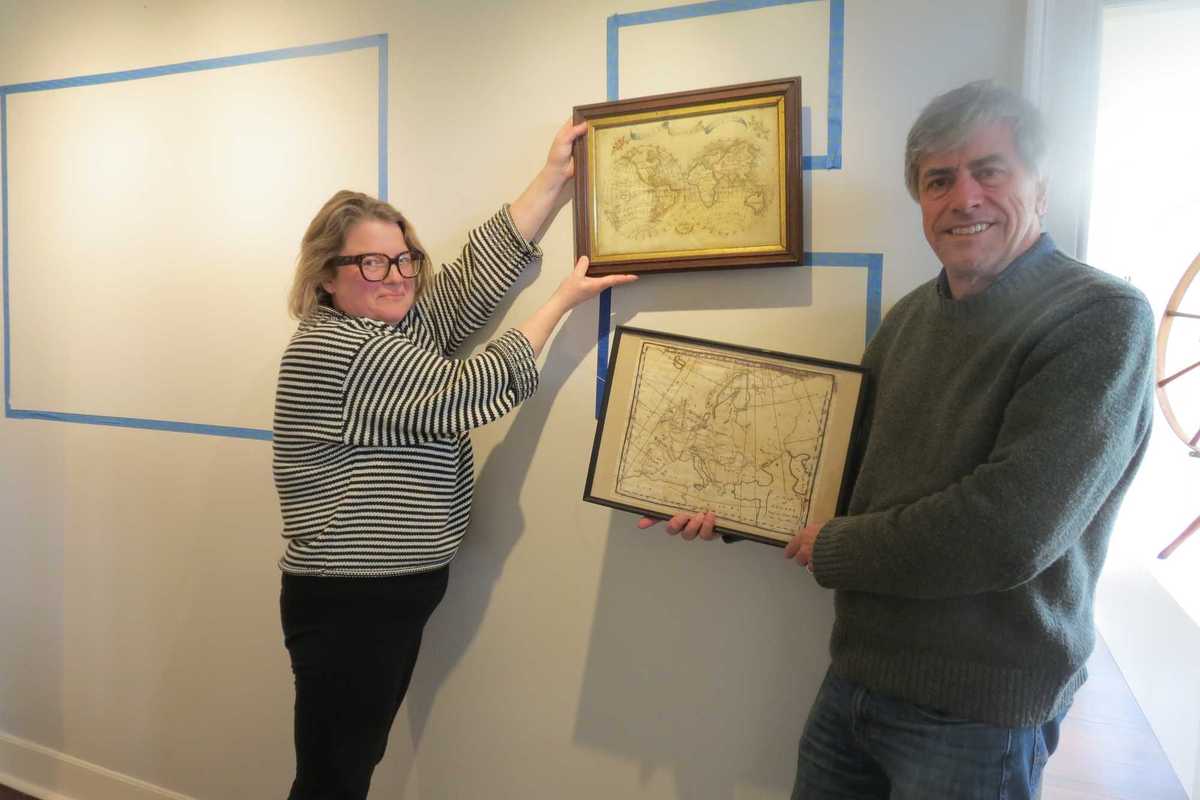
Sharon Historical Society director Abbey Nova and President Christopher Robinson show old maps that are part of the ‘Independence Revisited’ exhibit now at the society’s museum.
Ruth Epstein
Sharon was the scene of a historic event the third week of November in 1778, when 4,500 British and German prisoners camped along the road to Amenia Union.
SHARON – Like communities across the country, Sharon is celebrating the 250th anniversary of the Declaration of Independence. But in its current exhibit, “Independence Revisited,” the Sharon Historical Society is taking a different approach to commemorate the event that shaped a new nation.
The exhibit is organized into three periods in Sharon’s history – 1776, 1876 and 1976. Co-curators Christopher Robinson, president of the Sharon Historical Society, and Abbey Nova, its executive director, said they aimed to create an exhibit that was interesting and thought-provoking while showcasing the organization’s archives and collections.
“We wanted to give a sense of what Sharon was like at those times,” Robinson said. “How they celebrated independence, why they did it the way they did and what independence meant to them.”
The duo noted that it was an intentional choice because various wars had gone on during those years.
The focus is largely on 1776. Although no battles were fought on Sharon soil during the Revolutionary War, its impact was significant. About 300 men joined militias and went off to fight, leaving their families to fend for themselves. Local farmers provided food while the iron industry supplied wartime equipment and materials. The war also brought new people to town who were seeking safety and community.
The exhibit is filled with stories about the people who inhabited Sharon during that time, including attorney John Canfield, who arrived in 1765 and was later elected to the Continental Congress in 1786, but died before he could serve. His nephew, Judson Canfield, took over his practice and served many terms in the House of Representatives, eventually becoming a judge.
A familiar name featured in the exhibit is Cotton Mather Smith, a Congregational minister described as one of the most influential men in Sharon. Arriving in 1754, Smith and his wife, Temperance Gale Smith, became the moral heart of the community, settling minor disputes, serving as matchmakers, taking in the sick and indigent and caring for people during the smallpox outbreak of 1784.

Sharon was the scene of a historic event the third week of November in 1778, when 4,500 British and German prisoners camped along the road to Amenia Union. After the defeat at the Battle of Saratoga, those men who survived were marched to Boston. Two years later, Washington ordered they be escorted to Charlottesville, Va. Divided into six groups of approximately 750, they were sent off in succession. Sharon was designated the hand-off place where the Connecticut militia was to transfer custody to New York. Chaos reigned when the New York militia arrived late. Alexander Hamilton, who was then stationed in Pawling, was called to Sharon to assess the situation. Eventually the week-long backlog eased and the prisoners continued on their way.
Visitors will also find stories of social intrigue, including the relationship between Theodosia Prevost and Aaron Burr, as well as lesser-known facts – such as Sharon’s support for Shays’ Rebellion and its comparatively restrained treatment of Loyalists.
Nova noted that an economic slump followed the war. “There was a lot of economic hardship,” she said. “There was a severe cost to rebelling.” By 1876, Sharon was a “town in transit,” with the iron industry declining and tourism starting to emerge.
While no notable centennial celebrations took place, in 1976, there were pageants and picnics and people talked about what independence meant to them. Visitors will recognize familiar faces in the photo collages taken during those times.
The exhibit, which features many photographs, paintings and historical pieces, will be open through the end of the year.

Keep ReadingShow less
Kent moves toward food truck ban
Alec Linden
Apr 29, 2026
KENT – A proposed ordinance that would ban all commercial food truck operations in town is under consideration, frustrating a local crepe maker who feels the town has been hostile to his food truck business.
Following a brief discussion at the Board of Selectmen’s April 21 meeting, First Selectman Eric Epstein said he would ask town attorney Randall DiBella to draft an ordinance prohibiting for-profit food truck activity in Kent.
The proposal would ban food trucks townwide, including on private property, and would require approval by voters. Epstein noted that Connecticut Department of Transportation regulations already restrict such businesses along state-owned roads, further limiting potential locations.
The discussion resurfaced in February when Kent resident Grégoire Pye appeared before the board seeking approval for a semi-permanent location for his food truck business, Crepe Royal. Pye operates his crepe venture out of a refurbished 1980s ambulance and said the antique auto shop Motoriot had offered space on its property.
Over the course of three meetings, several local restaurant and business owners opposed Pye’s request, arguing that allowing one would “open the floodgates” and harm existing establishments.
Elissa Potts, who owns the long-running Fife’n Drum Restaurant and Inn, stated during the April 21 meeting that permitting food trucks, which are not subject to the same tax requirements as brick and mortar establishments, would be “really hard on the other businesses in town.”
“Just put it to rest,” she said.
John Casey, general manager for Kent Green, put his views more bluntly in a March 3 letter sent to the First Selectman: “The idea of allowing food trucks to come in and capitalize on local businesses’ investment of time and money seems like a slap in the face to those of us who have invested so much for so long.”
The issue stems in part from a regulatory gap dating back to 2021 and 2022, when a jurisdictional dispute between the Board of Selectmen and the Planning and Zoning Commission left the matter unresolved.
No formal ruling was ever passed, and the issue “keeps rearing its ugly head,” Potts said.
Former Land Use Office Director Donna Hayes, who was involved in earlier discussions, said the matter requires a town ordinance.
“You need to make a decision and get it over with,” Hayes said, noting that the commercial nature of food trucks raises both regulatory and competitive concerns.
Other nearby towns regulate — but do not ban — food trucks. New Milford allows mobile vendors with permits and requires them to operate on private property at least 250 feet from the nearest restaurant, with a cap of 20 permits per month. Sharon and Cornwall also permit food trucks subject to fees and regulations.
Falls Village is currently in the process of developing specific regulation of food trucks, while North Canaan drafted an ordinance and held a public hearing in 2022, but did not bring it to a vote.
Pye, who was unable to attend the April 21 meeting, said in an e-mail afterwards that he was disappointed by the opposition.
“I have attempted to contact those opposing my inquiry, but it appears there is significant pressure from established interests in Kent pushing the selectmen to prevent my operations.”
Keep ReadingShow less

Want more of our stories on Google? Click here to make us a Preferred Source.

Singing for the trees
Lakeville Journal
Apr 29, 2026
Provided
Seventh graders at Cornwall Consolidated School perform a song they wrote to help students learn about identifying trees. It was a big hit.
North Canaan celebrates with poetry and song
Alec Linden
Apr 29, 2026
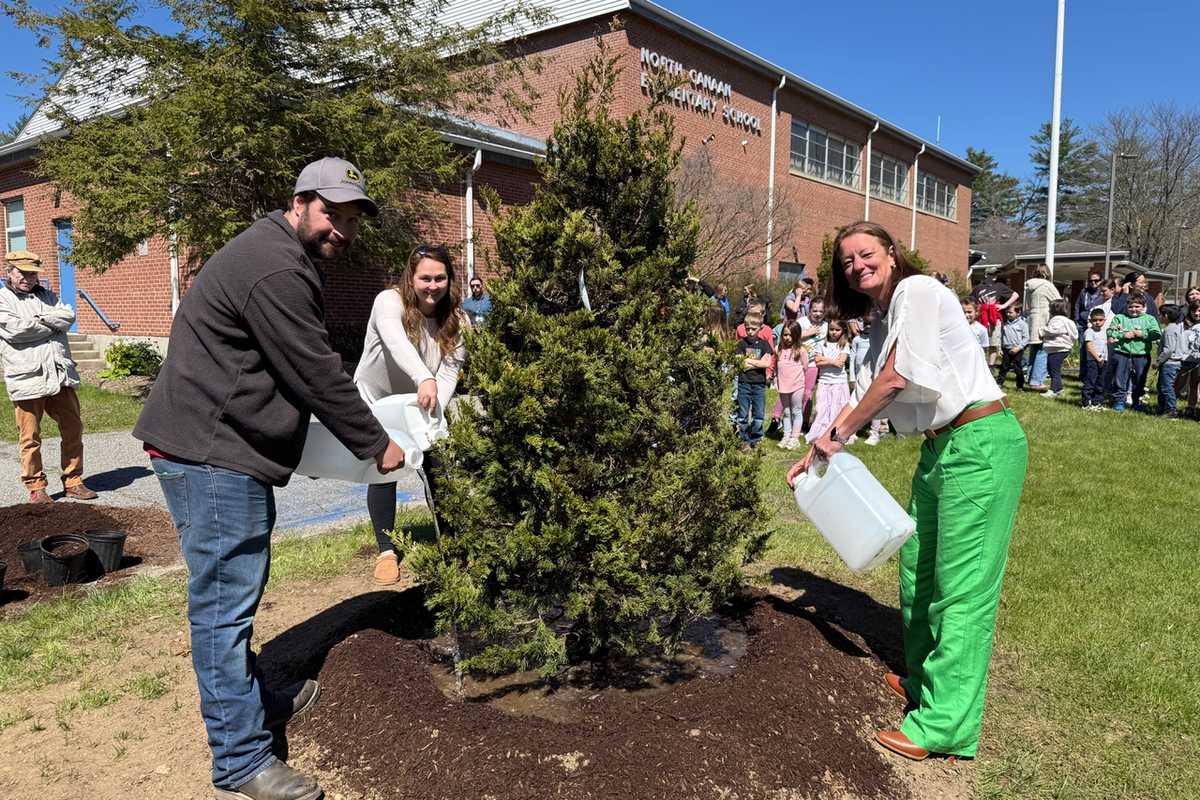
Selectmen Jesse Bunce (left), Melissa Pinardi (middle) and NCES Principal Beth Johnson water the newly-planted cedar near the close of the Arbor Day proceedings on Friday, April 24.
Provided
NORTH CANAAN – The North Canaan Elementary School’s arboretum was expanded yet again on Friday, April 24 in celebration of Arbor Day. With much fanfare, music and verse, the school community welcomed an eastern red cedar as the Class of 2029’s class tree.
“We are probably the best shaded campus in Litchfield County,” said local tree preservationist Tom Zetterstrom, reflecting several days after the event. Friday’s ceremony was NCES’ 36th observance since its first ceremony in 1990, and the cedar, which was planted by the Town Crew the day before, is the 36th tree Zetterstrom has personally ushered into the school’s lush grounds.
“Diversity promotes resilience and stability in forests,” he said, explaining that since he started coordinating Arbor Day at NCES in 1991, his goal has been to introduce a new native shade tree each spring.
The real focus, though, is the students. “We need to nurture and educate the environmentalists of the future if we’re going to sustain life on this planet,” Zetterstrom said.
The Class of ’29 seems up to the task. During Friday’s proceedings, five fifth graders recited arboreal odes to the gathered crowd of NCES students, staff, and community members, including selectmen Jesse Bunce and Melissa Pinardi.
Following the verse came ecological education, presented by Zetterstrom and fellow North Canaan Beautification Committee member Christian Allyn, both NCES alums. The two, who are both deeply involved in the regional fight against invasive plants, advocated for caring for local trees.
Lower school students then performed Arbor Day songs and mulched the freshly planted cedar, and the eighth grade presented former music teacher Mary Davidson with a signed poster in thanks for her years of teaching the same songs“that everyone in Canaan now knows,” as Zetterstrom said. NCES Principal Beth Johnson thanked the Canaan Foundation for funding the yearly additions to the school’s arboretum, the town staff and officials who helped plant the tree, Laurelbrook Natural Resources for providing soil, Tallon Lumber for mulch and finally Zetterstrom and Allyn as the North Canaan Beautification Committee.
Keep ReadingShow less
Kent students plant, share eco-projects
Ruth Epstein
Apr 29, 2026
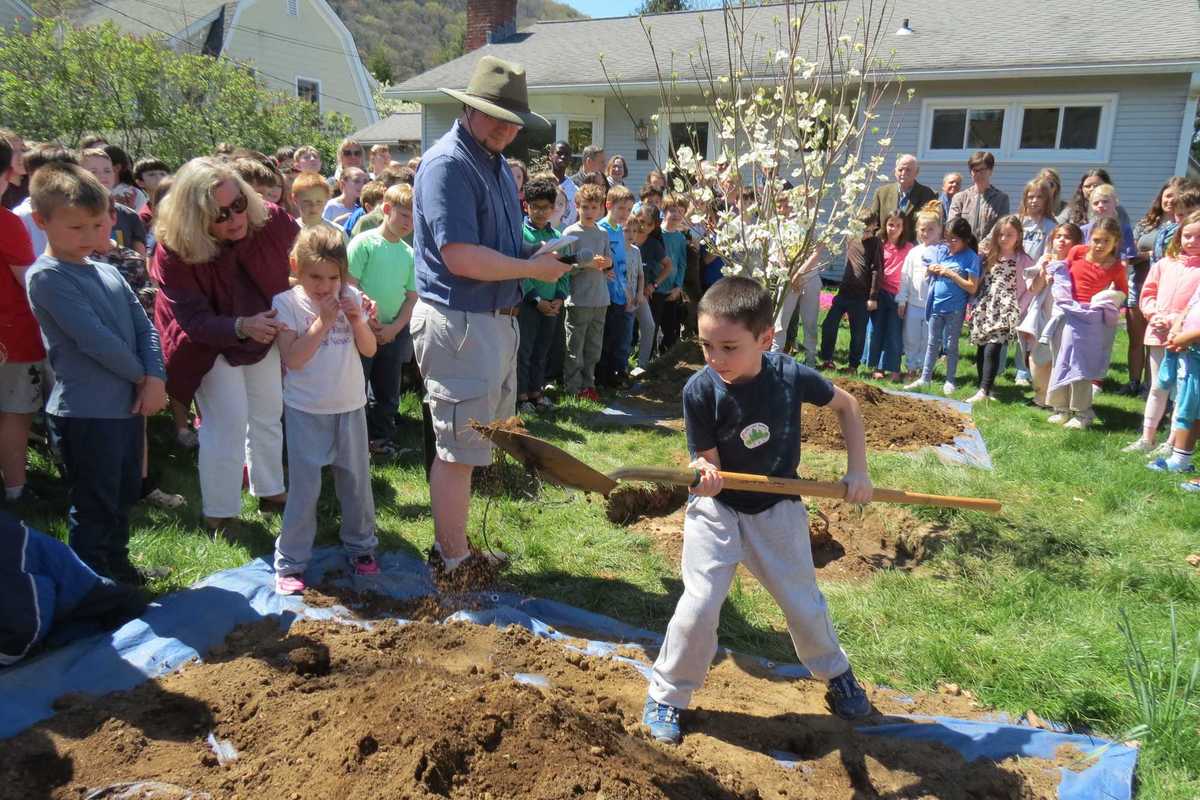
Kent Center School kindergartner Landon Sensenbrenner shovels dirt onto the newly planted flowering dogwood tree Friday, April 24.
Ruth Epstein
KENT — Christopher Martin, a former high school teacher who moved to town five years ago, spends his time volunteering at Kent Center School – and recently offered a spot on his Elizabeth Street lawn as the site for an Arbor Day tree planting.
The entire school walked to Martin’s home Friday, where fifth- and sixth-grade science teacher Christopher Rose spoke about the flowering dogwood that will soon blossom there. He pointed to another mature dogwood down the street that towers over houses, noting that some day the little one being planted will be that size.
A representative from each class stepped forward to pour a shovelful of dirt into the planting, which was made possible through the Kent Conservation Commission and the Kent Garden Club.
Back at school, students, staff and guests gathered in the gym for the annual Arbor Day celebration featuring projects involving music, art and recycling. Fifth-graders talked about the history of Arbor Day, noting that Birdsey Grant Northrup, a Kent native, founded the state’s observance. The first celebration was held in 1887. In 1970, President Richard Nixon declared the last Friday in April as National Arbor Day.
Eighth-grade students unveiled their environmentally-themed murals, the school joined in song and winners of a billboard design contest sponsored by Housatonic Resources Recovery Authority were announced.
Teacher Ane Starr reported that the school had collected 1,000 pounds of plastic fill over the year.The effort earned the school a bench made from recycled plastic.
“What an accomplishment,” she said. “We’re taking care of our earth not just for today, but every day.”
Keep ReadingShow less

Want more of our stories on Google? Click here to make us a Preferred Source.
loading