Mountain rescue succeeds through hail, wind, lightning

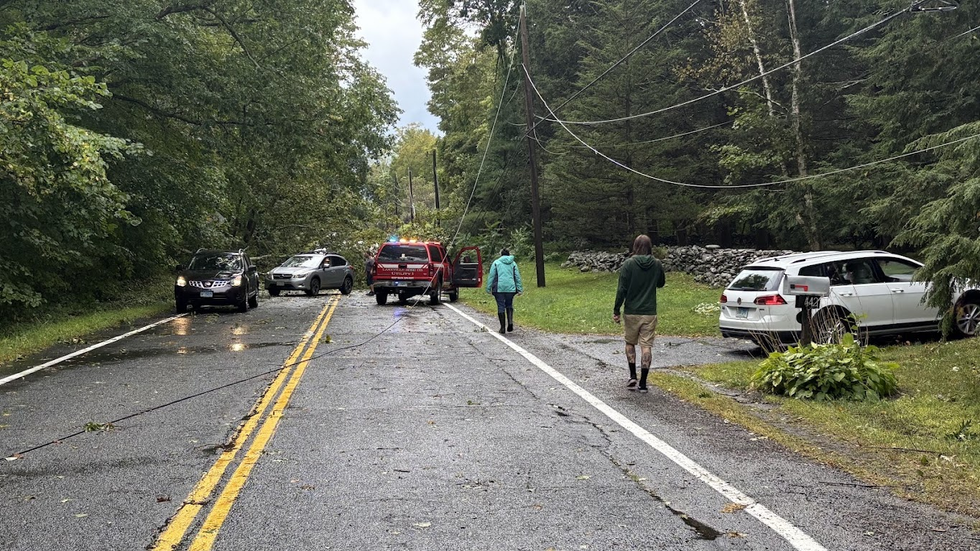
Undermountain Road in Salisbury was closed the afternoon of Saturday, Sept. 6, as rescue crews worked to save an injured hiker in the Taconic Mountains.
Photo by Alec Linden

Undermountain Road in Salisbury was closed the afternoon of Saturday, Sept. 6, as rescue crews worked to save an injured hiker in the Taconic Mountains.
SALISBURY — Despite abysmal conditions, first responders managed to rescue an injured hiker from Bear Mountain during a tornado-warned thunderstorm on Saturday, Sept. 6.
“It was hailing, we couldn’t see anything,” said Jacqui Rice, chief of service of the Salisbury Volunteer Ambulance Service. “The trail was a river,” she added.
Just after 3:30 p.m., Rice was positioned back at the station, her uniform spattered with mud from the harrowing mission high on the ridgeline of the Taconic Mountains. “It was really something,” she said with a chuckle as fellow first responders filtered into the station, sharing their own reports of unnavigable roads due to downed trees and powerlines.
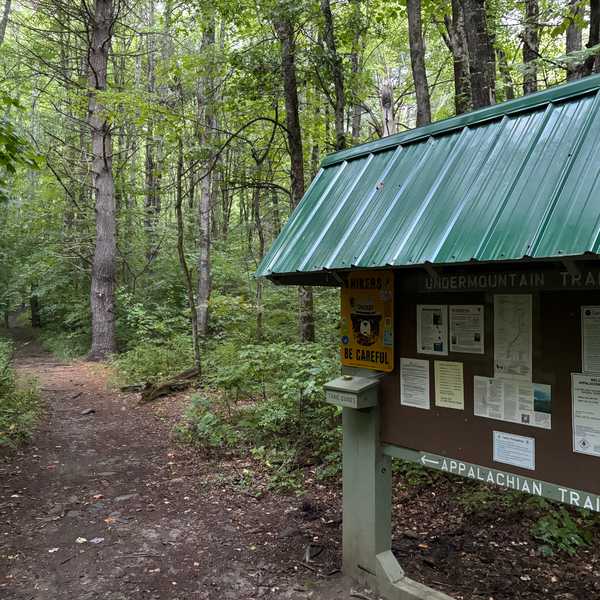
Rice said that emergency crews were dispatched at 11:30 a.m. on report of a hiker with an injured left knee on the Appalachian Trail at North Bear Mountain, just south of the Massachusetts border. The victim was unable to walk and needed to be transported off the mountain.
The team gained elevation from Salisbury via Mount Riga and Mount Washington Roads, leaving an ambulance at a location three miles from the hiker. The group travelled as far as possible with ATVs but eventually had to continue on foot due to the “very steep” and rocky terrain.
Rice said conditions were fair during the approach, but when they reached the injured party — “then the weather deteriorated bigtime.” Wind, rain, thunder, lightning and hail made the remainder of the extraction difficult, Rice reported, as they transported the victim via a Stokes litter basket on the slope. Responders deployed ropes to safely transport the victim through the difficult terrain despite the adverse conditions.
Overall, the team consisted of more than 20 members of various regional first response teams. Rice reported that rescuers from Salisbury Volunteer Ambulance, the Lakeville Hose Company, the Northwest Regional Ropes Rescue Team and responders from the state Department of Energy and Environmental Protection made up the mutual aid effort. “Even the ropes team from Amenia, New York came."
Once off the steep terrain, the victim was brought via ATV to the ambulance. Rice said that due to storm damage blocking the roadways, the team left the ATVs at the site and exited the area with the ambulance. The victim was reportedly taken to Sharon hospital in stable condition.
Despite the adverse weather, Rice confirmed that the victim was transported off the mountain safely. Lakeville Hose Company Chief Jason Wilson said that the rescue itself was straightforward despite the conditions, and had wrapped up by 2:30 p.m.
The storm, which was blowing off to the Northeast by then, had wrought havoc across the far Northwest Corner, and as a result had clogged the emergency airwaves in addition to the streets – the Salisbury Volunteer Ambulance Service had to self-dispatch the rescue as the Litchfield County Dispatch was jammed up by extensive emergency calls across the region.
The thunderstorm was one of the strongest of the season. It showed signs of rotation on weather radars, which indicates the possibility of tornado formation. Rotating supercells, of which there were several in the region as a line of strong storms passed through in the mid-afternoon yesterday, are rare in New England. The atmospheric conditions they require to form align only a handful of times per year.
The National Weather Service issued a tornado warning at 1:23 p.m. in Dutchess County for a cell moving northwest. At 1:42 p.m., the NWS reported a storm “capable of producing a tornado” above Ancram, New York, that would impact northwestern Salisbury and part of North Canaan just after 2 p.m.
The line of storms was observed to have produced 60+ mile per hour straight-line winds in several locations across Connecticut and Massachusetts. There have been anecdotal reports from storm chasers and residents of funnels trying to drop from the storm, but without touching down. These sightings have not been corroborated by weather officials.
The NWS confirmed one tornado that touched down near Worcester, Massachusetts later in the day, but has not reported any in the Northwest Corner or surrounding region.
Still, the storm wrought significant impacts across the area, closing Route 44 between downtown North Canaan and the intersection with Belden Street for a short period due to downed wires, as well as a section of Route 41 in Taconic that only reopened Sunday afternoon after a fallen tree was removed.
First responding crews reported Taconic was especially hard hit, with travel in some areas essentially impassable immediately following the storm. Major roadways have since been cleared of blockages.

Affordable housing moved forward in 2025, including two homes on Perry Street in Lakeville. Jennifer Kronholm Clark (with scissors) cuts the ribbon at one of the two affordable homes on Perry Street along with (from left) John Harney, State Representative Maria Horn (D-64) and housing Commissioner Seila Mosquera-Bruno.
SALISBURY — Salisbury expanded its affordable housing stock in 2025 with the addition of four new three-bedroom homes developed by the Salisbury Housing Trust. Two of the homes were built at 26 and 28 Undermountain Rd, with another two constructed at the top of Perry Street in Lakeville.
Motorists and students from The Hotchkiss School will soon benefit from a new sidewalk along Sharon Road (Route 41) connecting the school to Lakeville village. In November, Salisbury was awarded $800,000 in state funding to construct the sidewalk along the southbound side of the road, linking it to the existing sidewalk between Main Street and Wells Hill Road.
Residents of Salisbury and Sharon will also see changes to how household waste is handled. On Oct. 29, the governor’s office announced that the Salisbury/Sharon Transfer Station had received a state grant to implement a unit-based pricing system — commonly known as “pay as you throw” — and to expand composting operations.
The state Department of Energy and Environmental Protection (DEEP) awarded the transfer station $266,692 through its Sustainable Materials Management grant program. The funds will support a gradual, three-phase transition to a pay-per-bag model to replace the current $150 flat fee paid by households. Both the Salisbury and Sharon selectmen endorsed the application when it was submitted in June.
After a sustained three-year effort, the highly invasive hydrilla plant appears to be gone from East Twin Lake. “The good news is, the hydrilla is pretty much gone. We have not found anything,” George Knoecklein of Northeast Aquatic Research (NEAR), the Twin Lakes Association’s limnologist, reported during an Oct. 8 meeting of local, state and federal scientists, environmentalists and stakeholders at O’Hara’s Landing Marina.
But the town and the Lake Wononscopomuc Association will keep a ban on outside boats in effect at Lake Wononscopomuc, also known as Lakeville Lake, for the third year.
The lake has not been affected by hydrilla, and to keep it that way the boat launch is closed to watercraft from anywhere else. To make up for this, the town Grove boat launch has paddle boards, kayaks, canoes and row boats, plus trolling motors for anglers, available for rent.
Water also featured prominently in local achievements, as Salisbury’s Phoebe Conklin, 14, competed at the YMCA National Long Course Swimming Championships in Ocala, Florida. Conklin qualified for nationals in the 50-meter freestyle, 100-meter freestyle and 100-meter butterfly.
New around town: The Grassland Dessert Cafe and Lakeville Books and Stationery opened for business in Lakeville.
Meanwhile, Craig Davis and Keavy Bedell opened East Mountain House in Lakeville, an end-of-life care facility designed to accommodate up to two guests at a time. The facility welcomed its first guest in mid-September.

In August, Rev. Johan Johnson assumed leadership at St. John’s Episcopal Church in Salisbury. Johnson is also the chaplain at Salisbury School.
And in June, Rev. Heidi Truax retired from Trinity Episcopal Church in Lime Rock at the end of June after 16 years.
Before saying farewell, Truax gave the pre-race invocation June 29 when NASCAR returned to Lime Rock Park for the first time since 2011. It was billed as the largest event in modern track history with an estimated 20,000 fans attending for the weekend of pro racing.
A few months later, on Saturday, Sept. 20, a small aircraft carrying two people crashed at Lime Rock Park after making an emergency landing due to a reported mechanical failure. The area was closed while officials investigated the incident and contained a small fuel leak.
Lime Rock’s Emergency Services team was the first to respond, and director Keith Byrne said the pilot was uninjured while the passenger may have sustained minor injuries.
“It was a huge relief once we saw them getting out the plane with nothing on fire,” Byrne said of arriving on the scene.
Saturday mornings on the town Green near the White Hart have long been the time and place for political activism. This has become supercharged since the start of the second Trump administration, with “No Kings” protesters turning out in significant numbers.

The Scoville Memorial Library maintained a busy schedule of programs throughout the year, often in partnership with organizations such as the Salisbury Association. A brief and necessarily selective sampling included a June 12 presentation by Michael LaScaleia, a scientist with the Arnold Arboretum in Boston, who guided audiences through the strange and often surprising world of caterpillars and invasive plants.
Ornithologist George E. Wallace highlighted recent conservation efforts directed at bird species in Hawaii during a presentation on March 13.
And leading up to the 250th anniversary of the Declaration of Independence, the library bought multiple copies of Russell Shorto’s “Revolution Song: The Story of America’s Founding in Six Remarkable Lives” and gave them out to complement a series of Revolution-centered activities and events.
Meanwhile, the normally placid confines of the Salisbury post office were briefly disrupted when patrons arrived to find the building closed on Monday, March 17, with a notice on the locked door warning of asbestos abatement.
Postal customers were directed to the Lakeville post office for their mail.
Salisbury Postmaster Lisa Hoage said the floor of the Salisbury facility had been in poor condition for some time. The matter was dealt with quickly and the post office was back up and running in a matter of days.
Connecticut will kick off 2026 with nearly two dozen new laws that are slated to wholly or partially take effect on Jan 1.
The laws touch a range of areas in the state, from farming to pharmaceuticals to housing to the justice system.
Connecticut laws are passed by the General Assembly during the legislative session each year — this year’s ran from Jan. 8 to June 4 — or in a special session. They typically take effect on Jan. 1, July 1 or Oct. 1.
Here’s a look at some of the laws that will be implemented on day one of the new year.
Most of H.B. 8002, a sweeping, contentious housing bill, will take effect on Jan. 1.
The bill’s major goal is to make it easier to build more housing in Connecticut. It requires towns to create housing growth plans with goals on how many units they’ll plan and zone for, changes minimum off-street parking requirements and incentivizes towns to take steps to allow more housing, among other measures.
It also expands the number of fair rent commissions — a government body that can hear complaints about rent increases and make decisions on whether to change that rental increase number — and bans “hostile architecture,” or the use of things like armrests in the middle of benches or spikes to make it harder for people experiencing homelessness to lie down.
The bill was a modified version of H.B. 5002, which Gov. Ned Lamont vetoed during the 2025 legislative session, saying he wanted to get local leaders on board with the measure. Behind the scenes, he and advisors fretted over the political implications of signing the measure as they received thousands of calls from opponents and Lamont considered a third-term run next year.
Lawmakers passed H.B. 8002 during a two-day special session from Nov. 13-14, and Lamont signed it into law on Nov. 26.
Condo complexes can no longer enforce provisions in their bylaws that “prohibit or unreasonably restrict” owners of single-family detached units from putting solar panels on their roofs under a new bill that also creates a solar panel approval process for condo unit owners and their associations to follow.
Existing condo associations can opt out of these requirements if at least 75% of their board of directors votes to do so. However, that vote would need to occur by Jan. 1, 2028.
Connecticut already restricts planned community associations from prohibiting solar panels. The new law is essentially an expansion to include condos as well.
Learner’s permit holders must take an eight-hour course prior to getting their driver’s license under existing law, and Connecticut currently allows students to take it both in-person and through distance learning. Beginning Jan. 1, anyone taking the class remotely must keep their camera on, and driving schools can now charge up to $200 for it (the previous limit was $150).
Under that same law, as of Jan. 1 many applicants for a driver’s license or learner’s permit — as well as drivers convicted of violating highway worker safety laws — must complete a program administered by the Department of Motor Vehicles on highway work zone and roadside vehicle safety awareness.
All 16- and 17-year-old driver’s license applicants who get a learner’s permit beginning Jan. 1, 2026 must take the program, as well as adult driver’s license applicants who meet certain requirements (like having not previously held a Connecticut license or not currently holding a valid license issued by another state, territory or country).
On Jan. 1, Connecticut’s minimum wage will increase by $0.59, from $16.35 per hour to $16.94 per hour.
That increase comes from a law signed by Gov. Ned Lamont in 2019 that, as of 2023, pegs the state’s minimum wage to the federal employment cost index.
Connecticut currently has the fourth highest state minimum wage, behind $16.66 in Washington and $16.50 in California and most of New York. Massachusetts and Rhode Island require a minimum wage of $15.
The Connecticut DMV will begin issuing commemorative license plates that recognize “The Borinqueneers,” the U.S. Army’s 65th Infantry Regiment made up largely of Puerto Rican servicemembers who served with distinction in the Korean War.
The plates will cost $60. They will be designed in consultation with the Hispanic-American Veterans of Connecticut Inc., and that group will receive $45 from the sale of each plate for bilingual services and assistance to the state’s veterans and current servicemembers.
HVRHS’s Victoria Brooks navigates traffic on her way to the hoop. She scored a game-high 17 points against Nonnewaug Tuesday, Dec. 16.
FALLS VILLAGE — Berkshire League basketball returned to Housatonic Valley Regional High School Tuesday, Dec. 16.
Nonnewaug High School’s girls varsity team beat Housatonic 52-42 in the first game of the regular season.
The atmosphere was intense in Ed Tyburski Gym with frequent fouls, traps and steals on the court. Fans of both sides heightened the energy for the return of varsity basketball.
HVRHS started with a lead in the first quarter. The score balanced out by halftime and then Nonnewaug caught fire with 20 points in the third quarter. Despite a strong effort by HVRHS in the last quarter, the Chiefs held on to win.
Housatonic’s Victoria Brooks scored a game-high 17 points and Olivia Brooks scored 14. Carmela Egan scored 8 points with 14 rebounds, 5 steals and 4 assists. Maddy Johnson had 10 rebounds, 4 steals, 2 assists and 2 points, and Aubrey Funk scored 1 point.
Nonnewaug was led by Gemma Hedrei with 13 points. Chloe Whipple and Jayda Gladding each scored 11 points. Sarah Nichols scored 9, Bryce Gilbert scored 5, Gia Savarese scored 2 and Jazlyn Delprincipe scored 1.
CORNWALL — At the Dec. 9 meeting of the Planning and Zoning Commission, the commission had a pre-application discussion with Karl Saliter, owner of Karl on Wheels, who plans to operate his moving business at 26 Kent Road South, which is an existing retail space.
Saliter said he will use the existing retail section of the building as a mixed retail space and office, and the rear of the building for temporary storage during moving operations.
There will be no external “personal” storage proposed for the property.
The commission decided that Saliter should go ahead with a site plan application under the regulations for “retail stores and trades.”
P&Z also set a public hearing on a proposed text amendment on dimensional requirements for properties in the West Cornwall General Business (GB) zone. It will be held Jan. 13, 2026, at 7 p.m. at the Cornwall Library.