A friend asked me what I was thinking while listening to President Obama’s inaugural address. Here were my reactions:Obama: “They [the Patriots of 1776] gave to us a republic, a government of and by and for the people.” The flood of money-shaping elections and politics has given us a corporate government of the Exxons, by the General Motors, for the DuPonts. Obama: “Together we resolve that a great nation must care for the vulnerable and protect its people from life’s worst hazards and misfortune.” In his first term Obama was indifferent to the more than 300,000 preventable fatalities a year in this country from hospital infections and malpractice, adverse drug effects, and occupational disease/trauma, in addition to coming perils of viral epidemics from abroad. Obama: “…our country cannot succeed when a shrinking few do very well and a growing many barely make it.” He reneged and kept silent on his repeated 2008 campaign promise to push for a $9.50 minimum wage by 2011 and for a card-check system to facilitate the growth of unions. In his first term he discouraged Democrats from championing these measures in Congress even though thirty million workers are making wages less than workers made in 1968, adjusted for inflation (see timeforaraise.org). He also opposed a Wall Street financial transaction tax and declined to reduce gigantic corporate welfare programs (that conservatives call “crony capitalism”) that beg for repeal. Obama: “We will respond to the threat of climate change, knowing that the failure to do so would betray our children and future generations.” Obama and the emissaries he sends to international climate change conferences have brought up the rear among nations, infuriating our allies who looked to the United States for leadership. He never pressed for a carbon tax that even Exxon and leading conservatives, such as Gregory Mankiw, support (Mankiw was the chairman of the Council of Economic Advisers under George W. Bush). I also believe that Obama will approve the Keystone XL Pipeline that will carry 900,000 barrels of dirty tar sands oil through the U.S. every day. A decision that Jim Hansen of NASA said would be catastrophic. Obama: “[E]nduring security and lasting peace do not require perpetual war….We will defend our people and uphold our values through strength of arms and the rule of law.” Hello! This coming from the ex-Constitutional law teacher who has turned his imperial presidency into an institutionalized violator of the Constitution, federal statutes and international treaties. He has personally ordered many unlawful military incursions and slayings in countries that are not at war with the U.S. against people who do not constitute “imminent threats.” (See the new documentary Dirty Wars https://dirtywars.org/.)The week of his inauguration President Obama sent drones to destroy “suspects” and whoever may be with or near them, including children, without the rule of law being observed. He is the law – the secret prosecutor, judge, jury, and executioner for such attacks that have taken many civilian lives and produced increased hatred toward the U.S. from Pakistan to Yemen. The alleged “secret law” in Justice Department memos that he relies on is designed to strip the Congress and the courts of their Constitutional roles, as well as to keep the American people in the dark about drone attack decisions he makes on what his aides called “Terror Tuesdays.” Obama: “We will support democracy from Asia to Africa, from the Americas to the Middle East….”What about attending to our deteriorating democratic protections and civil liberties in our country? Washington, D.C. is corporate occupied territory in all three branches of government. Never in the past half century have the people and concern for their necessities been more shut out of their government. It continues to be “pay to play” time in the nation’s capital. Obama: “You and I, as citizens, have the obligation to shape the debates of our time…” Well, then how about working to shift more power away from the few and toward the many? How about campaign finance reform and federal ballot access reform so voters can have more choices from third parties whose candidates, by the way, he should have been gracious enough to invite to his January 21, 2013 gala. Granted, inaugural addresses are meant to be general and inspirational, not programmatic and revelatory. In a few days, Mr. Obama will have a chance to present his program in his more lengthy State of the Union address before the Congress. But inaugurations set tones as did the dominant militaristic displays and the managed adulation of the “imperial presidency.” Tom Sherwood, a local commentator, watching the Inaugural parades up Pennsylvania Avenue from the sixth-floor balcony of the Newseum decried “the extraordinary expense – financial and psychological – of turning America’s Main Street into an armed camp where democracy is suspended for several days…. Protest groups are ‘assigned’ demonstration areas, and required to pay fees and adhere to strict assembly instructions…. This being the week of the Martin Luther King Jr. holiday, it makes you wonder what success would have been achieved if civil rights workers had acceded to police demands not to march here or there, or to pay to get detailed permits first.”Sherwood adds: “but why not a parade that showcases the social services, arts and industries, and sciences along with our military services.” He then gives examples for his refreshing proposal. (You can follow him on Twitter @tomsherwood.)Writing in The New York Times, David Brooks had qualms in an otherwise laudatory column on Obama’s speech, concluding that “we have no party that is comfortable with civil society, no party that understands the ways government and the market can both crush and nurture community, no party with new ideas about how these things might blend together.” Good point, Mr. Brooks, but not true for some third parties and their candidates who were the Obama parade’s uninvited ones.Consumer advocate Ralph Nader grew up in Winsted and is a graduate of The Gilbert School.
Latest News
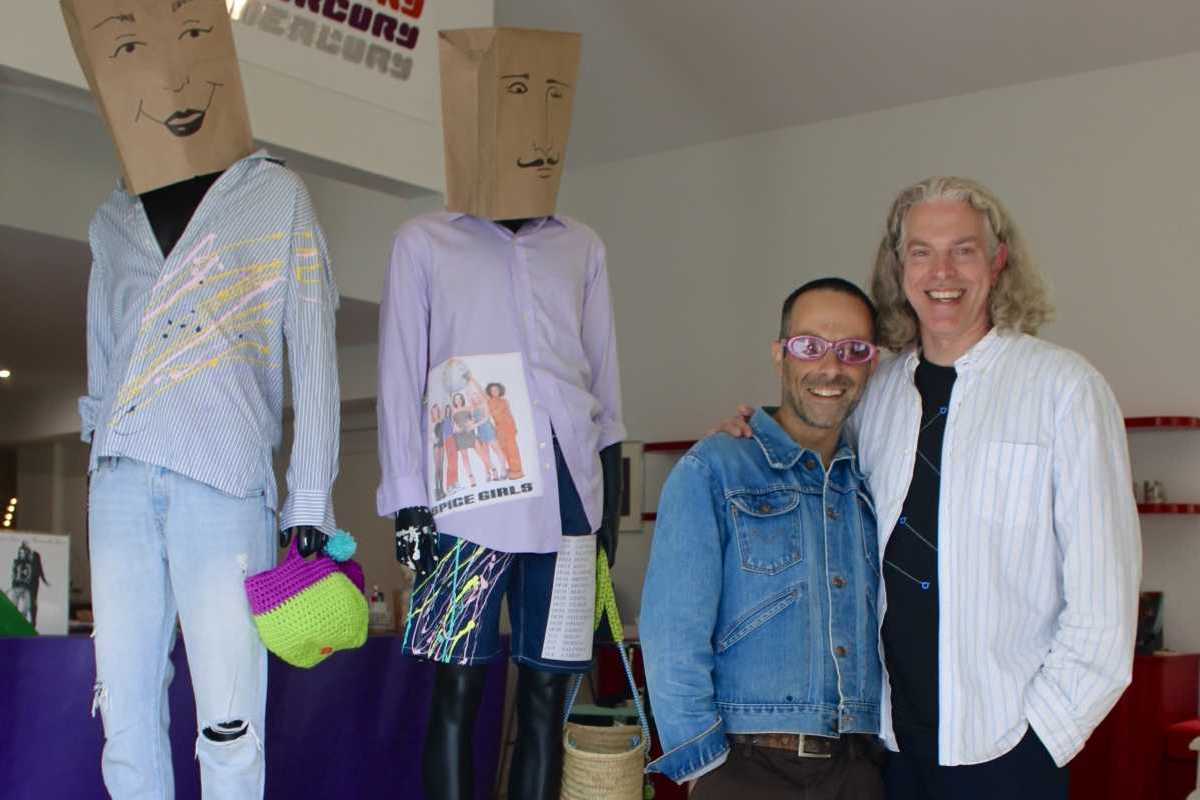
Greg Fricke and James Boehmer, co-owners of Peggy Mercury in Kent, recently launched their first fashion line, “Imaginary Concerts.”
Provided
Fricke and Boehmer are not there to stock their shelves with the same products customers find at standard makeup retailers. They’re there to help customers find what works for them. That usually means asking customers about themselves and learning about their beauty habits, skin, style and the way they like to present themselves. Fricke and Boehmer believe it’s their job to help customers bring out the qualities that suit them and determine what works best for their look.
So much of the Peggy Mercury world is about emboldening people to become more creative, and possibly bolder, versions of themselves. Some of this comes through the store’s creative collaborations with artists, designers and stylists.
It’s part of an ethos that encourages them and their friends to use the shop as a kind of laboratory, trying out new creative experiments without knowing how they might turn out. Whether in fashion, painting, fiber arts or photography, the projects almost always turn out marvelously.
A line of sterling silver charms they sell started as a small project by their friend Nolan Percival. In the beginning, the pieces were for close friends and loved ones. But Boehmer and Fricke encouraged Percival to get a little more serious about the project and create a whole line for the store. Today, it’s one of their top-selling collections.
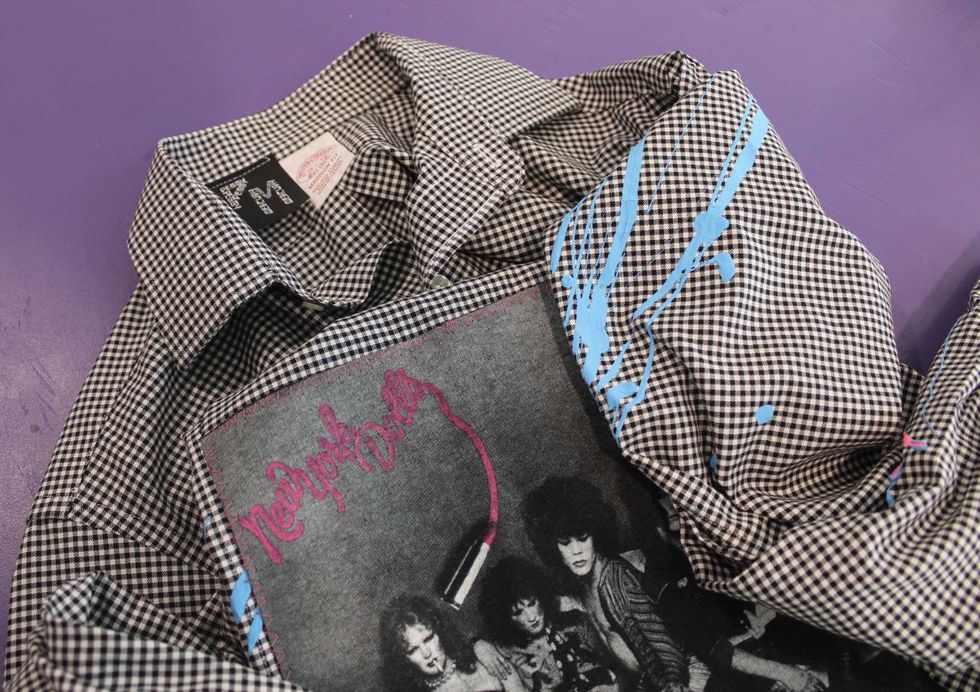 Classic styles, bold colors, and creative concerts make up the “Imaginary Concerts” line at Peggy Mercury.Provided
“Imaginary Concerts” has the duo taking their own advice.
The project started as a way for Boehmer to connect with his mother, who had been diagnosed with Alzheimer’s disease. Taking old concert shirts from his own collection, Boehmer and his mother began cutting out the graphics with the idea that they would make a quilt together. Unfortunately, she died before they could complete the project in 2025. The pieces, which were ready for production, were put on the back burner as Boehmer and Fricke dealt with their loss and the whirlwind of projects that never seemed to cease at Peggy Mercury.
But the harsh winter of 2026 presented an opportunity to take some time and focus on themselves. Part of that meant revisiting and redefining the concert T-shirt project. This time, instead of looking to the warmth and comfort of a quilt, they turned to another passion — fashion.
Taking a page from their own book, they wanted to create something that felt comfortable to them. They took two disparate loves — one rooted in simple preppy style, with clean lines and classic silhouettes, and the other in the nitty gritty worlds of punk rock and pop — and blended them together to create something entirely new. Pulling from the staples of vintage Brooks Brothers and Charvet collections, they applied the graphic elements with bold stitching reminiscent of punk jackets of the ‘70s and ‘80s, but with a much more sophisticated air.
But the remixing isn’t just the pairing of prep and punk. The pieces are not canon. They take liberties with the realities of concert tours, combining one band’s dates with another band’s logos, mixing them all up until the reality is lost and imagination is the only truth.
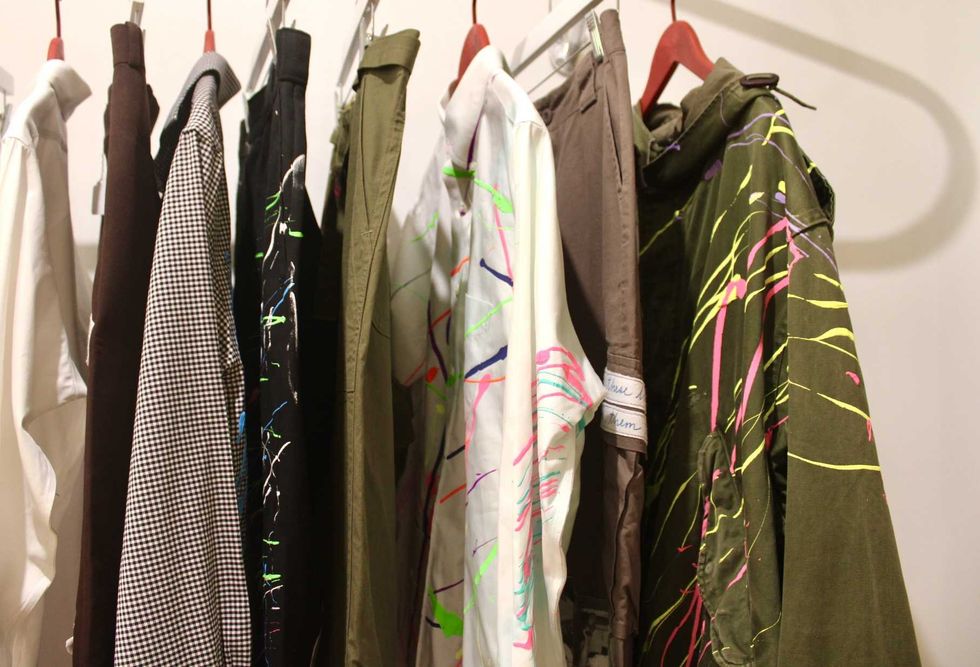 Shirts from Peggy Mercury’s first fashion line, “Imaginary Concerts,” hang on display.Provided
Adding to the mix is an element of perpetual creativity. Art can be messy, both figuratively and literally, and many of Fricke and Boehmer’s artist friends carry evidence of their work on them at all times. As a nod to these tireless creatives, the duo added haphazard splashes of bright color, giving the line an even more distinctive feel.
For them, “Imaginary Concerts” passes the “Peggy Test.” The mythical Peggy Mercury is a fictional figurehead for the company, a character who thrives on creativity and change. The name, much like the clothing line, is a mixture of interests: Mercury is a planet, a deity and an elusive, transformative element, while Peggy is the wonderfully stylish and boundary-pushing Peggy Guggenheim.
Everything Fricke and Boehmer put in their store has to pass this test: Would Peggy Mercury approve? For their first collection, the answer is a resounding yes.
Peggy Mercury is at 9 Maple St., Unit 2, Kent.


Want more of our stories on Google? Click here to make us a Preferred Source.