FALLS VILLAGE - The effort to revive the old Clark B. Wood agricultural education building at Housatonic Valley Regional High School has found a generous friend.
The 21st Century Fund, a local nonprofit foundation that sponsors learning opportunities for high school students, has stepped forward with a leadership gift to help bankroll the transformation of the partly dormant building into a state-of-the-art math, science and technology center.
"Public education is very important, said John F. Perotti, who chairs the 21st Century Fund's advisory council, in an interview. "I believe in it."
Last month the fund made a commitment of $35,000 toward the renovation of the aging facility. Total costs of the project are estimated at $1 million, with about $200,000 needed to improve the building to the point that its rear portion can be occupied by students.
In addition to the gift, the 21st Century Fund will lend its fundraising expertise to help officials start a capital campaign to raise the remaining funds.
And the Wood buildings flat roof is likely to make the project eligible for grants that could support alternative energy possibilities such as solar power. That would give students the opportunity to become involved with such technologies, according to Region One Schools Superintendent Patricia Chamberlain.
Using funds that had already been set aside, The Region One Board of Education last year hired Cornwall architect Einar Lindholm to produce drawings for the renovations. Aside from Lindholm's fee, the project will be completed with private donations and will have little impact on taxpayers.
Saved from demolition
Named after the founder of the school's agriculture education program, the facility at the rear of the campus was supposed to be torn down when the new agicultural education (ag-ed) complex was completed in 2001. A group of teachers in the ag-ed department, with the help of ag-ed alumni and some local officials, including ag-ed department co-chair Mark Burdick and former Falls Village First Selectman Louis Timolat, fought hard to save the old building - against the wishes of the Region One Board of Education and then Superintendent John O'Brien.
The request to save the Wood building came after construction had already started and would have added to the cost of the renovation. Alterations would also have been required to make the road between the Wood building and the new ag-ed wing wide enough for firetrucks to pass through.
In the end, though, the decision was made to save the Wood building.
Burdick and his group had plans to use it to store new trucks the ag-ed department had purchased (with state grant money) after the renovation had begun. There were also plans to create a workspace for the growing robotics team in the Wood building.
The building remained dormant for some years, and was mainly used to store old desks and other school equipment. A few years ago, a group of parents and artists raised money to renovate one portion of the building and turned it into an after-school art space called the "artgarage."
Perotti, a 1964 graduate of Housatonic and chief executive officer of Salisbury Bank & Trust, was one of those ag-ed alumni who advocated to save the Wood building, which was constructed in 1961.
"I was one of the first students to go through that building, so I was sad when they wanted to demolish it," said Perotti. "I knew it was solidly constructed."
Future is in math, sciences
21st Century Fund council member Sidney Shore, an inventor and scientist, first got the idea of turning the Wood building into a science and technology center a few years ago.
Region One Assistant Superintendent Thomas Gaisford took it a step further when he presented a two-and-a-half page paper to the Board of Education in 2006, arguing that the future of the building lies as a math and science center. Gaisford made a similar presentation to the fund's leadership last year.
A facility of this size will allow members of the school and the community to become more involved in activities that require large amounts of space, such as robotics demonstrations.
"It will be a place for science and technology endeavors that won't have to be taken down every day, as they would in a more traditional classroom setting," Chamberlain explained.
Housatonic Principal Gretchen Foster said the school's Career Day statistics indicate a high level of interest in science and technology. Moreover, the "demonstrated achievement" of the school's science-based teams, such robotics and Envirothon, "merit such an extraordinary facility."
Housatonic would appear to be in an unusual position relative to other small rural high schools. Unlike many schools that are geographically isolated, Housatonic, which has seen its enrollments shrink by almost 10 percent since 2004, faces significant competition for students from private institutions such as the Kent, Salisbury, Berkshire and Hotchkiss schools.
"Public schools locally are losing students to private schools. They've got the endowments and the facilities," Perotti explained. "There's no reason public schools need to take a back seat and feel inferior."
"We would hope modern technology, science and math programs will attract students," Chamberlain added.
Funding student learning
The mission of the fund, which was created in 1993, is to sponsor learning opportunities that extend beyond traditional high school programs.
Jack Mahoney, a Falls Village resident who is vice chair of the fund's advisory council, was principal of the high school in 1993 when the fund was established. A year earlier, he had taken a tour of schools across the country, looking for ways to improve the high school experience at Housatonic.
One stop on that tour was La Jolla High School in southern California, where a private foundation helped fund activities for the students. Mahoney determined to start a similar program for his own public school.
"Private foundations assisting public schools is a '90s and 2000s phenomenon," Mahoney said. "This cooperative venture is evolutionary and revolutionary in itself."
Many grants have been given since the fund's inception, including some that support the school's robotics team (the Who'sCTEKS) and the Envirothon Team (which took first-place honors in the high school North American competition last summer).
It has also helped make possible a trip to China by Housatonic students and faculty in the fall of 2006.
"To survive, we need to think outside the box," Perotti said.
Perotti said the fund's board will meet soon with those who are interested in the project to decide the next step.
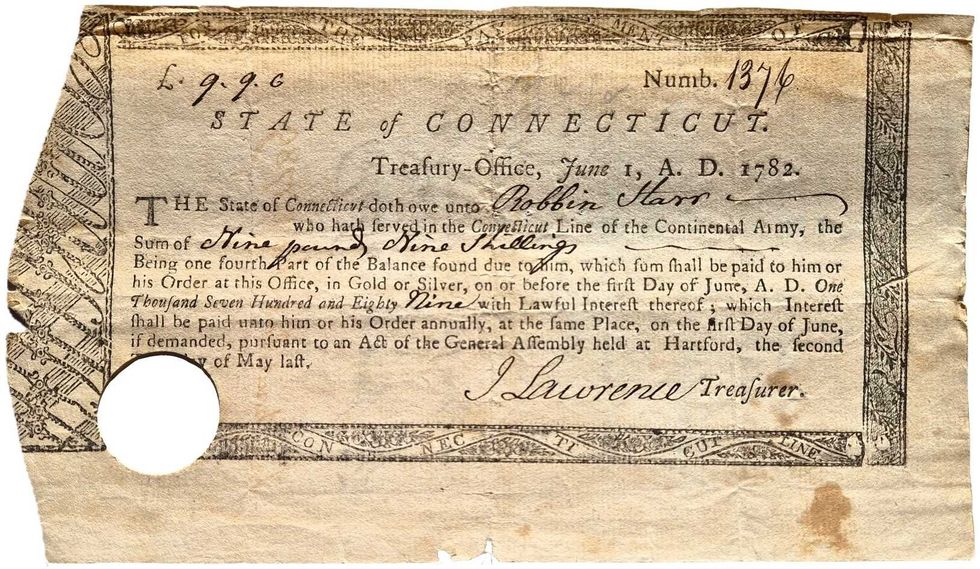 Pay Bill for Robin Starr’s service in the Continental Army.Courtesy the Alex Breanne Corporation
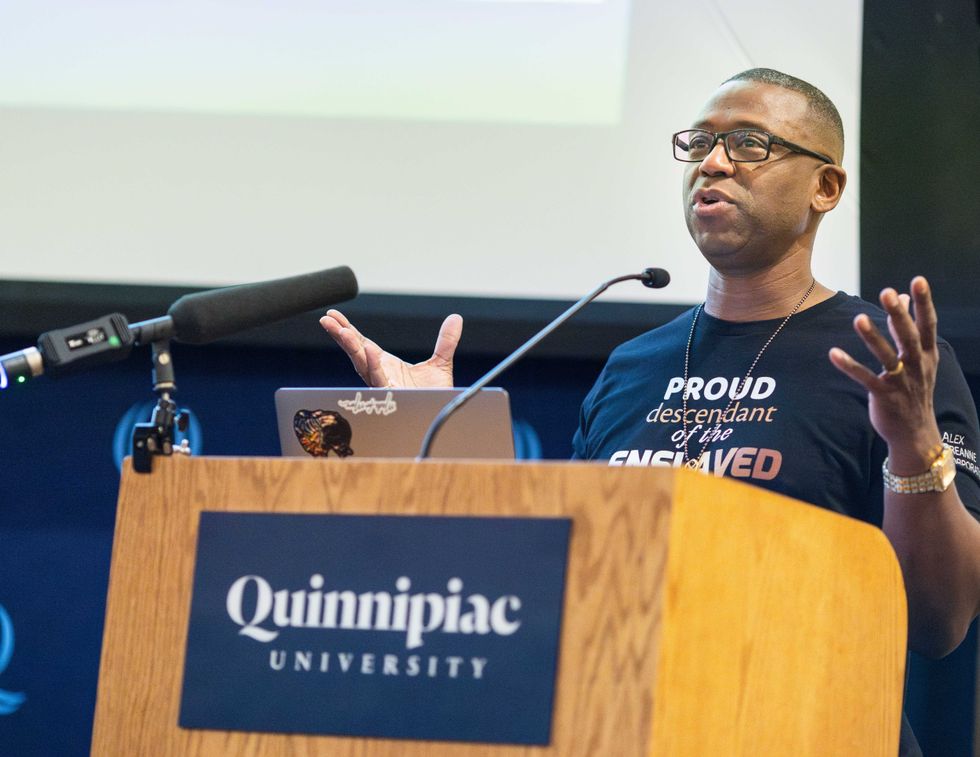 John Mills speaking at Quinnipiac University.Courtesy the Alex Breanne Corporation
 Stephanie Saetta,with her rescue dog George and Blue (left), a shepherd mix awaiting his forever home.Madi Long
 Blue, a 7 year-old Shepard mix, is waiting for his forever home. Madi Long