Salisbury gets set for safe summer on Lake Wononscopomuc

Salisbury gets set for safe summer on Lake Wononscopomuc

Hotchkiss students took part in the Polar Plunge Sunday, April 7, at Lake Wononscopomuc: A fundraiser for the Jane Lloyd Fund.

Submitted

SALISBURY — The Board of Selectmen voted to approve new fees at the Town Grove during the regular monthly meeting Monday, April 1.

Several fees have been raised by $5. Grove manager Stacey Dodge said the fees have not been updated in some years.

Dodge said the Grove is adding a credit card machine, which will increase costs somewhat, and the fee hikes will help cover that.

In an update on lake access in general, First Selectman Curtis Rand confirmed that the Grove and Lake Wononscopomuc will be closed to outside boats because of the danger of hydrilla, an extremely invasive and destructive plant that has made it to East Twin Lake.

Dodge said the Grove has purchased several trolling motors and put them on town-owned boats for the use of anglers.

Rand said he wanted to make it clear that the town is not trying “to turn this into a private lake.”

Rand said the state will be making changes to the public boat launch at East Twin Lake this month. Only car-top boats will be allowed: canoes, kayaks, etc. Rand said OHara’s Landing is getting a boat inspection process together, “at least for busy weekends.”

And Long Pond will be open for car-top boats only.

Rand said if hydrilla gets into other water bodies such as Mudge Pond or the Housatonic River “then it’s game over.”

The selectmen clarified the food truck policy. Food trucks will be allowed at the Lakeville Journal’s August street fair, during the Fall Festival at the ski jumps, and during the Merry and Bright weekend in December. Food truck operators need the landowner’s permission and the go-ahead from the First Selectman’s office.
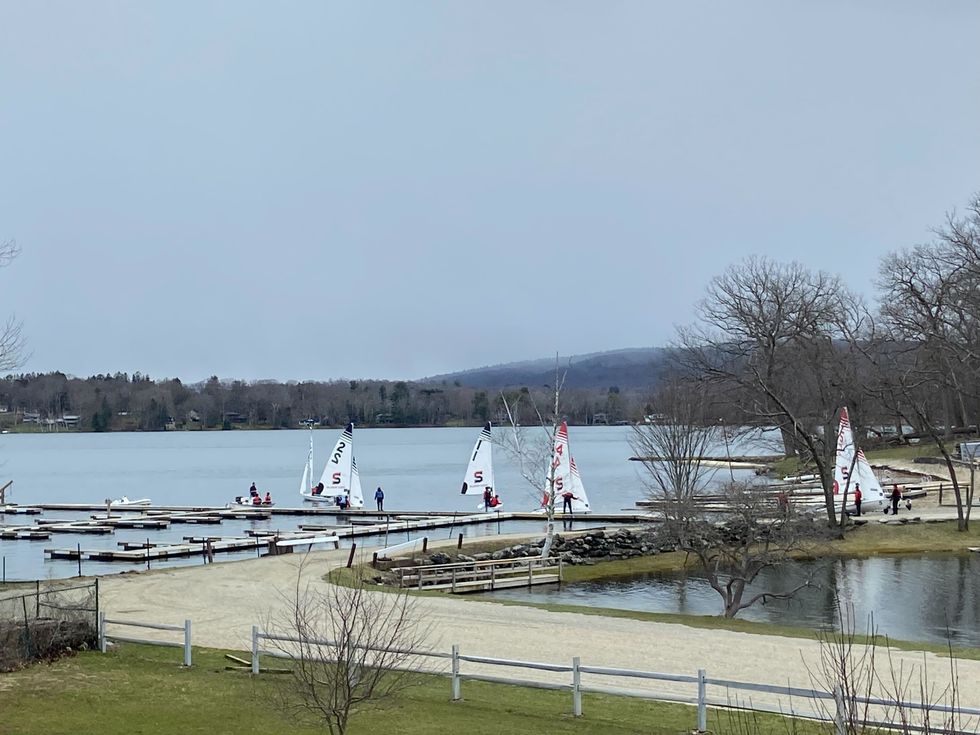
The Salisbury School sailing team practiced on the lake April 5.Maud Doyle

Latest News

A new life for Barrington Hall

A new life for Barrington Hall

Dan Baker, left, and Daniel Latzman at Barrington Hall in Great Barrington.

Provided

Barrington Hall in Great Barrington has hosted generations of weddings, proms and community gatherings. When Dan Baker and Daniel Latzman took over the venue last summer, they stepped into that history with a plan not just to preserve it, but to reshape how the space serves the community today.

Barrington Hall is designed for gathering, for shared experience, for the simple act of being together. At a time when connection is often filtered through screens and distraction, their vision is grounded in something simple and increasingly rare: real human connection.

Keep ReadingShow less

Gail Rothschild’s threads of time

Gail Rothschild’s threads of time

Gail Rothschild with her painting “Dead Sea Linen III (73 x 58 inches, 2024, acrylic on canvas.

Natalia Zukerman

There is a moment, looking at a painting by Gail Rothschild, when you realize you are not looking at a painting so much as a map of time. Threads become brushstrokes; fragments become fields of color; something once held in the hand becomes something you stand in front of, both still and in a constant process of changing.

“Textiles connect people,” Rothschild said. “Textiles are something that we’re all intimately involved with, but we take it for granted.”

Keep ReadingShow less

Sherman Players celebrate a century of community theater

Sherman Players celebrate a century of community theater

Cast of “Laughter on the 23rd Floor” from left to right. Tara Vega, Steve Zerilli, Bob Cady (Standing) Seated at the table: Andrew Blanchard, Jon Barker, Colin McLoone, Chris Bird, Rebecca Annalise, Adam Battlestein

Provided

For a century, the Sherman Players have turned a former 19th-century church into a stage where neighbors become castmates, volunteers power productions and community is the main attraction. The company marks its 100th season with a lineup that blends classic works, new writing and homegrown talent.

New England has a long history of community theater and its role in strengthening civic life. The Sherman Players remain a vital example, mounting intimate, noncommercial productions that draw on local participation and speak to the current cultural moment.

Keep ReadingShow less
google preferred source

Want more of our stories on Google? Click here to make us a Preferred Source.

Reimagining opera for a new generation

Reimagining opera for a new generation

Stage director Geoffrey Larson signs autographs for some of the kids after a family performance.

Provided

For those curious about opera but unsure where to begin, the Mahaiwe Theater in Great Barrington will offer an accessible entry point with “Once Upon an Opera,” a free, family-friendly program on Sunday, April 12, at 2 p.m. The event is designed for opera newcomers and aficionados alike and will include selections from some of opera’s most beloved works.

Luca Antonucci, artistic coordinator, assistant conductor and chorus master for the Berkshire Opera Festival, said the idea first materialized three years ago.

Keep ReadingShow less
BSO charts future amid leadership transition and financial strain

Aerial view of The Shed at Tanglewood in Lenox, Massachusetts.

Provided

The Boston Symphony Orchestra is outlining its path forward following the announcement that music director Andris Nelsons will step down after the 2027 Tanglewood season, closing a 13-year tenure.

In a letter to supporters, the BSO’s Board of Trustees acknowledged that the news has been difficult for many in its community, while emphasizing gratitude for Nelsons’ leadership and plans to celebrate his final season.

Keep ReadingShow less
A tradition of lamb for Easter and Passover

Roasted lamb

Provided

Preparing lamb for the observance of Easter is a long-standing tradition in many cultures, symbolizing new life and purity. For Christians, Easter marks the end of Lenten fasting, allowing for a celebratory feast. A popular choice is roast lamb, often prepared with rosemary, garlic or lemon. It is traditional to serve mint sauce or mint jelly at the table.

The Hebrew Bible suggests that the last plague God inflicted on the Egyptians, to secure the Israelites’ release from slavery, was to kill the firstborn son in every Egyptian home. To differentiate the Israelites from the Egyptians, God instructed them to mark their doorposts with the blood of a lamb. Today, Jews, Christians and Muslims generally believe that God would have known who was Israelite and who was Egyptian without such a sign, but views of God’s omnipotence in the Abrahamic faiths have evolved over the millennia.

Keep ReadingShow less
google preferred source

Want more of our stories on Google? Click here to make us a Preferred Source.

google preferred source

Want more of our stories on Google? Click here to make us a Preferred Source.