WINSTED — The battle is on over whether The Gilbert School is unfairly charging the town too much for its students, and Independent Party Selectman Russell Buchner wants to take the fight into the open.
Despite a presentation by The Gilbert Corp. Chair Steven Sedlack last week that he hoped would "set the record straight" on the ongoing debate over the school’s funding, Buchner insists that something is seriously amiss in the Laurel City.
"I know we’re paying too much for Gilbert students," he said last week, vowing to continue his quest for answers. "They’re far overcharging; I just want to know how much."
For the better part of a year, Buchner and his fiancée, Cheryl Bartley — who sits on the Board of Education — have co-hosted a weekly cable-access show on Channel 13, titled "The Gilbert Code," which delves into what he terms "inconsistencies" in the way The Gilbert Corp. reports to the town. They claim the school — one of three so-called "endowed academies" in the state, which are technically private schools but which operate under state regulations — has, for years, been overcharging the town on a cost-per-student basis.
Sedlack addressed the selectmen at their meeting last Monday. Responding to remarks Buchner made to the board at its previous session, Sedlack said the Independent Party selectman had presented "inaccurate, incomplete and misleading" data about The Gilbert School.
But Buchner last week defended his position, arguing that it was The Gilbert Corp. — not Buchner — who was playing fast and loose with the numbers.
"All the numbers I’ve been using come from the Strategic School Profile," he said, claiming that the Gilbert data is, for some reason, shrouded in mystery. "Strangely enough, when you go to the Gilbert file, none of their data has been on file for years."
The current issue centers on the perceived "inequity" between the per-pupil expenditures at Winchester elementary and middle schools and those at The Gilbert School. The Winsted Independents have long complained that the semi-public Gilbert School spends too much on its students, at the expense of Winsted’s public schools.
Buchner said the overcharging is largely the result of Gilbert double- and sometimes triple-charging the town for special needs students and "keeping the money."
At the Oct. 16 regular session, Buchner presented his fellow selectmen with data from the Connecticut Department of Education’s 2003-2004 Strategic School Profile on regular education costs per student.
The data, he posited, shows that the discrepancy in per-pupil expenditures between elementary and secondary (high school) students in Winsted is far greater than at other area schools, in particular those of Avon, Torrington and Glastonbury.
But at last week’s meeting, Sedlack accused Buchner of manipulating the data to make the issue seem graver than it was.
"Selectman Buchner uses the technique of ‘cherry-picking’ the data, that is, using only small samples of data that will support his case," Sedlack said. "Such a misuse of data, designed to mislead, is intellectually dishonest methodology."
But Buchner fired back, saying he selected those towns specifically to prove a point.
"I put Glastonbury and Avon in there to prove that you can have equitable distribution, as recommended by the Connecticut state statute," he said, referring to a clause in Chapter 170, Section 10-220 of the Connecticut statutes, which states:
"Each local or regional board of education... shall provide an equitable allocation of resources among its schools."
Buchner said the meaning is clear.
"Every attempt should be made to have equitable distribution of funds for all the students," he said.
But while Buchner rests his argument on his interpretation of that statute, others argue that the reality of educating high school students is, naturally, costlier than educating younger students, because the classes are more rigorous, they have more teachers and extracurricular activities, and the facilities are generally larger and more complex.
Sedlack last week said the Gilbert data Buchner had presented lacked vital information, and hence was not a fair comparison.
To this Buchner had no answer, except to again point out that the Gilbert numbers were not readily available, and so he had to calculate them himself.
"Gilbert keeps their numbers hidden, because they don’t want people to know," he said, though he did admit that his calculations were off. "I used a different criteria, because I didn’t know the criteria they used [on the Strategic School Profile]. I always say, ‘If my numbers are wrong, correct me.’"
Buchner said he is actually pleased that Sedlack did just that, because he hadn’t even seen the real numbers until last week’s meeting.
"Now a real dialogue begins," he said.
But Sedlack took umbrage at Buchner’s suggestion that Gilbert intentionally hides such data.
"Of course that is not so," he said, asserting that the three endowed academies in the state — Norwich Free Academy, Woodstock Academy and The Gilbert School — are simply not required to report information in the same way as public schools.
"[Buchner] reported data to the selectmen, and I made a presentation to the selectmen to clarify information which I feel needed clarification," Sedlack said. "My dialogue is with the selectmen; I do not intend to have a dialogue with Russel Buchner."
But Buchner isn’t ready to rest his case. According to figures provided by Buchner and Bartley, the difference in cost per pupil for regular education students has actual risen — from $1,500 in 2003-04, to over $2,304 this year.
"My point has been made by Mr. Sedlack, the costs at Gilbert are out of control and getting worse every year," Buchner said, pointing out that, according to a recent article in The Norwich Bulletin, the cost-per-pupil at the Woodstock Academy this year is $9,840 — while Gilbert charges $12,304.
"All the figures I am providing can be checked and they all reveal that The Gilbert School is overcharging the taxpayers of Winsted," Buchner said.
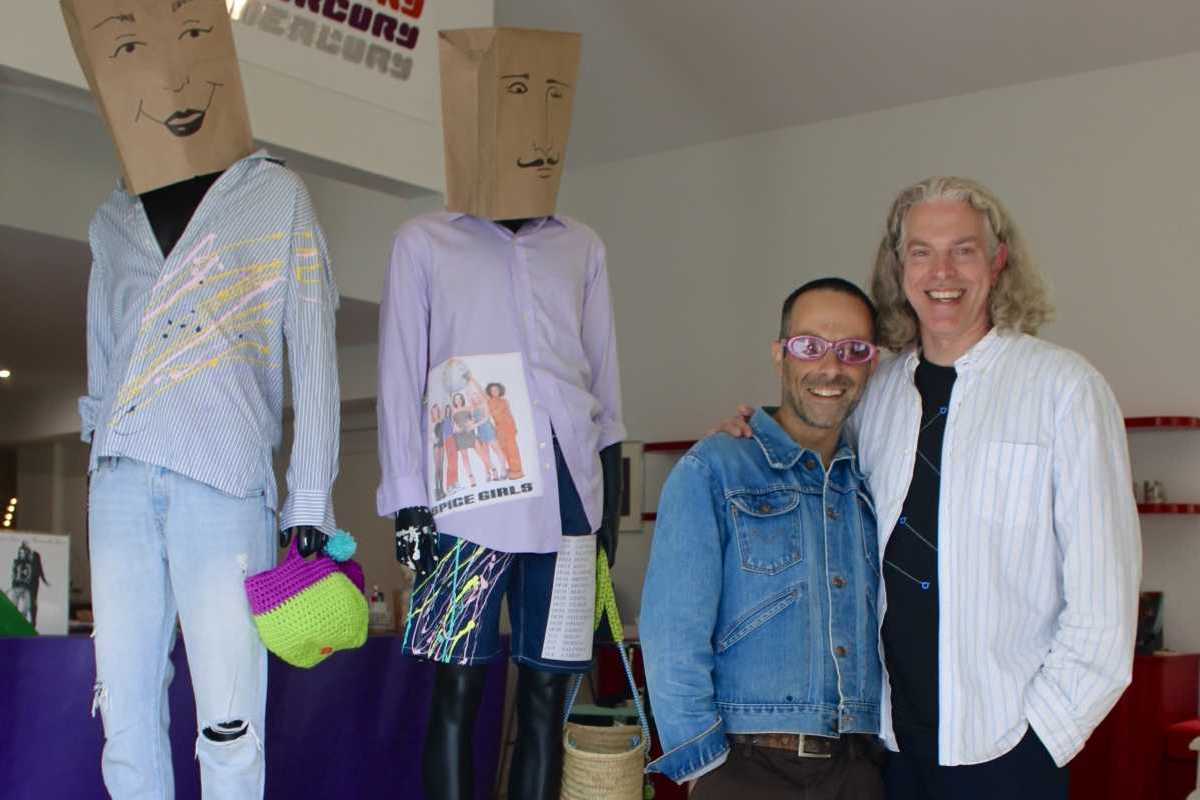
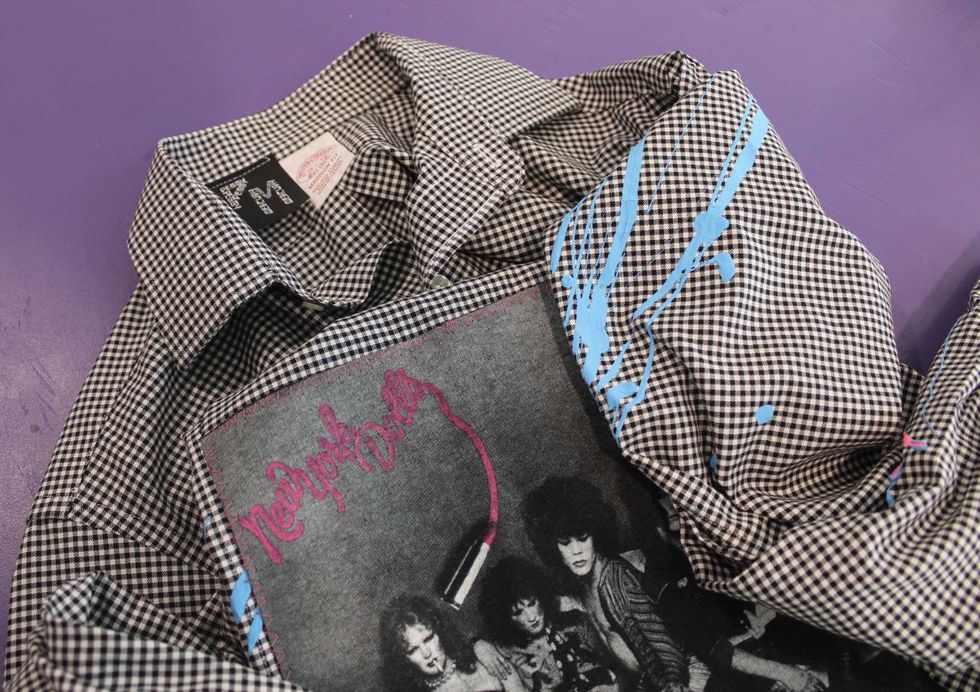 Classic styles, bold colors, and creative concerts make up the “Imaginary Concerts” line at Peggy Mercury.Provided
 Shirts from Peggy Mercury’s first fashion line, “Imaginary Concerts,” hang on display.Provided