The color of music: Sarah Davis Hughes’ ‘The Colorways and the Circle of Fifths’

The color of music: Sarah Davis Hughes’ ‘The Colorways and the Circle of Fifths’

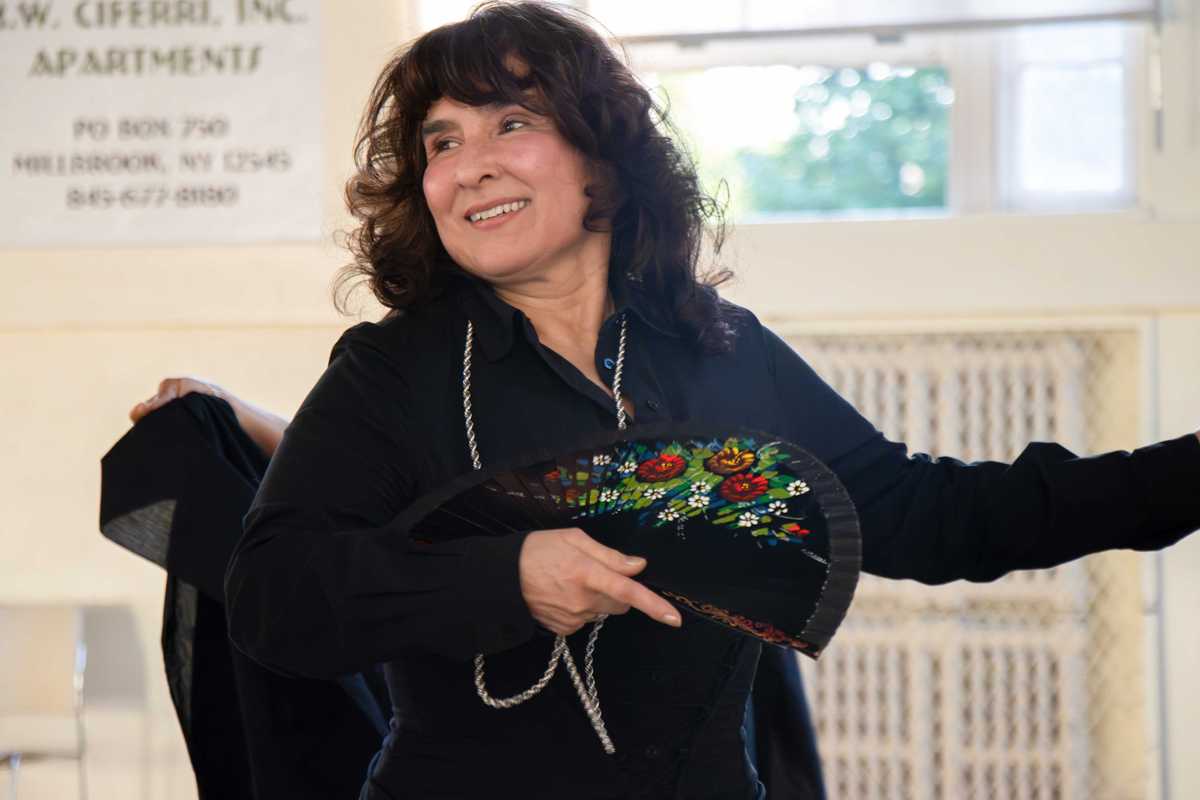
Sarah Davis Hughes demonstrates Colorways, a visualization tool she developed that maps musical notes to colors by aligning the circle of fifths with the color wheel.

L. Tomaino

Artist Sarah Davis Hughes had always loved music, but after winning an accordion from the New England Accordion Connection and Museum in Canaan, that love became a musical journey, ultimately leading to her book “The Colorways and the Circle of Fifths.”

Hughes explained that the idea for the book came after studying with Paul Ramunni of the Accordion Connection for a year. “He introduced a piece of music that I knew well by ear but had never seen written down.” Upon seeing the music, Hughes described a sense of blindness. “The chords looked like thorny blueberry bushes on the page,” she said.

Determined to figure it out, Hughes said, “I knew color systems, design and theory, so it was simply a matter of organization. If I could assign a color to each note and color that black-and-white score, I would instantly recognize the notes.”

She set out to create a system. “The colors that I assign to each note should make sense together like the notes make sense together,” she said.

She recalled the color wheel, which illustrates the harmonic structure of color, and the Circle of Fifths, which shows the harmonic structure of music. Both serve as foundational systems —one for color, the other for music. “What if I simply superimposed a classic color wheel onto the Circle of Fifths?”

She began by placing the primary colors — red, yellow and blue — then set the note C at the top. The next primary color, yellow, aligned with E, followed by blue at A-flat/G-sharp.

“I was very surprised to see that all of the hot colors — blood red, vermilion, orange, gold, hot yellow, chartreuse — fell on the white notes C, G, D, A and B,” Hughes said. “The cool colors — green, teal, blue, lavender and purple — are black notes.”

Once the colors were mapped onto a miniature keyboard, Hughes saw clear correlations. “For instance, there are two oranges: G, vermilion, and D, orange,” she said. “The notes are diatonic partners” and harmonize with one another. She found similar relationships between the two yellows — hot yellow and gold, corresponding to E and A — as well as chartreuse and green, B and F-sharp.

She also observed that the triangular relationships among primary, secondary and tertiary colors mirrored musical thirds, or counterbass notes. Mixing all three primary colors produces “mud,” she said, just as playing all the notes in the triangle creates dissonance. But pairing two colors, such as yellow and blue, produces green, while their corresponding notes — E and A-flat — form part of a major chord. “Add B, chartreuse, as the fifth — E, A-flat, B — and you get a beautiful chord,” she said.

In songs that move upward by thirds — from C to E to A-flat, as in “The Impossible Dream” — she said the effect is a vertiginous sense of ascent. Compositions built on the three primary colors, she added, are similarly bold and striking, citing Mondrian’s circus paintings as examples.

“Everything was about setting it up so that I could look at a color and immediately know what to play,” Hughes said. “I practiced chords and scales on the keyboard, fixing my eye on each color as I played it. It worked.”

“At that point, Paul and I started to plan how we could share it with people and wondered if it might help others enter music,” Hughes said.

The result is “The Colorways and the Circle of Fifths,” a guide for students, teachers and musicians of all levels to help them understand, play and compose music. The book includes worksheets to support learning.

“The Colorways and the Circle of Fifths” is available at Oblong Books and Music in Millerton. Hughes is artist in residence at the Accordion Connection and Museum, where her pastels, prints and original artwork from the book are on view upstairs.

Latest News

Gail Rothschild’s threads of time

Gail Rothschild’s threads of time

Gail Rothschild with her painting “Dead Sea Linen III (73 x 58 inches, 2024, acrylic on canvas.

Natalia Zukerman

There is a moment, looking at a painting by Gail Rothschild, when you realize you are not looking at a painting so much as a map of time. Threads become brushstrokes; fragments become fields of color; something once held in the hand becomes something you stand in front of, both still and in a constant process of changing.

“Textiles connect people,” Rothschild said. “Textiles are something that we’re all intimately involved with, but we take it for granted.”

Keep ReadingShow less
A tradition of lamb for Easter and Passover

Roasted lamb

Provided

Preparing lamb for the observance of Easter is a long-standing tradition in many cultures, symbolizing new life and purity. For Christians, Easter marks the end of Lenten fasting, allowing for a celebratory feast. A popular choice is roast lamb, often prepared with rosemary, garlic or lemon. It is traditional to serve mint sauce or mint jelly at the table.

The Hebrew Bible suggests that the last plague God inflicted on the Egyptians, to secure the Israelites’ release from slavery, was to kill the firstborn son in every Egyptian home. To differentiate the Israelites from the Egyptians, God instructed them to mark their doorposts with the blood of a lamb. Today, Jews, Christians and Muslims generally believe that God would have known who was Israelite and who was Egyptian without such a sign, but views of God’s omnipotence in the Abrahamic faiths have evolved over the millennia.

Keep ReadingShow less

Tangled tackle fondling 2026

Tangled tackle fondling 2026

The snow is mostly gone, the mud is flowing, the stocking trucks are rolling and that means only one thing: it’s tackle fondling time!

Yes, it’s that happy time of year when we dig out all the gear we carefully cleaned and stowed away back in November.

Keep ReadingShow less
google preferred source

Want more of our stories on Google? Click here to make us a Preferred Source.

The Pasquale Grasso Trio

The Pasquale Grasso Trio
Provided

The Pasquale Grasso Trio performs at 7:30 p.m. April 4 at The Stissing Center in Pine Plains. The Italian-born guitarist, a rising jazz star and winner of the Wes Montgomery International Jazz Guitar Competition, is known for his virtuosic, piano-like style. A frequent collaborator with vocalist Samara Joy, he has performed at major festivals worldwide and is supporting his 2025 release “Fervency.” Tickets at thestissingcenter.org

Salisbury budgets head to hearing with 4%–5% increases
Salisbury Town Hall
Aled Linden

SALISBURY — At a special meeting Thursday, March 26, the Board of Finance voted to send the proposed spending plans for 2026-27 to a public hearing Monday, April 27, at 7:30 p.m. at Town Hall.

Salisbury Central School principal Stephanie Magyar said “this is the easiest update I’ve ever given.” She said the final number came in some $23,000 less than the initial presentation, bringing the increase down from$339,528 (4.92%) to $316,367 (4.59%) for a total budget of $7,213,515.

Keep ReadingShow less
/
The Salisbury-Sharon transfer station.
Patrick L. Sullivan

SHARON — Residents will be asked at a town meeting on April 16 to decide whether to join a nascent regional waste authority, as towns across the Northwest Corner consider a coordinated response to uncertainty over the future of a key disposal facility.

The proposal centers on the Torrington Transfer Station, where Sharon and other municipalities send household waste for consolidation and shipment to disposal sites.

Keep ReadingShow less
google preferred source

Want more of our stories on Google? Click here to make us a Preferred Source.

google preferred source

Want more of our stories on Google? Click here to make us a Preferred Source.