Berkshire Waldorf School updates “Little Women”

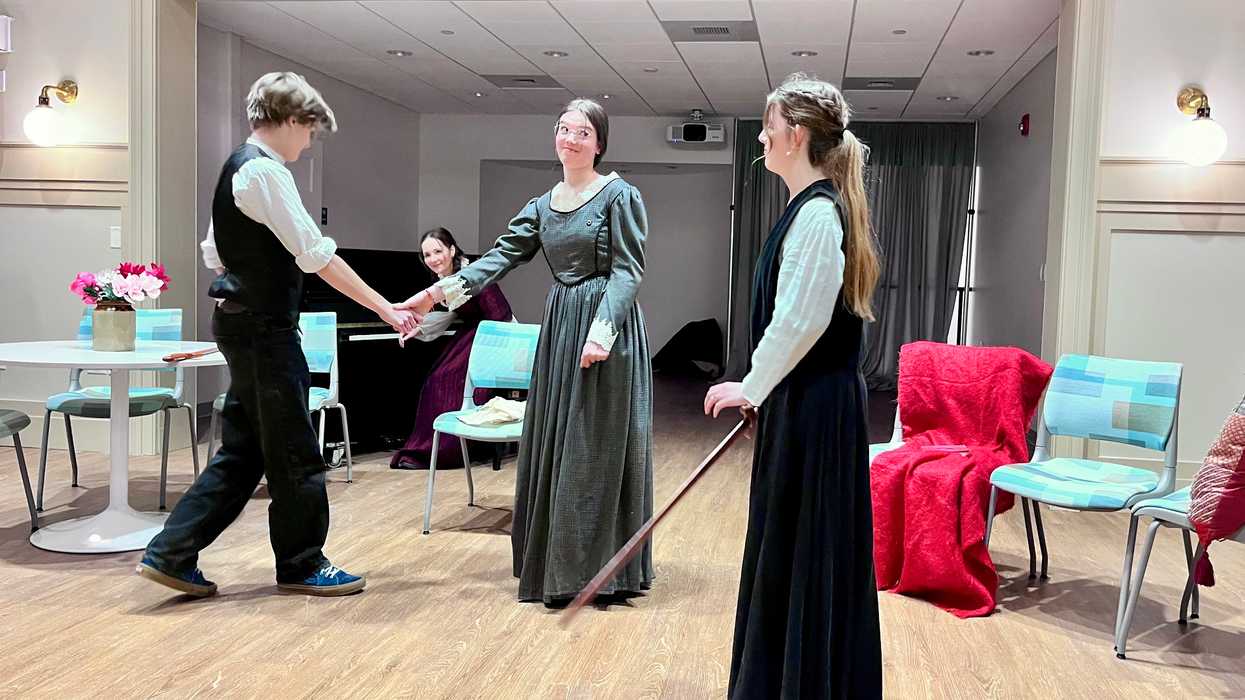
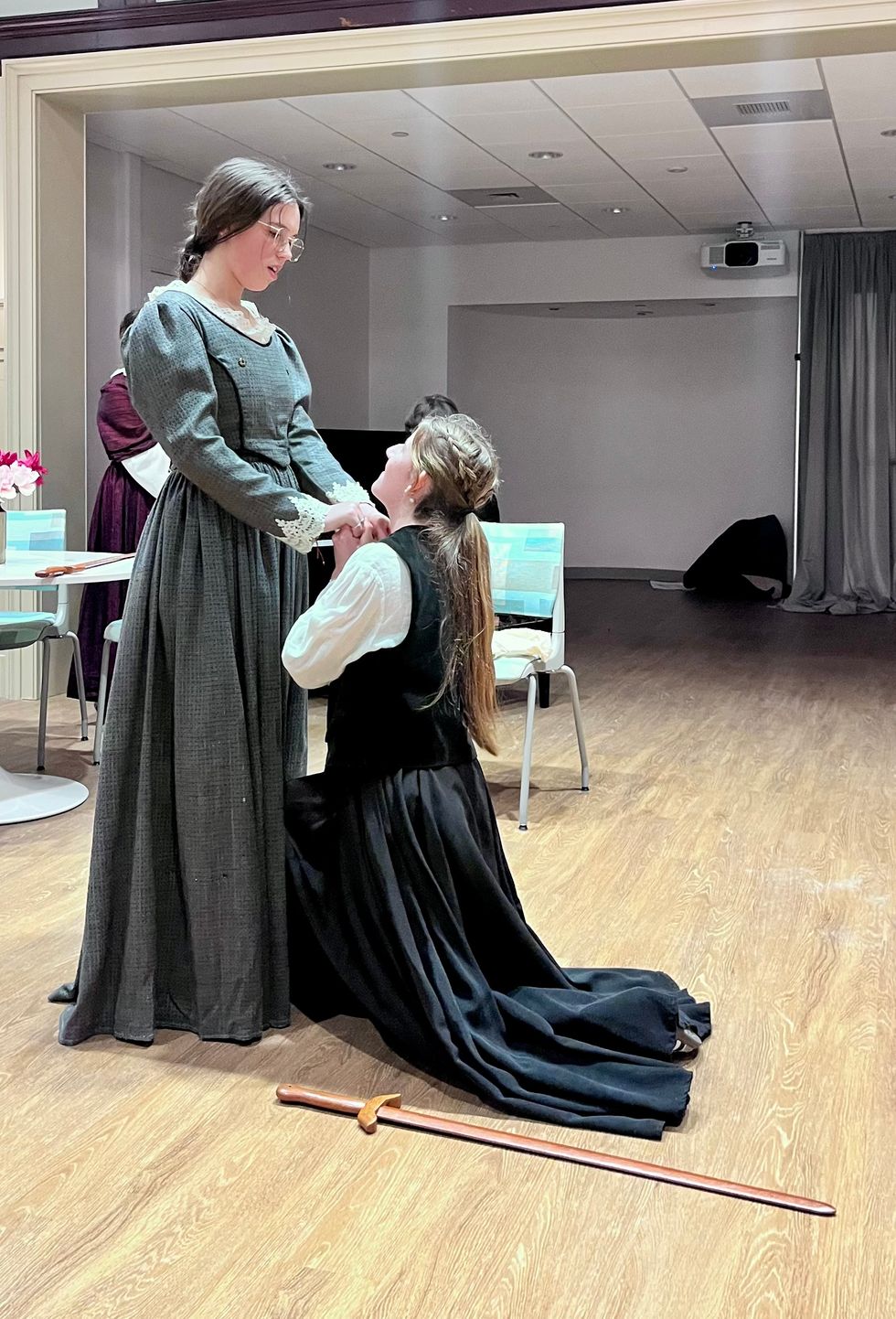
Students at Berkshire Waldorf High School rehearse for the performances of “Little Women” March 13-15 at The Unicorn Theater in Stockbridge.
Mike Cobb

Students at Berkshire Waldorf High School rehearse for the performances of “Little Women” March 13-15 at The Unicorn Theater in Stockbridge.
Update - Friday, March 13, 2026:
Due to illness, this weekend's performances have been postponed to Thursday, April 2, at 7 p.m., Friday, April 3, at 7 p.m., and Saturday, April 4, at 2 p.m. Saturday will be free for students from any school and chaperones. Suggested donation is $10 for students, $25 for adults and $60 for families.
The Berkshire Waldorf High School presents “Little Women” by Kate Hamill, adapted from the novel by Louisa May Alcott, at The Unicorn Theater in Stockbridge, Massachusetts.
Director Kendell Shaffer has taught screenwriting for the Writers Guild Foundation High School Screenwriting Workshops. About the choice of play, Shaffer said,
“The idea of ‘Little Women’ came from our senior girls who wanted a play with a heavy female cast after doing ‘The Outsiders’ last year. Kate Hamill’s adaptation is spunky, funny, with a contemporary feminist slant that transcends Louisa May Alcott’s ideas to today’s audience.”
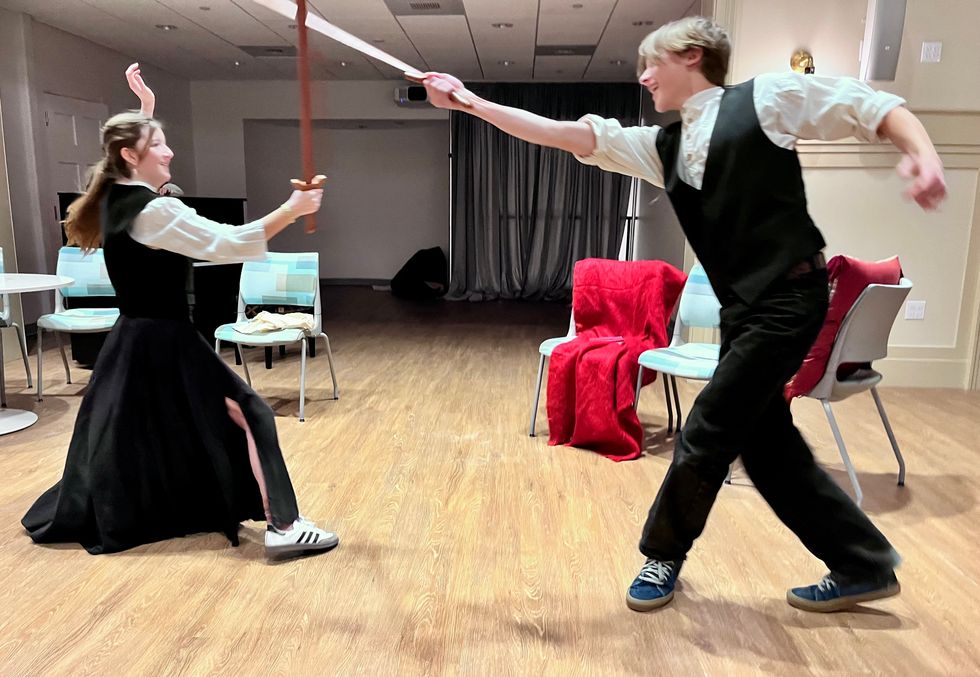
Actor Noelle Bodenstab said, “My role is Hannah. She’s very sassy and a very big contrast from the role I played in ‘The Outsiders’ last year. I feel as though it’s exercising my acting abilities, and I’m really excited to see how it turns out in the play.”
Actor Leo Martinez said, “I am playing Laurie, who is a friend of the Marches and this lonely, rich, sentimental guy who doesn’t really like the traditional idea of a man. His character revolves around his love for Jo, who doesn’t fit into the role of a girl very well, and them growing up together.”
The production features contemporary and original songs performed by the Berkshire Waldorf High School rock band.
“Having been a TV producer in L.A. before relocating to the Berkshires, I like to add live music to plays I direct, similar to underscoring a film or TV episode,” said Shaffer. “The music helps guide the emotion and elevates the experience for both the audience and actors. Using contemporary music performed by our school’s rock band updates this classic play.”
“We are fortunate to have so many talented students at the Berkshire Waldorf High School and professional mentors working with the students as costume designer, choreographer, musical director, and vocal coach. The Berkshires are alive with artists, and it’s a gift to work with its seasoned and emerging talent,” Shaffer added.
Performances start at 7 p.m. Friday, March 13; 7 p.m. Saturday, March 14; and 2 p.m. Sunday, March 15.
For more information, visit berkshiretheatregroup.org.

Alec Linden
Author Ian Gill speaks to a captivated crowd about a life filled with mystery, tragedy and resilience at the Hotchkiss Library, April 19.
SHARON – Family histories are inherently complicated, but few more so than Ian Gill’s. On the snowy afternoon of Sunday, April 19, the Manila, Philippines-based writer brought that dramatic lineage from —the subject of his 2024 book “Searching for Billie” —from the bygone days of early 20th century China into the warm interior of the Hotchkiss Library.
Over the course of an hour, Gill demonstrated to an eager audience of 20 that with a little digging – or rather several decades of it, in his case – the stories of our mothers, fathers and the ancestors before them can reveal startling truths about ourselves.
“You were two sons rolled into one,” Gill told the audience his mother, the Billie of his book’s title, had said to him long ago. “I didn’t know what that meant, and it took me 40 years to figure that out,” he recalled.
The story revolves primarily around Billie Newman, an orphaned child raised by a Chinese-born white British father and Chinese mother who showed up in a basket one day at the couple’s doorstep. Billie went on to work for influential magazine T’ien Hsia Monthly, then as a wartime radio broadcaster, then for top government advisors, and ultimately ran the Secretariat of the United Nations Disarmament Conference until her retirement, for which she was awarded a Member of the British Empire award. This was all despite pressures from the Sino-Japanese War, family tragedy, single motherhood and racism, Gill emphasized.
But the history also carries with it Gill’s own journey of self-discovery, which began with his first visit to Hong Kong with his mother in 1975, when he was a 29-year-old journalist based in New Zealand. That trip, he recalled during a cozy reception for the event hosted by his friend and Sharon local Bill Cowie Sunday evening, “lifted the curtain” not only on his mother’s vast life story, but on the “vanished” China of yesteryear and, crucially, on himself.
“Her story is my story,” he said, “including finding my father at the end – the other half of the genetic jigsaw.”

The centerpiece of Gill’s book, and of Sunday’s presentation, is the tragic drowning of Billie’s first son, Brian, and subsequent conception of Ian himself, all of which took place during four brutal years living in an internment camp while Hong Kong was occupied by the Japanese between 1941 and 1945.
Brian’s father, an Irishman serving in the British Army, had since left the picture, and Billie spent her years on the internment camp as a single mother.
Gill told the audience that conditions were dismal, with up to 50 people sharing just a few rooms. “The worst thing though were the rations,” he said. “Hunger was a constant problem.”
After Brian’s death, a “cynical journalist,” per Gill’s description, named George Giffen comforted Billie, and eventually she became pregnant again. “Their relations had deepened,” Gill put it wryly.
Gill recounted that his mother revealed an illuminating memory of the grief period to him when he was well into adulthood: “All I could think of was to replace my loss.” Thus, Ian became the two sons rolled into one.
At the end of the war, Giffen returned to a previous marriage in Canada, and Gill would not see him until he was 40 years old, having tracked him down to a remote island in British Columbia. Despite the circumstances, Gill said he and his father grew close for the remainder of Giffen’s life.
Back at Cowie’s home high in the Sharon hills, Gill said that he and his old university friend – the two had met in England over 60 years ago – only realized the previous evening that both had met their dads as adults. Cowie reunited with his father at 21 after not seeing him since early childhood.
“Two boys, him and me, looking for our fathers” was how this story of faraway countries and timelines connects to Sharon, Gill said, since Cowie was the reason he had come to Sharon to tell his story.
Aside from his immediate family, Gill’s research reveals fascinating tales from other pockets of his ancestry, such as his great-grandmother who hailed from a country parish in western England and eventually became a hotelier in a Chinese resort town, and her son, Billie’s adopted father, who developed postal routes in remote parts of China and broke social customs by marrying a Chinese woman. He eventually left her, and the family, for an affair with a Russian woman stuck in China following the 1917 Bolshevik Revolution.
The rest of the details are in the book, Gill said with a smile.
“Searching for Billie: A journalist’s quest to understand his mother’s past leads him to discover a vanished China,” was published by Hong Kong English-language company Blacksmith Books and is distributed in the U.S. by Simon & Schuster. It’s available for purchase online via Amazon and other retailers.
Lakeville Journal
Confronting evil
War is never a good solution to international disputes, and casualties are always too many, but sometimes it cannot be avoided.
For 47 years, Iran has spread terror throughout the Middle East and beyond. Directly and through proxies like Hamas, Hezbollah, and the Houthis, it has attacked neighbors, killed over 1000 American servicemen and civilians, and organized assassination plots against U.S. leaders. Iran also sponsored Hamas’s October 7 massacre, in which 1,200 Israelis died and 250 were taken hostage.
Every American administration since 1979 has attempted to neutralize Iran’s aggression. Every avenue has been explored: bribery, sanctions, and appeasement.
Iran responded by building offensive missiles, pursuing nuclear weapons, and funding and training terror proxies. When Iranian citizens peacefully protested their resulting economic and political conditions, they were tortured and executed. In recent months alone, the regime is estimated to have murdered between 10,000 and 30,000 of its own citizens, with more executions recently announced.
After reports indicated Iran possessed significant quantities of highly enriched uranium and was sprinting toward a bomb, the U.S. engaged in diplomacy (ultimately futile) before striking nuclear development centers. However, Iran restarted its program and increased missile production, prompting further attacks and counterattacks, including the Iranian closure of the Straits of Hormuz and a subsequent U.S. blockade of Iranian ports.
Iran’s actions also triggered attacks from proxies like Hezbollah, which has effectively captured Lebanon. In violation of UN Resolution 1701, Hezbollah built terror infrastructure in Lebanon opposite Israel’s northern border. Following October 7, they fired thousands of rockets into Israel from positions embedded within civilian areas, stashing weapons in homes and schools, deliberately putting civilians in harm’s way. While Lebanon’s elected government has recently struggled to disarm Hezbollah, it has failed to do so, and Israel has begun that task. Now Israeli and Lebanese officials are meeting to find a path toward achieving this goal together.
At its core, this conflict revolves around Iran’s desire to dominate the region and hold the world hostage with nuclear weapons. While every recent U.S. president has stated that Iran must never obtain such weapons, no plan has yet successfully achieved that goal.
This conflict is the price the world is paying to finally confront the evil intentions of the current Iranian regime. It is not pretty, and it is not without civilian casualties, mistakes, or immense cost. However, it may be the last chance the world has to eradicate the threat posed by a regime that seeks only domination, death and destruction.
We pray for a quick and successful end to this conflict, and for the safety of the civilians caught in its wake.
Michael Auerbach
Alan Friedman
Nadav Goshen
Lawrence Hutzler
Thomas Morrison
Lakeville
Happy Birthday, NDP!
Have you heard we are celebrating the 75th Annual
National Day of Prayer May 7, 2026?! It’s coinciding with America’s 250th Anniversary, which leaders are calling a “providential” convergence. The 2026 Theme is “Glorify God among the Nations,
seeking Him in all generations” as our Founding Fathers did 250 years ago. Every U.S. President has signed a Proclamation for the National Day of Prayer which was amended in 1988 to be held annually on the First Thursday in May. This milestone event, established by Congress in 1952, features thousands of local gatherings all across our Nation’s fifty states.
Let’s join together to celebrate this significant event with our very own North-West Corner neighbors. I’m excited to see many friends turning out to hear generous town leaders read a prayer for their respective community roles and perhaps a few surprises!Mark your calendars for Thursday, May 7th at 6:00pm, Salisbury Town Hall, War Memorials. See you there!
Mary T. Davis
Lakeville

Want more of our stories on Google? Click here to make us a Preferred Source.
Norma Bosworth
125 years ago — April 1901
Connecticut’s onion crop is threatened. From time immemorial Southport boys have quit school when “setting out” time came, earning good wages on the onion farms till fall. “Where are all the boys?” Principal Tait asked on Monday. “Setting out sets,”
came a chorus of answers. Onion farmers promptly were notified by the indignant principal that school attendance was compulsory under the State law, onions or no onions. “What’s this mean?” the wrathful onion growers asked the School Board. “Don’t mind him. He’s only been here a year,” said the School Board, who grow onions themselves. But Principal Tait is still determined to make the boys return to school.
Mrs. Julia Ayres, aged 87 years, died at her home early Saturday morning. Mrs. Ayres had been a resident of this place for many years. Her husband, Whiting L. Ayres, was one of the iron workers on Mt. Riga years ago. He, with two sons Daniel and Henry, and grandson Charles Ball, were in the civil war. The deceased was the head of five generations of whom the following survive: seven children, 21 grandchildren, 42 great-grandchildren and four great-great-grandchildren. The funeral was held at the Congregational Church Monday afternoon, Rev. J.C. Goddard officiating.
Ground has been purchased on Frink Hill, near Salisbury, and the buildings of a new school for boys will be put up at once. This school has been hitherto located at New Brighton, Staten Island, and is to move up here for next year. It will admit a younger class of boys than attend our school. It is understood that military discipline will be employed. The Head Master is Mr. Quaile, a graduate of Dublin University, Ireland.
A Methodist Episcopal Church and bank building will be built at once at Falls Village in place of those recently burned.
100 years ago — April 1926
Auto owners will do well to see that garages are well locked at night in view of the recent theft of cars and tires. A watchful eye and a double barreled shotgun might make things interesting for the miscreants.
The waste places in the village where the uncut brush and grass have accumulated are going to receive attention, and the danger of fire removed. This evening at 6 o’clock the members of the Lakeville Hose Co. and others will visit the danger spots and if there is not too much wind will burn them over under controlled methods. Every member of the company is requested to be on hand and lend their assistance. This is a wise move and will make for safety.
The ice left the lake during the past week — a much later date than in a number of years.
50 years ago — April 1976
Scores of Salisbury residents flocked to the Town Grove this Monday for some pre-season wading and sunbathing. Temperatures near the 90-degree mark for four successive days coincided with the area schools’ vacation week, the beginning of Connecticut’s fishing season and a severe general outbreak of spring fever. The week of unseasonably hot and dry weather in Connecticut’s Northwest Corner has also produced the worst spring forest fire danger in five or six years, according to Arb Roberts, Department of Environmental Protection regional fire manager. His department is keeping Gov. Ella Grasso advised but Roberts said the danger is not yet bad enough to warrant a recommendation to close woodlands in the state.
For the past two weeks, an advertising film crew using professional actors and local residents has been roving the Northwest Corner shooting commercials for television. Producer of the retail sales commercials is William Muyskens, who lives in Taconic and incorporates his neighbors’ houses, dogs and nearby scenery in the commercials. The advertising firm of Madison, Coleman and Muyskens Inc. is headquartered in New York City but the majority of the spring and summer commercials are filmed in Northwest Connecticut. Muyskens said the countryside here offers everything “except sand dunes and surf.”
Two Housatonic Valley Regional High School juniors, Cindy Brammer of Salisbury and Kathy L. Blanke of North Canaan, were elected Future Homemakers of America state officers at the FHA state convention on Thursday and Friday, April 8 and 9. Miss Brammer will serve as vice-president of Reporting and Records, while Miss Blanke will serve as treasurer for the1976-77 school year.
Harrison Salisbury of Taconic and New York City, retired reporter and editor for The New York Times, will appear twice weekly as a press critic on CBS Morning News.
Esther Freund of East Canaan was honored in Hartford Tuesday as Connecticut’s Mother of the Year. Mrs. Freund, a farmer’s wife and mother of five children, was selected for the honor by the American Mothers Committee Inc., a group which has its headquarters in New York City.
The end of April will see the passing of yet another small Canaan business. Donati’s Market, an East Canaan mainstay for the past 40 years, is closing according to Louis (Babe) Donati. Donati said last week he is retiring from the business because of the long hours and the steadily increasing pressures on small businessmen. Obviously reluctant to close the little store, he spoke wistfully of all the customers who make his store a regular stop.
George and Genevieve Stenman of Ashley Falls, Mass., have sold a parcel of land on West Main Street in Canaan to the North Canaan Airport Inc. The land in question has been leased by the airport for the past several years. The Stenmans reserved a parcel in the southwest corner of the property for themselves but gave the airport first refusal if they should ever sell the land. The operation of the airport has been a source of controversy over the years with neighboring landowners complaining about the noise from tow planes which pull gliders aloft each weekend.
25 years ago — April 2001
SHARON — First Selectman Robert Moeller, Sharon Historical Society President Edward Kirby and archaeological engineer Stephen Sopko examined the Sharon lime kiln last Thursday in preparation of its upcoming restoration project. If the project comes together as planned, Mr. Kirby tentatively expects the onsite restoration work to start mid-August.
“Pack up your troubles in your old kit bag and smile, smile, smile.” That’s the message of a videotape by local filmmaker Eric Veden entitled, promisingly, “Falls Village. Episode One.” The 55-minute documentary has been aired several times on public television, and copies of the tape can be found at the D.M. Hunt Library.
CANAAN — In a downsizing move, Connecticut Sand and Stone Corp. is giving up mining operations and recently sold two of its sand and gravel pits in Canaan for a total of $1.25 million. It also plans to sell a third one soon.
These items were taken from The Lakeville Journal archives at Salisbury’s Scoville Memorial Library, keeping the original wording intact as possible.
Anne Vance
According to the Town of Sharon Board of Finance, there’s no justification to, as one member thundered at a recent meeting, raise the Sharon Center School budget “by so much as one dollar”.
Meanwhile, other schools in Region 1 proposed increases ranging from 2.69% to 6.41%. Annual inflation is up 2.5%, and Sharon’s school labor costs, which make up four-fifths of the budget, are slated to go up 3%.
So why is the Board of Finance so obdurate? Is school spending wildly extravagant and out of control? Can the town not afford the school budget?
Here are some facts:
• Actual spending at SCS over the last eight years was virtually flat: up 01.5%, while inflation rose 32% and municipal spending jumped 36%.
• Sharon spends a lower proportion of its overall budget on education than any other town in Region 1 except Kent.
• Education spending per town resident is the lowest in Region 1.
• The State of Connecticut puts Town of Sharon wealth (figured by property tax and individual income) at sixth highest out of 169 school districts. (In Region 1, the next wealthiest is Salisbury, at #12.)
• Since 2017, Sharon town taxes (Mill rates) have been consistently among the three lowest in the state.
Clearly, the town can afford its public school. As for extravagance, you don’t get savings amounting to a third of costs over an eight-year period without sustained, careful, thoughtful cuts in staffing, supplies, and in one instance, benefits. (The school is up to date on capital projects and major repairs.)
The uncompromising stance of the Board of Finance is due to one figure, and one figure only: per pupil cost, which is extraordinarily high. And the reason for this is that the student population has fallen sharply. Public school attendance in Connecticut is at a 20-year low, the US birthrate has dropped to record lows, and Sharon has been especially hard-hit by the loss of most of its middle class, traditionally a crucial support of public schools.
That drop meant that Sharon could and did make big cuts in education spending. But Sharon is a geographically large town with a large school building to maintain, and there’s a limit to how much you can cut before you begin to hurt students’ education. Sharon has reached that point.
This year, the Board of Education requested a 1.98% increase for the 2026-2027 budget, or $82,000. The Board of Finance said no. The Board of Ed found another $13,000 to take off the budget and asked the Board of Finance to consider, as an offset, the estimated $40,000 in tuition to be paid into town coffers by out-of-district SCS students. This would have reduced the real cost to the town to $29,000 out of its total budget of $11.8 million. Instead, the Board of Finance opted to keep those tuition funds for town expenses, and again said no.
So on April 8th the Board of Education authorized closing the cafeteria kitchen. There are two other small schools in the region that have cafeterias without kitchens, but this is an especially harmful option for Sharon students. The number of children who qualify for free or reduced-price school meals generally hovers around one third, sometimes rising to 40% or more; many buy breakfast as well as lunch. Now, instead of fresh, hot food prepared on site, lunch will be trucked in from the high school, two towns away. Shelf-stable breakfast items – think packaged muffins – will be delivered once a week.
And other options considered by the board were even more painful.
I believe that most Sharon residents are strong supporters of the public school. I think they would be in favor of raising spending the tiny amount needed to keep the cafeteria, or field trips, or mathematics coaching, or any of the other items that were chopping-block candidates. I also believe that the context and cause of the high per pupil cost, the ways it has been addressed, and the overall financial position of the town, are not well known and have not been an adequate part of the public discussion – which is why I have written this piece.
In one respect, I have great sympathy for the current leadership of the town of Sharon and the difficult task they now face. Over the last decade and more, the town has built up a backlog of at least $20 million in today’s dollars in capital and maintenance projects, and the need to deal with this problem has become acute. I think these efforts, too, would benefit from better understanding and broader discussion – including how to keep that from ever happening again.
But when it comes to cutting the budget, education spending has done its part, and rising costs are one of the realities of life. When you’re dealing with highly regulated education mandates, fixed building costs, a unionized workforce, and inflation, it is impossible for any budget to remain flat. Trying to do so puts an undue burden on the backs of school children – and on some of the least affluent people in town.
Anne Vance is a former member of the Sharon Board of Education. She was Vice Chair from 2023-2025.

Want more of our stories on Google? Click here to make us a Preferred Source.

Want more of our stories on Google? Click here to make us a Preferred Source.
A quiet moment with Secretariat, and a local Derby Day tradition
Debra A. Aleksinas
Long before the hats, the laughter and the rising hum of voices waiting for the starting horn, there was a quieter moment, one that has stayed with me far longer than any Kentucky Derby Day celebration.
It happened in the mid-1970s, during a private family invitation to Claiborne Farm.
We were invited to see Secretariat — the legendary American Thoroughbred known, somewhat mischievously, for tugging shiny hoop earrings from ladies’ ears.
Decades later, I still remember the anticipation, and then, the sudden stillness as the powerful stallion appeared.
Led from the barn by his handler, Secretariat stepped into view not with the thunder of hooves that defined his racing days, but with a calm, deliberate presence. Up close, he seemed even more extraordinary, his gleaming chestnut coat catching the light, his sheer size and strength unmistakable.
There was a brief moment of instruction, and I realized I was the only one in our small group wearing hoop earrings. Quietly, I slipped them off, suddenly aware of just how close we were about to get.
And then, just like that, I was within arm’s reach of Big Red.
There was no crowd, no grandstand roar, just our family, the handler nearby, and the soft sounds of the farm. And yet, the weight of what he had been**, and what he still was,** felt unmistakable.
This was the thoroughbred who stunned the world at the 1973 Belmont Stakes, winning by 31 lengths in a performance that still borders on the unbelievable.
But that afternoon, greatness was quiet.
It stood in the barnyard.
It breathed.
It watched.
And it let us come close.
That memory returns to me every year around the Kentucky Derby, especially now, as the Northwest Corner prepares for its own celebration.
At the Salisbury Rotary Club’s Kentucky Derby Social on May 2 at Noble Horizons, there will be no starting gate, no Churchill Downs stretch run. Instead, there will be neighbors gathered shoulder to shoulder, creative hats adorned with flowers and flair, a shared countdown to the horn, and the kind of collective anticipation that, for a moment, makes the room feel trackside.
As Rotary Club President Bill Pond has observed, you might think the crowd is actually at the Derby.
But what makes it matter isn’t the imitation of the race.
It’s the purpose behind it.
In small towns like ours — from Salisbury to North Canaan, Sharon to Cornwall — tradition often takes on a different shape. We recreate big moments in ways that are closer, more personal, more rooted in community. The energy at Noble Horizons will not be about wagers or winners, but about something quieter and more enduring: neighbors supporting neighbors.
It is, as Pond describes it, a circle of generosity.
Proceeds from the event ripple outward to local food banks, scholarships, backpacks for students heading back to school, and organizations that quietly meet needs many never see. The celebration becomes something more than a party; it becomes a way of sustaining the fabric of the community.
And that is what brings me back, unexpectedly, to that afternoon at Claiborne Farm.
Because what stayed with me about Secretariat was not just the magnitude of what he had done, but the quiet dignity that followed — the way greatness, once achieved, settles into something steadier, something lasting.
Not loud. Not fleeting. But present.
In its own way, that same spirit carries through Derby Day here in the Northwest Corner — the excitement, the laughter, the hats, the shared moment when the race begins, and the quieter understanding that what we’re really celebrating is connection.
A shared experience. A tradition that gives back.
Secretariat once ran a race the world has never forgotten. And a few years later, standing just a few feet away in that Kentucky barnyard, I learned something else about greatness:
Sometimes, it meets you in stillness.
And stays with you long after the race is over.
Debra Aleksinas is a freelance writer for The Lakeville Journal.