The large demonstrations at the state Capitol in Madison, Wisc., are driven by a middle-class awakening to the specter of its destruction by the corporate reactionaries and their toady Gov. Scott Walker. For years the middle class has watched the plutocrats stomp on the poor while listening to the two parties regale the great middle class, but never mentioning the tens of millions of poor Americans. And for years, the middle class was shrinking due significantly to corporate globalization shipping good-paying jobs overseas to repressive dictatorships like China. It took Gov. Walker’s legislative proposal to do away with most collective bargaining rights for most public employee unions to jolt people to hit the streets.Republicans take rigged elections awash in corporatist campaign cash seriously. When they win, they aggressively move their corporate agenda, unlike the wishy-washy Democrats who flutter weakly after a victory. Republicans mean business. A ram rod wins against a straw all the time.Gov. Walker won his election, along with other Republicans in Wisconsin, on mass-media driven Tea Party rhetoric. His platform was deceitful enough to get the endorsement of the police and firefighters unions, which the latter have now indignantly withdrawn.These unions should have known better. The Walker Republicans were following the Reagan playbook. The air traffic controllers union endorsed Reagan in 1980. The next year he fired 12,000 of them during a labor dispute. (This made flying unnecessarily dangerous.)Then Reagan pushed for tax cuts — primarily for the wealthy — which led to larger deficits to turn the screws on programs benefitting the people. Reagan, though years earlier opposed to corporate welfare, not only maintained these taxpayer subsidies but created a government deficit, over eight years, that was double that of all the accumulated deficits from George Washington to Jimmy Carter.Maybe the unions that endorsed Walker will soon realize that not even being a “Reagan Democrat” will save them from being losers under the boot of the corporate supremacists.The rumble of the people in Madison illustrates the following:1. There is an ideological plan driving these corporatists. They create “useful crisis” and then hammer the unorganized people to benefit the wealthy classes. Gov. Walker last year gave $140 million in tax breaks to corporations. This fiscal year’s deficit is $137 million. Note this oft-repeated dynamic. President Obama caved to the minority party Republicans in Congress last December by going along with the deficit-deepening extension of the huge dollar volume tax cuts for the rich. Now the Republicans want drastic cuts in programs that help the poor.2. Whatever non-union or private union workers, who are giving ground or losing jobs, think of the sometimes better pay and benefits of unionized public employees, they need to close ranks without giving up their opposition to government waste. For corporate lobbyists and their corporate governments are going after all collective bargaining rights for all workers and they want to further weaken The National Labor Relations Board.3. Whenever corporations and government want to cut workers’ incomes, the corporate tax abatements, bloated contracts, handouts and bailouts should be pulled into the public debate. What should go first?4. For the public university students in these rallies, they might ponder their own tuition bills and high interest loans, compared to students in Western Europe, and question why they have to bear the burden of massive corporate welfare payouts — foodstamps for the rich. What should go first?5. The bigger picture should be part of the more localized dispute. Gov. Walker also wants weaker safety and environmental regulations, bargain-basement sell-outs of state public power plants and other taxpayer assets.6. The mega-billionaire Koch brothers are in the news. They are bankrolling politicians and rump advocacy groups and funding media campaigns in Wisconsin and all over the country. Koch Industries designs and builds facilities for the natural gas industry. Neither the company nor the brothers like the publicity they deserve to get every time their role is exposed. Always put the spotlight on the backroom boys.7. Focusing on the larger struggle between the people and the plutocracy should be part and parcel of every march, demonstration or any other kind of mass mobilization. The signs at the Madison rallies make the point, to wit — “2/3 of Wisconsin Corporations Pay No Taxes,” “Why Should Public Workers Pay For Wall Street’s Mess?”, “Corporate Greed Did the Deed.”8. Look how little energy it took for these tens of thousands of people to sound the national alarm for hard-pressed Americans. Just showing up is democracy’s barn raiser. This should persuade people that a big start for a better America can begin with a little effort and a well-attended rally. Imagine what even more civic energy could produce!Showing up lets people feel their potential power to subordinate corporatism to the sovereignty of the people. After all, the Constitution’s preamble begins with “We the People,” not “We the Corporations.” In fact, the founders never put the word “corporation” or “company” in our constitution which was designed for real people.As for Gov. Walker’s projected two-year $3.6 billion deficit, read what Jon Peacock of the respected nonprofit Wisconsin Budget Project writes at wisconsinbudgetproject.org about how to handle the state budget without adopting the draconian measures now before the legislature. Consumer advocate and former presidential candidate Ralph Nader grew up in Winsted and is a graduate of The Gilbert School.
Latest News
Harding concedes State Senate District 30 to Zimmer
Patrick Stachniak
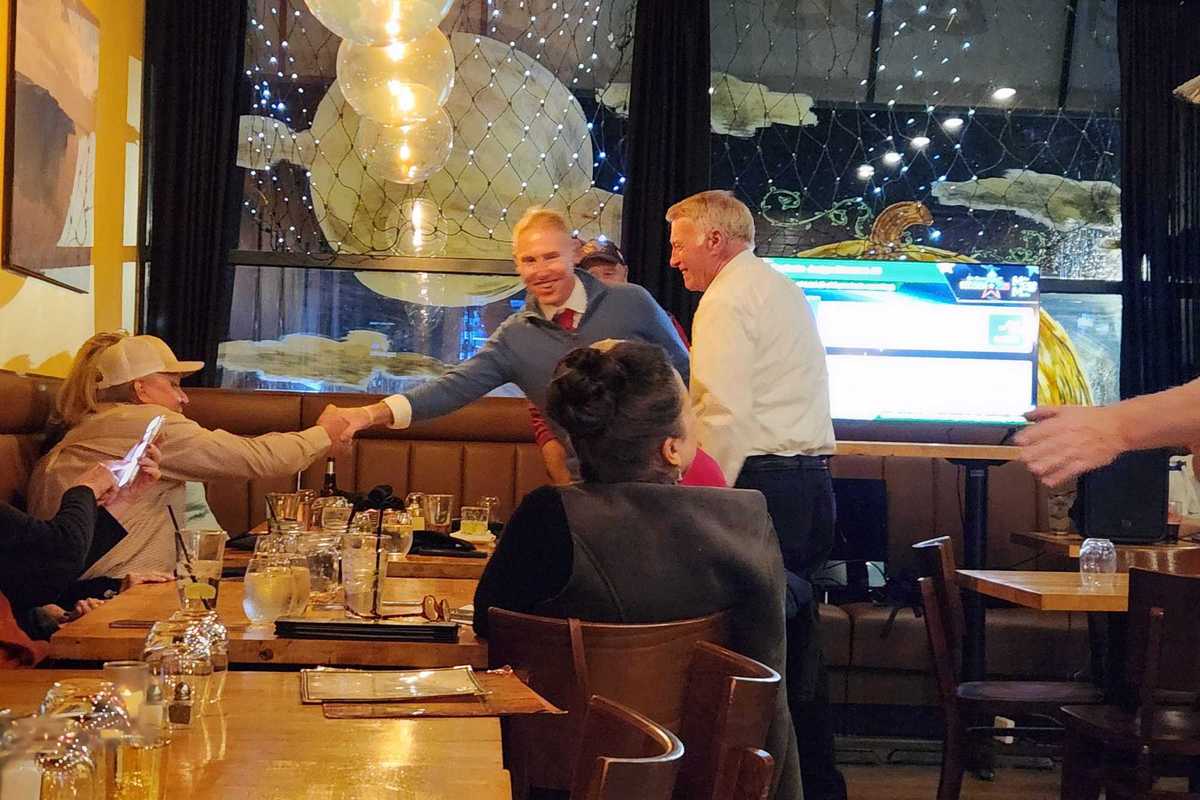
Just as polls close, Former District 30 State Senator Stephen Harding greets supporters at his election watch party at The Abby Restaurant & Bar in New Milford, CT, Nov. 3.
In an unprecedented midterm election the evening of Nov. 3, Democrats across the country flipped battleground races for federal and local representatives in what has been described as a blue tsunami. The results in Connecticut were no different.
Small trout, big lasagna and bad movies
Patrick L. Sullivan
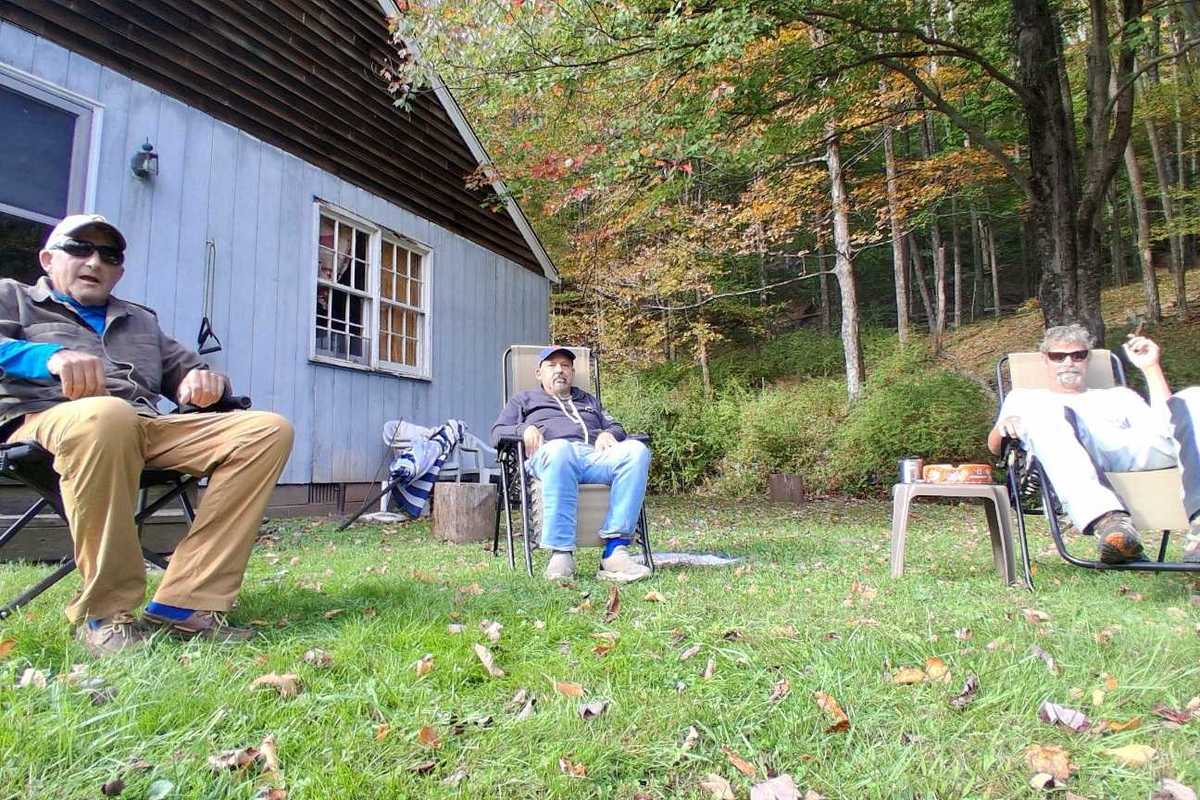
The Men of CACA. From left, the author, Steve DeSimone, and Tom Gallucio.
I recently convened the fall meeting of CACA, which stands for Cinema, Angling and Culinary Appreciation.
This takes place in Phoenicia, New York. We fish all day, make a bountiful dinner, and watch the world’s worst movies.
CACA was founded about 25 years ago, back when we had to worry about the elderly VCR eating the tape of “Death Race 2000.”
Attending this year were Steve DeSimone, who I met in the sixth grade, and my itinerant attorney Tom Gallucio.
Steve is gainfully employed and could only manage a couple of days. Tom wanders the nation with a small camper, so he was underfoot the entire week.
When the cool weather begins and he starts to molt, he knows it’s time to head south. So this was his last hurrah in the Northeast.
The culinary appreciation began when Tom made a 15 pound lasagna. We weighed it to be sure. It lasted all week.
On the cinema front, the big discovery was John Boorman’s 1974 ode to weirdness, “Zardoz.”
Whatever you do, do not Google the words “Zardoz” and “Sean Connery” and then select “images.”
If you do you will see something that cannot be unseen. And because this is a family newspaper, that’s all I have to say on the subject.
The angling was so-so. The Esopus was suffering from turbidity, so we concentrated on tributaries, which were running clear.
What we were hoping for was brown trout ready to put on the nosebag.
What we found were small wild rainbows.
I caught my fish on Leadwing Coachmen wet flies and small, heavy Bread and Butter and Surveyor nymphs.
Here in Connecticut, the stocking trucks have been rolling and a trip to the Blackberry, Housatonic or Farmington will probably be rewarding.
Sharon ambulance captain carries on family tradition of service
Ruth Epstein

Thalia MacMillan
SHARON — Whether it’s in her professional work or her community volunteerism, Thalia MacMillan strives to advocate for others. She developed that instinct from her many family members who also have the same calling.
Many in the region know her dad, Stanley MacMillan, who served for decades as a building inspector and fire marshal. Her mother, Grace Kandefer, was a longtime nurse at Sharon Hospital. Both were active volunteer first responders. Her brother Stanley MacMillan, Jr., is a member of the Sharon Fire Department.
MacMillan, who is currently captain of the Sharon ambulance squad, was raised in Sharon, attended Sharon Center and then Oliver Wolcott Technical School with the intent of studying nursing.
“I wanted to help others, but realized not in that way,” she said during an interview Saturday. “I decided to take the social work path.”
After receiving a bachelor’s degree from Mt. St. Mary’s College in Newburgh, she went on to earn a master’s in social work from Fordham University. She then took a position with Lighthouse for the Blind, while also working as a teaching assistant. Later she earned a PhD in social welfare from Fordham.
As a teaching assistant, she found she really enjoyed working with students. That led to her current position as full professor at Empire State University, which is part of the State of New York system. Her courses include human services, addiction, disability and policy. Her teaching is now online and through independent study.
Most of her students are 30 and over who are coming back to school to get a degree. “As one who did that, I get it; I understand where they’re coming from,” she said.
MacMillan’s sense of caring and compassion comes through very clearly when she talks about preparing her students to work with individuals with disabilities, older adults, housing communities, those living in housing projects and people suffering from addiction.
For someone who loves to have fun and display a quirky sense of humor, MacMillan takes on a serious tone when talking about her students. “Things have gotten worse in the past few years. They are seeing some horrible things.”
She is also the author of several books dealing with topics related to her profession, including “An Introduction to Psychoactive Drugs and Medication,” “The ABCs of CPL: A Guide to Credit for Prior Learning” and “New Directions in Treatment, Education, and Outreach for Mental Health and Addiction.”
While working in New York, she met her husband, Andy Tam. They made the decision to move to Sharon in 2009. Both continued to commute to New York City before her teaching went online and he has transferred to Danbury, where he’s a purchasing manager.
“I wanted to come back and see what I could do for my community,” she said.
She joined the ambulance corps and when Jamie Casey retired in 2023, she took over the helm. She credits those whom she originally served with, including Casey, Jack Murtagh, David Chase, Betsy Hall and Tom Casey, with sharing their expertise to help her learn what she needed to know. “They gave me a lot of wisdom,” she said.
Speaking about the ambulance corps, she said the pool of volunteers has dwindled since the pandemic, with only about 14 to 15 members now. The hours required for certification and recertification are steep. Similar to other departments, Sharon has had to hire paramedics to cover certain hours. “Financially, it’s a struggle,” she said. “The burdens of the squad weigh heavily on me.”
But she went on to emphasize that the volunteers who are serving are phenomenal. They are very dedicated “and above all else, are very good people.”
One of the group’s big fundraisers is on the horizon for the fifth year, for which MacMillan is now preparing. Luminara, small bags filled with sand and tea-lights, are sold for $10 each. They are marked with names in honor or memory of someone. On Dec. 5 they will be put out all around the Green creating a magical glow to start off the holiday season. Last year a total of 2,200, including donations from a large number of businesses, were sold. Ambulance member Patricia Chamberlain came up with the idea. So far, 900 have been ordered for this year.
The ambulance squad also hosts monthly pancake breakfasts from March to September, In addition to raising some money, she likes that they bring the community together in an informal way.
For relaxation, MacMillan and Tam enjoy attending Comic-Cons, dressing up in wild costumes that depict some of their favorite characters.
“I love it just as much as kids,” she said. Among her favorites are the witch from “Snow White,” Ursula and “Super Girl.”
She said her favorite is Snow White because their backyard is a haven for stray animals and Snow White loves animals.
She is also a voracious reader, focusing mainly on stories about witches and vampires. “I like light reading; not heavy. My friend calls my favorites ‘fairy porn,’” she said with a laugh.

Want more of our stories on Google? Click here to make us a Preferred Source.
Sharon plans replacement of West Cornwall Road bridge
Patrick Stachniak

SHARON — The Board of Selectmen and Planning & Zoning Commission have approved new plans to replace the West Cornwall Road bridge over Pine Swamp Brook, just south of the historic covered bridge over the Housatonic River in West Cornwall.
The project has been in the works for three years after a survey determined that the structure was nearing the end of its intended life-span. After passing the P&Z commission, the project now only needs approval from four property owners near the site to begin the bidding process.
Demolition and the new bridge will cost an estimated total of $1.5 million, with Sharon responsible for 50%. First Selectman Casey Flanagan is “cautiously optimistic” construction will begin in spring 2027.
“We conducted a bridge assessment of our structures between six and 20 feet in length,” said Flanagan. “This bridge was identified as the top priority because of its poor condition, so that was the first one we started with.”
The approximately 15-foot bridge that crosses Pine Swamp Brook, and the several other bridges along West Cornwall Road can be indistinguishable from the normal road for commuters, according to Flanagan.
Flanagan did not identify any dangers or deficiencies but said the bridge has reached the end of its design life.
Connecticut’s $16 million State Local Bridge Program, administered by the Department of Transportation (CDOT), reimburses municipalities for repairs and replacement for small bridges. Though each town is responsible for the design, bidding and construction process, the state will reimburse 50% of the project’s total cost.
“Whether it’s kids going to school, people heading to work, or traveling to visit friends and family, every community depends on bridges that are safe and built to last,” said Governor Ned Lamont in July.
“This grant program provides significant relief to our towns and cities, helping them tackle costly infrastructure projects they couldn’t take on alone.”
The largest hurdle for both the Board of Selectmen and P&Z Commission was the revelation that four separate private properties intersect at the middle of the extended design’s Western side, which increases its lifespan.However, Flanagan stated that the property owners were cooperative and willing to allow the updated bridge design to stretch roughly 15 feet into their properties. Sharon has sought a permanent easement on the land to allow the new guardrails and road to remain on the properties, as well as enable maintenance and upkeep.
Though the complication increased the approval process timeline, Flanagan feels confident the town can compensate the property owners fairly and estimates Sharon will be able to complete the bidding process over the winter and begin construction in 2027.
The new design will not make substantial changes to the present bridge and will be functional for the next 100 years.
“Everything’s been going well. Hopefully the property owners are still eager and willing to work with us because it’s going to benefit them just as much as anybody else,” Flanagan said. “I’m cautiously optimistic that we’ll be able to negotiate deals with them all and move forward.”
Salisbury Forum links science, religion and Earth’s future
Patrick L. Sullivan
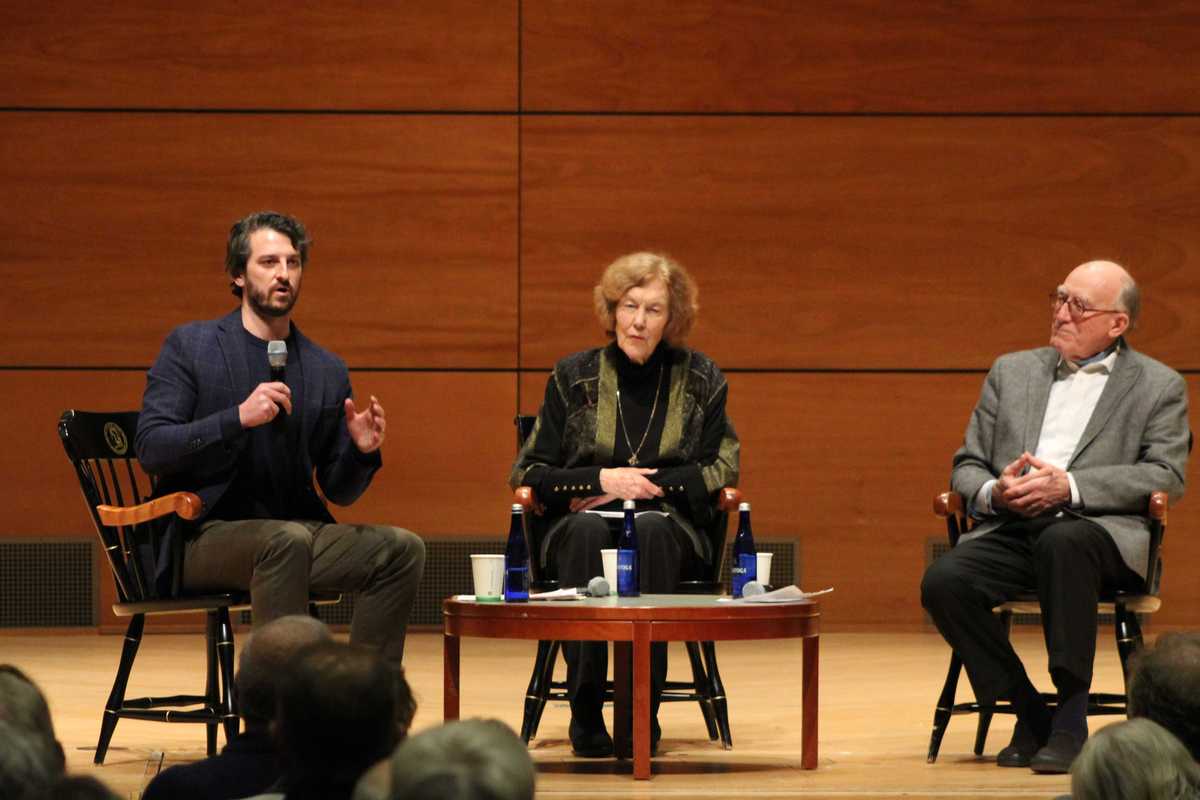
From left, Sam King, Mary Evelyn Tucker and John Grim discuss how religion and science can be used to address environmental challenges on Oct. 30.
LAKEVILLE — Religious scholars Mary Evelyn Tucker and John Grim and environmentalist, writer and former Hotchkiss teacher Sam King delivered a presentation at The Hotchkiss School Friday, Oct. 30.
Sponsored by the Salisbury Forum, “Change the Story, Change the World: A New Vision for an Ecological Era” explored how religious tradition and modern science can be used together to address environmental and spiritual challenges.
Tucker and Grim are co-directors of the Yale Forum on Religion and Ecology. King is project director for Journey of the Universe and taught environmental humanities at Hotchkiss.
Tucker and Grim were both students of Thomas Berry, a Catholic priest and professor at Fordham University who advocated for humanity to see itself as part of an interdependent community with the Earth, rather than using scientific and technological advances to exploit the planet.
The speakers made frequent references to “Journey of the Universe,” an Emmy Award-winning documentary co-written by Tucker. The film tells the story of the evolution of the universe, the Earth and humans from the Big Bang to the present.
Tucker said Berry was looking “not just for ways of enlightenment but a new way forward.”
“We need a new story that will integrate the discoveries of science” with religious beliefs, she said. “This new story has to be told in many forms.”
Grim said the challenge of “Journey” was how to tell the story of the evolving universe in what was originally a two-hour program, later edited down to one hour for television.
The subject matter was daunting, and the film deals with questions such as “Where did gravity come from?”
Tucker said the response to the film was gratifying and surprising. “China has really picked this up because it works with their traditions.”
Grim said he met a student from Pakistan who wanted to bring the film to that country even though it might be seen as contradicting Islamic teachings.
The student “cracked that nut,” and the film was shown in private and public schools in Pakistan without incident.
King, whose work on “Journey” includes arranging screenings, publishing a newsletter and hosting a podcast, said he taught at Hotchkiss from 2016 to 2019 in interdisciplinary humanities courses that asked students questions such as “Where do we come from?” and “What is a good human society?”
He said he discovered the film at a retreat and knew he had found something.
“I felt like I was meeting my own teachers.”
He started thinking about “a new cosmology with a new science.”
“We stand at a profound cosmic moment. We’re in the sixth mass extinction event, and the first caused by humans.”
The question for King was how to inspire young people to move from a model of human exploitation of nature toward a mutually enhancing relationship with it.
“We need to instill in young people a sense of fulfillment as creatures.”
Tucker said the interest is there. “Young people are very keen on science and cosmology.”
“This generation has gone through cynicism, disempowerment and despair. They’re coming out in a new place of hope and possibility. I’m very excited.”
Backgammon group adds ‘Pizza and Play’ at White Hart
Ruth Epstein
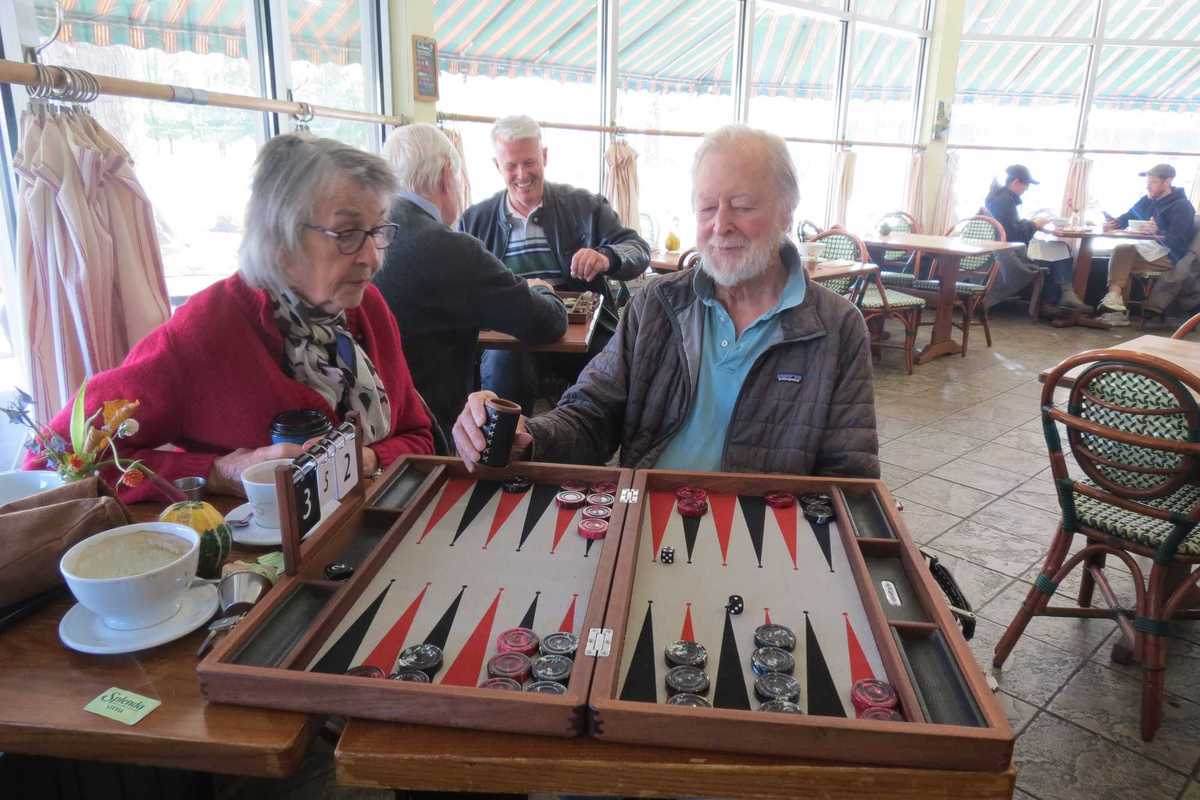
Playing backgammon at the Saturday session at Le Gamin in Sharon are front, Jennifer Dowley and Harding Bancroft. Behind them are Michael Lonergan and David Dabill.
Like pickleball enthusiasts who just can’t get enough of the game, those who love backgammon are eager to play as often as possible.
With interest growing, Backgammon of Northwest Connecticut has added a third location for its weekly gatherings.
Besides offering instruction and play at the Hotchkiss Library at 2 p.m. Wednesdays and competitive play at Le Gamin Cafe at 9 a.m. Saturdays, the group now gathers in the White Hart Inn’s library in Salisbury at 5 p.m. Wednesdays, where players can purchase pizza made in the outdoor oven.
What began as a handful of players has grown to a mailing list of 70 people, most of whom live within 30 miles of Sharon. They come from Cornwall, Litchfield, Torrington and Kent, with some traveling regularly from New York and Boston.
Several members teach the game at the Hotchkiss Library at no charge. Beginners and intermediate players are welcome. There are no membership requirements or dues.
On Saturday mornings, players are paired with others of similar proficiency. On Wednesdays at the Hotchkiss Library, the emphasis is on teaching, using a lesson plan composed of 14 components.
“Backgammon combines the strategy of chess, the luck of poker and the randomness of dice to create a unique experience for both the novice and the seasoned player,” said group founder Roger Lourie. “The use of the doubling cube takes the players to a whole new dimension of competitiveness. The use of the cube marks a player’s graduation from social play to competition; from novice to the first steps of expertise.”
Lourie, who introduces players to one another, said competitive play is also about enjoying one another’s company. He aims to match players of similar skill.
Ed Corey, director of membership services for the U.S. Backgammon Federation, provides informal instruction. Advanced beginners and intermediate players also play backgammon chouettes, a format in which a team strategizes together to defeat a single player known as “the box.”
During most sessions, players can purchase food to enjoy while they play.
The new location at the White Hart gives players another opportunity to gather with the four-year-old group.
David Dabill of Falls Village, the organizer of the “Pizza and Play” sessions, said, “This is a way for people to connect on an individual basis. Winters are long here and the White Hart is a community center for many activities. Long winters and dark days give us a chance to connect, dine and compete.”
Want more of our stories on Google? Click here to make us a Preferred Source.