Want to travel, raise a family, entertain friends, be engaged and productive into your 80s and 90s and grow old with pride and even joy? In a beautiful place?
Be an artist. In northwest Connecticut.
Yes, literature brims with the angst, the isolation, the pain of many painters, poets, performers, writers and musicians pursuing a new idea and an expressive image. Some, though, seem charmed.
Among them, Tim Prentice, 87, an architect and sculptor who draws in the air, he says. At age 43, he quit his architecture firm in New York, moved to Cornwall with his late wife Marie and their children, made mobiles: large, shining, witty, flags of shimmering squares, trembling in the air and lobbing light into space. The time was right: demand for public art was surging and he made a lot of corporate headquarters more beautiful, more engaging, and maybe a bit jollier.
Some of his constructions are just joys to figure out, like the huge plastic sewer pipes, 16 of them, aligned from short to tall to make a scale. Prentice stands on a balcony above them and hammers out something like music when he bops the upper openings with a paddle. Many of us have seen Prentice’s snake of red squares hanging above baggage checkers and ticket issuers at Bradley Airport. It was removed during some remodeling and is waiting to be returned to its post above the travelers. For me, the most intriguing structure is in his yard: a primordial shelled creature hanging in a cage, drifting with the breeze, nosing, now and then, to a feeding dish. It’s, well, eerie.
And then there are the barn swallows diving to divert people from nearing nests in Prentice’s barn. It’s a wonderful place.
Lately, Prentice has lost a lot of vision in one eye from macular degeneration. He presses his face against his large computer screen to locate images and documents. But he says his work has not suffered much. “I can see with my hands,” he tells me. And he is assisted by two artists: David Colbert and David Bean.
At the end of our talk, a car drives up. His daughter arrives to have lunch with him. He is overjoyed.
In another part of West Cornwall, Robert Parker lives and works in a house crammed with his paintings, constructions, drawings, and his history. Yes, the car won’t start. And the humid morning is exciting little summer bugs that fly at his nose and eyes. But he is still courtly, handsome, upright and full of stories. He tells me he is 100 years old and then corrects himself. He is only 90.
Parker entertained himself at an early age with drawing when he was confined to a sleeping porch in his family’s home in New Mexico. He had tuberculosis and lots of time to read and paint and think. “That’s how I entertained myself,” he told me.
He went to art school and his first job was teaching at The New York School for the Deaf. He learned to sign, and he figured how to outsmart the pranks of his students.They were difficult. “It was a terrible job,” he said.
His next job, though, changed his life. The producer of “A Lust for Life,” an MGM movie based on Irving Stone’s novel about Vincent van Gogh, needed an artist to rough in early parts of van Gogh’s paintings and film representing the painter’s hands. The job took him to France and Holland and Parker made enough money on this job to buy a house in New York City. His gallery on 8th Street in the Village did well and he taught at The New School of Visual Arts.
He, too, is suffering now with the start of macular degeneration. “I can still work up close,” but reading, he added, is very hard.
His workshop is beautiful, quirky and engaging, with models of airplanes (he could fly before he could drive) multitudes of paintings and drawings and constructions and portraits of friends, other artists and wonderful, expressive animals.
Prominently displayed is a photograph of his last birthday party with 173 of his friends in front of the house on River Road.
Neil Estern, age 92, is a sculptor, an artist who works in the most cumbersome, costly and collaborative branch of art. Of course he did not start with figures cast in bronze. He began carving erasers at age 12 when he traveled from the Flatbush section of Brooklyn to Saturday classes at Pratt Institute.
He liked to draw, and his parents encouraged his interests in art. He admired the statues of a lion and cubs in the Grand Army Plaza near his Brooklyn home. A lifetime later his bust of John F. Kennedy stands there.
Now it’s tough making a living as a figurative sculptor. Much of this genre is public art and supported by public fundraising (which occasionally evaporates midway through a project). So, first, he had to make a living while he built a reputation. He lived on Remsen Street in Brooklyn Heights: near the river, across from lower Manhattan, so gorgeous at night, and he made a pretty good living modeling clay dolls for manufacturers to copy. His most successful figure was Patty Play Pal. She was big as a three-year-old who, a video claims, could wear her owner’s own clothes and had saran hair that could be combed. Google sells one Patty Play Pal model online now for $450.
Estern’s goal, of course, was to make figurative pieces off heroic figures like FDR, his wife Eleanor, the Kennedys and numbers of mostly Democratic politicians like his hero, New York City’s Mayor LaGuardia in the 1940s. He had a little attraction to show biz folk like Jack Nicholson and royalty too, with a figurative work of Princess Diana. By the time he gained commissions on many of them, they were dead. So Estern gathered every photograph he could find of Kennedy, say, or Fiorello LaGuardia, to make a vital, even animated, figure. He lives now and continues to work at home on Cream Hill Road in West Cornwall.
Prentice, Parker and Estern are three patriarchs in a group of 30 artists in the Open Your Eyes Tour June 30, July 1 in Cornwall, Goshen and Warren.More info at www.Openyour
eyestour.org.


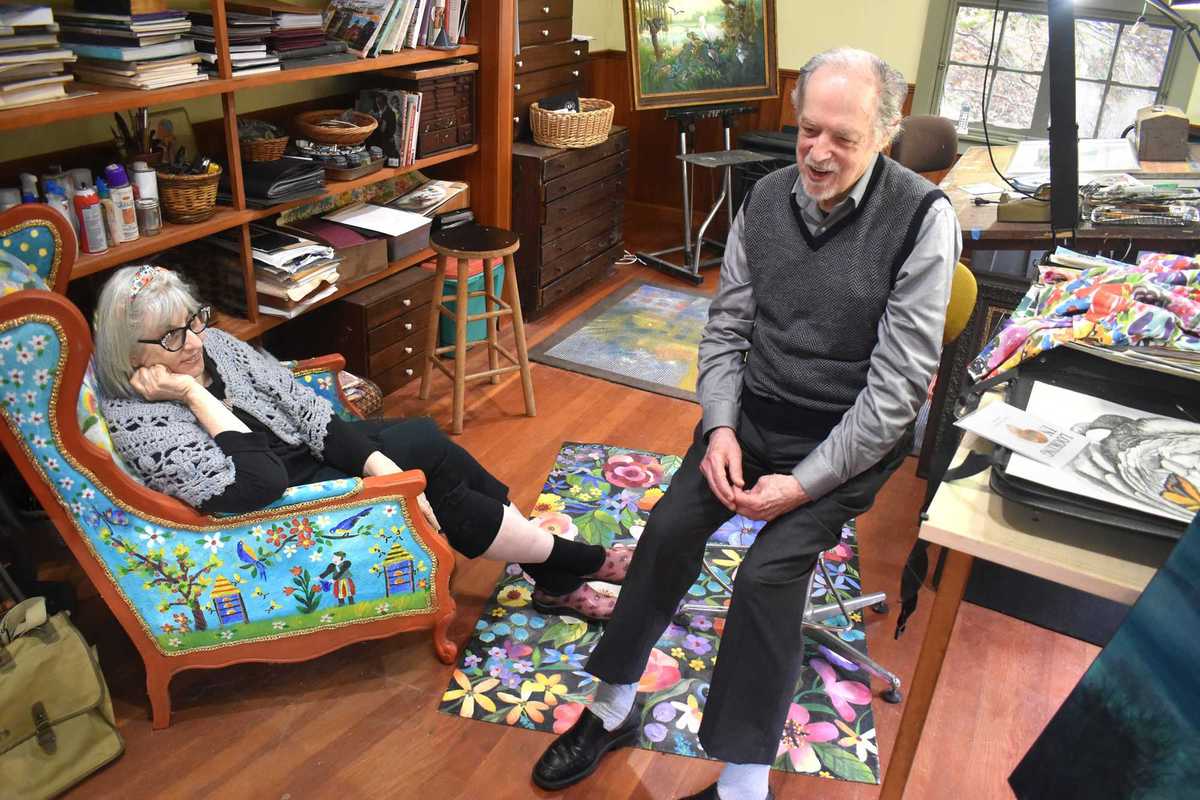
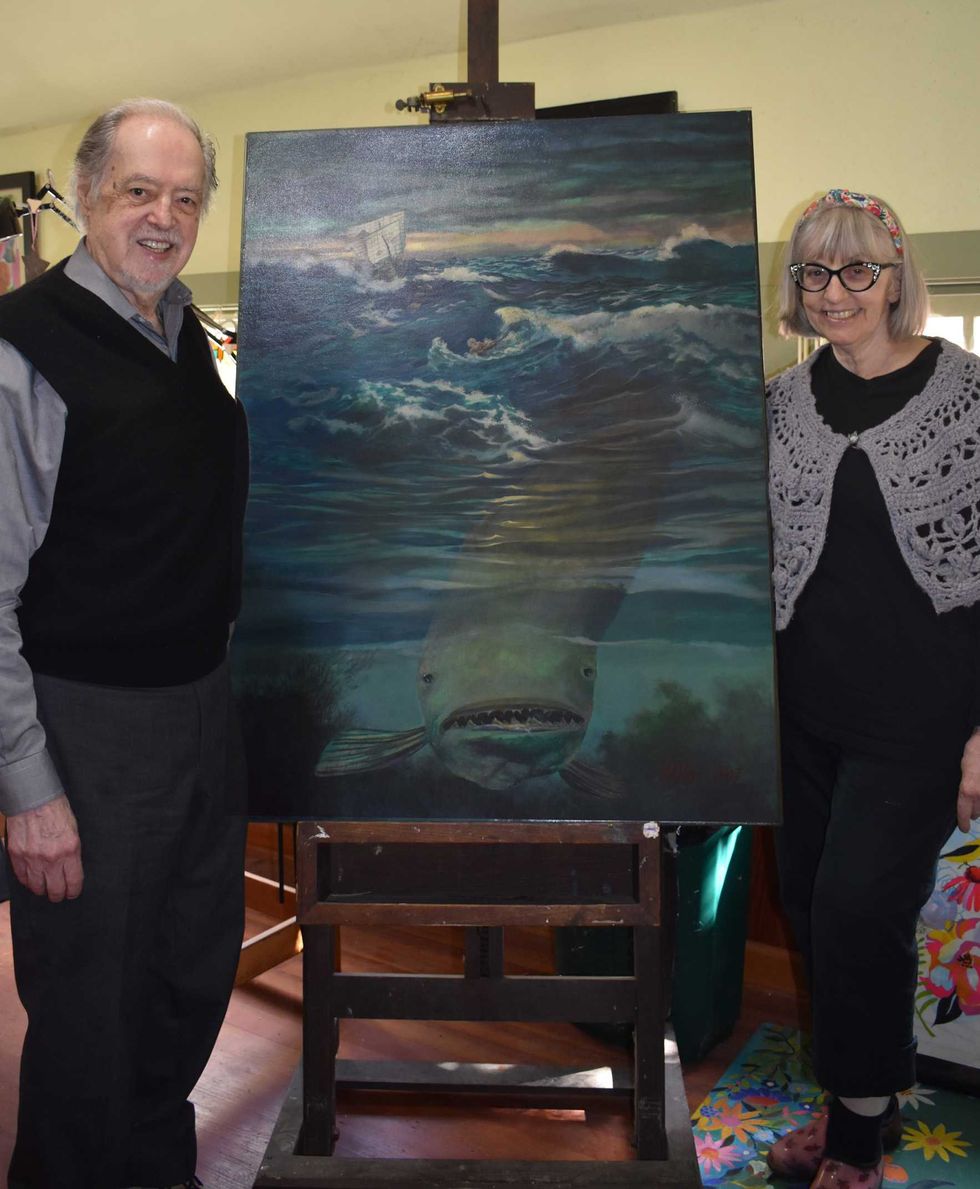 Justine and Victor Valla in their studio with a painting of Victor’s,”Jonah and the Whale.” Robin Roraback


 A ceramic vase by Kathleen Heidemann.Provided
 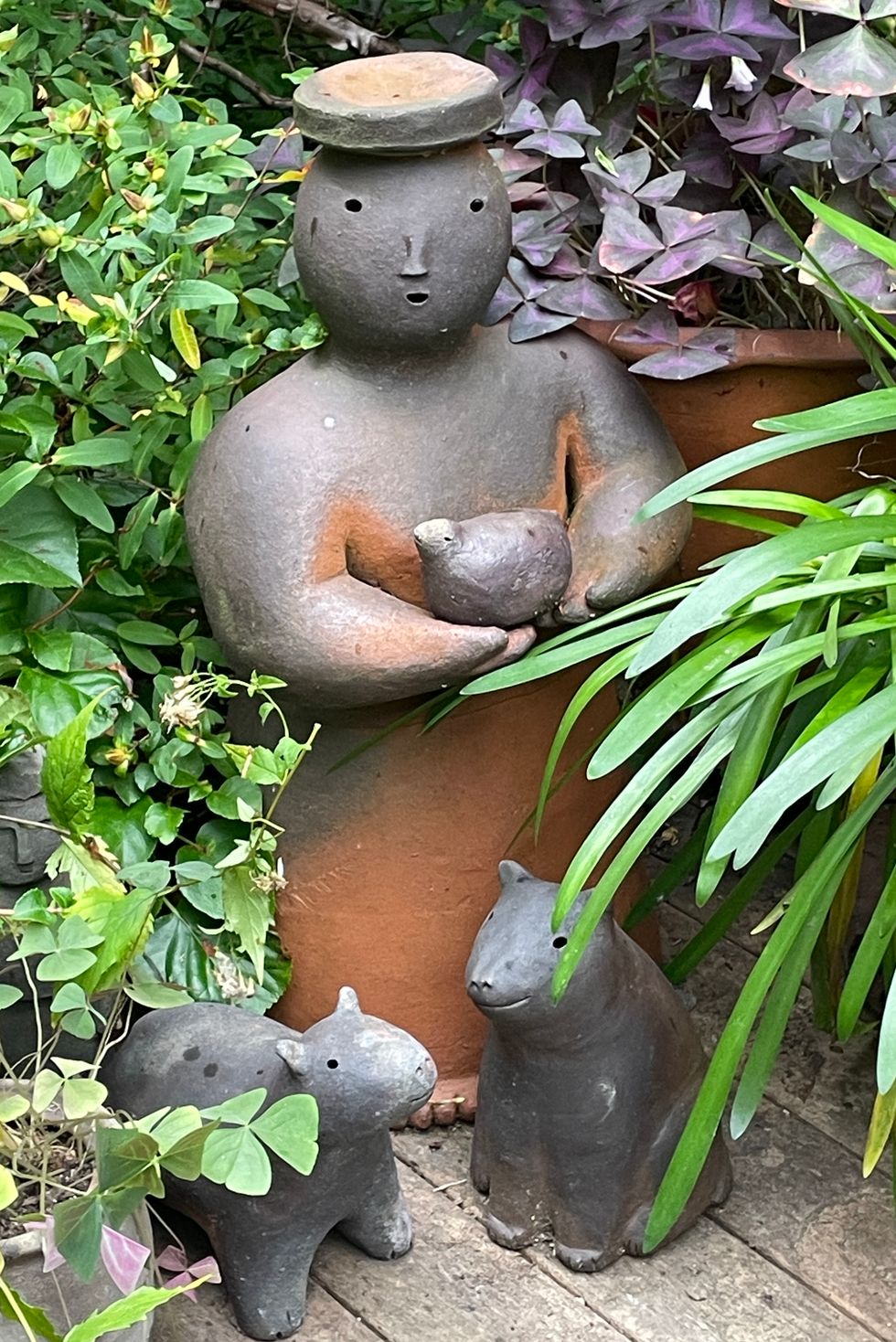 Joy Brown’s delightful ceramic sculptures.Provided