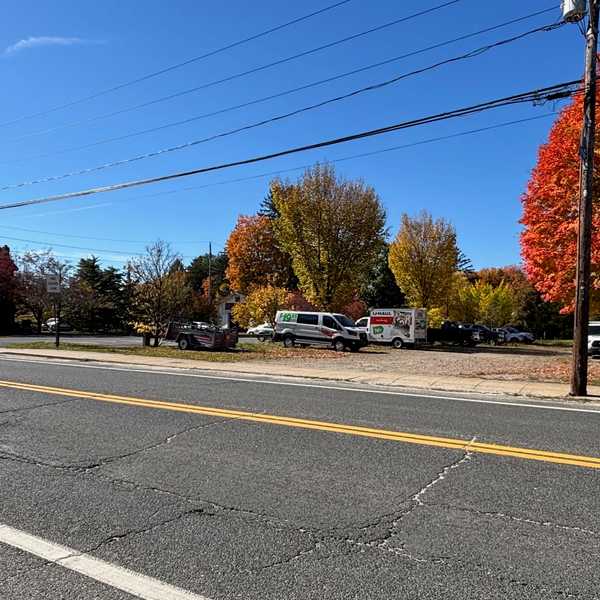
Town Farm overrun with egg hunters

Young egg hunters rushed across the Town Farm.
Patrick L. Sullivan


Young egg hunters rushed across the Town Farm.
FALLS VILLAGE — A brisk and chilly wind made no difference to the 25 or so children gathered at the Town Farm property, primed for Easter egg hunting, Saturday morning, March 30.
Emily Peterson and Dan Carr separated the children into two groups: under the age of six, and everybody else.
Showing considerable discipline, the older children waited patiently as Peterson allowed the smaller contingent to go first.
After a few minutes, Carr gave the go-ahead, and there was a surge of youngsters into the playground and adjacent fields.
The adults huddled around the pool entrance, trying vainly to avoid the wind, and indulging in coffee and baked goods from the Lee H. Kellogg School eighth graders.
Afterwards, as the children opened the plastic eggs and assessed their hauls, Peterson trooped around with some additional eggs, to make sure everybody got something.
Hannah Johnson
Each spring, FFA students compete in a variety of career and leadership development events, commonly known as CDEs and LDEs. This year, Housatonic Valley FFA had over forty students compete across ten different events, demonstrating their knowledge and dedication to the agricultural area of their choice.
On March 24, two Mechanics teams each consisting of 4 students traveled to Cobleskill College to show their understanding of equipment mechanics. Housatonic’s A team took first place in the state, led by senior Hayden Bell who was the competition’s top ranking individual.
Eight weeks later on May 15, six teams traveled to University of Connecticut with one securing first place. Students had a great time showing their skills within their designated areas which included agricultural sales, veterinary science, dairy judging, natural resources, farm businesses management and the winning agricultural communications team led by freshman Olivia Simonds who placed second in the state individually.
The agricultural sales team, which has been vigorously preparing for their competition for months, just fell short of the win taking home second as a team. Member Riley Mahaffey led her team in points. “Being so close to winning felt so rewarding knowing we gave it our all and were so close,” Mahaffey said. “It made me want to continue growing in that area.”
On Saturday, May 30, eight students competed in the opening and closing ceremonies CDE along with two individuals, Hayden Bell and Christopher Crane, competing in prepared public speaking and Byron Bell competing in extemporaneous public speaking.
The opening and closing ceremonies team and Crane each took home first place and will join the ag communications and mechanics teams at national convention next fall. “Hearing my name called as first place made all of the practice, stress and anticipation worth it,” Crane said.
Housatonic’s FFA chapter president Riley Mahaffey praised the chapter for its students’ dedication. “Seeing so many kids involved in various activities this year has shown the true strength and capacity of our chapter,” he said.
Hannah Johnson & Anna Gillette
Housy seniors sport merch showing off the colleges and universities they each plan to attend after graduation.
On June 19, the class of 2026 will receive their diplomas at the Housatonic Valley Regional High School graduation, marking the last milestone all of these students will share. With life after high school approaching, graduates are doing big things in lots of different directions.
Next fall, senior Wes Allyn can be spotted playing football while wearing a University of New England jersey. With offers from multiple schools, Allyn described his decision making process. “I would go on visits for football, and then tour the school regularly, so that way I’d kind of see every side of the campuses,” he said. “After doing all that, I kind of just felt the best at the University of New England.” Allyn plans on majoring in athletic training.
In order to get recruited for football, Allyn reached out to coaches at several schools. “That was a really important step,” Allyn said. “I probably sent out over 15 emails and I was in contact with at least seven coaches.”
He credits HVRHS for teaching him how to properly compose emails and communicate professionally, although he didn’t feel entirely prepared for other aspects of this process. “I feel like it would be beneficial if they had a program or something to help athletes who have aspirations of playing in college.”
To prepare for the fall season, Allyn has been increasing his workout intensity after recovering from a knee surgery. His pre-season will begin in mid-August. Allyn is confident that he can manage class work while playing a sport. “I know the University of New England has mandatory study halls for freshmen,” he said. “I’ll definitely have dedicated time to do all my work, so that way I won’t be falling behind.”
Another difficulty about college applications is entering into a competitive field, but that didn’t stop Chloe Hill. Set on majoring in nursing, Hill applied to 14 programs before settling on the University of Rhode Island.
Hill described the application process. “It was really discouraging,” she said, “There was one week where a lot of the decisions came back, and five days in a row, I got five different rejections.”
To ensure getting into a nursing program all four years, Hill applied to a direct entry program for each school. This made the process more competitive. “I knew it was gonna be a struggle,” she said. “[The University of Rhode Island] offered me a lot of money, it was the perfect distance away from home, and they have a really good nursing program, so it all kind of worked out,” Hill said.
Ever since getting her certified nursing assistant license, Hill has been working at Geer Village as a nursing assistant. “I feel a lot more confident,” she said. “I’ve met a lot of people and learned a lot about the career I’m going into.”
Not all graduates are continuing their education next fall. A large portion of students are pursuing a career in the workforce. For example Ashton Osborne plans to continue working to grow his business.
It is not uncommon for students at Housatonic to enlist after graduation. This year only one student has taken that challenge. Senior Nick Crodelle will be joining the Coast Guard. “I can’t sit in school for four more years,” Crodelle said. This among his need for adventure is why Crodelle chose to enlist.
His next steps will be to prepare physically. “I’ve been running before school,” he said. “I’ve got to start swimming and lifting a little more.”
His dedication shows how committed he will be to the organization. “I mean, you get to protect, save, and serve your country,” Crodelle said.
Shanaya Duprey
As the school year comes to a close, Housatonic Valley Regional High School seniors are beginning an uncharted part of their lives. With many pursuing higher education at universities, the cost of continuing school has prompted some students to voice concerns about access to continuing education.
Meadow Moerschell, a junior at HVRHS, said she sees value in a university education. “I do feel that pursuing a college education is worth the challenges since it is such a valuable experience, both socially and academically,” Moerschell said. “College seems like a time to grow, learn, and meet new people in a safer environment than the real world, while still having a lot of independence.” Other students, such as graduating senior Mollie Ford, voiced conflicted feelings on college spurred by apparent barriers to access. “I have mixed feelings about college,” Ford said. “It’s obviously a business, but I also think that it’s hard to be successful without a degree.” Ford will be going into Fordham University’s Class of 2030 in the fall.
Despite the barriers, she also advocates for a college education. “I think it’s necessary, I think kids should seek it out,” Ford said.
While the views around college’s value vary, Housy students generally view university education as inaccessible. “I don’t think higher education is accessible, I think it’s wildly expensive,” Ford said.
It’s not only the costs of the school that are of concern. Students drew attention to pre-college standardized testing and how more affluent families can often spend more to give their students an advantage in applications. “When someone has more money they have a huge advantage in higher education, since they’d be able to take the SAT as many times as they want, pay for study courses, travel to visit schools, pay application fees, and so many more factors that give kids a leg up in the college process,” Moerschell said.
Rachel Matsudaira, HVRHS’s scholarship coordinator, has a more optimistic and hopeful outlook. “In a merit-based educational system, one’s hard work determines one’s outcomes,” Matsudaira said. “In America, public school is free, and access to college is still based on merit. If a student works hard during the free education years, they will be able to earn scholarships and attend college if they so choose.”
Ford believes that there is a certain group at a significant disadvantage when it comes to college costs. “The most disadvantaged group I’d say are average middle class people. When you’re thinking about finances, they’re overlooked when you think about scholarships or FAFSA. You have to be really wealthy or really below the line.”
As a high school, HVRHS provides various support systems for students going into college. The perceived success of these support systems varies. “I think that HVRHS works hard to support its students in the college search through the CCRC, college fairs, advice panels, and yearly meetings with counselors,” Moerschoell said. “However, with only about half or something of the Housy population going to college, there’s only so much that they’re going to be able to do for the kids considering college after school.”
The school’s counseling office was highlighted as an adequate resource. “Our supports are extremely personalized, with one-on-one assistance throughout the process,” Matsudaira said. “Our school counselors meet 1-on-1 with every student at least once a year to check in and access student goals. Additionally, students can make appointments to meet with their counselors whenever they need, throughout their 4 years here.”
When compared to other schools, however, some believe that HVRHS could provide more support. “Other schools like private schools in the area have a college advisor per ten students, the difference in ratio is kind of shocking,” Ford said. “I think that Housy does support students seeking higher education, but I don’t think there’s a big enough support system, like Mrs. Terni shouldn’t be the only college counselor.”
With HVRHS being such a small school, there are advantages and disadvantages beyond the support systems that impact students. Matsudaira said the school’s small, rural status actually helps students stand out in applications. “In our merit-based education system, a student who shows rigor from a small rural high school that doesn’t offer SAT prep courses and doesn’t have much classroom competition–that student will stand out to college admission teams,” she said.
Ford also credited the high school’s extracurricular programs. “It is easy to find niche opportunities, like niche internship opportunities or summer programs,” Ford said. “We have a lot of things that you can do that make your application stronger.”
With advantages comes the downside of coming from a small high school. A key issue, Ford said, is what she describes as a lack of specific guidance.
“There’s not enough teachers here telling kids what to do and how to do it correctly,” she said. “Kids at Hotchkiss or at Berkshire have adults telling them you should do these activities, it’ll make it [college application] stronger, but we don’t have that. We’re kind of doing it by ourselves.”
Finances are a major stressor for students pursuing college, but there are social challenges as well. “The biggest stressor is that college culture has become really intense,” Ford said. “A lot of kids are more worried about the name of their school or the vibe of their school more than actually receiving an education in college.”
Matsudaira offered advice to parents and students that she hopes can alleviate some stress.
“Make sure you have examined the cost vs. value equation for yourself and your family,” Matsudaira said. “Make sure the college is a good fit for you. Do not go into any debt to pay for college.”
Ford suggests that students “Apply to as many schools as you can, and as many Connecticut schools as you can. The admissions process is so competitive, and like everyone is applying to college, and it’s so expensive, so you have to have options in Connecticut.”

Want more of our stories on Google? Click here to make us a Preferred Source.
Mia Dirocco
Silas Tripp crosses the finish line at a track meet.
As spring sports face their endings, senior captains prepare for the end of their sports careers at Housatonic. Each took on their roles as mentors and leaders for their teammates, and brought Housatonic sports to the end of a highly successful spring season.
Senior Wes Allyn has been one of the three Housatonic baseball captains this season. The team which made it all the way to states this year on June 1, has had an 8-12 record this season. This year, Housatonic baseball will be saying goodbye to seven seniors: Owen Riemer, Hunter Conklin, Tyler Roberts, Anthony Foley, Nick Crodelle, Abram Kirshner, and Wesley Allyn.
Allyn described his role as a senior captain as “A little bit different than being a captain for other sports. The main responsibilities I had were setting a good example and making sure things got done, like bringing equipment up for away games or picking up after home games and practice.”
For many seniors on the team, this goodbye will be a difficult one. “I will miss the culture me and the other seniors created in our four years here,” said Allyn. “We transformed our team from being just a team to more of a family.”

Senior Silas Tripp has participated in track for all of his four years at Housatonic, and has committed to run track and cross country at University of Hartford next year. “For us captains we really just aim to serve as a role model for the younger athletes on our team, whether that’s providing encouragement during practice or just remaining a positive attitude during a hard workout,” he said. “These make all the difference for our team chemistry.”
Captains, especially seniors, are highly responsible for the team’s environment and players’ experience. While it can be difficult at times, Tripp has greatly enjoyed his time as a track and field captain. “It’s hardest just knowing it’s my last high school sports season, but it’s been a really amazing season and I can’t complain about any of it,” he said.This season, track and field will be saying goodbye to seniors Olivia Brooks, Ava Segalla, Katie Crane, Hannah Johnson, Maddy Johnson, Joseph Villa, Anthony Labbadia, Peter Austin, Cohen Ceccinato, Cole Simonds, Simon Markow, and Silas Tripp.
“Everyone on the team is very close and it really does feel like another family that supports you,” said Tripp.

Housatonic Girl’s Tennis has senior Victoria Brooks, her final year as captain of the girls’ tennis team has not been an easy one. Recovering from a severe wrist injury during her basketball season, Brooks began the season being unable to practice at all, missing the first two matches. After recovering from her injury, Brooks went on to become a Berkshire League Tournament all-star and semi-finalist this season.
Anna Gillette
A years-long tradition is returning to Housatonic Valley Regional High School, aiming to provide a safe and fun environment for seniors to celebrate their graduation.
The annual event, called Project Graduation, takes place after seniors receive their diplomas on June 19. HVRHS Assistant Principal Steven Schibi promoted the event as a drug and alcohol free alternative to private parties outside of school grounds.
“It’s just to give our seniors one last fun moment with each other that is free of alcohol or drugs,” Schibi said. “We just want a dry, fun place to be, with food and games for the seniors.” The night starts at 10 p.m. “That way kids can go home or go out to eat with family if they want,” Schibi said.
The night will have a range of activities to keep students entertained throughout the six hour long event. The activities include axe throwing, karaoke, laser tag, hide and seek, bouncy houses and a raffle to conclude the event. “We use the auditorium to show movies, and the band room for video gaming,” Schibi said. “Kids can do laser tag in the hallways. Last year they went out and played manhunt in the fields.”
Class president Madison Graney helped organize the event. “There’s definitely going to be lots of food, candy, and an ice cream bar,” she said. “We’re going to play games all night.”
For the most part, students are able to move freely throughout the school. “It’s not a free for all,” Schibi said. “But it’s a lot of fun.” Teachers volunteer to stay for different shifts or throughout the entire night, ensuring everyone’s safety and monitoring activities. Senior class advisors Leticia Garcia-Tripp and Jeffery Tripp will spend the entire night, along with superintendent Melony Brady-Shanley.
“I feel like most people won’t sleep,” Graney said. The celebration ends at 4:30 a.m. but students can leave any time before then if picked up by a parent.
Students who face difficulties organizing a ride home will be dropped off at the middle school in their town by PTO members. “Nobody drives home,” Schibi said.
Garcia-Tripp emphasized the upside of staying until the end. “If you want to get a raffle prize, stay,” she said. Raffle prizes include things like microwaves, mini fridges, electronics, and gift cards. These items are donated through an annual appeal to community members and businesses.
But students have to stay the whole time to participate in the raffle. “If people choose to leave, then they leave, and they don’t get to partake in the raffle,” Schibi said.
The event is primarily organized by Schibi and FFA secretary Sara Jack, along with help from senior class advisors, class officers, and a few contributions from junior parents. “Their role is to go out and solicit businesses for the food portion, and to pick up and drop off food the day of,” Schibi said. “Some of them will come and help decorate or set up tables and stuff like that. We’ve even had a couple that would stay overnight.”
Putting together this event takes a lot of work, but year after year it proves to be worth the effort. Students have a memorable experience, leave with a prize, and keep themselves out of harmful situations. “It’s going to be the last time that we’re all together as a class, so I think it’s going to be really special,” Graney said.
Ibby Sadeh
A group of Housatonic Valley Regional High School students participate in the NEXT women symposium in New York City.
One week in April saw some students missing classes for three field trips in a row, prompting questions about the impacts that back-to-back trips have on classroom performance.
The trips — one each on April 7, April 8 and April 9 — took many of the same students out of the classroom for each one. Students and teachers expressed a range of responses to the back-to-back trips, acknowledging a field trip’s ability to enhance classroom learning but expressing frustration over how trips can sometimes disrupt in-school learning.
Housatonic Valley Regional High School senior Sara Ireland went on three trips to New York City that week. “To some it might sound like a nightmare but I really did enjoy it,” Ireland said.
The first trip was NEXT Women Symposium, to talk to seven professional women and hear their experiences in male dominated fields, organized by Abby Auerbach. The second was for the AP Lit and English 12 Honors class to see “Death of a Salesman” on Broadway, providing hands-on experience with a Broadway production as the class learned and read plays. The third was for Chorus, Band, and the musical theater society to see Hadestown and The Great Gatsby on Broadway.“These field trips weren’t just fun outings, they were genuine experiences that help to shape student’s interest, help their futures, and of course are still fun,” Ireland said.
Social Studies teacher John Lizzi is generally supportive of field trips, but he said trips should be a supplement to classroom schooling. “I think in general field trips can be extremely valuable depending on the class, depending on what the experience offers and I think there are times when they really need to happen. Teachers should be looking for those types of really unique opportunities for their students when they apply to the curriculum,” Lizzi said. “Teachers should try to get everything they can out of the classroom experience, what can be done inside the classroom, and that should be the primary focus, but there’s always going to be things that you cannot do in the classroom, so we should have those opportunities.” Ireland called attention to the impact of getting out of the classroom. “It can feel really overwhelming being stuck in a classroom day after day and often doing the same stuff over and over again,” she said.
Lizzi also called attention to a disparity in student involvement in field trips. He said higher-level courses take students on trips more often, leaving students that aren’t enrolled in more rigorous classes without opportunities to take trips. While he acknowledged the current data may be incomplete because the year hasn’t ended, it is still an important thing to consider as field trips are planned. Lizzi said teachers and administrators are looking to improve inclusivity. “There was total agreement that opportunities need to be available for everyone in the student body, not just certain classes or groups,” Lizzi said.
But field trips can have negative consequences too, especially three back-to-back trips. For Ireland, the impacts vary from class to class. “I’ve had incidents where teachers have told me field trips aren’t any excuse for not being ready to take a test or be behind and that it is solely our responsibility to keep up in class while on these field trips,” Ireland said. This has made her feel discouraged and not supported by certain teachers, turning what is supposed to be a class enhancing experience into a stressful one.
Lizzi gave a teacher’s point of view. “As a teacher, students being taken out of classes for field trips can be really frustrating,” Lizzia said. “I think that we have to work to improve. It’s not that it’s happening, it’s being unaware that these trips are taking place or that they’re coming up at the last second.” This problem is exacerbated because field-tripping students also have many other classes together, so one trip can disrupt an entire day’s worth of learning.

Want more of our stories on Google? Click here to make us a Preferred Source.

Want more of our stories on Google? Click here to make us a Preferred Source.