Thank you!
Your support is sustaining the future of local news in our communities.

‘Vulnerable Earth’ opens at the Tremaine Gallery

‘Vulnerable Earth’ opens at the Tremaine Gallery

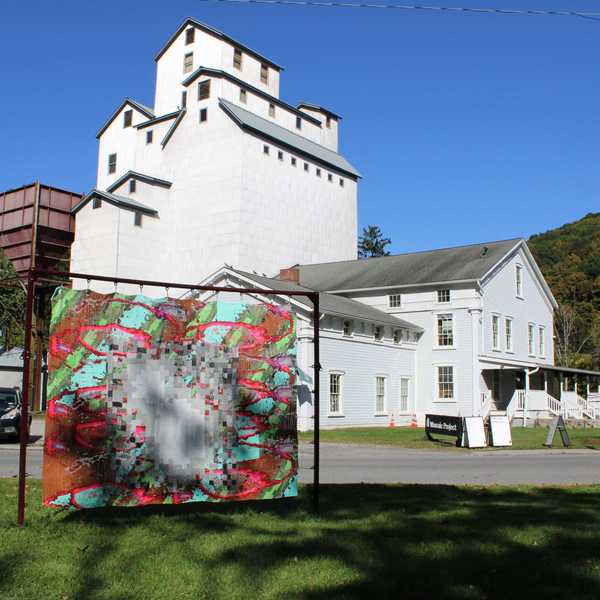
Tremaine Gallery exhibit ‘Vulnerable Earth’ explores climate change in the High Arctic.

Photo by Greg Lock

“Vulnerable Earth,” on view through June 14 at the Tremaine Gallery at Hotchkiss, brings together artists who have traveled to one of the most remote regions on Earth and returned with work shaped by first-hand experience of a fragile, rapidly shifting planet, inviting viewers to sit with the tension between awe and loss, beauty and vulnerability.

Curated by Greg Lock, director of the Photography, Film and Related Media program at The Hotchkiss School, the exhibition centers on participants in The Arctic Circle, an expeditionary residency that sends artists and scientists into the High Arctic aboard a research vessel twice a year. The result is a show documenting their lived experience and what it means to stand in a place where climate change is not theoretical but visible, immediate and accelerating.

That shared experience — weeks spent together navigating the waters around the Svalbard Archipelago —forms the connective tissue of the exhibition. Artists work across video, photography, performance and digital media, but what binds them is proximity: to the landscape, to one another and to the evidence of environmental change.

“The residency is fantastic,” Lock said. “You fly into the most northerly airport on the planet, get on a ship with a bunch of artists and then sail around the archipelago and find a bay or a glacier, get into little rubber boats and go to shore. There are three guides with rifles … and they form a triangle around us to protect us from polar bears, and then you’re just there.”

That immediacy — of risk, of beauty, of isolation — is evident in the work on view. “Everyone is concerned with the environmental shifts that are occurring, and you’re witnessing it out there,” Lock said. “We were cleaning the beach one day and there’s so much trash on this beach in the middle of nowhere … because there’s plastic in the sea. We are witnessing these things firsthand.”

Lock’s own contributions underscore how quickly the landscape is changing. In one piece, two photographs are mounted on a glacier-shaped metal stand. “I went to photograph the glacier, and we were sailing around and because of the map, we knew we were at the glacier, but we couldn’t see it,” he said. Dense fog, created by warming air meeting cold ground, obscured what should have been unmistakable. Only later, in post-production, did the glacier emerge. “In Photoshop, I could extract the glacier, but to the naked eye, it was no longer visible.”

Other changes are even more stark. Lock recalled the reaction of the ship’s captain comparing current conditions to his charts. “His ‘up to date’ map showed that the glacier was 8 kilometers between one side and the other, but we parked at one side, sailed and moored on the other side and it was 1.4 kilometers,” Lock said. “So, it’s just like bam. It’s happening so fast.”

There is a sense of urgency in these images, but the collection also is a testament to process and to the community that forms in such extreme conditions. “There’s quite a nice network of artists who are pretty tight,” Lock said. “We were on a ship together in tight quarters for three weeks, so we got to know each other really well. And I found connections across the work with my own practice.”

Mindful of the environmental stakes embedded in the work itself, Lock made decisions aimed at reducing impact when curating the exhibition. “A lot of this work I printed with their permission to cut down on my carbon footprint,” he said.

And yet, for all its focus on fragility and loss, the Arctic exerts a pull. “It was funny, I’ve been twice,” Lock said. “When I left the last time, I was like, oh, I don’t know if I need to go back. And then I got back, and all I wanted to do was go back.”

The Tremaine Gallery is located on the Hotchkiss campus at 11 Interlaken Road, Lakeville. Gallery hours are Tuesday - Saturday, 10 a.m. to 4 p.m. and Sunday, 12 noon to 4 p.m.

Latest News

Bed Race returns to North Canaan Saturday night, still time to register

The Royal Flush won the bed race in 2025.

John Coston

NORTH CANAAN — The Annual Bed Race will return to Summer Nights of Canaan on Saturday July 18, following the Fireman’s Parade at 6 p.m.

Now a Summer Nights tradition, and before that, a staple of Railroad days since the early 1990s — the Bed Race is back after being revived in recent years by Will and Samantha Perotti. After the event lay dormant for several years, the couple volunteered to take it over and have been working to grow participation.

Keep ReadingShow less
Grand jury indicts Cole Bushnell on murder, evidence tampering charges

Cole Bushnell appears in Berkshire Superior Court on Thursday after a grand jury indicted him on charges of murder and evidence tampering.

Madi Long

An Ashley Falls man whose arrest drew attention on both sides of the Massachusetts-Connecticut border has been indicted on charges of murder and evidence tampering in connection with the June 1 killing of Michael A. Moore, a former Falls Village resident.

A Berkshire County grand jury has indicted Cole Bushnell, 41, on charges of murder and evidence tampering in the death of Moore, 40, of Winsted. The evidence tampering count is a new felony charge, with prosecutors alleging that Bushnell attempted to destroy his cellphone following the killing to conceal evidence.

Keep ReadingShow less

Angry bees close Mudge Pond Beach

Angry bees close Mudge Pond Beach

Officials closed the Sharon town beach at Mudge Pond on Wednesday, July 15, after a fallen tree limb exposed a large beehive. The beach is expected to reopen Thursday.

Alec Linden

SHARON – The town beach on Mudge Pond closed on Wednesday, July 15, but the cause wasn’t the smoky haze drifting in from Canadian wildfires – it was angry bees.

According to Sharon’s Parks and Recreation Director Bryan Failla, a large limb fell from an old tree near the lifeguard stand overnight, exposing a hole that houses a large beehive. He said the town made the decision to close the beach Wednesday morning “out of an abundance of caution.”

Keep ReadingShow less
google preferred source

Want more of our stories on Google? Click here to make us a Preferred Source.

Millerton dressmaker forged path as early businesswoman
Mary Kisselbrack, left, and her husband, George.
Provided

If you’ve driven down Main Street in Millerton, you’ve passed the former home and shop of one of the village’s earliest female entrepreneurs. At a time when most businesses were owned by men, Mary Kisselbrack made a name for herself in the late 1800s as a well-respected milliner and dressmaker.

On April 11, 1891, train conductor George Kisselbrack purchased a 124-by-232-foot vacant lot at 54 Main St. and hired locally renowned builders Beers and Trafford to design what would become their home and Mary’s business.

Keep ReadingShow less
Wastewater project coming to fruition after decades of debate

Millerton’s business community will soon see the completion of a public wastewater system, addressing what local officials and business owners have called a major constraint on commercial development in the community for decades.

The $13.8 million project, which is expected to serve the core of the Village of Millerton and a commercial stretch of the Town of North East along U.S. Route 44, represents one of the largest infrastructure investments in the community in decades, and brings an end to calls for a sewer system that stretch back to World War II. Officials say the system will safeguard local waterways while creating a foundation for long-term economic stability.

Keep ReadingShow less
Millerton Moviehouse marks 120 years with structural upgrades

Wooden beams made from tree trunks comprise the load-bearing structure under Millerton’s Moviehouse.

Graham Corrigan

There are a handful of buildings that have stood the test of time over Millerton’s 175-year history. But if there’s one that stands out as a singular representation of the town, it’s the Millerton Moviehouse and its iconic clock tower.

Built in 1903 as a grange hall, it was soon converted into a movie theater with a second-floor ballroom. It was one of a handful of buildings that came to define the town in the following decades, standing tall across the street from the Episcopal Church and Millerton Inn, next to Terni’s, and up the hill from Millerton’s train station.

Keep ReadingShow less
google preferred source

Want more of our stories on Google? Click here to make us a Preferred Source.

google preferred source

Want more of our stories on Google? Click here to make us a Preferred Source.