How many overseas bases does the United States maintain? George Kiefer of Salisbury asked me. I didn’t know and said I would try to find out. The answer, according to Lawrence M. Vance in "America’s Global Empire," is 702 bases in 135 countries as of 2006.
Seven hundred two! The number is astounding. Of course it undoubtedly includes small weather stations and other essentially service installations as well as giant NATO bases in Germany and our various installations in Iraq. It may also include remnants of what used to be called the DEW Line, the Distant Early Warning System established in the Canadian Arctic to detect an attack by Soviet planes, long since rendered largely obsolete by the advent of intercontinental missiles.
But it also undoubtedly includes many remote installations designed to insure a capability for reaching any part of Russia, China or North Korea with nuclear weapons, not to mention Iran. If spokesmen in Moscow, Beijing, Pyongyang or Tehran sometimes sound paranoid about being encircled by the United States, it is easy to understand why.
u u u
Is this all a requirement foisted on us or undertaken as the world’s only superpower? Do we see ourselves the world’s unofficial policeman? Is our primary aim to preserve access to oil and other strategic materials? Do we seek to purchase the allegiance of other nations through a combination of military and economic aid?
And in 135 nations, nearly twice the number of countries that existed as independent entities when I was covering the United Nations 40 years ago. We are indeed spread all over the world. For every opportunity to do good as we see it, there is an equal opportunity to stir resentment and animosity, especially if we are as ill-informed about local cultures and history as the Bush administration was when it invaded Iraq. The advent of many gated "little Americas" abroad does not endear us to the natives.
Thus it is understandable if many persons in other countries now feel that, with economic globalization on top of the military network, there is simply too much American presence in the world. The antidote is not for us to withdraw into isolationism, which is impractical today, but the impact of our far-flung reach can be lessened by working through international organizations such as the United Nations and NATO.
The older I get, the more I am convinced that we simply do not have the power or the wisdom to rule the world, much less to re-create it in our image as in the ill-advised attempts to impose democracy in the Middle East. And I also would hope that a successor to this administration will show that it understands the first half of Theodore Roosevelt’s dictum about carrying a big stick, which is to speak softly.
u u u
Despite the ambitious title of the Community Forum on Universal Health Care held at the Salisbury Congregational Church Sunday afternoon, I would be content if we could narrow the focus from the whole wide universe to simply every resident of Connecticut. With that whimsical correction, I applaud the effort to explore the practical prospects with Sen. Andrew Roraback, Rep. Roberta Willis and Juan Figueroa, president of the Universal Health Care Foundation of Connecticut.
Vermont, Maine and Massachusetts have all encountered difficulties in the mandated efforts to extend health-care coverage to every resident, difficulties from which Connecticut can learn. It was evident at Sunday’s meeting that most participants favored a single-payer system, but many feared that the hold of health maintenance organizations and the insurance industry is too great to make that immediately feasible.
That may discount the ability of the insurance industry to meet new challenges once it is convinced that the popular support for a single-payer system is organized. Polls have shown single-payer support to be strong. In that connection Rod Lankler of Salisbury made what I regard as an ingenious suggestion. Instead of contending over the format in the General Assembly (or, by inference, in Congress), he said, why not put the matter in a constitutional amendment in which a majority of voters could prevail irrespective of the corporate opposition?
Anyhow, it is good to see people taking an active interest in what is surely the most important domestic issue before the country.
u u u
Every morning I watch the goldfinches, chickadees, nuthatches, woodpeckers and other avian visitors flock to our birdfeeder, sometimes as many as eight or 10 at a time. We put the feeder out each morning, having taken it in at night to avoid attracting bears.
Shortly after this competition, three or four large black crows appear underneath like would-be pallbearers, deigning to pick up seed that has fallen. Intermingled among them may be three or four doves plus a disconsolate gray or red squirrel that has decided that the next best thing to climbing onto the feeder, rendered impossible by a baffle, is to swallow his pride and compete for the seed on the ground. Occasionally, a cardinal also joins the ground feeders.
The relative size of the crows astonishes me; these are crows, not the much larger ravens, but they must be as much as 50 times the size and weight of the chickadees that seem not the least disturbed by their presence. To me it indicates a local version of a sort of natural order and tolerance among animals that we saw in Kenya some years ago. Sometimes you wish human beings were humble enough to emulate.
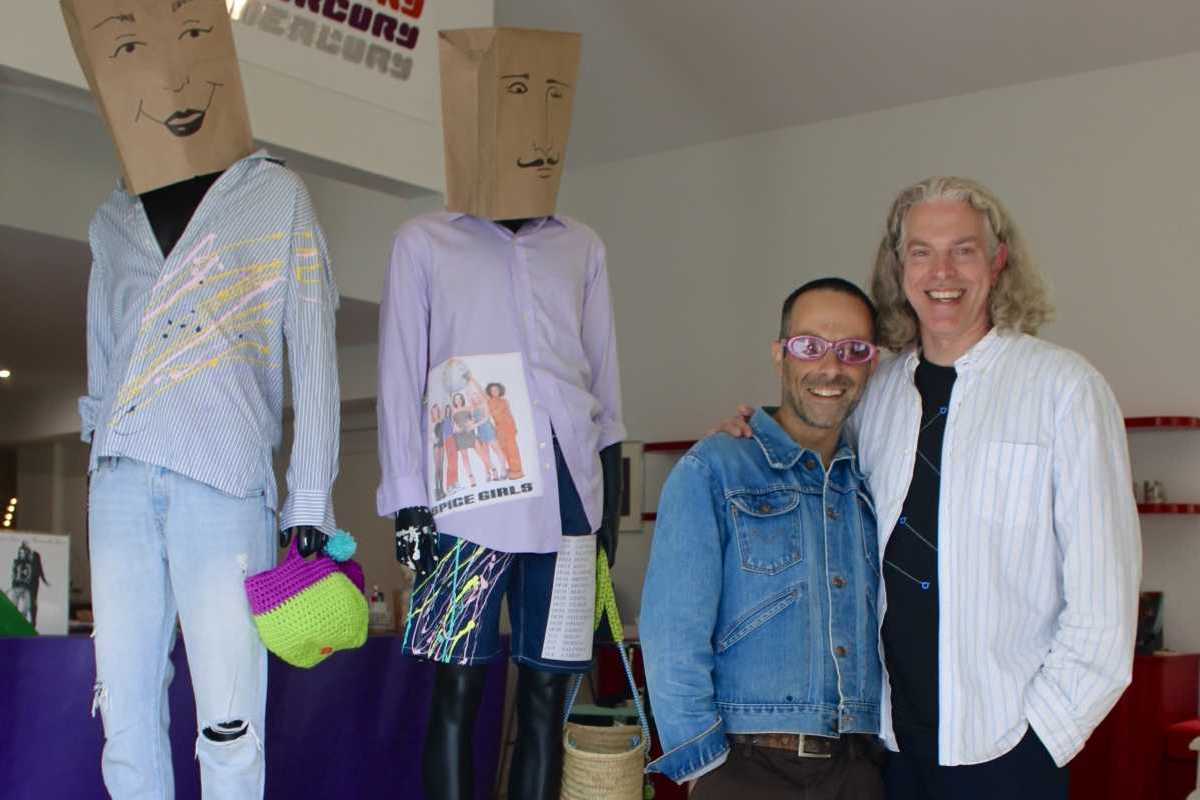
 Classic styles, bold colors, and creative concerts make up the “Imaginary Concerts” line at Peggy Mercury.Provided
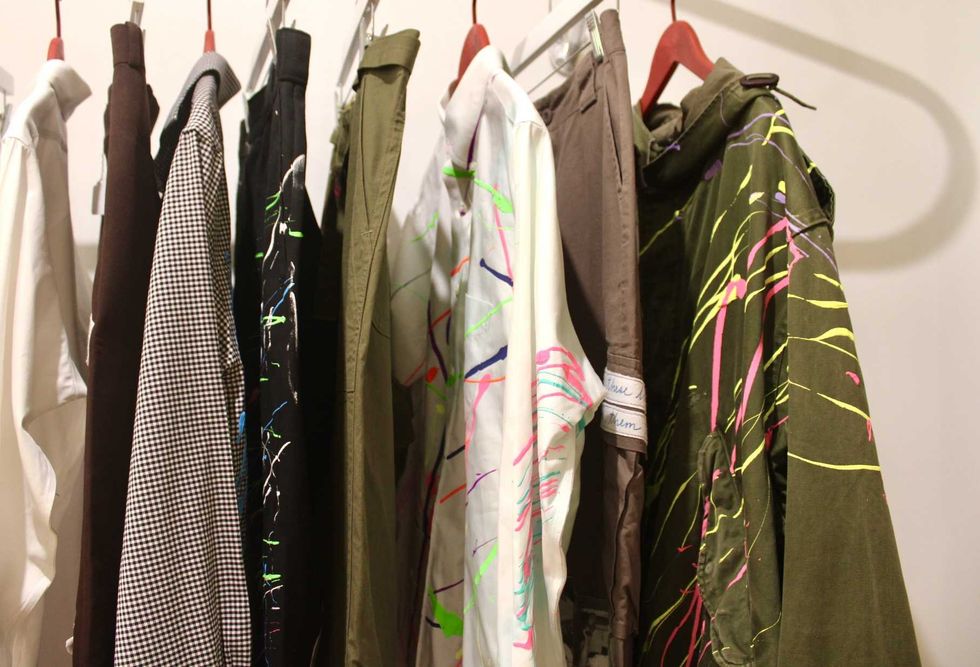 Shirts from Peggy Mercury’s first fashion line, “Imaginary Concerts,” hang on display.Provided