In winter, almost everything shuts down. Tanglewood, Jacob’s Pillow, Music Mountain, musicals at TriArts — all closed except the renowned Norman Rockwell Museum.
What to do with those visitors who arrive in mid-winter? Take them to the Rockwell, where they can see works of art that have become American icons, as well as special exhibits that are absolute gems.
An example is "More than Words: Artists’ Illustrated Letters," which runs through Jan. 14. This traveling exhibit put together by the Smithsonian will then move on. It is the only time these letters will tour.
The show’s sojourn at the Rockwell is enhanced by the addition of letters written and illustrated by Rockwell himself (from the museum’s own collection). His letters include artful pleas to his children’s teachers to excuse them to go hunting and such, and include rebuses such as employing an image of a bee for the word, be. He must have had fun creating them, and it is just plain fun for the viewer to puzzle them out.
Few people write letters by hand. Fewer still draw pictures on them. That’s the point of this lovely exhibit. We can see a letter from Frida Kahlo, smothered in real lipstick kisses, in which she mentions her continuing love for "Diego." (Note: to conserve
certain letters, a reproduction is on display fixed over a box that holds the authentic letter, access to which is obtained by sliding back a panel. Light damage is irreversible; it tends to darken paper and make it brittle.)
Some of the envelopes are illustrated, too.
The show is divided into themes: Bon Voyage; I Do; Plays on Words; Visual
Events. Clearly everyone whose letters were chosen for display believed that "words alone were not enough." It was a thrill to see a letter from Frederic E. Church (of "Olana" and Hudson River School renown) to his fellow painter, Martin Johnson Heade in 1870; the two shared a studio.
Curator Liza Kirwin, emphasized that each letter was probably meant to be seen by only one person.
As a collector of folk art, I was delighted to see a letter from Howard Finster. He wrote right up to the edges of the sheet of paper, and lavished drawings of heads among his words. A letter from John Frazee to his wife, written and illustrated meticulously in 1834, with an entire train of cars and an engine, makes us remember when trains made travel a popular option. Frazee notes they "were off like a shot at 15 M.P.H." and draws an arrow to where he sat on the train — "this is my car." He comments on and illustrates "smoke, soot and noise."
The curator noted that the "I Do" section was difficult to assemble because some people who had written love letters had moved on to other wives and partners when time came to ask permission to reproduce them. All the writers included in this section are deceased — easier that way to get publishing and display permission.
In the introduction to the engaging (and affordable) catalog, Kirwin says, "Illustrated letters are inspired communications. They have the power to transport the reader to another time and place — to recreate the sights, sounds, attitudes and imagination of their authors."
I came away with a yearning both to embellish the letters I send, and to receive such tiny works of art and care and love.
Allen Tupper True sent to his daughter (1927) only a few words of affection, but covered the rest of the page with a watercolor that includes skyscrapers, a plane, a bridge, clouds, people and cars — a wonder.
When Eero Saarinen, the famous architect, wrote to his second wife, Aline, in 1953, he started his note with a big red heart and then included sketches of his current project, noting, " Darling, actually I have gotten quite a lot done..." my heart melts.
Samuel F.B. Morse, artist and designer and inventor, writes engagingly to a cousin in 1827, sketching himself in various postures. Jump to Yves Saint Laurent writing to Alexander Liberman in 1970 from Marrakesh. It is a short note in French set atop his sketch of a veiled woman with a colored background carefully designed by Saint Laurent.
The artist Dorothea Tanning writes (1948) to the innovative artist Joseph Cornell a letter in which an engaging woman is drawn pulling aside a curtain to reveal the text.
One of my favorites was a letter from Antoine de Saint-Exupéry, ca. 1943, to a friend, mentioning the completion of his masterpiece for both adults and children, "The Little Prince." He shows the enigmatic, wise "child" atop a hill, and the flowers that ornament the hillside look ing much like musical notes to me. A mystery yet unsolved? His handwriting itself was "the most difficult letter to translate, like chicken scratches," noted Kirwin.
Visiting this extraordinary exhibit is like taking a mini-tour of a major museum of fine arts. There are illustrated letters from Thomas Eakins, Alexander Calder, Thomas Hart Benton, Walt Kuhn, Paul Manship, John Sloan and Andrew Wyeth. This last was ºwritten to his then dealer when Wyeth was barely in his 20s and just setting sail (the sketch includes a tiny boat and seascape) in his career.
The exhibition transforms these famed artists into people with relationships and needs and moods.
The Norman Rockwell Museum is open every day of the year except Christmas, New Year’s and Thanksgiving. This is an exhibition you will remember forever.
For further information: www.nrm.org or call 413-298-4100.
style="font-size: 10pt; font-family: arial">
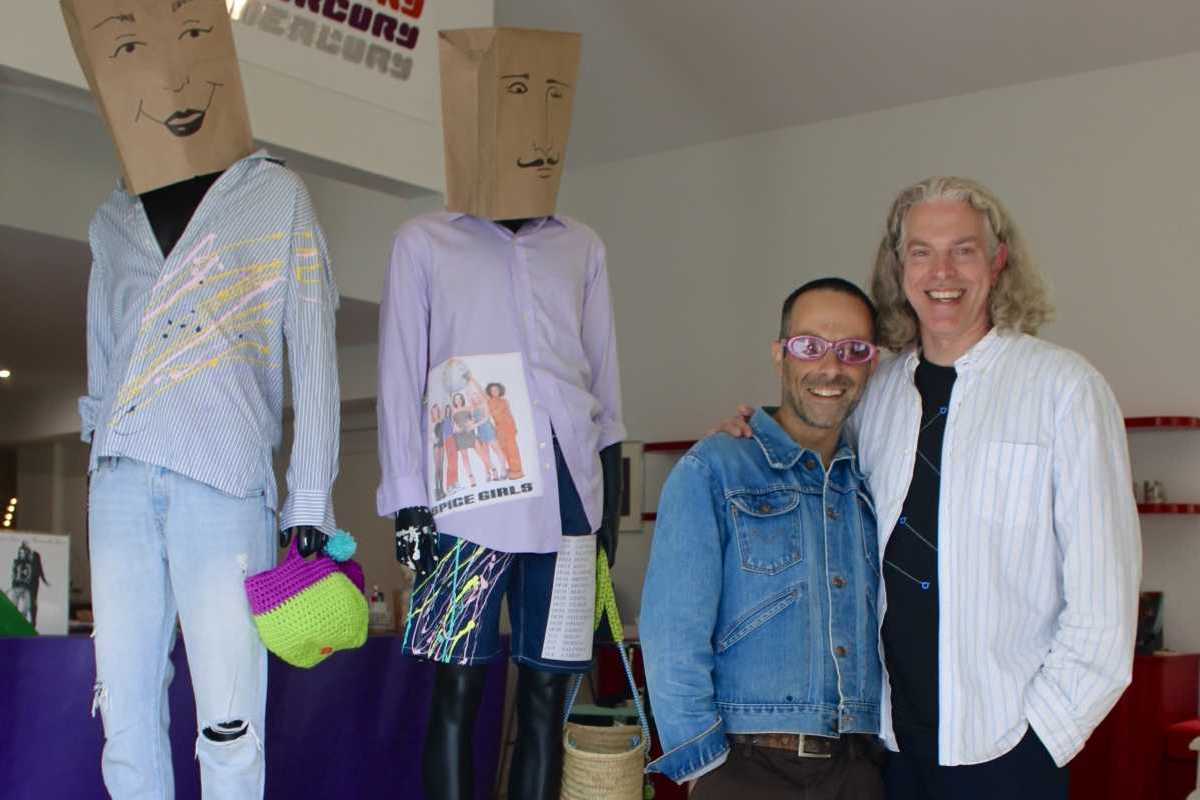
 Classic styles, bold colors, and creative concerts make up the “Imaginary Concerts” line at Peggy Mercury.Provided
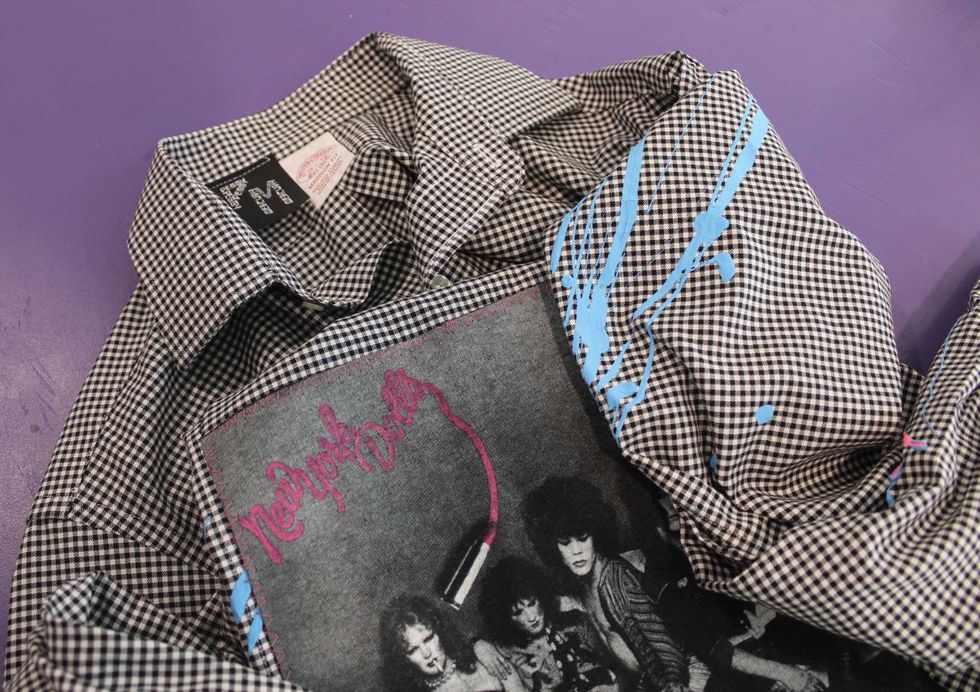
 Shirts from Peggy Mercury’s first fashion line, “Imaginary Concerts,” hang on display.Provided