Alex L. Taylor III

LAKEVILLE — Alex L. Taylor III, a longtime reporter with Time and Fortune magazine who covered the auto industry with understated and unsurpassed flair for nearly three decades, died on Feb. 8, 2024, in Lakeville, where he lived. The cause was complications from Parkinson’s disease.
Born on Jan. 1, 1945, Alex grew up in Old Greenwich, the oldest of five siblings.
His father, Alex L. Taylor II, owned the Alex Taylor & Co. sporting goods store in Midtown Manhattan, and his mother, Cherry (Grafton), was a teacher.
A graduate of Kent School, he earned a bachelor’s degree from Middlebury College and a master’s in journalism from the University of Missouri.
He began his journalism career at a radio station in Indiana. He went on to a series of reporting stints at WZZM-TV in Grand Rapids, Michigan, and The Detroit Free Press. As a newsman for Time and Fortune magazine, Alex was regarded as a smart, dogged reporter with meticulous storytelling skills and one of the most knowledgeable journalists covering the auto industry. He won numerous awards for his writing, including three first prizes from the Detroit Press Club Foundation and “Journalist of the Year” from the Washington Automotive Press Association. A former adjunct professor at Columbia University’s Graduate School of Journalism, in 2000, he was selected one of 100 Notable Business Journalists of the 20th Century.
He was a member of the International Motor Press Association and was on the jury for the North America Car of the Year Awards. Alex was the author of “Sixty to Zero: An Inside Look at the Collapse of General Motors – and the Detroit Auto Industry.” Drawing on more than thirty years of experience and insight as an automotive industry reporter, the book was released to positive reviews in 2010.
Beyond his work, Alex is remembered for his love of his family and friends, tennis, nonfiction books, and Brooks Brothers. He was admired for his wit and all-around generosity, as well as his good cheer and courage living with Parkinson’s.
He is survived by his wife of 41 years, Mary; son, Alex, daughter, Madeleine; sisters Holly and Faith along with nieces and nephews. He was predeceased by his parents and his brothers, John and David.
Please consider donating in Alex’s honor to The Michael J Fox Foundation for Parkinson’s research.
A memorial service will be held on June 15 at the Congregational Church of Salisbury.
The Kenny Funeral Home has care of arrangements.
Debra A. Aleksinas
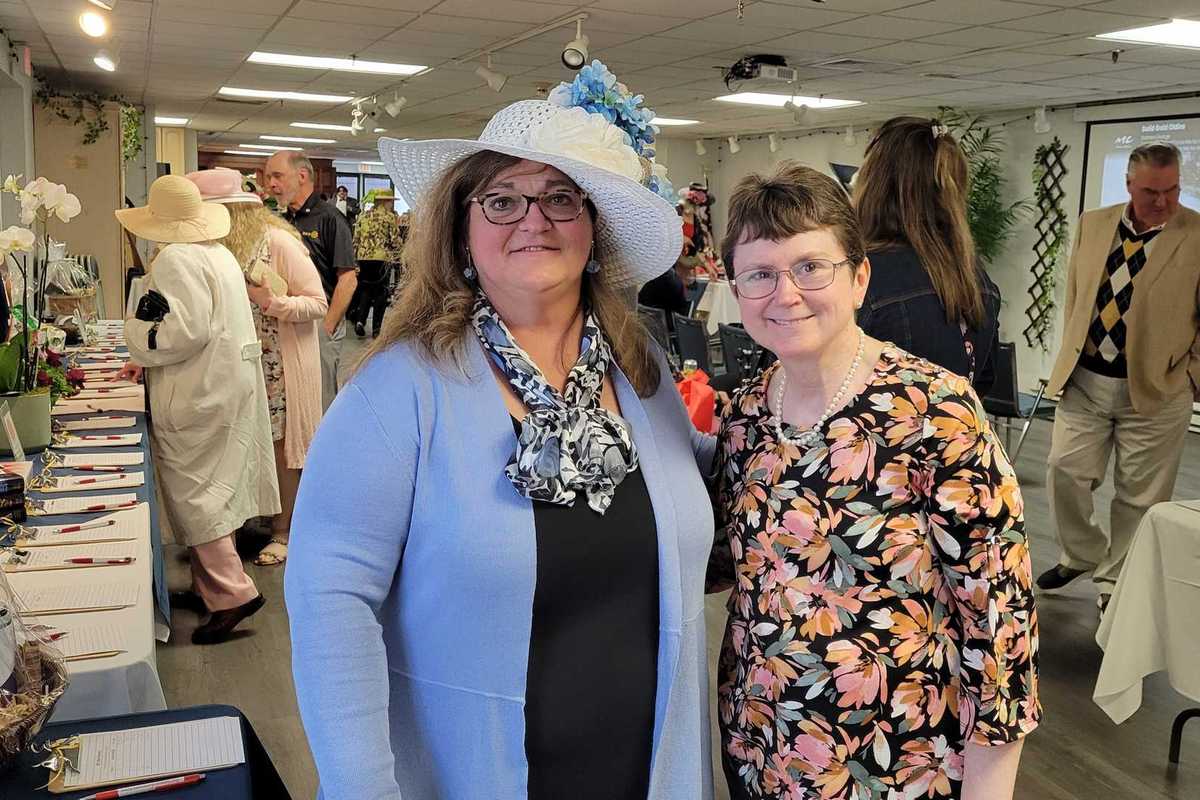
Rae Etting, left, recipient of the Best Derby Hat award, and Kelly Galgano, scoped out the silent auction items during the Kentucky Derby Social, May 2.
SALISBURY — About 80 people attended the Salisbury Rotary Club’s 2026 Kentucky Derby Social at the Noble Horizons Community Room Saturday, May 2, and many dressed to the nines.
Rotarians Fran and Randy Chapell presented awards for the best Derby hat and for the best Derby outfits, and attendees cheered for their favorite horse during the televised race from Churchill Downs.
All proceeds from the event, which included auctioned items donated by local businesses, will benefit local nonprofit organizations.
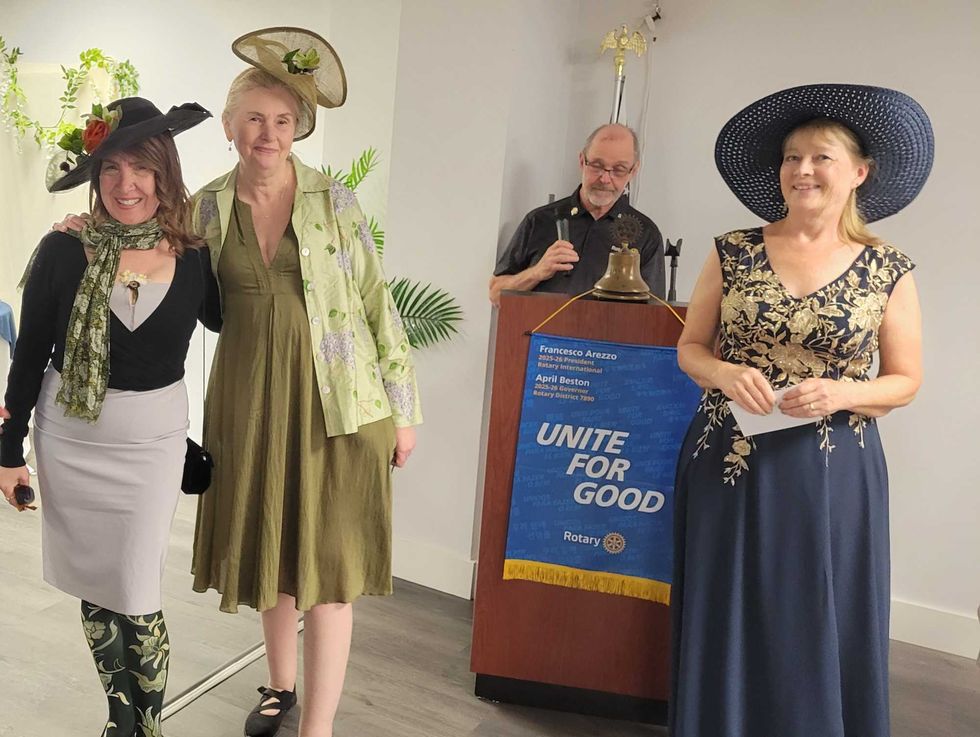 Best Derby Outfit awards go Carol Overby and Jan Hazard.Debra A. Aleksinas
Patrick L. Sullivan
NORFOLK — A “fisher cat” is neither a cat nor the source of nighttime screeching sometimes heard in rural Connecticut.
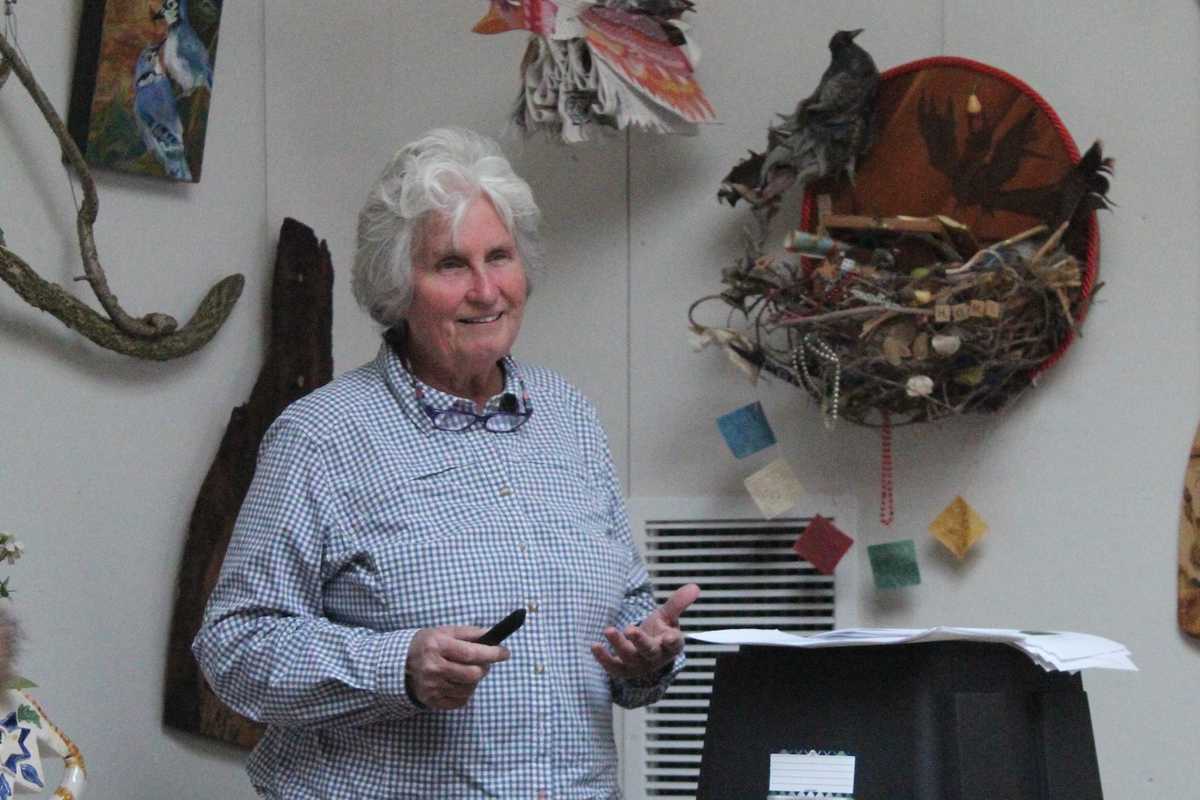
Those were two takeaways from wildlife expert Ginny Apple’s talk at the Norfolk Hub Saturday, May 2, titled, “Fishers: Connecticut’s Stealth Hunter.”
Apple, a Master Wildlife Conservationist with the Connecticut Department of Energy and Environmental Protection, frequently delivers presentations in Northwest Connecticut towns.
The fisher’s range runs from the Canadian Rockies to the Atlantic, in parts of Northern California, and in New England, Apple said. She estimates 100,000 exist today, a little under 100 in the state, and only half a dozen or so in northwest Connecticut.
Apple corrected common misconceptions, noting that a fisher is a member of the weasel family —not a cat.
The hair-raising screams people hear at night — often attributed to the non-existent “fisher cat” — are almost always from red foxes, Apple said.
The fisher is the rare Connecticut predator that will take on a porcupine, however.
Fishers are skilled and silent hunters and only let their guard down at night when they are relaxing in a tree.
“Then they make a little chortling sound, which you won’t hear unless you’re under the tree,” Apple said.
Pekania pennanti, the official name of the fisher cat, is the second largest weasel species in the state, next to the river otter.
Fishers can rotate their hind feet, which allows exceptional mobility in trees. Apple said they are just as nimble in trees as squirrels.
They are carnivorous omnivores, meaning they prefer meat and will go to considerable effort to find it.
Males can weigh up to 18 pounds and get to be between 35-47 inches long – including their tail. Females are roughly half the size.
Fishers live up to 12 years in ideal circumstances. This does not include Connecticut, Apple said.
“We’ve got a lot of roadkill and rodenticide poisoning,” she said.
On the latter, Apple said the use of rodenticide for rat and mouse control is troublesome because the poisoned rodents get eaten by predators – including fishers – who in turn get sick.
She urged attendees to use traditional snap mousetraps or “Hav-A-Hart” no-kill traps, which come in mouse dimensions.
DEEP is currently conducting a study of fishers using electronic collars to determine why they prefer the northeastern part of the state. Apple asked the audience to call DEEP at 860-424-3211 or email deepFisherSightings@ct.gov with any sightings or roadkill reports.
Jennifer Almquist

Hilary Hopkins Criollo, co-owner of Hopkins Vineyard (left) and her father Billy Hopkins, its founder, with their 2024 “Heritage” Riesling wine that was served at the White House April 28.
WARREN — More than 400 years after their ancestors arrived in America aboard the Mayflower, the Hopkins family is still making history – this time in a glass of wine.
Wine produced by Hopkins Vineyard in Warren, Conn., was served at a White House state dinner for King Charles III and Queen Camilla on April 28, 2026.
Hilary Hopkins Criollo, president and co-owner of the vineyard with her husband Jorge Criollo, said the recognition came unexpectedly.
She received a call just two weeks earlier from a White House chef requesting several wines for a tasting. Soon after, an order followed for 48 bottles of the vineyard’s 2024 “Heritage” Riesling.
Hilary said the chef requested expedited shipping for the $33 bottles, still not knowing what they were to be used for.
“We saw on social media that our wine was served at the state dinner,” Hilary said of the visit from King Charles III and Queen Camilla. “I was so surprised that I asked people to pinch me.”
The moment marks a milestone generations in the making.
Stephen and Elizabeth Hopkins left England on the Mayflower seeking religious freedom. During the voyage, Elizabeth gave birth to their son Oceanus Hopkins. More than a century later, after serving in the American Revolution, Elijah Hopkins purchased farmland in Warren, Conn. – land that would eventually become the vineyard.
In 1956, Bill Hopkins took over his family dairy farm. In 1979, anticipating the decline of small dairy operations, he and his wife, Judy, sold their herd, applied for Connecticut’s first winery permits, and began producing wine. By 1988, the farm was recognized as a Bicentennial Farm, having remained in the same family since the signing of the U.S. Constitution. In 2017, Hilary and Jorge purchased the 30-acre vineyard from her parents.
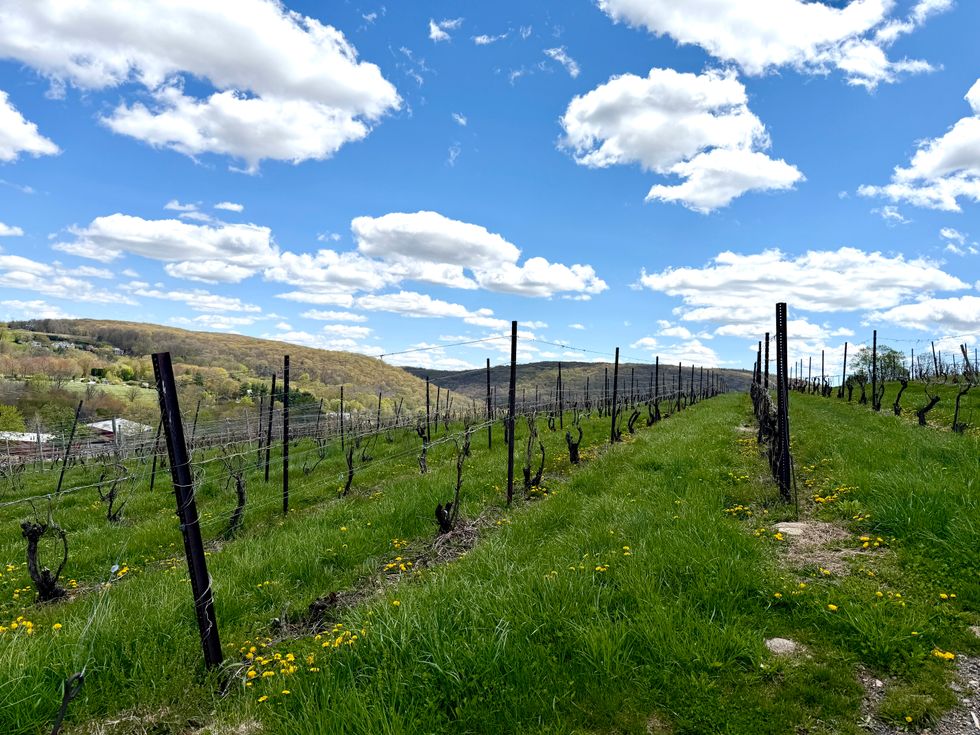 Grape vines at Hopkins Vineyard overlooking Lake Waramaug in Warren, ConnecticutJennifer Almquist
The “Heritage” Riesling label reflects that legacy, featuring an image of Hilary’s grandfather forking hay into a horse-drawn wagon overlooking the lake.
Bill Hopkins recalled the moment with pride.
“My wife and I are the founders of Hopkins Vineyard,” he said. “I had a midlife crisis and decided to start a vineyard. I am proud of everyone involved. It’s quite an honor to have the king drink our wine.”
Jorge Criollo said the news was difficult to believe.
“When I woke up at 4 a.m., we were on the news,” he said. “I spent the whole day not believing it. It’s like a miracle. They could pick wine from anywhere in the world.”
In a statement, the White House said the wine list, which included Hopkins Vineyard’s 2024 Riesling “Heritage,” was curated to “complement the menu while honoring the shared heritage and enduring friendship between the United States and the United Kingdom, and to celebrate the strength of American winemaking today.”
Winemaker and vineyard manager Jim Baker said producing wine in the Northeast requires patience.
He said Riesling is hardy and withstands the winter. “It takes three to four years for a plant to produce fruit and get a good crop,” he said. “It’s a learning curve with any new variety. Because of the rain and cold in the east, the trick is growing it.”
Baker, who has worked at the vineyard for 34 years, said the landscape keeps him rooted as he walks along the row of vines where the King’s Riesling grapes grow.
Bill Hopkins’ granddaughter, Paloma Criollo,a filmmaker, reflected on that connection in a video featured on the vineyard’s website.
“I’ve realized that without this land, without our farm, we lose our identity and connection to this land. This is our home, and this is my family’s legacy.”

Want more of our stories on Google? Click here to make us a Preferred Source.
Norma Bosworth
125 years ago — May 1901
The new school house at Chapinville was formally presented to the district by Mr. Robert Scoville in behalf of his mother, Mrs. Frances W. Scoville on Thursday. The new building is a neat wooden structure containing two rooms opening into each other, a teachers’ room and a splendid basement that can be used as a winter play room. All the modern ideas in regard to ventilation, heat and light are incorporated in the building.
Mr. and Mrs. Edward Everett have returned from their wedding tour and are staying in Sharon until their home is ready for them in Millerton.
A.H. Heaton is suffering with a large carbuncle on the side of his neck and is under Dr. Bissell’s care.
Wanted, to employ a person who is accurate at figures for a short time monthly at their home. Address Marcus B. Simpson, Salisbury, Conn.
100 years ago — May 1926
Swat the fly now and save killing a million or two later on.
Some take chances with their lives in drinking bad hooch, some try to beat the train to the crossing, and some do jaywalking. They say there is a fool born every minute but some one must have advanced the time, or stepped on the gas.
Millerton which went on daylight saving time has already tired of the change and most of the business places have returned to standard time.
A woods fire at Twin Lakes last Sunday afternoon threatened to destroy the Barnum, Brandegee and Cady cottages. Several acres were burned over, and one cottage did catch fire but the blaze was quickly extinguished. A large number of men in that section assembled with brooms, shovels, pails, and anything handy for fire fighting, and did some effective work in checking the blaze.
50 years ago — May 1976
The indulgence of using “throw away containers” has been voluntarily discarded by a considerable number of Sharon residents. They have made it a habit to deliver bottles and newspapers to the Sharon Boy Scouts. The Boy Scouts have turned a profit on the arrangement, though not without a great deal of hard work. Myron Allen, Boy Scout Committee Chairman who initiated the recycling project, seemed somewhat relieved this week that this latest enterprise of the Scouts would soon be taken over by the town. The new facility, on Route 41 one-fourth of a mile south of the junction of routes 41 and 112 near Lakeville, is not a dump as such, but rather an area to deposit waste which will then be hauled away by truck. The cost of transporting unusable garbage can be defrayed by the sale of recyclable materials.
The Salisbury Store, a department store under the proprietorship of Bud and Chrys Trotta, will open Monday in the former Shagroy Market space on Main Street in Salisbury village. The Trottas, assisted by their daughter Beth and their daughter-in-law Carol, will offer house and family goods ranging from infants’ clothing to men’s and women’s jeans and sneakers, and from Corning and Pyrex ware to Luminall paints. Other items on the shelves will include Buster Brown clothes for children, school supplies and stationery, toys, jewelry, hardware and tools and small electronic appliances. The store will be open from 9 a.m. to 5:30 p.m. every day except Sunday.
The Canaan Bicentennial Commission has endorsed the idea of a beard-growing contest as part of this summer’s Bicentennial observance. The idea was presented to the commission during last Thursday’s meeting by Richard Brooks of Stadium Systems. The contest will be open to all comers and growers. The town welcomes contestants from neighboring towns who wish to join in the contest. Contestants will march in the gala parade on July 24. Judging will take place after the parade at the block party in the Town Hall parking lot.
CANAAN — Sgt. Ronald G. Greene, son of Francis G. Greene of Canaan, has received the Bronze Star Medal at Yokota Air Base, Japan. Sgt. Greene was cited for meritorious service as a fuel supervisor at U-Tapao Airfield, Thailand. Now assigned at Yokota, he serves with a unit of the Pacific Air Force. He is a 1962 graduate of Housatonic Valley Regional High School in Falls Village.
25 years ago — May 2001
With land management comes compromise, especially when it comes to foresting. The need to harvest timber to meet operating expenses in a working forest can mean putting aside the preferred environmental approach. The ideal is to have another source of income. At Great Mountain Forest in Norfolk, that ideal is about to become reality. Owners are negotiating the terms of a $4.1 million grant that will allow the state Department of Environmental Protection to buy an easement on the state’s largest privately owned forest. What that means, according to Starling Childs, whose grandfather bought the land nearly a century ago, is a long-term working endowment that will ensure that Great Mountain stays just as it is — a working forest dedicated to research and education.
Two Canaan men survived a crash landing at Great Barrington Airport April 28. Ralph Stanton Jr., 51, and Noel Anderson, 59, consider themselves lucky. Despite the fact that the single-engine plane he bought a few days earlier may not be salvageable, Mr. Stanton is grateful that his friend will be OK. Mr. Anderson sustained the only injury between the two, a cracked vertebrae that could keep him out of work for several months. “I think I hurt my pride more,” said Mr. Anderson, who has had his pilot’s license for 30 years. “It’s just one of those things. We don’t know what happened,” Mr. Stanton said.
Colin Gold, a senior at Housatonic Valley Regional High School, has been named an exemplary student and community member by the Governor’s Coalition for Youth with Disabilities. He will receive a plaque and a check for $1,000 from Gov. John Rowland later this month.
These items were taken from The Lakeville Journal archives at Salisbury’s Scoville Memorial Library, keeping the original wording intact as possible.
Lakeville Journal
Enjoyed profile of Amenia’s Edgewood
I thoroughly enjoyed your article on Amenia’s late Edgewood Restaurant; especially since it brought back memories of another long-gone venue on the road to Sharon.
It was the Brookside and during the Sharon Playhouse’s annual season it served as sort of a green room for the actors, apprentices and audience members after the Playhouse’ curtain fell.
During those years of the nineteen fifties the Playhouse was staffed by actors who were in repertory. Every week in July and August they appeared all sorts of comedies showing great versatility in the roles they portrayed.
In addition, they gladly interacted with the rest of the Company, including the nightly fun at the Brookside with some getting up on the small Brookside to do a song or two.
In 1960 I worked full-time in the Playhouse’s box office and was warmly welcomed as a member of the “Family.”
Oh, and I often dined at the Edgewood!
BillKnowlton
Liverpool, NY
Education is not a line item to trim
As a taxpayer, a community member, and a product of public schools, I write with concern about the proposed zero-budget by the Board of Finance (BOF) for Sharon Center School. Reducing investment in our schools carries long-term economic costs that far outweigh any short-term savings.
Research consistently shows that every dollar invested in early and primary education yields significant returns — in workforce productivity, reduced reliance on public assistance, and lower rates of incarceration. Further, it has been found that students in better-funded schools earn higher wages, are more likely to graduate high school and attend college, and contribute more in taxes over their lifetimes. Cuts to education don’t eliminate costs — they defer them, often with interest.
At the local level, the stakes are equally clear. Businesses considering where to locate or expand look at the quality of public schools as a key indicator of community health and the future workforce. We risk Sharon being less competitive and less attractive to the kind of investment that sustains property values and local employment.
I understand the need to make difficult fiscal decisions. But treating education as a line item to trim, rather than an infrastructure investment to protect, reflects a short-term view.
It was evident at the BOF hearing on April 28, 2026 that many members are more interested in closing Sharon Center School than in building it to be the best school it can. Public schools are for all children – of all educational abilities. This is how a child learns compassion and how to work with others.
I am a senior. I live on a limited income. Yet, I know the importance of having a school in Sharon. This is not the parents vs. others in Sharon. I applaud Tom Bartram and Jessica Fowler, BOFmembers, who listened to all who presented testimony at the public hearing on April 24th, and believed that Sharon Center School should receive the $41,250from tuition payments – not the Town’s General Fund. The answer from some BOF members was – it’s always been done this way. I say, this is a new day – a new and very competent and committed BOE. All of whom want Sharon Center School to be the best it can be for ALL children. No one should want to always do things as they were done in the past. How can we ever move forward? Can the school live with a no budget increase? Possibly – but not necessarily with some of the cuts.Not something that I want to take a chance. Especially given that the tuition should be in the BOE”s budget.
I hope residents will attend the Sharon Town Meeting on May 8th at 6 pm at Town Hall and vote NO on the budget. Let’s tell the Board of Finance to revise the budget to credit the $41,250 in tuition payments to Sharon Center School and not into the Town’s General Fund. It’s a small gesture, but it speaks volumes about our support for our school.
Marlene Woodman
Sharon
Context for Sharon’s flat education budget
The Sharon Board of Finance would like to provide additional context regarding its recent request that the Sharon Board of Education consider a flat, or zero-increase, budget for the coming fiscal year. We appreciate the strong interest this topic has generated and are encouraged by the thoughtful engagement from members of our community.
A key factor in this discussion is the state’s Minimum Budget Requirement (MBR). In general terms, the MBR requires towns to fund education at least at the prior year’s level, regardless of changes in enrollment. Over time, this has created a structural dynamic for Sharon: as our school-aged population declines, the budget does not automatically adjust downward. As a result, even modest increases can have lasting effects on future required funding levels. School leadership, including Board of Education Chairman (and former Sharon Center School Principal) Dr. O’Reilly and Principal Tomkalski, has indicated publicly that a flat budget would continue to support students’ needs for the upcoming school year.
It is also helpful to distinguish between a budget and actual expenditures. In recent years, the Board of Education has spent less than the full amount appropriated. Based on year-to-date figures as of March 31, 2026, this pattern is continuing. While budgets must appropriately plan for uncertainty, these trends suggest that recent appropriations have provided a margin that has not been fully utilized. Notably, the cumulative surplus from the past two years exceeds the adjustment requested by the Board of Finance for the 2026–27 fiscal year.
At approximately $48,000 per pupil, Sharon’s per-student cost is currently the highest in Connecticut. We recognize that several factors contribute to this figure, including the scale of our school and the range of services we provide. In addition, a prior comparative review of certain non-salary expenditures—such as purchased services and supplies—indicated higher spending levels than a peer school, even after accounting for differences in facility size. We have requested updated information to better understand these differences and to help inform future discussions.
Our request for a flat budget reflects an ongoing effort to balance educational needs with long-term financial sustainability thoughtfully. The Board of Finance, as elected volunteers, is responsible for reviewing both Town and Education budgets, considering near-term priorities alongside future obligations, and being mindful of the diverse financial circumstances of Sharon residents. These responsibilities require us to look carefully at both current conditions and longer-term trends.
We also want to recognize the positive progress within the School. Recent assessments indicate improving academic performance among students, and we appreciate the continued efforts of the Principal, teachers, staff, and the Board of Education in supporting student success and serving the broader community.
At the same time, Sharon—like many communities in our region—faces longer-term challenges related to declining enrollment and the ongoing work of sustaining and strengthening academic outcomes. The level of community engagement in this year’s budget conversation is encouraging, and we hope it can serve as a foundation for continued constructive dialogue.
The Board of Finance remains committed to working collaboratively with the Board of Education in the months ahead to address both current and future needs, with the shared goal of supporting students while maintaining long-term fiscal responsibility for the town.
Sharon Board of Finance
Tom Bartram
Jessica Fowler
John Hecht
Carol Flaton
Michele Pastre
Mary Robertson
Maryanne Toppan
Sharon
Opposition to proposed Sharon Budget
I write to express my opposition to the Sharon Board of Finance’s proposed 2026–2027 budget calling for a zero increase for the Sharon Center School.
I have a long and meaningful connection to the School. I attended Sharon Center School for four years in the 1970s and early 1980s, as did my brother. My parents ultimately transferred me—against my wishes—to Indian Mountain School. In hindsight, that decision did not serve me particularly well and only reinforced what I already believed at the time: Sharon Center School was providing a strong and grounded education that compared favorably with more expensive alternatives.
Sharon has approximately 1,250 tax-paying households. The School’s requested increase—approximately $69,000—would barely move the needle when spread across the town.
It is often said that too much money is being spent on the School. The Town’s financial records show otherwise. For nearly a decade, the School’s budget has stayed in a narrow range of roughly $4.1 to $4.5 million. For the fiscal year ending June 30, 2016, the Sharon Center School budget was $4,165,513. For the fiscal year ending June 30, 2025, it was $4,119,978. Adjusted for inflation, that same approximately $4.2 million in 2016 dollars would be roughly $5.8 million today. In real terms, the School is operating with substantially less funding than it did ten years ago, making the claim that too much is being spent difficult to sustain.Over the same period, the Town’s tax base has grown significantly, with total taxable property now exceeding $1 billion. In other words, while the School’s budget has remained flat, the Town’s ability to fund it has increased.The impact is visible. Sharon does not have a dedicated foreign language teacher and offers only limited after-school programming—hardly signs of excess.
The comparison to neighboring towns points in the same direction. Salisbury, which shares the same Region One district, supports its elementary school at roughly $6.9 million annually—substantially higher than Sharon’s approximately $4.1 million. While Salisbury does benefit from a larger tax base, it nevertheless commits a greater share of its resources to its elementary school.
Much has been made of the rising “cost per pupil,” but that figure is a misleading shorthand. When enrollment declines, fixed costs—teachers, facilities, transportation—do not disappear, and the School must still serve every student. For many families, private school tuition is simply not affordable, and relocating to another town is not a realistic option. Even for families with the means, private schools routinely turn away qualified applicants, including those able to pay. Our public school also has a responsibility to welcome and support students with special needs—something that requires resources and continuity of funding.
It is difficult to avoid the conclusion that the Board is taking a philosophical stand rather than responding to a fiscal constraint. If that is the case, it is the wrong place to do it. Our elementary school should not be the vehicle for making a broader point about spending.
At the same time, the proposed budget continues to allocate significant public funds to certain favored institutions, including the Hotchkiss Library (approximately $130,000) and the Sharon Historical Society (approximately $15,000). These are all worthwhile organizations, but they are also able to raise funds privately. My wife and I have been long-standing private donors to these organizations, and we value their work. The School, however, relies almost entirely on public funding to meet its basic operating needs.
It is also worth noting that the School receives approximately $40,000 annually in tuition from non-resident students. If that amount were directed back to the School, it would cover a substantial portion of the requested increase. By contrast, private institutions such as Indian Mountain School do not contribute their tuition revenue to the Town.
This is not simply about dollars and cents. Sharon is, by any reasonable measure, a very affluent community, with many private amenities—such as a very expensive country club—supported entirely by those who choose to use them, not by the Town. In that context, it is difficult to argue that a modest investment in the one institution that must serve all children is out of reach.
I encourage the residents of Sharon to vote down the proposed 2026–2027 budget at the Sharon Town Hall at 6:00 pm on Friday, May 8, 2026 (attendance is required to vote).
Michael Lynch
Sharon
Confronting evil – counterpoint
The Thursday April 23rd edition of The Lakeville Journal included a letter to the editor titled Confronting Evil and justifying our attack on Iran.You can’t argue with the terror it has spread throughout the Middle East and that it has to stop. I take issue with the justification that it was too close to “sprinting towards a bomb.”This is because no part of the knowledge to build an atomic bomb from rocks you mine from the earth that is a secret.It isn’t even necessary to test your bomb design once you have enough U235 – it’s that reliably well understood.So, if we start with a “no bomb” red line in our strategic positioning, we will never succeed unless we kill everyone. Leaders of our government and others would lead us to believe that making an atomic bomb is some kind of mystery and if we just take out a few leaders and destroy some equipment, the job is done.That just isn’t true.
Let’s please ask our leaders to focus instead on what we can control through whatever means we have but excusing our conduct or planning for a “no bomb, no enrichment” outcome is a fool’s errand.
Theodore Rudd O’Neill
Town
Mr. O’Neill was involved in the development of wavefront sensors (a critical technology) for the Star Wars Weapons program and was part of a due diligence team in 1986 that was invited to inspect and bid on the purchase of the U.S. only centrifugal uranium enrichment facility inPiketon, OH.
Secretariat wins …
I enjoyed reading Debra Aleksinas’ account of meeting the amazing Secretariat. Watching him win the Triple Crown was one of the two most impressive sportingevents I have seen.
The second was seeing Bjorn Borg, down two sets and a point or two away from losing to John McEnroe, battle back to win. It took hours, and the focus and determination he showed in addressing one point at a time, and not giving in to defeatism, was one of the greatest displays of will and discipline I have ever seen.
A friend who speaks Arabic fluently recently told me of a tribute to, probably, a long ago superhorse: “The mount whose pace/Made the world seem a smaller place.” I will never forget the stunned silence in the stands as the crowd witnessed Secretariat, half the track ahead, win the Belmont.
Pam Osborne
Salisbury
Want more of our stories on Google? Click here to make us a Preferred Source.
Want more of our stories on Google? Click here to make us a Preferred Source.