Search for missing dog leads to animal cruelty arrest; 27 dogs rescued

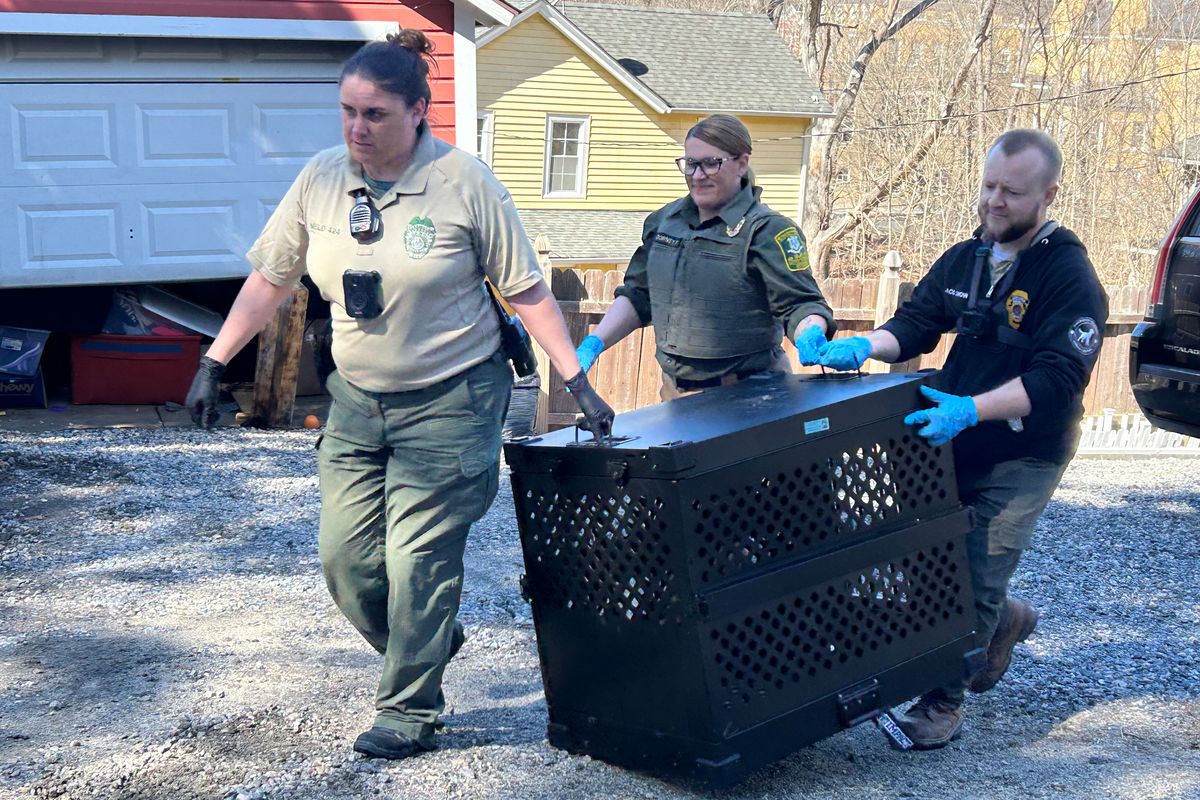
Animal Control Officers from several towns worked together rescuing 27 dogs March 18 in Winsted.
Photo by Jennifer Almquist

Updated March 26, 2025 at 9:30 a.m.
WINSTED — An organized search for a missing dog and an investigation by Winchester Police Department, Harwinton Regional Animal Control and Suffolk County New York District Attorney’s office led to the recovery of more than two dozen dogs in the early hours of March 18.
A press release later that day stated two warrants were served to Sarah Smolak at her Winsted home. She was arrested on two counts of cruelty to animals and transferred to Torrington Superior Court to beheld on $150,000 bond.
In a follow up interview, Winchester Chief of Police Chris Ciuci said, “The number of dogs rescued is 27. The teams are still doing their work here. There were dogs loose, there were dogs in crates.”
“The search warrant is sealed so we can’t share any details associated with those investigations, or that search,” said Ciuci.

Marshmallow, the missing dog that prompted the search, was not among the 27 dogs rescued on March 18.
The next morning, a second individual turned himself in and was held on $75,000 bond. WPD released a statement March 19:
“This morning David Reid turned himself in at police headquarters and was arrested on an outstanding warrant related to the case referenced above. The warrant is part of theon-going cruelty to animals investigation.”
As for the 27 dogs rescued on March 18, Chief Ciuci said, “Every dog is being tagged, documented, will be examined by a vet, is being cared for, housed and treated, mostly by Harwinton Regional Animal Control. They had to enlist the help of the Torrington Animal Control.”
The investigation remains open and individuals with relevant information are asked to contact WPD at (860) 379-2721.

While it’s not likely to be widely understood, there may be a profound lesson in this week’s rejection by the state Public Utilities Regulatory Authority (PURA) of the bid by the South Central Regional Water Authority to acquire Aquarion Water Co.
The lesson is that most people involved with the issue concluded that ordinary government regulation of privately owned utilities is better than government’s direct operation of them.
The water authority is a state government agency providing water to 15 towns in the New Haven area. It was established by state law in 1977 and three years later acquired the New Haven Water Co.
Aquarion is the biggest water utility in Connecticut, serving 60 towns and about 700,000 people, and is a subsidiary of the state’s largest electric utility, Eversource. Like Eversource, Aquarion’s rates and services are regulated by PURA.
The big complaint against the regional water authority’s acquisition of Aquarion was that it might eliminate state government’s control over the water company -- even though the water authority is itself part of state government, with the water authority’s directors appointed by representatives of the municipalities the authority serves.
As long as Aquarion is a privately owned utility, PURA will regulate it. But if a government agency acquires Aquarion, PURA’s regulation would cease and the water authority could set rates for its greatly expanded service area however it wanted.
If a government agency acquired Aquarion, municipal property taxes on the utility -- revenue to the towns the company serves -- would cease as well.
The regional water authority claimed that as a government agency that doesn’t have to make a profit for investors, it could serve customers less expensively than Aquarion can. But critics noted that the authority was going to pay Eversource $2.4 billion for Aquarion and that much of the purchase money would be borrowed and thus incur huge interest costs for the authority, costs the authority almost certainly would recover through higher water charges to customers.
Most people involved with the issue came to think that if the water authority acquired Aquarion, its directors naturally would have more loyalty to the authority itself than to its customers, and that customers would be better protected by PURA. After all, PURA is often in the spotlight and is sensitive to utility customers, but the water authority board is seldom watched by anyone.
Leaders of the Republican minority in the General Assembly applauded rejection of the water authority’s bid for Aquarion.
Governor Lamont seemed to applaud it too, noting that interest expense on the purchase money borrowed by the water authority almost surely would drive up water prices. But last year the governor signed the legislation authorizing the authority to take over Aquarion. How, last year, did the governor think the water authority would repay the borrowed purchase money?
State Attorney General William Tong’s comment on the defeat of the acquisition was strange as well.
“This deal was a costly loser for Connecticut families and PURA was right to reject it,” Tong said. “Eversource desperately wanted to offload Aquarion, and they concocted this maneuver to extract as much cash as possible by guaranteeing the new entity free rein to jack up rates. Eversource is free to find a new buyer but should understand that any new attempt to end public regulatory oversight over water bills for hundreds of thousands of Connecticut families is going to be a non-starter here.”
But Tong is a Democrat and the bill authorizing Eversource’s supposed scheme to “offload” Aquarion on the water authority was abruptly foisted on the General Assembly by his own party’s legislative leaders over Republican opposition during a special session last year. As they often do in special sessions, Democratic leaders forced the bill through without normal review and public hearing, which might have avoided a lot of wasted time.
This high-handedness didn’t seem to bother Tong back then, and this week, like the governor, he conveniently seemed to forget where the enabling act came from.
Chris Powell has written about Connecticut government and politics for many years.
The House and Senate approved a wide-ranging housing bill earlier this month to replace a similar bill that Gov. Ned Lamont vetoed after the regular session.
House Bill 8002 requires towns to create housing growth plans, changes minimum off-street parking requirements, expands fair rent commissions and incentivizes towns to take steps to allow more housing, among other measures.
Its goal is to make it easier to build more housing in Connecticut. Housing costs have gotten more expensive and homelessness has risen over the past several years. Experts say there hasn’t been enough housing built in Connecticut to meet the need, which has made these and other issues worse.
Lamont is expected to sign the new bill, which he helped negotiate with local leadership. Here’s a breakdown of the housing legislation passed in the recent special session.
Why was there a special session?
During the regular session, the legislature passed a sweeping housing bill known as House Bill 5002, but Lamont vetoed the measure after facing opposition from local leaders. He said he wanted to find a way to get them on board with the measure.
After months of working on a new version of the bill, Lamont called the legislature into special session for two days. The House met Wednesday, Nov. 12, and the Senate met the following day. They passed the housing bill in addition to three other bills.
Lamont has touted the new bill because local leaders, who broadly opposed the old bill, have signed on. A bipartisan group of mayors and first selectmen spoke at a press conference in support of the new bill.
Democrats said they wanted to get a bill passed to meet the need for more housing as soon as possible, while Republicans criticized the special session, saying the bill should have been brought in regular session when the public could read it and comment.
What will change in my town’s zoning?
Some of that isn’t clear yet and is up to your town. The bill requires towns to create housing growth plans, with goals on how many units they’ll plan and zone for.
If towns create these plans or take certain steps to add more housing near train and bus stations or in downtowns, they’ll have access to a new state fund and can get more state reimbursement for what they spend on school construction.
The bill also says that towns can’t require developers who build new apartments with fewer than 16 units to add off-street parking, with a couple of exceptions.
Democrats and housing advocates say these measures will help push towns to build more housing because a lot of local zoning makes it hard to build apartments. Republicans fear it will reduce local control.
What else is in the bill?
This is a big bill that deals with a lot of different issues. It expands the number of fair rent commissions, which is a government body that can hear complaints about rent increases and make decisions on whether to change that rental increase number.
It bans “hostile architecture,” or the use of things like armrests in the middle of benches or spikes to make it harder for people experiencing homelessness to lie down.
It also establishes the Connecticut Department of Housing as a statewide housing authority, which means they can work with towns to build more housing and build on state land.
How is this different from the old bill?
This bill has a lot of similarities to the old bill. Many Democrats who worked on the bill said the majority has stayed the same; it’s mostly the zoning portions that have changed.
One difference is the creation of the state fund to encourage towns to participate in the programs to increase housing density near public transit and in downtowns. The former bill had measures that would have prioritized certain existing infrastructure funding for towns that decided to make certain zoning changes.
It also eliminates a process known as “fair share” that assigned each town a specific number of units to plan and zone for. Instead, regional councils of government will figure out how many units each town needs to plan for. Towns can either participate in the plans from the COGs or create their own plans and their own goals.
Members of the Knights of Columbus Berkshire Council No. 1520 distributed coats at the Bitterman Center in North Canaan on Thursday, Nov. 13, for children in Salisbury, North Canaan, Falls Village and Norfolk.
Since 2009, the Coats for Kids Program has provided warm winter coats to children living in cold climates across the United States and Canada. This year 72 coats were distributed for kids in this region. From left: Jerry Baldwin, Steve Allyn, Theresa Grainey and Dave Barger.
KENT — A proposal to revise several conditions on High Watch Recovery Center’s special permit drew sharp objections from a small group of residents at the Planning and Zoning Commission’s Nov. 13 meeting, with opponents arguing the changes would jeopardize public safety.
High Watch, a substance use disorder treatment facility on Carter Road, is seeking to modify or eliminate seven of the 34 conditions placed on its 2019 permit. CEO Andrew Roberts said some provisions are outdated, unnecessary or conflict with federal law.
At the center of residents’ concerns were two proposed changes. One would amend a condition requiring High Watch to notify police and the first selectman whenever a patient leaves the facility without authorization. Roberts said the rule violates federal confidentiality law and puts both the center and P&Z at legal risk. Under the proposed change, law enforcement would be contacted only if an absent patient poses a risk to themselves or others.
The second contentious proposal would remove a condition barring High Watch from accepting patients under legal custody or those mandated by a court to attend treatment.
Roberts said the change reflects common practice for individuals facing addiction-related charges, such as DUIs.
“We only admit people that are appropriate for this level of care,” Roberts said. “There are not people being dropped off in handcuffs, and we wouldn’t accept people who are violent criminals… that would be a risk to our community, our staff, or otherwise.”
During public comment, five residents spoke out against the proposed changes.
Karen Altfest, who lives two doors from High Watch, described seeing people wandering in the woods behind her home. “I don’t know who they are but they sure as hell scare me,” she said.
Lew and Ellen Altfest shared similar fears. “They’re eroding the safety of our town,” Ellen said. Lew added that he believes High Watch has not been sufficiently transparent with residents in the past, saying, “Who wants to fill up Kent with criminals?”
Roberts pushed back on those assertions. “There appears to be some sort of misinformation in the community,” he said. “No one comes to High Watch under the auspices of the Department of Corrections..”
He explained that while guests are supervised, they are not detained. “They come of their own free will, and they are entitled, because they are free people, to leave if they so choose.”
Outgoing First Selectman Marty Lindenmayer cautioned against the language used by several speakers.
“The word ‘criminal’ has been thrown about here in an unbelievably improper manner,” he said. “That’s not what this community has been about.”
Commission member Alice Hicks echoed that concern, but wanted more specifics as to their complaints. “We need a little more clarification as to what the real complaint here is.”
After the discussion, the Commission turned to the other modifications being sought. One would remove the requirement that High Watch contract with a private ambulance service.
Roberts said the center has a “positive” and mutually beneficial relationship with the Kent Volunteer Fire Department’s EMS service, an assessment Ambulance Chief Mary Van Valkenburg affirmed.
Another amendment would allow guests to be admitted after 8 p.m. in circumstances such as flight delays, ensuring they are not turned away late at night.
High Watch further sought approval to add two beds to its medically intensive detox center.
Van Valkenburg said the EMS corps’ relationship with the facility has been “pretty positive,” but requested the application be tabled so the Volunteer Fire Department can review whether the additional beds might increase call volume. Commissioners agreed the potential impacts should be studied.
The hearing will continue at the Commission’s next regular meeting on Dec. 11.