
Boxes and portals: the new era of scavenger hunting

Originally called the “GPS Stash Hunt,” geocaching is a relatively new outdoor activity that began at the start of the 21st century, after Dave Ulmer placed the first container in the woods near Beaverneck, Ore. From there, the new game spread all around the world. There are even numerous hidden geocaching sites here in the Tri-state region.

The objective of geocaching is simple: Using coordinates, and maybe a hint that needs to be decrypted from the geocaching website or phone app, find the geocache with a GPS. 

There are a variety of containers that geocaches come in, including smaller “micro” or “nano” holders disguised as chewing gum, golf balls, bolts or rocks. Larger geocaches can be containers such as plastic food storage boxes. Hiders and seekers often leave trinkets and mementos in these larger caches (the rule is that if you take something out of one of the boxes, you have to leave something in its place).

Some geocaches may require you to solve a puzzle before you can open them. Sometimes you have to find other hidden geocaches that enclose coordinates that will eventually lead to the container.

Worldwide, there are more than 6 million geocachers and 2,676,480 active geocaches, including in Antarctica, according to the geocaching website at www.geocaching.com.

To try it out, go to the website and create an account (or log in using a Facebook account).

Then you enter your ZIP code to get a list of nearby caches. Plug the coordinates  into your GPS. In some cases, the GPS is equipped with a geocaching option that lets you download multiple sites. There is also a geocaching app available for smartphones.

When using the app on a smartphone, look for geocaching icons on the map on your screen. Click one, press “start” and follow the onscreen compass to the location; it will alert you with a sound when you are 30 feet from the hiding place.

Letitia Garcia-Tripp, science teacher and cross-country coach at Housatonic Valley Regional High School, said, “We love to geocache because it allows our family to combine the beauty of nature with the fun of a scavenger hunt. The kids really enjoy finding a cache and signing the log. It is one of the many great ways to keep our family active. It’s easy to do; whenever we hike we just use the app to find a nearby cache. Fun for all ages!”

A game similar to geocaching is letterboxing, which is believed to have caught on in the U.S. in the 1990s when Smithsonian magazine ran an article on letterboxing in Dartmoor National Park, England, where the game originated in 1854.  

Unlike geocaching, no GPS is needed to do a letterbox hunt.Hunters go to the letterboxing website at www.letterboxing.org and search for nearby hiding places. Clues are provided that are sometimes very simple and easy to follow and sometimes elusive.

The clues may include roads, landmarks, compass directions or paces to step off.

Once a letterbox is reached, the hunter uses a rubber stamp and inkpad to sign in to the logbook inside the letterbox (again, usually a plastic food container).

Each letterbox has its own rubber stamp and the hunter stamps his or her own logbook with that stamp.

Letterboxes will not be “micro” or “nano,” so there is no worry that you will have to overturn gum or search through bolts to find it.

There are about 50 letterboxes in the six-town Region One School District area; Sharon leads with 17. There are also letterboxes hidden in New York state. 

When asked why she enjoys letterboxing, Cynthia Hochswender, executive editor at The Lakeville Journal, said, “It reminds me of doing treasure hunts when I was a kid.” 

She also explained that since letterboxes can be found around the world, she can search for them on vacations, as a way to get away from the standard tourist sites.

Another scavenger game that is growing in popularity is called Ingress. It is played on mobile devices and it intertwines virtual gaming with landmarks or other culturally significant places known as portals, which are, again, found worldwide.

In Ingress, gamers are split into two teams, blue (representing the Resistance) and green (representing the Enlightened). The two teams wage a virtual war against each other to gain possession of portals such as the Lakeville Post Office.

Unlike many computer games, this one is not solely virtual: Gamers have to actually go to the portal in order to capture it. 

Darryl Gangloff, associate editor and special sections editor at The Lakeville Journal Co., wrote an article about Ingress in the June 11 Compass arts and entertainment supplement of The Lakeville Journal Co.

He has been playing the game with his wife and with co-workers James Clark and Derek Van Deusen.

Although diverse, these three games are alike in that they all offer full-time residents as well as holiday visitors a chance to find interesting hidden corners of the Tri-state region. 

Latest News

To mow or not to mow?

To mow or not to mow?

A partially mowed meadow in early spring provides habitat for wildlife while helping to keep invasive plants in check.

Dee Salomon

Love it or hate it, there is no denying the several blankets of snow this winter were beautiful, especially as they visually muffled some of the damage they caused in the first place.There appears to be tree damage — some minor and some major — in many places, and now that we can move around, the pre-spring cleanup begins. Here, a heavy snow buildup on our sun porch roof crashed onto the shrubs below, snapping off branches and cleaving a boxwood in half, flattening it.

The other area that has been flattened by the snow is the meadow, now heading into its fourth year of post-lawn alterations. A short recap on its genesis: I simply stopped mowing a half-acre of lawn, planted some flowering plants, spread little bluestem seeds and, far less simply, obsessively pluck out invasive plants such as sheep sorrel and stilt grass. And while it’s not exactly enchanting, it is flourishing, so much so that I cannot bring myself to mow.

Keep ReadingShow less

Where the mat meets the market

Where the mat meets the market

Kathy Reisfeld

Elena Spellman

In a barn on Maple Avenue in Great Barrington, Kathy Reisfeld merges two unlikely worlds: wealth management and yoga, teaching clients and students alike how stability — financial and emotional — comes from practice.

Her life sits at an intersection many assume can’t exist: high finance and yoga. One world is often reduced to greed, the other to “woo-woo” stretching. Yet in conversation, she makes both feel grounded, less like opposites and more like two languages describing the same human need for stability.

Keep ReadingShow less
Capitol hosts first-ever staging of Civil War love story

Playwright Cinzi Lavin, left, poses with Kathleen Kelly, director of ‘A Goodnight Kiss.’

Jack Sheedy

Litchfield County playwright Cinzi Lavin’s “A Goodnight Kiss,” based on letters exchanged between a Civil War soldier and the woman who became his wife, premiered in 2025 to sold-out audiences in Goshen, where the couple once lived. Now the original cast, directed by Goshen resident Kathleen Kelly, will present the play beneath the gold dome of Connecticut’s Capitol in Hartford as part of the state’s America250 commemoration — marking what organizers believe may be the first such performance at the Capitol.

“I don’t believe any live performances of an actual play (at the Capitol) have happened,” said Elizabeth Conroy, administrative assistant at the Office of Legislative Management, who coordinates Capitol events.

Keep ReadingShow less
google preferred source

Want more of our stories on Google? Click here to make us a Preferred Source.
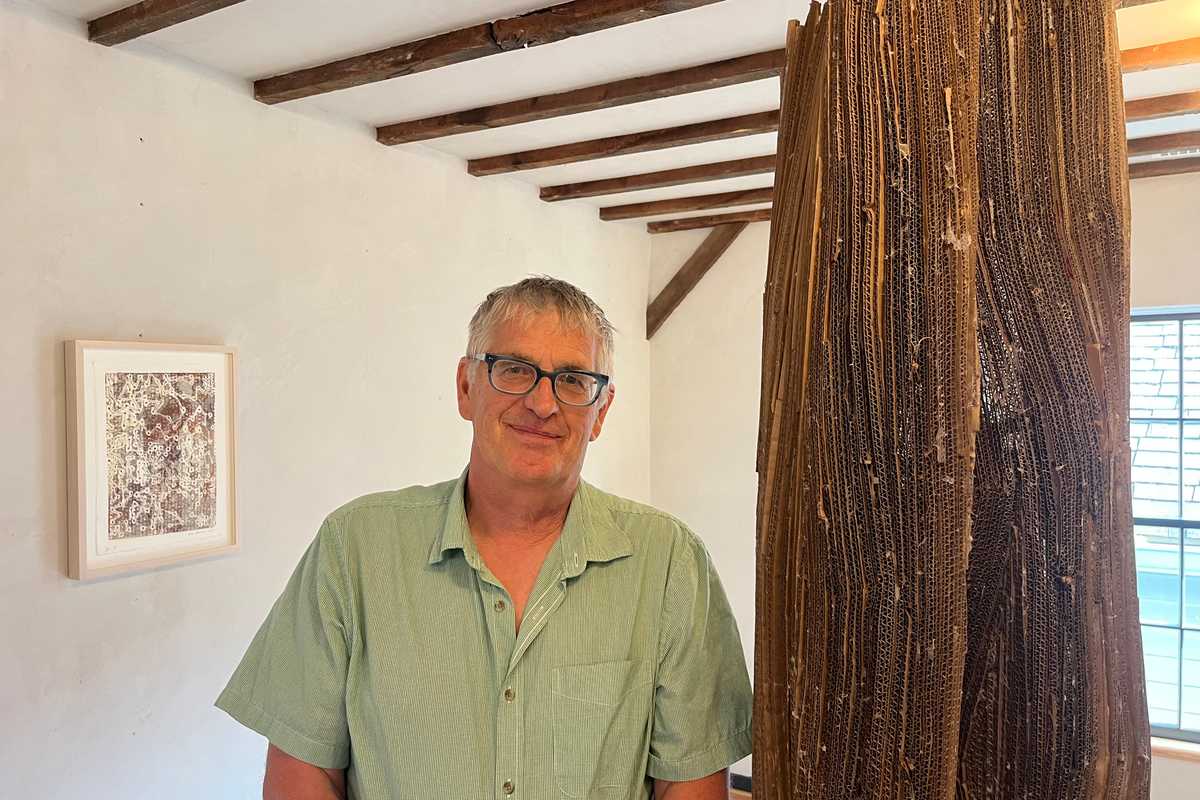
Hunt Library launches VideoWall for filmmakers

Yonah Sadeh, Falls Village filmmaker and curator of David M. Hunt Library’s new VideoWall.

Robin Roraback

The David M. Hunt Library in Falls Village, known for promoting local artists with its ArtWall, is debuting a new feature showcasing filmmakers. The VideoWall will premiere Saturday, March 28, at 6 p.m. with a screening of two short films by Brooklyn-based documentary filmmaker and animator Imogen Pranger.

The VideoWall is the idea of Falls Village filmmaker Yonah Sadeh, who also serves as curator. “I would love the VideoWall to become a place that showcases the work of local filmmakers, and I hope that other creatives in the area will submit their work to be shown,” he said.

Keep ReadingShow less

A bowl full of stars

A bowl full of stars

A bowl full of stones.

Cheryl Heller

There’s a bowl in my studio where pieces of the planet reside. I bring them home from travels, picking them up not for their beauty or distinction but for their provenance. I choose the ones that speak to me — the ones next to pyramids, along hiking trails, on city sidewalks or volcanic slopes.

I like how stones feel in my hand: weighty, grounding. I don’t mind them making my pockets and suitcase heavier. The bowl is about the size of an average carry-on. It has been years since it was light enough for me to lift.

Keep ReadingShow less
One-woman show brings Mumbet’s fight for freedom to Scoville Library

On March 29, writer, producer and director Tammy Denease will embody the life and story of Elizabeth Freeman, widely known as Mumbet, in two performances at the Scoville Library in Salisbury. Presented by Scoville Library and the Salisbury Association Historical Society, the performance is part of Salisbury READS, a community-wide engagement with literature and civic dialogue.

Mumbet was the first enslaved woman in Massachusetts to sue successfully for her freedom in 1781. Her victory helped lay the legal groundwork for the abolition of slavery in the state just two years later. In bringing Mumbet’s story to life, Denease does more than reenact history.

Keep ReadingShow less
google preferred source

Want more of our stories on Google? Click here to make us a Preferred Source.
google preferred source

Want more of our stories on Google? Click here to make us a Preferred Source.