Pockets of Poverty: A Northwest Corner Series
Poverty in the Northwest Corner doesn’t define an entire town. Instead, it exists in quieter pockets — apartments above storefronts, income-restricted housing and older homes where seniors and working residents struggle to keep pace with rising costs.
Pockets of Poverty is a series examining where financial hardship exists in Region One towns, what is driving it and how communities are responding.
Janet Lynn has lived her entire life in Lakeville.
At 84, the lifelong resident carefully plans her errands around trips outside the Northwest Corner — driving to Torrington, where groceries and gasoline cost less, and stretching each tank of gas long enough to refill it when she visits her daughter in Harwinton.
“People don’t understand,” Lynn said. “The prices here are geared to the rich.”
Like thousands of residents across Northwest Connecticut, Lynn falls into a category economists call ALICE — households that earn above the federal poverty line but still struggle to afford the basic cost of living.
ALICE — short for Asset Limited, Income Constrained, Employed — describes households whose incomes are too high to qualify for many public benefits but still too low to reliably cover necessities such as housing, food, transportation and health care.
Lynn was born at Sharon Hospital and has spent all her 84 years in the Lakeville section of Salisbury, on property once owned by her parents.
“But I’m struggling to stay here,” she said.
To stretch her limited budget, she regularly visits the local food pantry and carefully limits spending to essentials. Her daughter pays for her cell phone as part of a family plan.
Lynn’s experience reflects a broader reality across the region.
In the Northwest Hills Planning Region, which includes the Region One towns of Salisbury, Sharon, Kent, Cornwall, Falls Village and North Canaan, about 36% of households fell below the ALICE threshold in 2023, according to United Way data.
Statewide, about 40% of Connecticut households fell below the ALICE threshold, including 11% living in poverty and another 29% classified as ALICE.
In the Northwest Hills region, roughly one in four households — about 13,000 families — fall into the ALICE category, meaning they are above the poverty line but struggle to cover everyday expenses.
Rising housing costs have been a major factor driving the region’s affordability challenges. Median home prices in several Northwest Corner towns range from $700,000 to $1 million, fueled in part by second-home buyers and limited housing supply.
At the same time, rental options remain scarce, and rents have risen with property values, with monthly rentals reaching into the thousands of dollars.
Federal poverty statistics often fail to capture that reality.
The federal poverty line is about $15,000 for a single person, yet a single adult earning between $15,000 and $38,000 a year in northwest Connecticut falls below the ALICE budget threshold.
For a family of four, the federal poverty line is about $30,000, yet households earning between $30,000 and $116,000 in the region can still fall short of covering the region’s basic cost of living, according to ALICE measures.
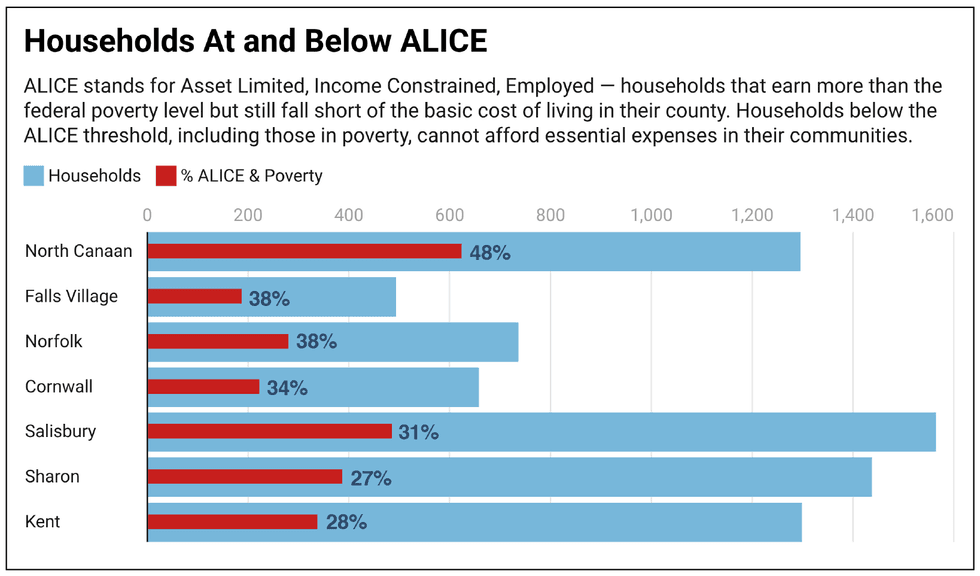 Source: United Way of Northwest/Created with Datawrapper
A quiet lifeline in Lakeville
Across the Northwest Corner, residents facing financial strain often rely on support networks to make ends meet.
One of those lifelines is The Corner Food Pantry, located in a modest white building behind St. Mary Church in Lakeville.
The church leases the building to the pantry for a nominal $1 per year, said Holly Kempner, co-president of the nonprofit with Amanda Halle.
“We couldn’t run the pantry without their help.”
Support also comes from local businesses, volunteers and community partners. LaBonne’s Market in Salisbury helps supply fresh produce, and a massive container filled with dozens of eggs recently came from the nonprofit Tenmile Farm Foundation in Dover Plains, N.Y.
Referrals are also submitted electronically from local social service agencies, including from the town of Sharon, as well as Project SAGE, which is a nonprofit domestic violence agency serving Northwest Connecticut and nearby communities in New York and Massachusetts, Kempner explained.
Hardship is often hidden, Kempner said.
“It’s hard to know who is struggling and who isn’t. It’s not as obvious as in the city where you have a lot of hardcore stuff going on.”
On a recent Saturday morning, cars filled the church parking lot across Wells Hill Road and stretched up the driveway leading to the pantry a half hour before opening.
The vehicles reflected the income disparity in the Northwest Corner — luxury SUVs alongside aging sedans and well-worn jalopies.
Volunteers worked with practiced efficiency, unloading produce and filling grocery bags.
Among the volunteers was Jo Loi, 85, a retired educator who taught in Cornwall for three decades.
“This is really important,” Loi said as she unpacked frozen chicken and pork chops. “This is something I can really do at age 85.”
Working at the pantry has also made her reflect on how quickly circumstances can change.
“I was thinking, what would my husband and I do if we lost our home? Where would we go? We could no longer afford to live here.”
Loi worries that rising costs are gradually pushing longtime residents out.
“When people can’t afford to stay, you lose the fabric of the community,” she said. “You’re losing institutional memory.”
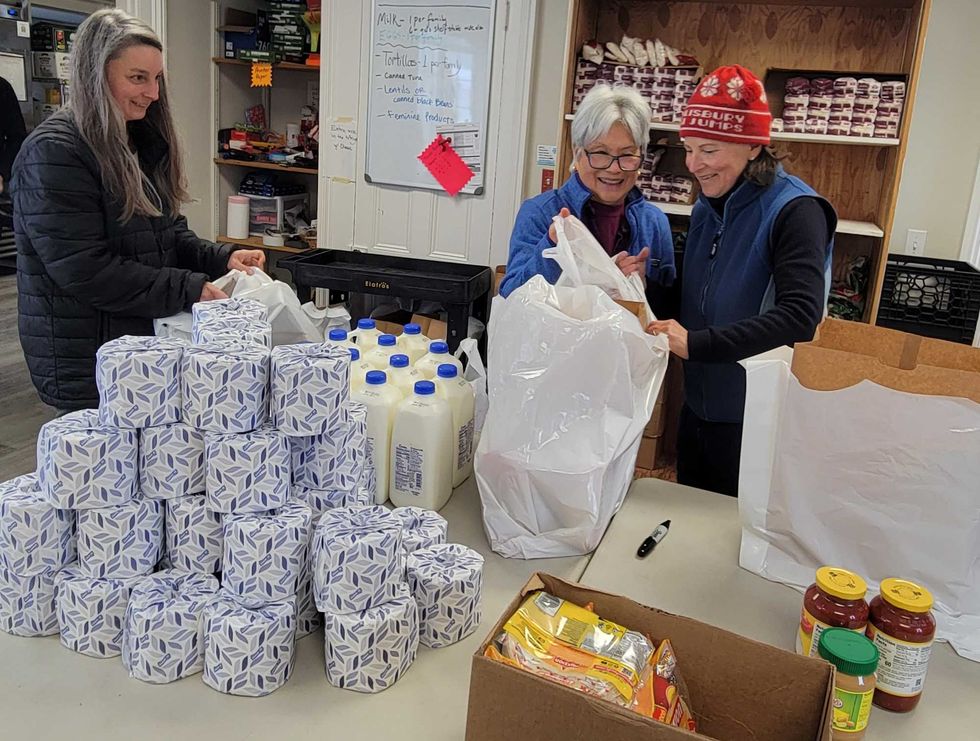 Jocelyn Ayer, Jo Loi and Erica Cohn, volunteers at The Corner Food Pantry in Lakeville, bag groceries and other items as a steady stream of patrons pick up their weekly supplies. Debra A. Aleksinas
The social toll
Beyond financial strain, some residents say there is also a growing sense of isolation.
Lynn said the community she once knew has changed as longtime residents move away.
“I’ve lived here my whole life, and I don’t know anyone anymore,” she said. “You feel invisible.”
That sentiment was echoed by Sharon resident Linda Swenson, whose financial and social challenges became more apparent after the recent death of her husband.
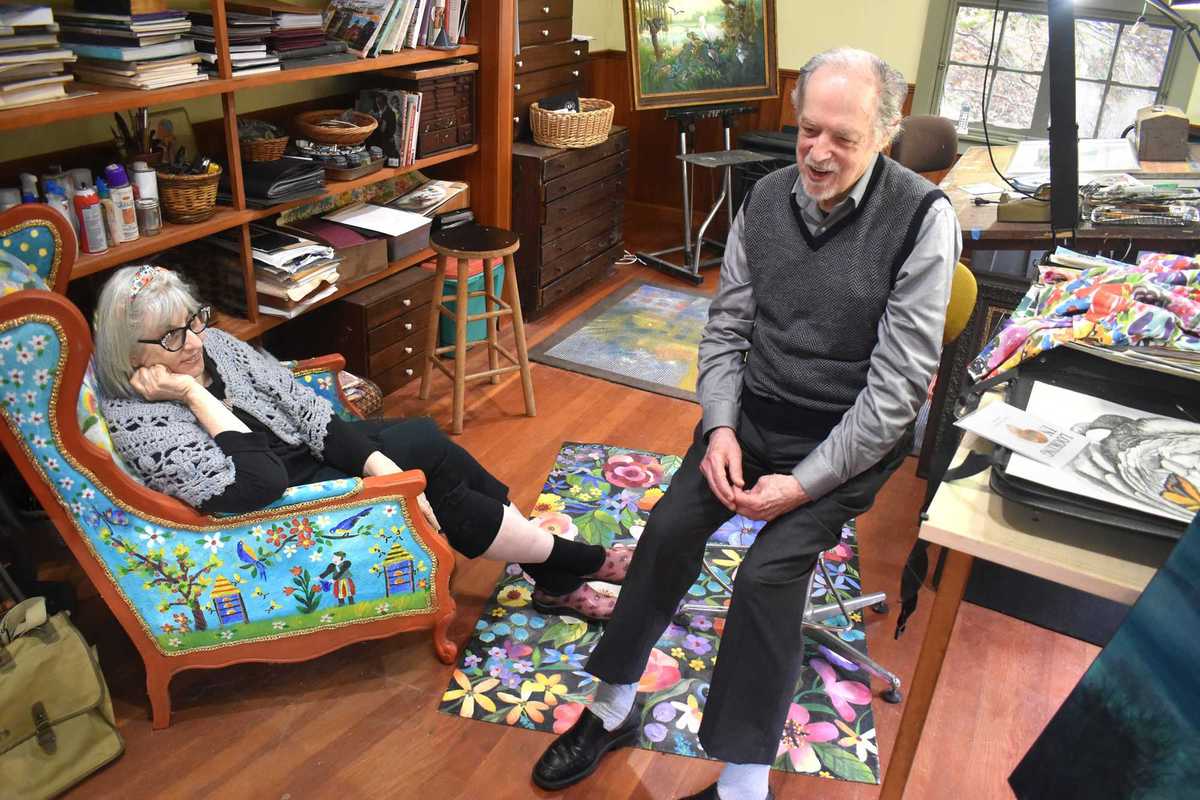
Swenson was raised in Indiana before relocating to New York. She and her late husband, both graphic designers, eventually moved to Sharon to open a studio.
“One of the things I love about this area is that people accept others as you are and are very respectful of each other,” she said.
Still, she said social connections can be harder to maintain after becoming single.
“Couples have all kinds of options, but for a single woman, it can be difficult to feel connected.”
Swenson believes rural Northwest Corner towns could do more to help residents living alone build stronger social ties.
“That’s something this community can really work on,” she said.
Impacts on families and children
Lisa Ferris, executive director of the United Way of Northwest Connecticut, said the organization focuses heavily on supporting ALICE households.
“Many are working two or three jobs to cover basic living expenses and still have a hard time putting food on the table,” she said.
Ferris also worries that changes to federal SNAP regulations could make it harder for some residents to receive food assistance.
“People may have to prove they have a part-time job or show volunteer hours to qualify for benefits,” she said. “But we’re here to give them a leg up. We don’t want them to fall into poverty or homelessness.”
Health providers working with children say financial pressures on low-income families are also showing up in schools.
Rebecca Malone, a primary care provider with Community Health & Wellness Center in North Canaan, serves students through school-based health centers in the Region One School District, including Housatonic Valley Regional High School.
“Hunger is an across-the-board challenge for families in the Northwest Corner,” Malone said.
Food insecurity often remains hidden, she noted.
“People may have neighbors forced to choose between paying for health insurance, or filling their refrigerators, or paying rent,” Malone said.
Often, multiple families are living under one roof to make ends meet.
Limited budgets frequently push families toward cheaper foods with little nutritional value.
“Many kids are eating empty calories — junk food that lacks nutrition,” Malone said. “It’s not through a lack of caring. Parents are trying to feed an entire family with a very limited amount of money.”
In response, a food closet has been set up at the high school where hungry students can help themselves to healthy food and snacks.
Seasonal employment can make the situation worse.
“A lot of families work in seasonal jobs, landscaping and outdoor work,” Malone said. “Those jobs shut down for winter and people get laid off,” creating financial stress that can spill into the home.
“We can’t expect excellence from children until we fill their needs,” she said. “Without a safe and secure shelter, and food, nothing else matters.”

 Justine and Victor Valla in their studio with a painting of Victor’s,”Jonah and the Whale.” Robin Roraback


 A ceramic vase by Kathleen Heidemann.Provided
  Joy Brown’s delightful ceramic sculptures.Provided