LAKEVILLE — Charlotte (Hall) Reid, first selectman of Salisbury from 1973 to 1989 and a reporter and columnist for The Lakeville Journal for 10 years afterward, died Aug. 20, 2011, at Sharon Hospital. She was 93 and lived on Porter Street.She was born on June 8, 1918, at Charter Oak Hospital in Hartford. Family lore was that cows crossing the road at the base of Avon Mountain caused a torturous delay for her mother’s arrival at the hospital. She was the daughter of the late Alfred Bates Hall, a teacher at The Hotchkiss School, and Edna (Spurr) Hall.Her grandfather, E.W. Spurr, founded a lumber, coal and hardware store that eventually became Herrington’s on Farnam Road. He drove his horse and buggy from Falls Village to work every day.Mrs. Reid attended elementary school in Lakeville in what is now a house at 240 Main St. with a Mrs. Tracy as the teacher. She was one of two graduates in her eighth-grade class — the other was Mary Helen Hawley, sister of Jack Hawley. She graduated from high school at the Great Barrington School for Girls in the former Searles Castle.She earned a bachelor’s degree from Barnard College in New York City, graduating in 1939, and then did graduate work at Bank Street College in New York and later Fairfield University. She received a master’s degree from Fairfield in education and counseling.She was the widow of Gordon S. Reid, who died in 1981. They were married in an evening service in The Hotchkiss School chapel in January 1943 and lived in Washington, D.C., where he worked for the State Department, until 1954, when they moved to the Hall home on Elm Street in Lakeville. Gordon Reid taught at Salisbury School and Mrs. Reid did psychological testing at what is now CMHA’s Northwest Center for Family Services.In 1973, she ran for first selectman of Salisbury, certain that as a Democrat and a woman she was doomed to lose. She won and served for the next 16 years. She was honored by former Gov. Ella Grasso as the state’s first female first selectman. A Democrat from the days of Pres. Franklin Roosevelt, she also served as a delegate to state party conventions.In 1989, she decided not to run again and became a reporter for The Lakeville Journal, where she worked for 10 years, writing on a wide variety of topics, including a front page column entitled, “Have You Noticed?”An avid birder, she spent many happy days scanning skies throughout the Northeast with her longtime friend and fellow former selectman, George Kiefer.She served on numerous boards and commissions and was a trustee of Salisbury School.She is survived by her sons Douglas and Daniel Reid of Lakeville, Dwight Reid of Peru, Mass., and David Reid of Rumford, R.I.; her daughters-in-law Erin, Holly and Coree Reid and Lu Cribari; her grandchildren, Casey Reid, Abigail Reid, Yasmin (Reid) Wilkinson, Noah Reid, Andie Reid, Andrew Reid and Jon Reid She became a great-grandmother on April 30 with the arrival of Elly Hall Wilkinson.She was predeceased by her granddaughter, Emily Reid O’Connor.Her burial will be private. A memorial service will be held at the Congregational Church in Salisbury at 11 a.m. on Sept. 24.Donations may be sent to the Gordon Reid Scholarship Fund at the Salisbury School.Arrangements are under the care of the Newkirk Palmer Funeral Home in North Canaan.
Latest News
Emberlin, Grace lead Housatonic at Berkshire League championships
Riley Klein
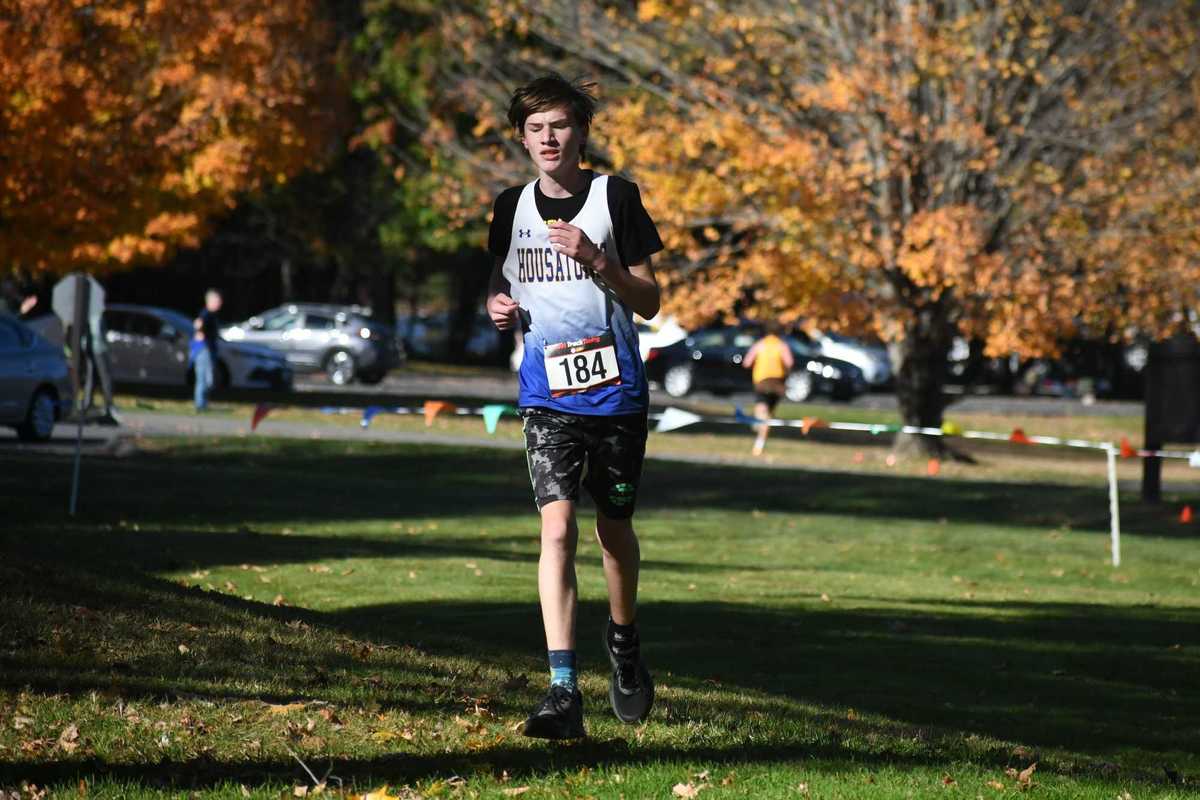
Tanner Spear, HVRHS’ lone entrant in the boys JV race, finished in 29:32
WATERTOWN — Varsity distance runners of the Northwest Corner met at Black Rock State Park Thursday, Oct. 22, for the Berkshire League cross country championships.
There were nine high schools represented at the event, including Housatonic Valley Regional High School.
The four races were split into girls varsity, girls JV, boys varsity and boys JV.
Thomaston High School emerged victorious in both the girls and boys varsity races. Thomaston also swept the boys JV podium and Shepaug Valley High School won the girls JV race.
The runners embarked on a five-kilometer course.
Ahead of her final meet, HVRHS senior Grace Graney described the feelingas “bittersweet.”
“We have such a great coach and a great team,” Graney said. “I’m going to remember most how supportive our team is towards each other. We’re a very close.”
The Mountaineer boys had a season record of 4-4 and the girls went 5-3. Below are results from the Berkshire League championships.
Girls
Briana Belanger of Thomaston won the girls varsity race with a time of 19 minutes 37 seconds. The second place finisher was Lily Casini of Shepaug (20:20) and third place went to Lilyana Markavich of LakeviewHigh School (20:33).
HVRHS’s top finisher was freshman Ella Emberlin who placed 19th with a personal-best time of 25:16. Emberlin was named to the Berkshire League all-star second team.
Also representing the Mountaineers in the girls varsity race were Celestia Galvin (27:53), Edith Losh (29:01), Kaitlyn Holst-Grubbe (31:18), Zaira Celso-Cristobal (36:02), Grace Graney (37:14) and Yamina Smithey (41:53).
In the girls JV race, Shepaug’s Laci Donovan won with a time of 25:52. Second place went to Maylin Worhunsky of Terryville (26:31) and third place went to Victoria Bargellini of Shepaug (26:42).
HVRHS had no runners in the girls JV race.
Boys
Beau Kociszewski of Thomaston won the boys varsity race with a time of 17:19. Second place went to Liam Riendau of Shepaug (17:33) and third place went to Braden Walker of Thomaston (17:35). HVRHS’s top finisher was sophomore Elden Grace who placed 15th with a personal-best time of 19:01. Grace was named to the Berkshire League all-star second team.
Also representing the Mountaineers in the boys varsity race were Owen Schnepf (19:35.3), Alastair Schnepf (21:13.0), Jaxon Visockis (21:38.8), Ishaan Tantri (22:45.3), Jackson Holst-Grubbe (22:57.2) and Silas Popadic (28:42.6).
Thomaston swept the podium of the boys JV race.
HVRHS had one runner enter in the boys JV race: Tanner Spear (29:32).
Few speak at Region One forums, but concerns persist
Ruth Epstein & Patrick L. Sullivan

Only a few residents spoke during six virtual forums held Oct. 20–22 on Region One’s organizational study. Those who did questioned whether consolidation would save money and raised concerns about longer bus rides and the effects on local schools.
Superintendent Melony Brady-Shanley led the forums to discuss recent survey results and hear residents’ views as the region examines its kindergarten-through-eighth-grade structure amid declining enrollment and rising costs. No consolidation plan has been adopted, and the study has no predetermined outcome.
The survey drew 860 participants, with 572 completing the questionnaire in its entirety. Among the 592 people who answered the relevant questions, 77% favored retaining an elementary school in their town, regardless of its grade configuration. A seventh- and eighth-grade program at Housatonic Valley Regional High School drew support from 54%, while 46% opposed it.
Brady-Shanley said at one of the forums that she regretted specifying Housatonic as the location in the middle school question.
“If I hadn’t put in the high school, there may have been more in favor of that,” she said.
The study will include a 12-member community subcommittee, with each town’s Board of Selectmen and Board of Education each selecting one community representative, preferably someone who does not serve on either board.
The study is expected to continue through May 2027, with findings presented in June 2027.
At each town forum, Brady-Shanley reviewed the town’s survey results, which are available at region1schools.org/organizational-study/, and sought feedback.
During the Cornwall forum, First Selectman Gordon Ridgway said parents had raised concerns about the time children would spend on buses.
“The less time spent on buses the better,” Ridgway said.
Ridgway questioned whether consolidation would produce savings, noting that local school buildings would still require maintenance.
“It would be helpful to know if this type of movement saves money. We’d still have to maintain local buildings. People are satisfied with the Cornwall Consolidated School education. The benefit of a local school is huge.”
“If it ain’t broke, there’s no need to fix it,” he added.
Ridgway also noted that school volunteers save the town money.
He asked how voting would work if the districts were regionalized, adding, “People like seeing the board members around town and having access to their decision making.”
Brady-Shanley said similar concerns about the study had been expressed in other towns.
Nikolle Lizana asked whether any particular circumstances had prompted the study now.
“I heard it surfaces every 10 to 15 years,” replied Brady-Shanley. “What spurred the conversation was where we are financially and enrollment.”
At the Kent forum, a woman asked whether there had been discussions with other districts about their approaches to consolidation. Brady-Shanley said the subcommittee would conduct that research.
In North Canaan, a woman raised the need for affordable childcare. Brady-Shanley said she had instituted free pre-kindergarten in her former district and hoped to explore that possibility for Region One.
In Falls Village, nearly two-thirds of those who answered the question supported a regional seventh- and eighth-grade program at HVRHS, compared with just over half region-wide.
At the Falls Village forum, Laurie Wadsworth, who runs the front office at Lee H. Kellogg School, said she was disappointed in the survey participation, which drew 111 respondents from Falls Village.
“I think we got to the school population, but I wish the resident population was a little higher.”
In Salisbury, a majority of those who answered the question opposed a regional seventh- and eighth-grade program at HVRHS, with 58% against and 42% in favor.
David Valcin, chairman of the Salisbury Board of Education, said concerns about bringing middle and high school students together had also surfaced during discussions about the regional middle school sports program.
He said he understood parents’ concerns, but noted that middle and high school athletes had ridden the same buses in recent years without incident.
Lilly Rand teaches art at HVRHS, has two children at Salisbury Central and taught for several years at Sharon Center School.
She said she can’t imagine having a middle school program at the high school because of the impact on town school enrollment.
“Sharon needs more kids.”
A majority of the 108 Sharon residents surveyed wanted to ensure the town had equal representation despite its smaller student population.
At the Sharon forum, residents asked how other towns had responded to the survey and expressed hope that communities shared more common ground than differences.
“I’ve always been curious and maybe a little trepidatious because our region is so quirky,” said Sharon’s Region One representative, Sara Cousins. “What are the roadblocks… as we talk?”
Paranormal investigator shares eerie encounters at Hunt Library
Patrick L. Sullivan
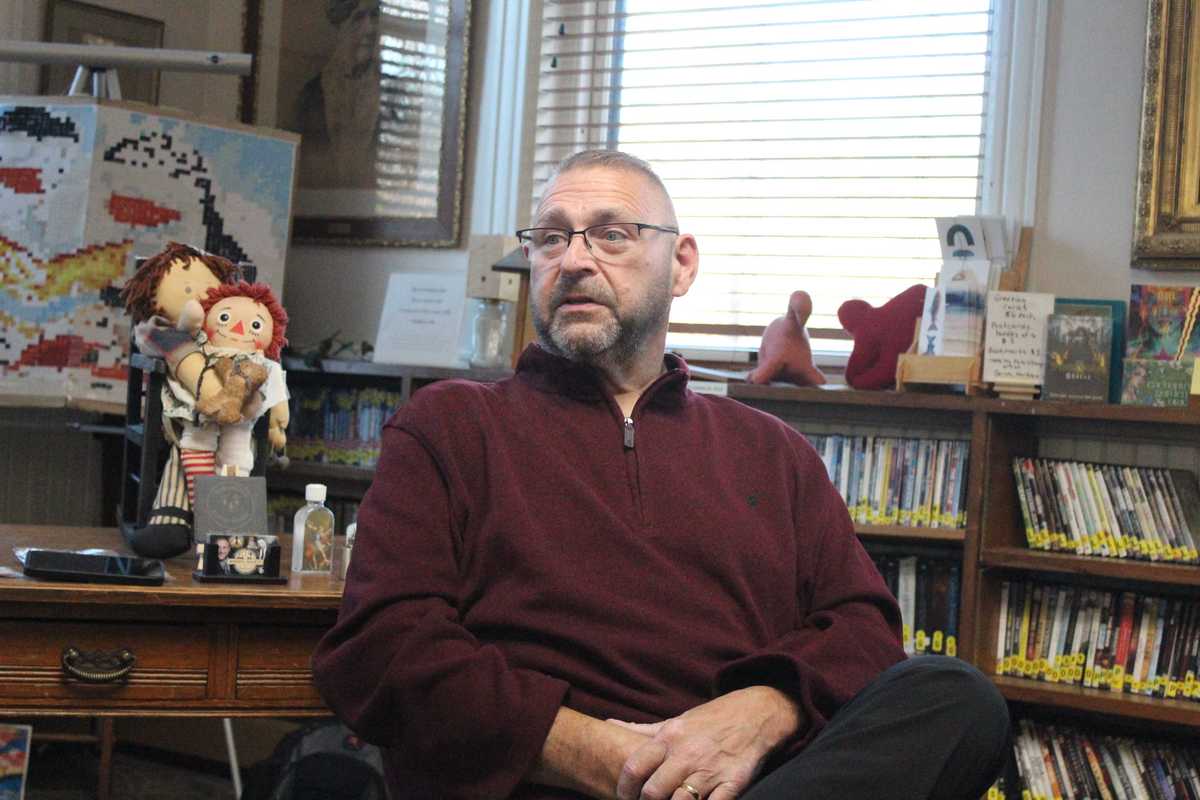
FALLS VILLAGE — Joe Franke of the Warren Society for Paranormal Research and Education visited the David M. Hunt Library Thursday, Oct. 15, to discuss his career investigating the paranormal. He also offered a warning to anyone considering experimenting with a Ouija board.
“Please don’t.”
Franke got his start in paranormal investigations as a teenager in 1986, when he met veteran researchers Ed and Lorraine Warren.
“When I first met the Warrens I felt an immediate connection. Lorraine told me ‘I can tell by your aura you were meant to do this work.’”
Forty years later, he’s still taking cases.
Franke said there is never a charge for his help. What money he makes from his work comes from lecture fees.
“All I want to do is help people.”
He asked the audience of 16 people if they believed in ghosts. Nobody said they didn’t.
Franke defined a ghost as “the spirit of a once living person who walked the earth.”
“I believe spirits are energy that can manifest in many forms.”
Franke showed several photographs taken with film cameras in cemeteries at night in the 1990s.
He said he was advised by the Warrens to take three or four shots in quick succession, in a controlled environment without ambient light, so the only illumination came from the camera’s flash.
One photo showed something that looked like wisps of fog coming from a gravestone.
Another had an image of what looked like a dog standing with ears up, also emanating from a gravestone.
A third, of a larger monument, had what looked like the face of a man gazing downward. One woman murmured, “It looks like Bogie,” referring to actor Humphrey Bogart.
Franke offered these images without much comment. “It would be irresponsible of me to tell you it’s a ghost because I just don’t know.”
However, when the photos were taken, “I felt a lot of energy.”
Franke had video footage as well.
He said doorbell cameras can be useful in investigations of the paranormal. A recent clip of about eight seconds, with a time stamp of 22:27 (10:27 p.m.), shows something appearing in the center of the frame and moving to the viewer’s right, where it seems to gather itself and disappear into the lower right-hand corner.
Franke said he showed the footage to people he described as experts, who he said could find no sign of fakery. He did not identify the reviewers or describe their expertise during the presentation.
Another short clip was taken by a woman who was dog-sitting for a friend. Sitting on the floor and using her phone camera, she calls the dog, who comes running. In the hallway in the background, what looks a lot like a human figure crosses the hall and disappears.
Franke said the dog sitter posted the video on Facebook, intending to share a cute moment with the dog.
“It blew up,” he said, with people asking in the comments who else was in the house.
According to Franke, the dog sitter said nobody else was in the house. He said the unnerved dogsitter called the police. Franke said after the officers saw the footage, they searched the house, weapons at the ready.
Franke said the figure appeared to vanish into a wall and that the homeowner later moved.
He also showed footage he identified as a 1985 exorcism of Maurice “Frenchy” Theriault in Warren, Massachusetts, conducted by Bishop Robert McKenna.
The footage shows Theriault sitting in a chair. McKenna is in and out of the foreground, reading the exorcism rite in Latin. Three or four men are standing behind Theriault, with only their torsos and arms visible. Occasionally one touches Theriault on the shoulder, or applies a towel to his face.
As the priest reads, what look like welts or cuts appear on Theriault’s forehead. He drools from his mouth, but what appears on his white t-shirt is dark, like blood. Eeriest of all, for several minutes Theriault doesn’t blink, and his eyes look like “snake eyes,” Franke said.
McKenna demands the demon identify itself. Franke said that if the exorcist can get the demon to give its name, that tips the balance of power in favor of the exorcist.
Theriault mutters repeatedly, “I am what I am.”
Franke said these cases usually move in stages.
Stage one is vexation, with scratching or growling sounds or other strange but not dangerous phenomena. It occurs two or three times and stops. Franke said vexation is designed to scare or annoy the victim.
Stage two, infestation, is when unexplained events occur on a regular basis.
The next stage, obsession, occurs when victims report a force putting thoughts in their minds.
“It’s not fleeting,” said Franke. “They hound you.”
Franke said stages four, oppression, and five, possession, are marked by events occurring more frequently and more vehemently. The fifth stage can “escalate into physical attacks.”
“I’ve been punched, bitten, burned and thrown across the room.”
How does someone protect themselves?
“Faith,” said Franke. “I’m no holy roller but I talk to God every day.”
Franke said he considers divination extremely dangerous.
“You’re seeking to foretell or obtain hidden knowledge by supernatural means” such as an Ouija board or tarot cards, Franke said.
“This is bad stuff. Lorraine used to say that demons have to be invited in, but if you’re playing with an Ouija board you’re opening the door.”

Want more of our stories on Google? Click here to make us a Preferred Source.
Books, baked goods and bargains in Falls Village
Patrick L. Sullivan
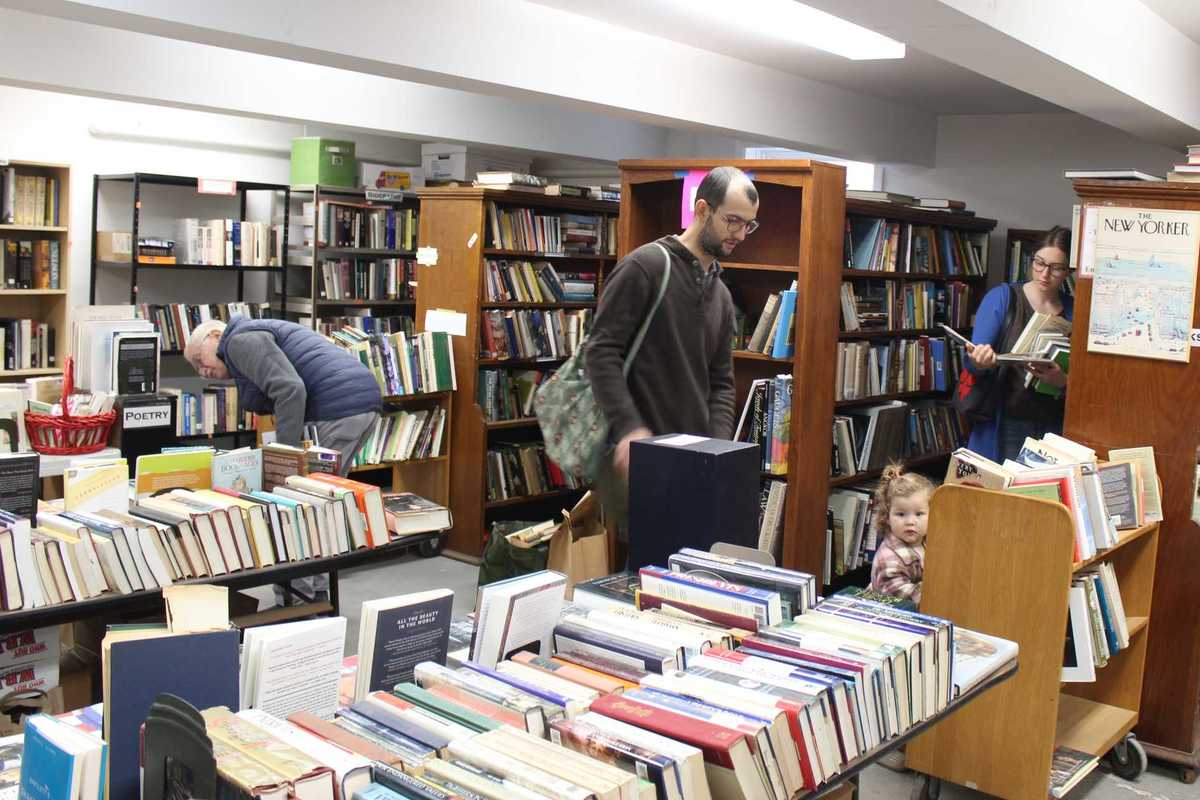
Greer and Britta Sallick look over the books on sale in the basement of the David M. Hunt Library.
FALLS VILLAGE — Bookworms were everywhere at the David M. Hunt Library Saturday, Oct. 24 for a massive book sale.
A five-dollar bill got a buyer a big bag of books.
Britta and Greer Sallick of Falls Village were stocking up on field guides and anything about fly-fishing. A quick scan of the basement sports section found two paperbacks by fly-fishing writer John Gierach in the angling category.
Dick Heinz was clutching two books by Ernest Hemingway, “A Farewell to Arms” and “The Old Man and the Sea.”
He said the latter was destined for a grandson. “Hemingway is great for boys. You can feel the line in the old man’s hands.”
Across the street at the Congregational Church was the annual “Apples ‘n’ Things” event.
Inside, tables were crammed with baked goods of every description.
Chili, cornbread and toppings were also available.
In the “things” department, shoppers could find big handmade potholders for $2.50.
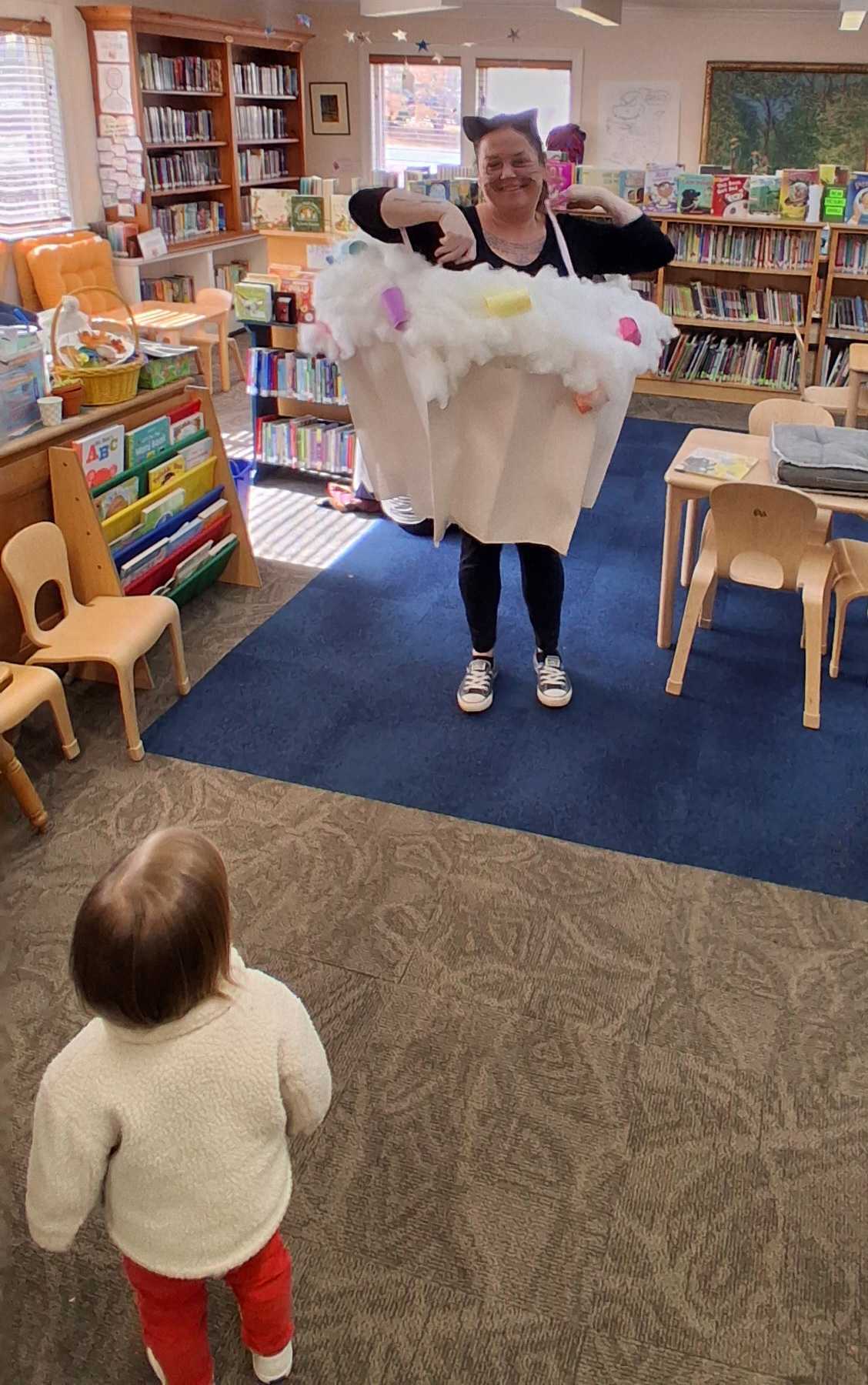 The Hunt Library’s Anna Pattison donned a cupcake costume during the book sale Saturday, Oct. 24.Patrick L. Sullivan
Letters to the Editor - October 29, 2026
Lakeville Journal
Can Connecticut become affordable?
We all can plainly see that the cost of living is out of control. The national news programs blame the war with Iran for high gasoline, diesel and home heating oil prices. The Trump tariffs are pushing up the cost of everything else. But we aren’t voting for Trump this year. Our interest this election is much more personal. The questions for Connecticut are increasingly high electric rates, income, sales, gasoline and many other taxes.
We pay the highest electric utility costs in the country 48% above the national average. But that’s not the whole story. Almost a third of our utility bills are taxes and a multitude of fees. When the Governor brags about all the benefits he is providing he neglects to mention that we have to pay for them. Everyone loves Santa Claus, but parents know they have to pay for all those presents.
It’s a paradox. Connecticut is among the 9 wealthiest states in the country. At the same time it ranks among the 5 least affordable states. Property taxes are the third highest in the country. We are fortunate in Salisbury with the 2nd lowest property tax in the state. Housing values are so high the low tax rates provides enough money to fund our efficiently run town.
So practically speaking what can we do about it? The political complexion in Harford isn’t likely to change, but the Governor of Connecticut enjoys a perk the President can only dream about. If Ryan Fazio is elected Governor, he can cut non-essential spending out of the ballooning budgets the legislature prepares by what is called a line-item veto. He won’t have to fight over the whole budget. He would be able to eliminate just the spending that isn’t necessary.
It’s worth considering before Connecticut just becomes too unaffordable to live, run a business or work in.
Bill Littauer
Lakeville
End one-party rule in Washington, D.C.
Tom Morrison’s letter/plea to “end one-party rule in Connecticut” has things backwards.It is time to end one-party rule in Washington, D.C. by the Republican party.
Since Republican office-holders on the CT state level have continued to support the Trump Administration and its policies, which have hurt the United States in many and varied ways, to the point where it may take us a generation to recover, a vote for any Republican nowis a vote to continue the bad actions that the Trump Administration is consistently taking.Mr. Fazio and other Republican candidates may have some things to recommend them for the privilege of holding elective office, but voting for any of them this year will assure the continuing realm of MAGA and the decline of democracy and the United States of America.
Tom Shachtman
Salisbury
Tong is indeed working for CT citizens
A recent letter writer to the Lakeville Journal suggested that our Attorney General, William Tong, wasn’t working for CT citizens when he supported or initiated lawsuits against the Federal government. Please think back to Trump’s first year of his second term; we felt helpless as our Federal government cut and cut and cut funding we citizens relied on – to public health, education, SNAP, Head Start, alternative energy, medical research, even to OUR OWN local public libraries. Our Attorney General William Tong showed us we were not helpless; he filed law suits in direct support and protection of CT citizens’ needs. William Tong is exactly the Attorney General we need to continue the fight to restore and protect the vital services we CT citizens expect and depend on.
Joanne Hayhurst
Lakeville
Obstructed views unkind
A comforting aspect of living in a small town is that an act of kindness can spread its benefit to a large number of local people. In Sharon an individualdonates funds to light an evergreen on the green around which we sing Christmas carolsand which brings a season of joy to people who pass by. People volunteer time to tend to elderly people which brings comfort to entire families. Acts of kindness like this improve quality of life for a large part of the community.
Every time I drive on East Street where it reaches its highest point I slow down to enjoy the view across the valley to Mohawk Mountain and give a little thanks for the moment. People driving on East Street have always enjoyed this view and churches in Sharon have held Easter sunrise services here for decades.
There has been a row of trees planted along the road at this point on East Street,blocking this beautiful view, depriving us all of this pleasure. Dear 152 East Street, please remove these trees and restore this treasure to the people of Sharon. Please do your part, as many people have done, to improve the quality of life for all of us.
Thank you,
William Trowbridge
Sharon
Want more of our stories on Google? Click here to make us a Preferred Source.