SHARON — Eliza Kellogg Klose, died on June 12, 2024, at Noble Horizons after a long battle with dementia. She was 83 years old.
Eliza attended Potomac School in McLean, Virginia, acquiring her love of music both from her conservatory-trained mother, Celina Robbins Kellogg, and also from her Potomac school days with music teacher John Langstaff, with whom she later performed in Spring and Christmas Revels productions in Washington, DC (1974) and Hanover, New Hampshire (1982).
Eliza graduated from Milton Academy in Milton, Massachusetts, where she was valedictorian of the Class of 1958, and Radcliffe College in Cambridge, Massachusetts, earning a BA in English Literature, Summa Cum Laude, Phi Beta Kappa, 1962.
After college, Eliza taught English at Bard College in Red Hook, New York, and at schools in Washington DC before marrying Kevin Klose in 1964. As mother of Cornelia (Nina, 1967), Kevin Brennan (Brennan, 1968) and Chandler (1972), she studied towards a Master’s in Early Childhood Education, as well as participating in progressive movements such as early efforts at racial integration and community participation through Columbia Road Children’s Center, the Community Playgroup movement, natural birth, and La Leche League. She taught creative music and movement at Columbia Road and also in the Six School Complex when her children joined one of the 6 schools, Horace Mann.
When husband Kevin was appointed Moscow Bureau Chief for The Washington Post in 1977-1981, Eliza learned Russian fluently, and became a guiding light for the family in navigating the challenges of life in the USSR. She helped Kevin conduct interviews (he hadn’t learned the language nearly as well) and supported the three kids in attending Soviet schools and learning fluent Russian. Both Eliza and Kevin became fascinated by the Soviet Dissident movement, coming to know and support the families of Dmitri Sakharov and Elena Bonner, Lidia Chukovskaya, Lev Kopelev, Vasily Aksyonov, Vladimir Voinovich, the Donetsk, Ukraine coal miner activist Alexei Nikitin and many others from the Soviet intelligentsia.
From Moscow, the family moved to Pomfret, Vermont, for two years while Kevin wrote an account of the Soviet dissident movement, and then to Chicago for four, during Kevin’s stint as Midwest & Canada Bureau Chief for the Post. During this time Eliza translated and published works by activist and writer Lidia Chukovskaya, and also taught writing at Midwest Talent Search, Northwestern University’s program for gifted youth.
Back in Washington, DC in 1989, Eliza joined and later became Executive Director of the small non-profit, the Institute for Soviet-American Relations (ISAR). As the Iron Curtain opened, ISAR expanded from public diplomacy efforts as a clearinghouse for Soviet-American civilian exchange to making seed grants to a wide network of NGOs within the former USSR. Under Eliza’s leadership, ISAR distributed over $15m in USAID funding to support citizen environmental groups through nine offices from Moscow to Almaty, Kyiv, Tbilisi and Baku.
Eliza divorced Kevin in 2006, the same year she retired from ISAR. Three years later she moved to Sharon, to marry Harding Bancroft. After retiring from ISAR she sat on the board of the International Crane Foundation, traveling in the Russian and Asian Far East to learn about and support the Foundation’s conservation work to preserve endangered crane populations. In Sharon, besides creating and maintaining an extensive garden, Eliza joined and then co-chaired the Sharon Garden Club, Sharon Women’s Club, and volunteered at the Sharon Historical Society. Eliza and Harding travelled extensively, enjoying tours in Europe, Former USSR, Egypt, Jordan, Norwegian fjords, the Galapagos, and glaciers in Tierra del Fuego.
Eliza battled dementia for eight years; in 2022, she and Harding moved to Noble Horizons. Throughout her battle with dementia, Eliza continued to astound and touch us all with her grace and acceptance of her condition. She received the skilled and devoted care of the team at Noble Horizons. Until her final hours, though she could no longer speak or move her body, she was able to communicate her love and gentle spirit with all who knew her.
She is mourned by her husband, Harding Bancroft, her children, Nina Klose (London, England); Brennan Klose (Washington, DC); and Chandler Klose (Northampton, Massachusetts); eight grandchildren and four great-grandchildren, as well as four stepchildren, eight step-grandchildren, and many other loving family and friends.

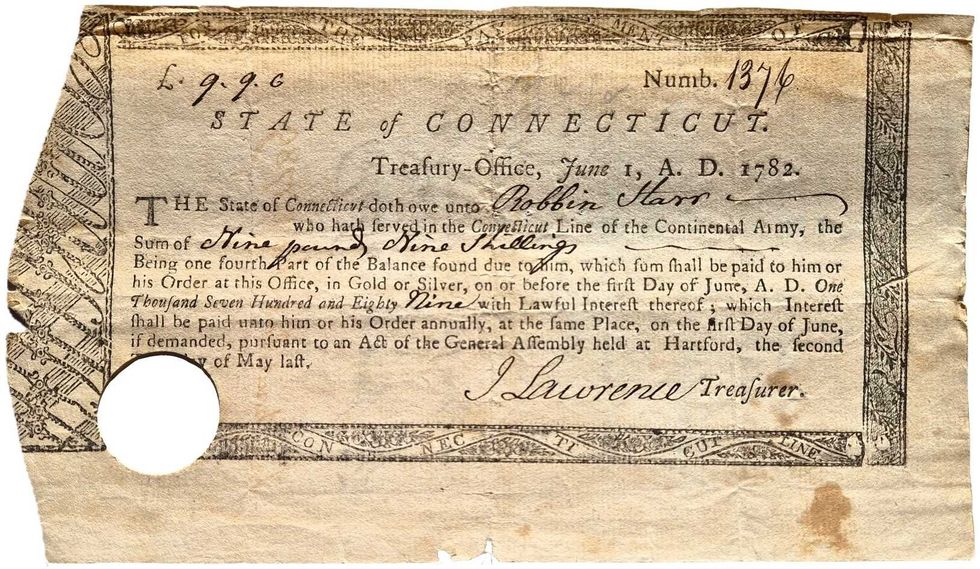 Pay Bill for Robin Starr’s service in the Continental Army.Courtesy the Alex Breanne Corporation
 John Mills speaking at Quinnipiac University.Courtesy the Alex Breanne Corporation
 Stephanie Saetta,with her rescue dog George and Blue (left), a shepherd mix awaiting his forever home.Madi Long
 Blue, a 7 year-old Shepard mix, is waiting for his forever home. Madi Long