LAKEVILLE — John Harney Jr. described growing up in Lakeville and Salisbury in the 1960s and 1970s as a magical time, filled with outdoor adventures that were largely unscripted and sort-of-supervised by an informal network of adults.
On Thursday, Oct. 16, Harney sat down for an interview for the ongoing oral history project, overseen by town Historian Jean McMillen. Harney, a Realtor, is in the process of moving from Lakeville to Cornwall Bridge.
The following is from that interview.
Harney was not born in Lakeville, or even Connecticut, but in Ithaca, N.Y., in 1954. His late father, John Harney Sr., who later ran The White Hart inn, was studying hotel management at Cornell University and his bride, Elyse, was there with him.
“I guess someone should have been studying more up at Cornell, and apparently there was a break in the action and all of a sudden I appeared,” said Harney. “So my first residence was — I’m not sure if it was the bottom, middle or top drawer, of a bureau, in some student room.
He laughed. “A crib was not to be had at that point, and apparently a drawer did just as well.”
The Harney family moved to West Cornwall around 1958, Harney said, and ran an inn there.
“Mom and Dad had a country inn there in the middle of town, and it was quite something,apparently.
“Instead of having inventory, Joe Bates had the meat store just up the road, it was a hundred feet up.
“If someone came in and ordered five steaks, Mom would take the order, and Dad would rush out the back door, pad his way up to Joe Bates’ meat shop, grab the key off the sill, go in, get the steaks out of the refrigerator, write a quick note — ‘I’ve got five steaks’ — and then run back down and start cooking.”
The three Harney boys — John, Keith and Michael — were often left in the care of the local barber.
“ I guess Mario babysat for us while he cut hair.”
Around 1960, Harney continued, his father “did some sort of partnership with Reese Harris and Don Warner with The White Hart, so they were probably the money and Dad was operations.” Harney ran The White Hart into the early 1980s.
Harney remembers one prominent guest: U.S. Sen. Everett Dirksen of Illinois, a powerful Republican.
Harney described his father as a Goldwater Republican. “I think he was a little to the right of Genghis Khan. But he was very proud of the fact that he got Everett Dirksen in, and I just remember, we were renting the house at the corner of Reservoir and Belgo, the one with the wavy stone walls, and I just remember seeing those two men.”
Both men were thin and wore “black patent shoes, black socks, dark trousers, white sort of starched shirts with a narrow dark tie, and I just remember them sitting out on the lawn on chairs, discussing politics.”
Harney’s friends growing up included Bob Dufour, Mat Kiefer, Gordon Whitbeck and “all those kids who skiied in SWSA” (the Salisbury Winter Sports Association).
“We sort of just hooked up with all the kids in the SWSA program. And it was sort of magical.
“I don’t know what happened to the sense of time, but back then there seemed to be plenty of time, because on Sundays and the weekends during the winter there would be five to 10 families, parents and children, on cross-country ski tours, starting on Selleck Hill, and we’d go up on Mount Riga and have lunch at Dresser’s cabin, which since it faced south always was the warmest.
“And then [we’d] ski all over Mount Riga and up to Bear Mountain or Lion’s Head.
“It was a different time, because you don’t see that happening now. No one either has the time, or maybe it was lack of snow the last couple of decades or something, but it’s interesting. When I ski up there alone, which I like to do during the winter, I don’t feel alone because I just remember all of the times skiing with the Ericksons and the Whitbecks and the Kiefers and the Harneys. I mean, all of those people, it was quite something.”
Harney also remembers — quite vividly — learning to hunt and fish with Skeet Morey.
“He was the best woodsman God has ever made. He taught us all how to hunt, and trap. He knew the woods and the animals in them better than they did.
“He took great joy just in walking through the woods, and he always had a stick or a rifle or something and he would show us” the signs of raccoon or mink or otter activity. “He’d show us how to put the traps in beeswax for the scent, and how to figure out where to place them, how to deal with everything.
“And he also showed us how to hunt, to the displeasure of my father, because hunting with Skeet also meant sort of freelancing — we never had any licenses.
“So Dad would come home, and he’d open the garage door and yell ‘God damn it!’ and he’d shut it, because there would be deer hanging in there. ‘Are these things legal? ‘No, we were out with Skeet.’”
One winter Skeet Morey took the Harney boys deer hunting.
“He brought us up on Mount Riga, in the mountain laurel, and he said to my two brothers and I to stay right there, and that he would push deer, and they would come out at this certain point, and to shoot them right there.
“So we were in the snow, in the mountain laurel, and sure enough, the deer came right out at the spot that he said. We shot it, and he came out through the laurel laughing. A little while later, he was showing us how to clean it, and we were all leaning over, intent, trying to learn, trying to be woodsmen.
“All of a sudden he stood up abruptly and spun around and said to my brother Mike, ‘Hold this.’
“It was this enormous liver — of the deer — and he put it in Mike’s hands. Whereupon Mike fainted, fell back, in the snow, with this enormous liver on top of his chest.
“Skeet howled with laughter. Oh, all he did was laugh.”
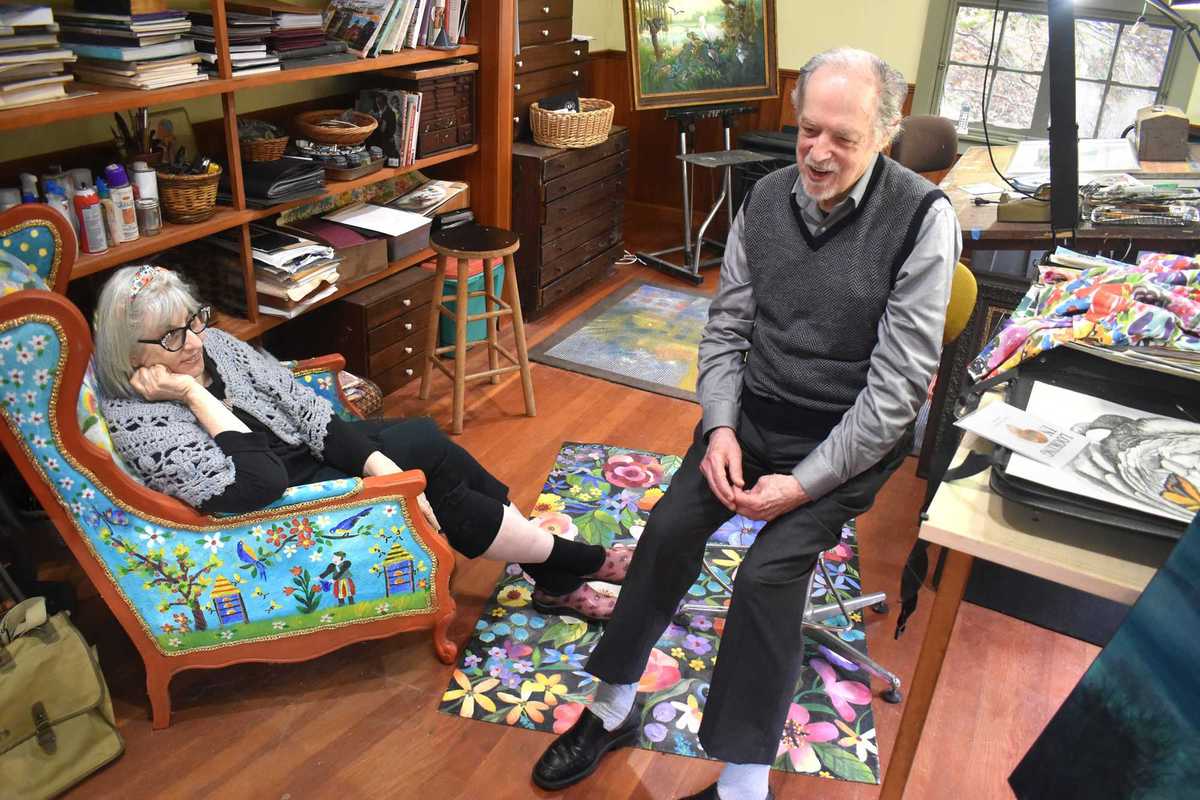
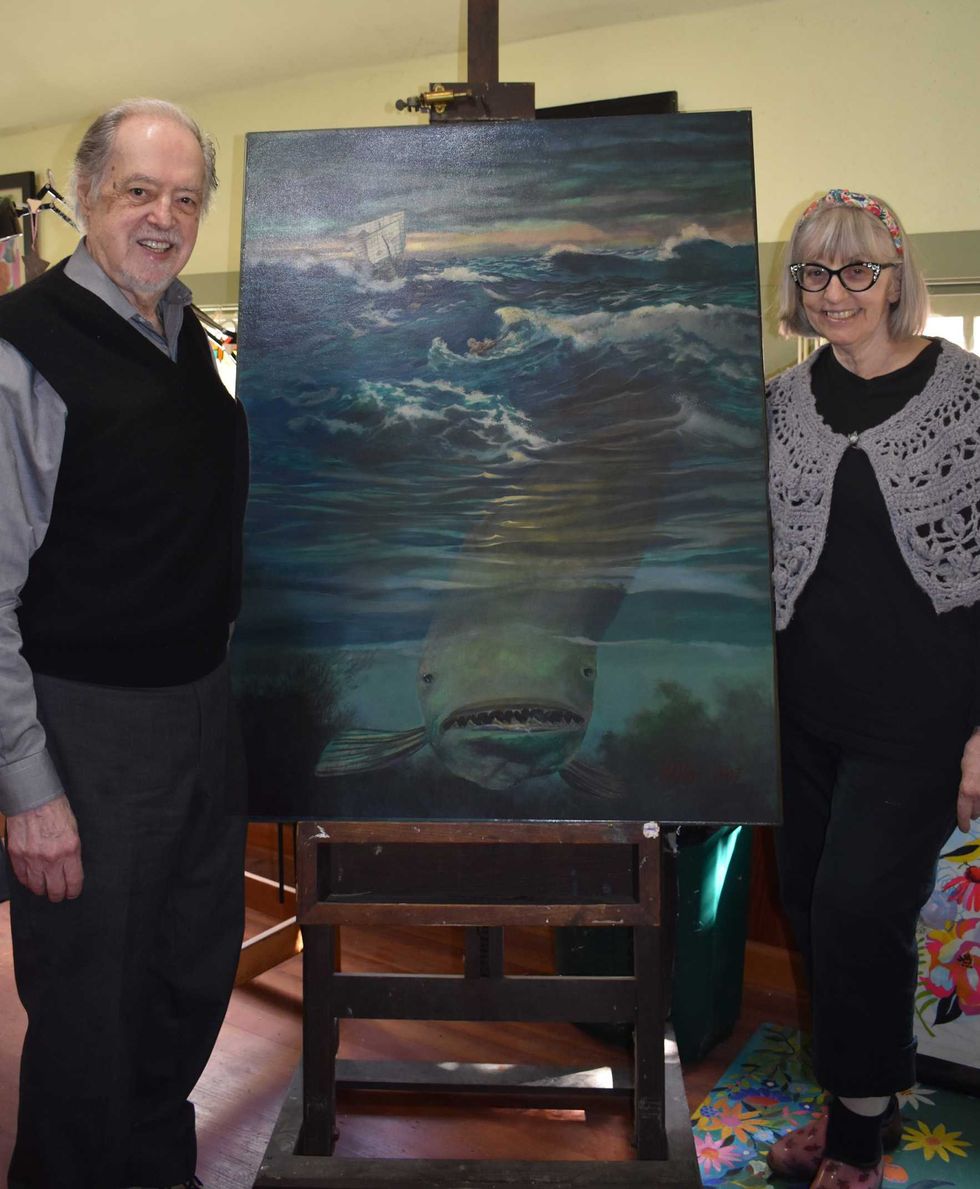 Justine and Victor Valla in their studio with a painting of Victor’s,”Jonah and the Whale.” Robin Roraback


 A ceramic vase by Kathleen Heidemann.Provided
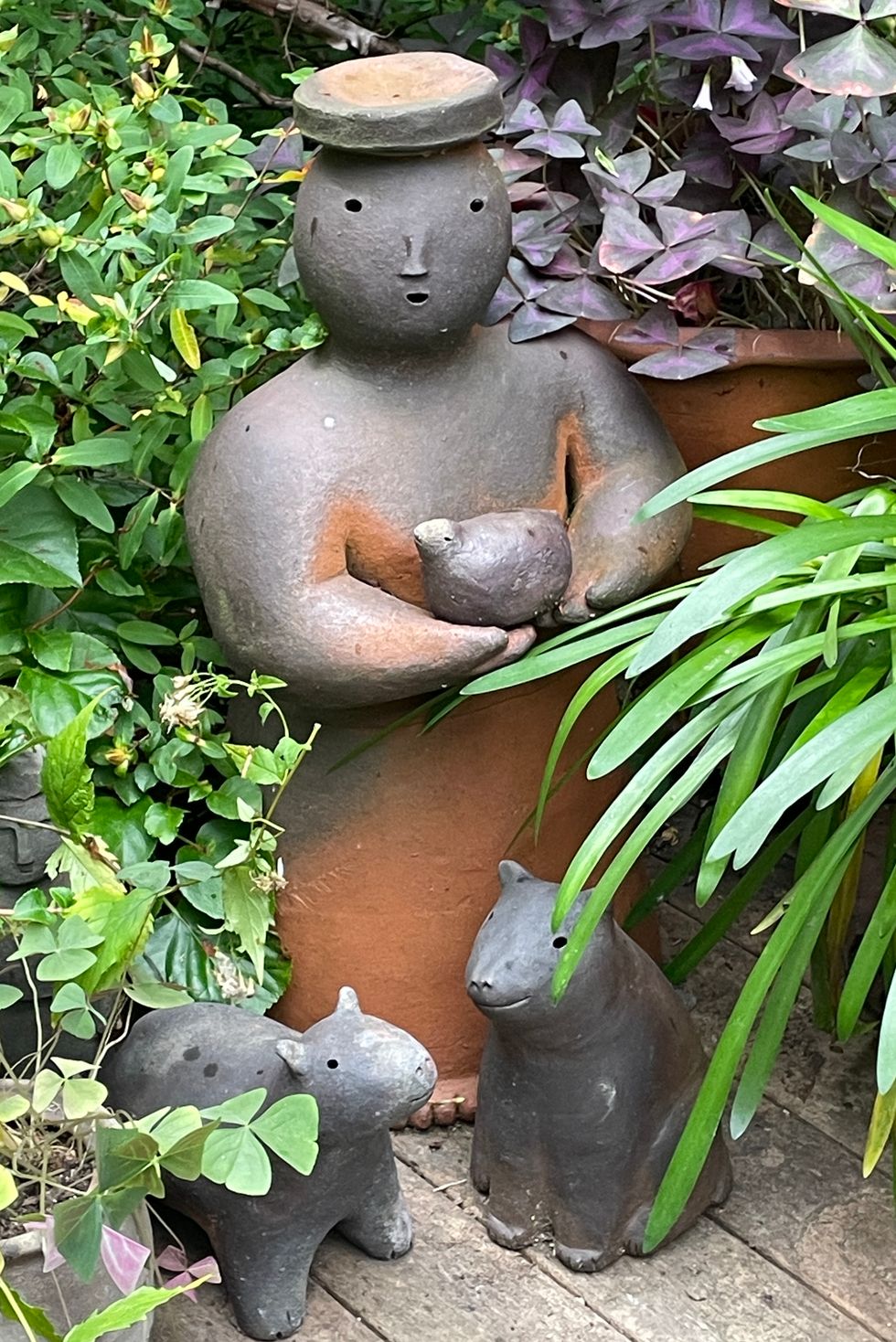 Joy Brown’s delightful ceramic sculptures.Provided