FALLS VILLAGE — About 70 people turned out for a Planning and Zoning discussion involving the town’s Plan of Conservation and Development (POCD) at the Lee H. Kellogg School Saturday morning, March 25.
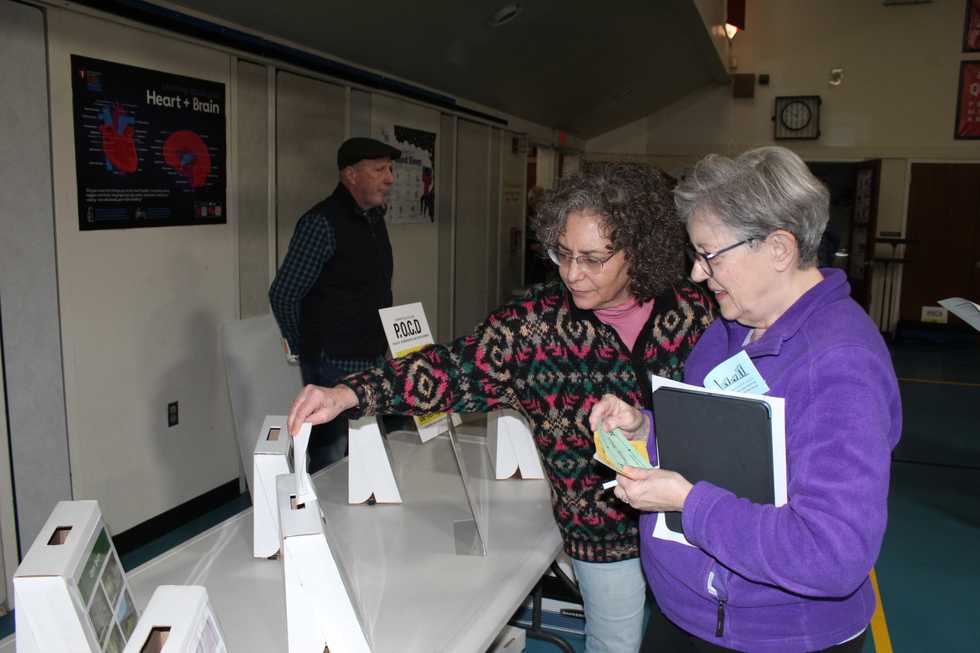
Upon entering, residents were given a sheet with the results from an online survey from January and five slips of paper that resembled coupons in denominations of points: one 20 point, two 10 point and two five point “coupons” for a total of 50 “planning points.”
These were to be deposited in the resident’s choice of 12 boxes, labeled with different areas of concern, such as economic development, natural resources and housing.
Planning consultant Glenn Chalder of Planimetrics, who ran the meeting, said the fact that the boxes outnumbered the coupons was deliberate.
“I apologize for putting you in a conundrum,” he said. “You expressed your choices — what’s important to you.”
The top four areas of interest identified in the exercise were: “Community Character,” “Housing Affordability and Needs,” “Economic Development,” and “Village Center.”
This generally reflected the priorities identified by some 231 residents who responded to the January online survey.
Andrea Downs said that the small size of the town’s population is an asset and promotes a tightly-knit community that is also welcoming to newcomers.
Pat Mechare, former first selectman and current chair of both the town and Region One school boards, commented on the “commitment of the few to the benefit of all,” in particular the volunteer fire and ambulance squads.
Judy Jacobs, speaking for the Falls Village-Canaan Historical Society, said visitors to her business, Jacobs Garage, often comment on the beauty of the historic buildings in the village center. She added a plug for establishing a historic district commission.
One individual got a laugh when he observed that the community’s characters were as important as the character of the community.
On affordable housing, Amy Wynn said housing supports all the other elements of the successful town.
Dan Silverman, chair of the Board of Finance, said the town needs to expand its tax base and one way to do that is to create affordable housing that attracts more people to town.
Denise Cohn said that affordable housing efforts should not neglect the “dozens of programs” aimed at first-time home buyers.
Chalders, mindful of the stated two-hour limit, kept the meeting moving.
On economic development, Mechare said the trick is figuring out how to “keep what we have,” and to encourage economic development while retaining the town’s traditional look.
Daly Reville said the town needs a septic system in the downtown area to attract businesses, and Jandi Hanna of the Falls Village Housing Trust said while there are jobs in the area, they are not particularly well-paid jobs, and more affordable housing rentals would allow those workers to live in town instead of commuting much longer distances.
Greg Marlowe said it is not realistic to expect a large number of new businesses in Falls Village. “Let’s focus on quality.”
On the village center, Jacobs said that well over half of the garage’s customers are from out of town and they book appointments based on when the Falls Village Cafe is open. She also noted that not being directly on a state road (Route 7) is a positive, as it allows the town to accommodate major events like the summertime car and motorcycle show without getting tangled up in state regulations.
Chalders started the meeting off by reminding everyone that POCDs are advisory documents and are required from all of Connecticut’s towns and must be updated every 10 years.