NEW PRESTON — As hydrilla and other aquatic invasive species spread across Connecticut, a new watercraft inspection and decontamination program at Lake Waramaug is testing an additional defense against their spread from lake to lake.
Launched this spring, the program operates at two sites: a municipal inspection station at the Lake Waramaug boat ramp and a hot-water decontamination facility slightly more than a mile away at the New Preston firehouse on Route 202. Organizers describe it as Connecticut’s first fully integrated, lake-based watercraft inspection and decontamination program.
By Saturday, Aug. 29, about 500 boats had been decontaminated during the 2026 season, program supervisor Jeffrey Gueniat said. Inspectors found invasive watermilfoil on boats arriving from Candlewood Lake — as well as Eurasian frogbit on a boat from Lake Zoar — though they had not detected hydrilla.
The program is designed to disrupt one of the principal ways aquatic invasive species spread: by hitching rides on boats, trailers and equipment moved between bodies of water.
At about 8 a.m. that Saturday, an inboard MasterCraft belonging to the Lake Waramaug Country Club sat on a trailer outside the firehouse as Gueniat and technician Pat Dwyer prepared it for inspection and treatment.
Gueniat began with a full examination.
“Underside, trailer, wiring, everything,” he said.
Dwyer connected an extension cord to the decontamination equipment, attached a hose and crawled beneath the four-ballast boat to flush its tanks. Gueniat then treated the boat’s underside and trailer with high-pressure water heated to 140 degrees.
After about 20 minutes, the boat was inspected again and fitted with a small wire seal connecting it to the trailer. The intact seal would tell monitors at the lake that the vessel had been cleared and had not been launched elsewhere.
The process is methodical by design: inspect, decontaminate, reinspect and seal.
The need for such precautions is growing. Greg Bugbee, an associate scientist with the Connecticut Agricultural Experiment Station’s Office of Aquatic Invasive Species and principal investigator of its invasive plant program, said Connecticut already leads New England in the percentage of lakes containing at least one invasive species.
“The horse is out of the barn at this point,” Bugbee said.
That does not mean prevention is no longer worthwhile. Quite the opposite, he said.
“Prevention, compared to management, is a bargain,” Bugbee said. “But it’s not going to be easy to pull off.”
From inspection to a second layer of defense
Lake Waramaug’s program grew out of decades of organized efforts to protect the lake.
The three towns bordering the 656-acre lake — Washington, Warren and Kent — have long worked with the Lake Waramaug Conservancy, the Lake Waramaug Authority and other lake organizations.
Under a 2004 agreement with the state, motorboats must pass an environmental inspection before entering the lake.
The new WISE Decon program — short for Waramaug Invasive Species Elimination — adds decontamination to that inspection system.
The program operates at two locations. The Washington Town Boat Ramp serves as the checkpoint, where monitors determine whether a boat has already been cleared for launch.
Boats without clearance are sent to the New Preston firehouse. There, technicians inspect and flush with hot water the hull, trailer, engine, anchor area, bilge, ballast tanks, live wells and other compartments where plants or aquatic organisms could collect.
The boat is then inspected again and a metal seal is attached between the vessel and its trailer. It returns to the ramp for a final visual inspection, where the seal is removed before the boat is launched.
According to the program’s interim report, the two-site system was adopted because the municipal ramp has limited space. The firehouse also has the water, power, drainage and staging area needed to inspect and decontaminate boats.
Gueniat, who also works as a launch monitor when he is not operating the decontamination unit, said he once “came across a weed on a boat” after it had gone through the hot-water treatment. That discovery prompted him to require a second inspection at the firehouse.
“That’s just me being cautious,” he said.
When a boat is removed from Lake Waramaug and loaded back onto its trailer, inspectors can attach a new seal connecting the boat to the trailer. If the vessel returns with the seal intact, monitors know it has not been launched in another body of water and can allow it to reenter Lake Waramaug without another decontamination.
“One guy has been back to the launch over 30 times, and he’s only gone to decon five times,” Gueniat said.
The seal system avoids unnecessary repeat treatments while identifying boats that may have entered other bodies of water.
Through June 30, the program recorded 67 repeat launches by vessels with intact seals, according to the interim report.
Those boats were allowed to return without undergoing another decontamination.
Lessons from the first season
Getting the program running by the opening of boating season was itself an accomplishment, said Sean Hayden, executive director of the Lake Waramaug Conservancy.
The Conservancy worked with the three towns, parks and recreation officials and other partners to develop the system during the winter.
“There was a lot of friction at first,” Hayden said. “Our program was one of the first of its kind ever in Connecticut. We were starting from scratch.”
“I was very happy that we had a program in place by April when the boat launch was ready to open,” he added. “That speaks volumes about what goes on behind the scenes to keep the lake healthy.”
Warren First Selectman Gregory LaCava said some boaters initially objected to the requirements, making clear explanations essential.
“There were a few upset at that point in time,” LaCava said.
He estimated that about 1 percent of boaters declined decontamination and left. He attributed at least one refusal to the process not being clearly explained.
Overall, however, resistance was “way less than I had expected,” LaCava said. He has received only one call at his office about the program since it began.
The interim report similarly found high compliance through June 30.
Officials, however, have identified several changes for next season, including reducing hours when the facility receives little use and improving signage.
They also plan to provide information in Spanish, particularly for people arriving with car-top watercraft.
The cost of prevention
The first-year program cost slightly more than $120,000, including about $40,000 for equipment, said Brian Zipp, co-head of the In-Lake Committee for the Lake Waramaug Conservancy.
The Conservancy purchased the main electric decontamination unit and a smaller, portable unit with a 300-gallon tank. The portable unit can be taken to parks, boat launches and other locations for off-site decontamination.
The proposed budget for the next fiscal year is about $65,000, Zipp said. They expect to lower operating costs by adjusting the facility’s hours and better utilizing the seal system to avoid unnecessary repeat decontaminations.
The Conservancy owns the equipment, while Washington, Warren and Kent share operating expenses on a 40/40/20 basis, according to the interim report.
Zipp said the investment also protects the lake’s ecosystem and the surrounding towns’ tax bases. An invasive species infestation can diminish property values, affecting homeowners and municipal revenue.
Bugbee said other lake communities may have difficulty assembling the money, expertise and municipal support required to establish similar programs.
“Most lakes don’t have organized associations around them, or the people who have knowledge at that level or are able to put out a lot of money,” he said. “A lot of these smaller lake groups are struggling.”
A model with limits
Hot-water decontamination cannot guarantee that hydrilla or another invasive species will never reach Lake Waramaug. But it can reduce the likelihood that invasive material will arrive on a boat, trailer or piece of equipment.
Even a small fragment can establish a new infestation, Bugbee said.
“It’s likely to regenerate even if a small fragment comes in,” he said.
The program could also intercept invasive species other than hydrilla.
“They could be preventing something else,” Bugbee said.
The program was modeled partly on programs in New York and several other states.
New York officials provided technical guidance and equipment assistance.
Lake George, which Waramaug officials consider the closest comparison, has inspected hundreds of thousands of boats and intercepted vessels carrying visible invasive species.
Lake Waramaug also has a geographical advantage: Most motorboat traffic enters through one municipal ramp.
“It’s a municipally managed ramp, not a state ramp,” Zipp said. “That gives us a unique position.”
That control allows local officials to tailor requirements to the lake. Replicating the system could be more difficult at lakes with multiple state, municipal or private access points.
“I think it is a great idea,” Bugbee said of the Waramaug model, “but I wonder how many public and private entities are going to be able to pull everything together as well as Waramaug did. We have a lot of lakes that really need these things, but I don’t know how fast it can happen.”
The need is growing. The aggressive Connecticut River variant of hydrilla was first identified near Glastonbury in 2016. By January 2025, DEEP had documented it in the Connecticut River and at 10 lake or pond sites. Its discovery in East Twin Lake in 2023 marked the first confirmed occurrence in a Connecticut lake.
Communities now face pressure in two directions: managing invasive species already present while trying to prevent them from reaching additional lakes.
At Lake Waramaug, that prevention begins each time a boat arrives at the ramp.
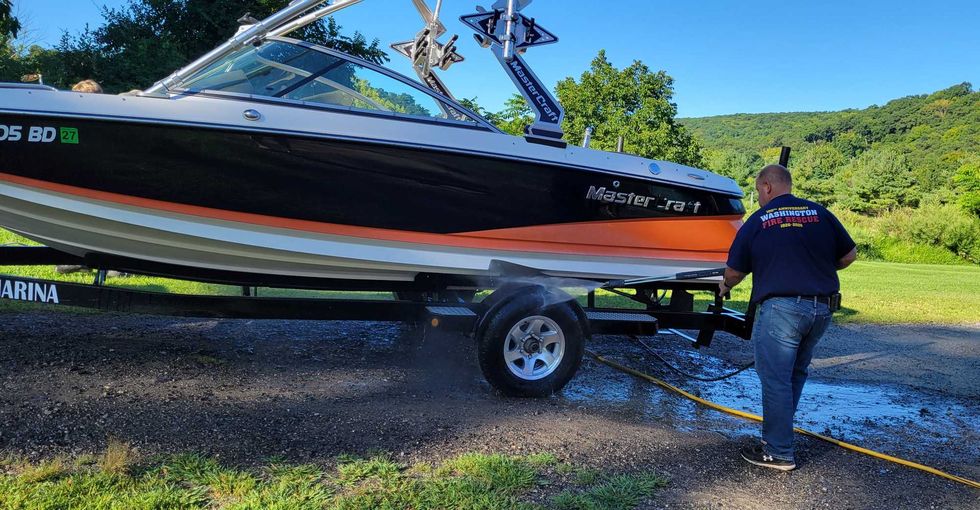 Jeffrey Gueniat power-washes a boat using high-pressure water heated to 140 degrees.Debra A. Aleksinas
DEEP begins testing boat decontamination units, including in Salisbury
Connecticut is not yet moving toward mandatory statewide boat decontamination, but the state is beginning to test washdown stations — also known as watercraft decontamination units — as part of its strategy against aquatic invasive species.
William Flood, a DEEP spokesman, said the agency recognizes watercraft inspection and decontamination as useful tools in combating AIS.
But DEEP, he said, oversees 117 state boat launches, most on inland waters, and a statewide inspection and decontamination program would require a significant investment.
The agency instead is taking a more targeted approach.
DEEP has received special funding from the U.S. Fish and Wildlife Service to pilot as many as three watercraft decontamination units along the Connecticut River, Flood said. Planning is underway for the first unit, which is expected to be installed at the Haddam Meadows State Park boat launch in Haddam.
A separate decontamination unit is planned for East Twin Lake in Salisbury using funding from a 2022 U.S. Fish and Wildlife Service grant. Flood said DEEP has worked with the town of Salisbury and the Twin Lakes Association to acquire the unit. The agency has received quotes from several vendors and is moving through the purchasing process.
DEEP says it currently has no plans to change statewide watercraft requirements. Instead, the agency continues to emphasize the Clean, Drain, Dry approach.
Since 2020, DEEP has awarded nearly $2.4 million to 80 projects through its AIS grant program, Flood said. The program is funded through the state’s AIS stamp and decal program.
Connecticut law requires boaters to inspect their boats and trailers and remove any visible aquatic plants or invasive species before transporting them. DEEP Environmental Conservation Police enforce the law statewide, regardless of whether a boat enters the water through a state, municipal or private access point.
But DEEP does not deploy seasonal boating education assistants or signage at non-state-operated launches. The emerging picture is therefore one of experimentation, rather than a statewide mandate.
For now, Connecticut’s approach remains experimental. Lake Waramaug has established its own integrated inspection and hot-water decontamination system, while DEEP is beginning to test decontamination units in other settings.
The agency said the pilot programs will provide information about the financial and staffing resources needed to deploy the units more broadly. Whether those pilots eventually lead to a wider statewide strategy remains an open question.



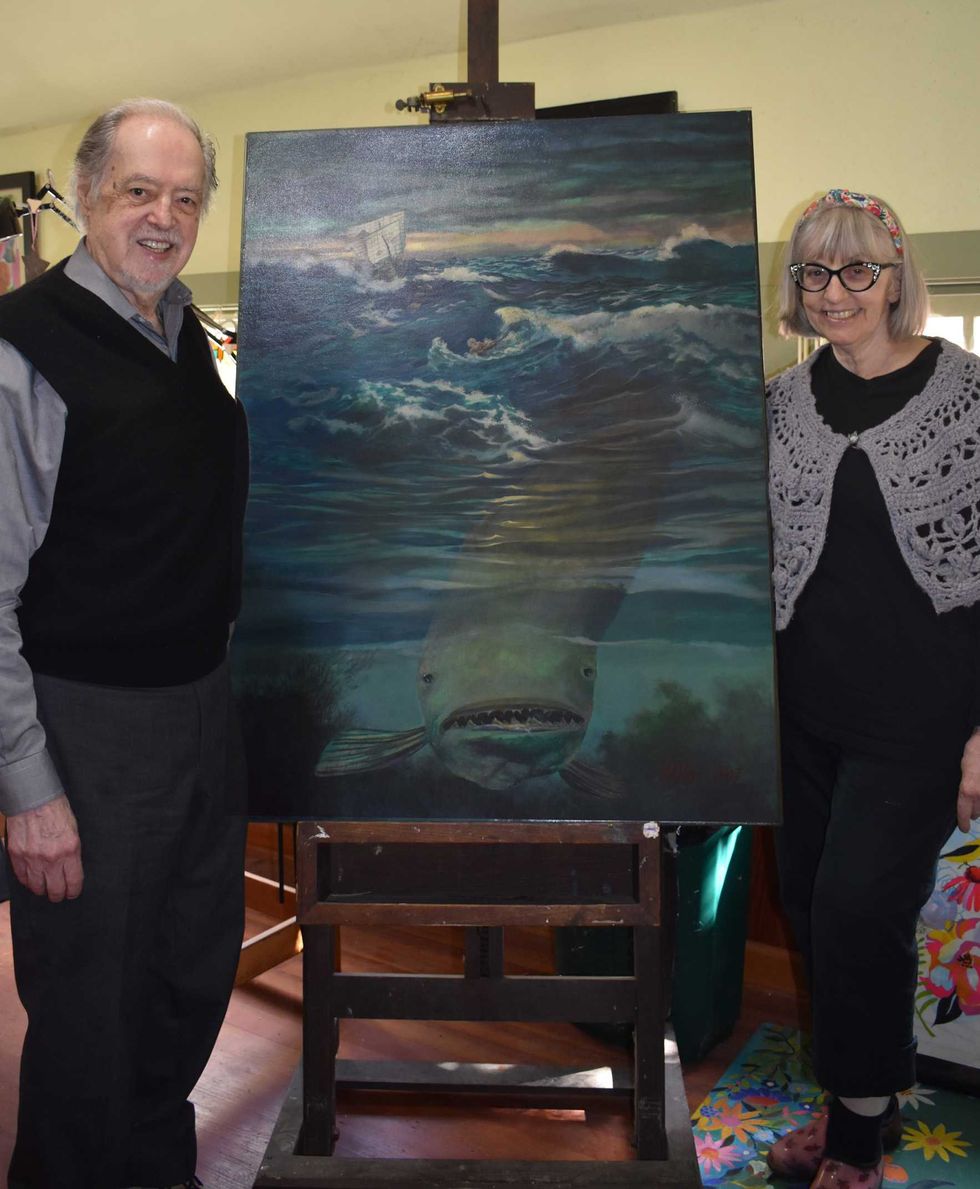 Justine and Victor Valla in their studio with a painting of Victor’s,”Jonah and the Whale.” Robin Roraback

 A ceramic vase by Kathleen Heidemann.Provided
 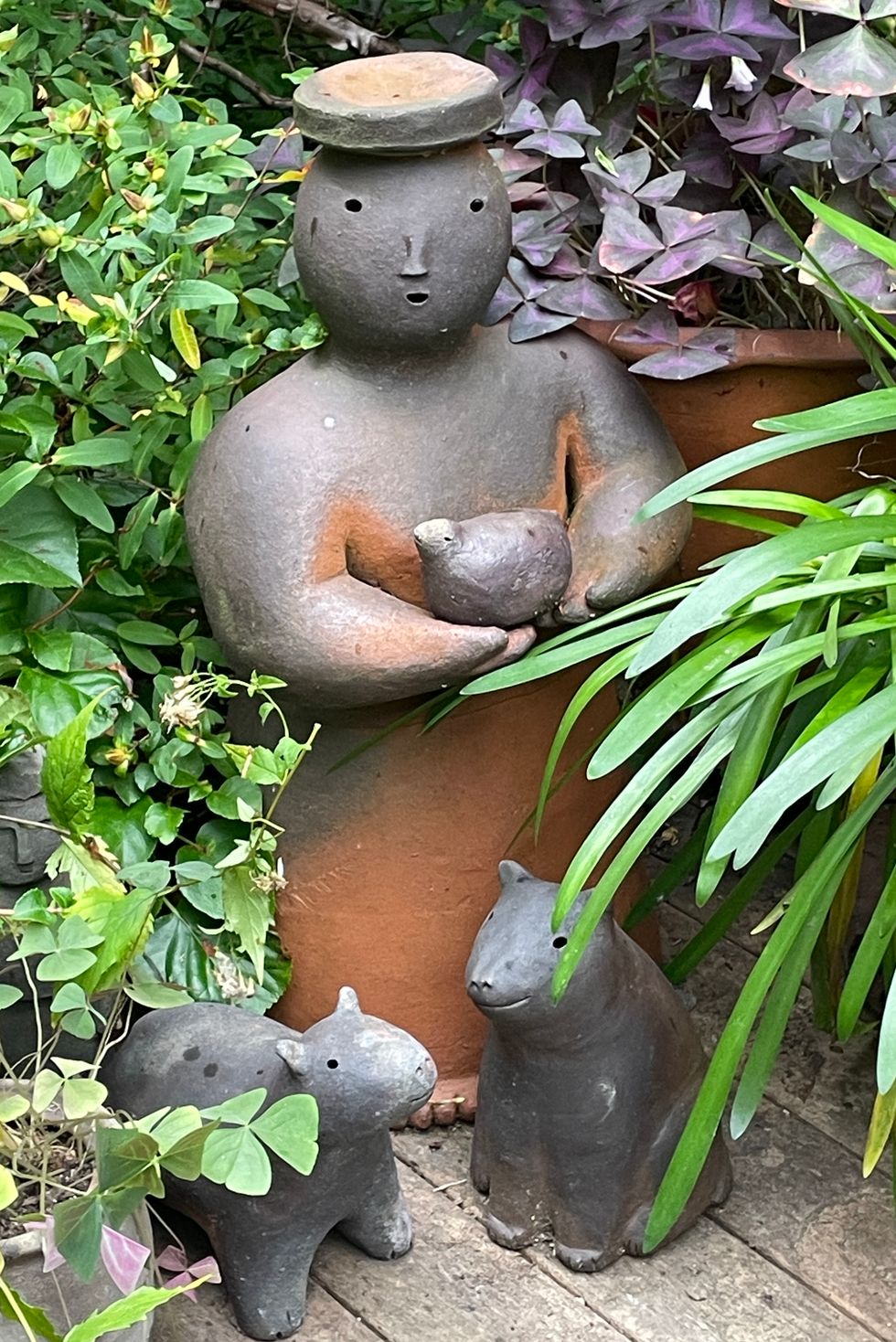 Joy Brown’s delightful ceramic sculptures.Provided

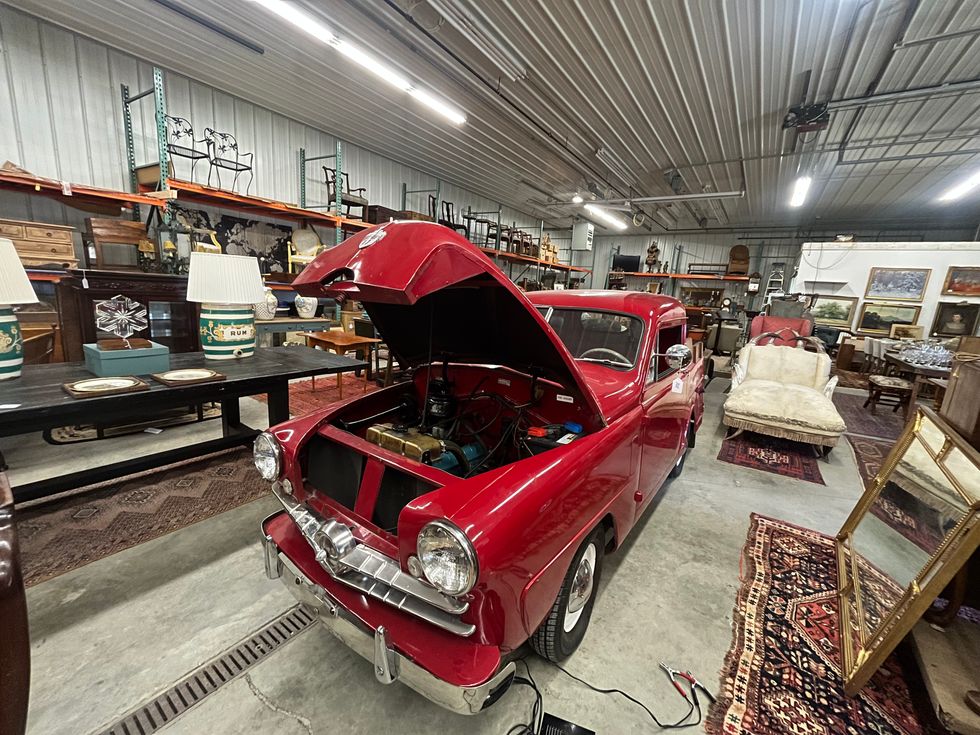 Hundreds of items at Stateline Auctions, including a candy-apple-red Crosley pickup truck.D.H. Callahan