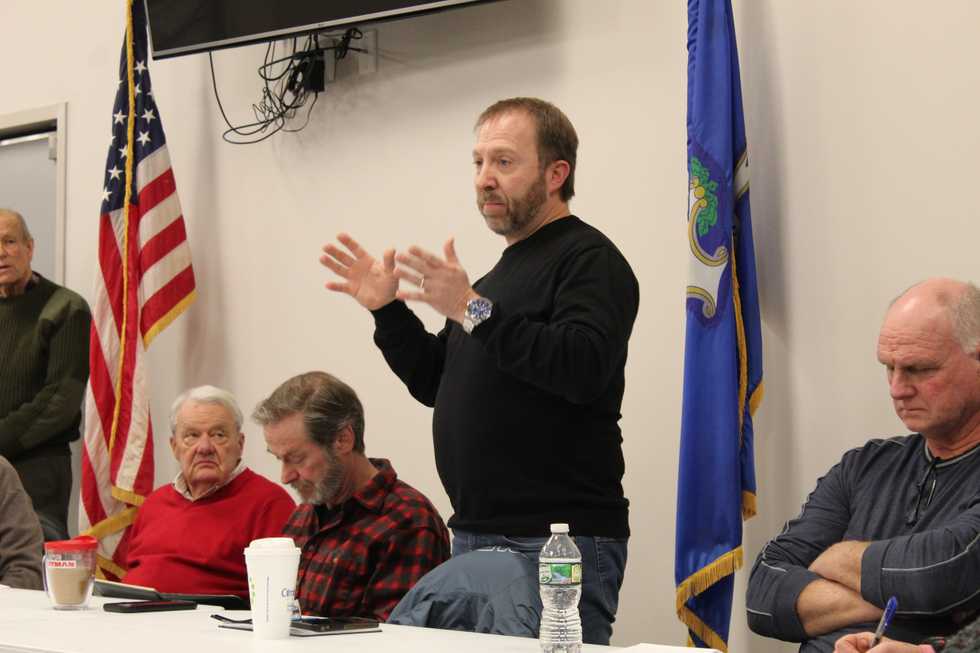
FALLS VILLAGE — Well over 50 people packed into the Emergency Services Center Friday night, Jan. 27, for a public hearing on the proposal to spend town funds to ensure all of Falls Village has access to fiber optic service.
The hearing was called by the Board of Finance and replaced a previously scheduled town meeting on the topic when it became apparent there were too many unanswered questions about the proposal.
There were additional participants online. This caused a slight difficulty at the beginning of the meeting, as someone was tuning a guitar and neglected to deploy the “mute” function.
Lou Timolat served as moderator.
He asked resident Tom Wilson to give an overview of the technology involved.
Wilson explained that fiber optics use glass fibers the width of a human hair to move information at the speed of light, as opposed to cable lines which move information at the speed of electrons.
Wilson said this means the fiber optic is roughly 10 times faster than cable, handles more bandwidth, is lighter and is designed to ultimately replace cable.
Asked what residential customers considering switching from cable internet to fiber optic will get, Wilson said the performance will be much better and the service will be synchronous, meaning the upload and download speeds will be the same. This is not the case with cable internet, he added.
First Selectman Henry Todd sketched out the Frontier proposal. He said the town has 618 homes, and Frontier is in the process of running the fiber optic lines to 502 of them. That leaves 116 homes (or 20% of the town) without access, on Barnes, Music Mountain and Undermountain roads.
Todd said Frontier is willing to extend access to those areas if the town kicks in $350,000. This number has come down from an initial figure of $750,000.
Todd suggested that the town use $150,000 from the general fund and borrow $200,000 from a local bank for five or 10 years. He said it would have a “minimal effect on property taxes.”
Todd also pointed out that Falls Village has several areas with no cell phone coverage. Any future infrastructure to provide better cell coverage will require fiber optic access before it can be built.
Joe Aresco, the head of construction and engineering for Frontier, said the company is in the middle of building a fiber optic network in the entire state.
He said one big advantage of fiber optics is that it is a “passive” system that will continue to function during power outages.
He said fiber optic offers “essentially limitless bandwidth.” After noting that he is not in the sales department, he said Frontier offers three monthly internet packages at $39.99 for 500 MB, $59.99 for 1 GB and $149.99 for 2GB.
Aresco said Frontier is not charging installation fees, and that the line to a home can be aerial or buried.
Carol Staats, speaking over the Zoom link, said someone from Frontier’s sales office told her Barnes Road was already wired for fiber optic.
Aresco said that he believed the information that Staats was given was incorrect.
There were questions and comments about the funding, which finance board chair Joel Jones said would be addressed by the board when it meets to consider the proposal and the input from the hearing. The Board of Finance is the entity that will decide whether or not to bring tha matter to the town meeting.
Finance board member Dan Silverman said he figured the cost of providing access to fiber optics for the 116 homes is about $3,000 per home.
Selectman Dave Barger said residents have told him that Frontier does not have a very good reputation for customer service.
Aresco said the company has gone through a bankruptcy and subsequent restructuring and is well into the process of building a statewide fiber optic network.
Timolat, taking his moderator’s hat off for a moment, said what residents need to consider is “the value to the future of the town to have the 20% included.”
There were some pointed observations about Frontier being a wealthy company that could afford to extend service ro everyone, and complaints about ever-increasing taxes.
As the meeting wound down, Todd said that residents will see substantial savings in their internet bills and asked, “Are we going to be fair to everyone in town?”