WINSTED — The Winchester Housing Authority has once again been named one of the nation’s best-run public housing communities.
The authority recently received a High Performer rating from the federal Housing and Urban Development (HUD) agency.
There are four possible overall ratings for HUD’s Public Housing Assessment Scores: High Performer, for a score of 90 percent or greater; Standard Performer, for score of 60 percent or greater; Troubled Performer, for score of less than 60 percent; and Modified or Withheld, which is given under special circumstances.
Fred Newman, the executive director for the Winchester Housing Authority, told The Journal Tuesday that the scores are based on three areas: comprehensive facility inspection, financial assessment and capital fund management.
And this year, Newman said, the authority received an overall score of 95 out of a possible 100 points.
“These kinds of things bode well for a housing authority,� he said of the high score.
This is the 10th year in a row the authority has received the top honor from the federal agency.
“We’ve just paid attention and listened … and kept our hands on the steering wheel,� Newman said.
Newman said achieving the High Performer rating has become increasingly difficult in recent years due to the the country’s economic downturn, which has “greatly impacted the requirement to manage growing waiting lists.�
He credited his small, three-person staff at the authority for continuing to maintain the agency’s high performance level.
“This achievement is due to their attitudes and willingness to assume the many new management requirements from HUD,� Newman said. “It serves as an example for many of the larger housing authorities.�
The High Performer ranking, however, has benefits besides bragging rights. The achievment also means that the authority is qualifed to receive a portion of any additional capital funding leftover in HUD’s coffers this year.
“And that money is then used to improve your properties,� Newman said.
He added that with the influx of American Recovery and Reinvestment Act dollars to HUD and other federal agencies over the last several months, the authority hopes that this year there will be more capital project funds available to local well performing authorities than in recent years.
“It could be a double whammy for us,� Newman said.
The Winchester authority also recently received word from HUD’s Hartford field office that its Chesnut Grove facility has maintained its Elderly Distinction status.
The status means that residency for the 80-unit facility is open to qualified elderly residents only. The designation is given when an overwhelming number of the residents — as well as those on the complex’s waiting list — are senior citizens.
“And that designation will continue now for another two years,� Newman said.
He said the elderly-only status is very important to the facility’s residents.
“Younger residents living in a facility will draw more younger people,� he said, adding that seniors tend to have a more secure feeling when they reside among those who are in the same age group.
Two months ago, the authority installed a new security system at Chesnut Grove.
The system, which was funded through a federal stimulus grant, uses the residents’ phone and cable television systems. The project cost $40,000.
To enter the complex, a visitor must “buzz� a specific apartment number. The buzz rings through to the resident’s phone. If after speaking to the visitor on the phone the resident is still unsure of who may be at the door, they can then view a live video of the visitor requesting entry on the complex’s cable Channel 14.
“No one can enter the facility without contacting a resident,� Newman said. “People living here feel very secure.�
The authority’s development corporation is also seeking to construct a new addition to Chestnut Grove.
The complex currently has 60 efficiency units and 20 one-bedroom apartments. The proposed expansion project seeks to add another 26 one-bedroom apartments.
Differing from Chestnut Grove’s current age restriction of 55 years old, the new addition would require that at least one household member be aged 62 or older.
And the authority has once again sought out HUD’s financial assistance for the expansion project, applying for a development grant through the federal department. Newman said the authority expects word this spring on whether its funding request was approved.
And finally, the authority’s foundation expects to break ground on its newest senior housing complex, Carriage Maker’s Place, this fall.
The new complex, which will be built at the upper end of Gay Street, will offer 17 one- and two-bedroom apartments to area residents age 55 and older.
The new facility will be the fourth senior housing complex operated by the authority in Winsted. The group also manages Greenwoods Gardens and Laurel Commons.
Newman said the authority’s development corporation recently received a $200,000 loan from the state to fund the preliminary planning portion of the project.
This has allowed the corporation to hire an architect to finalize the required development plans, which the foundation expects to be completed by the end of this month.
The total cost of the project is estimated at $3.5 million. The foundation is partnering with the Winsted-based Northwest Community Bank to fund the construction of the senior living complex.

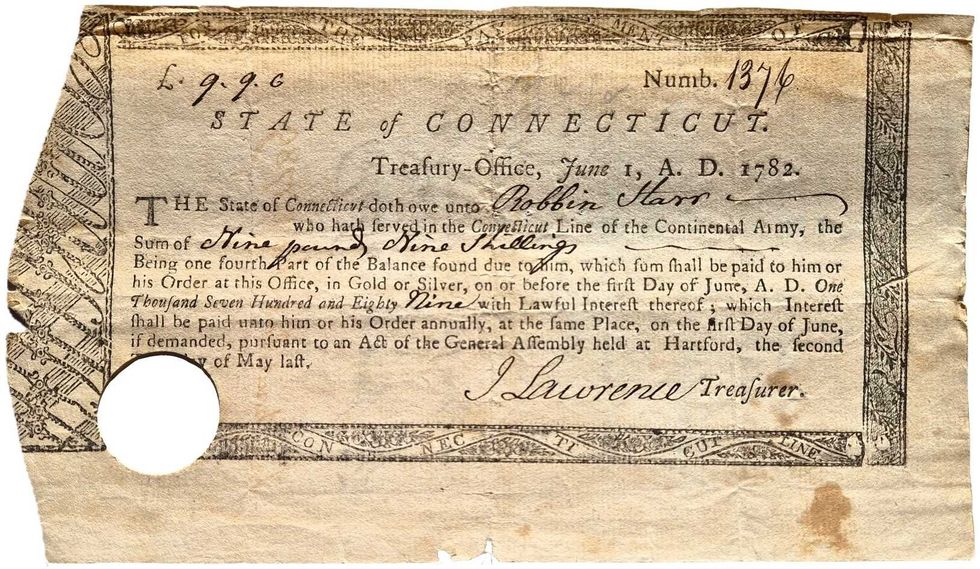 Pay Bill for Robin Starr’s service in the Continental Army.Courtesy the Alex Breanne Corporation
 John Mills speaking at Quinnipiac University.Courtesy the Alex Breanne Corporation
 Stephanie Saetta,with her rescue dog George and Blue (left), a shepherd mix awaiting his forever home.Madi Long
 Blue, a 7 year-old Shepard mix, is waiting for his forever home. Madi Long