SALISBURY — Do you carry your Social Security card with you? How about credit cards, even one? Do you ever write your Social Security number on forms or applications? If you’ve answered "yes" to any of these questions, you’re leaving yourself open to identity theft, according to Frederick J. Tedesco, security officer for Litchfield Bancorp and Northwest Community Bank. His firm, Connecticut Mutual Holding Company, is on Main Street in Winsted.
Speaking at a Salisbury Rotary Club meeting last week at Geer Village in North Canaan, Tedesco warned against complacency in thinking there’s more security in the country than in the city. He emphasized the importance of protecting financial information wherever you live, since criminal activity can, and does, occur everywhere.
For instance, he said, a Webster Bank ATM machine in Litchfield was broken into in January, with the robbers bringing some large equipment to lift the automatic teller machine right off its foundation. Tedesco also noted that criminals use rural route mail boxes as an opportunity to steal mail, like electric bills, credit card bills or checking account statements left by the post office in the mail box on the street. Or, they can access this information in trash cans left out on the street awaiting pickup, known as dumpster diving. They then use the information to access accounts and run up illegal charges, or to outright steal identities.
According to Tedesco, some kinds of illegal accessing of financial accounts are not easily limited, like the use of forged bank checks or money orders. The criminals will change the victim’s address on the accounts, making it difficult to trace the path of the stolen money, or even for the victim to be aware of the theft.
Another path criminals have to financial information is the telephone. Phone scams to obtain credit card and Social Security numbers are common in the country and the city, Tedesco said. His advice is to avoid talking to anyone on the phone if they call you for information. Rather, get their number and call them back to confirm they are actually attached to a legitimate financial institution with which you do business. In other words, know, without a doubt, whom you’re talking to.
Why not carry your credit or Social Security cards on you? Tedesco said it not only leaves you open to a thief stealing your wallet and obtaining all your personal information, but also to an illegal activity known as "skimming." Skimming devices can be hidden in the pocket of sales person or a server in a restaurant, who can scan your credit card while taking it to process a payment. He said he will follow any service person with whom he’s unfamiliar who takes his credit card into another room to process it, just to confirm they’re processing it legitimately.
Tedesco advises leaving your cards (credit, Social Security, Medicare) in a secure place that a family member or friend knows about, only bringing a credit card along when you know you’re making a major purchase. Otherwise, use cash. If you’re asked for your Social Security number on an application, including employment applications, ask three questions: 1. What do they do with it? 2. How do they store it? 3. Who sees it? Be sure these questions are answered to your satisfaction before you hand over your personal information.
He also advises shredding personal trash before processing it to the dumpster. He believes the regular straight shredders are sufficient to protect your information. "No thief is going to sit there and try to reassemble shredded documents, they’ll just go on to the next garbage, where it’s easier to get the information," Tedesco said.
It’s important to view your credit report at least once a year, he said, and this can be done, depending on your state’s laws, either for no cost or at no more than $9 per report. The three major credit bureaus are: Equifax, 800-685-1111, equifax.com; Experian, 888-397-3742, experian.com; and TransUnion, 800-916-8800, transunion.com.
For further information on protecting yourself from identity theft, go to consumer.gov/idtheft or call 877-ID-THEFT at the Federal Trade Commission.


 Justine and Victor Valla in their studio with a painting of Victor’s,”Jonah and the Whale.” Robin Roraback


 A ceramic vase by Kathleen Heidemann.Provided
  Joy Brown’s delightful ceramic sculptures.Provided

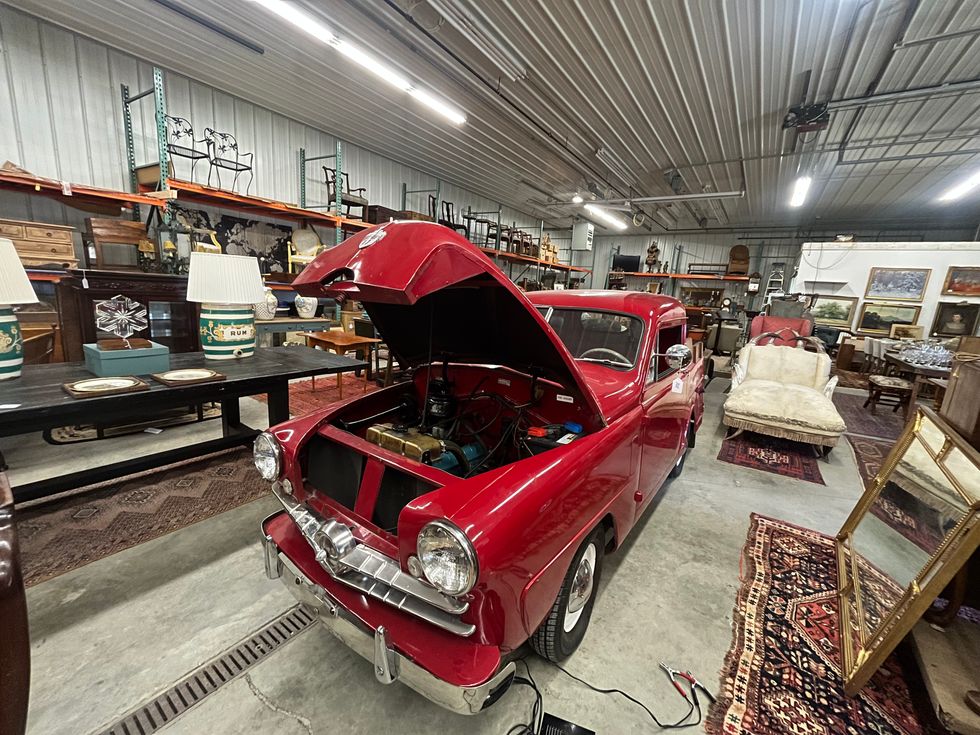 Hundreds of items at Stateline Auctions, including a candy-apple-red Crosley pickup truck.D.H. Callahan