Kent Transfer Station set for major upgrades with $408K grant

Kent Transfer Station set for major upgrades with $408K grant

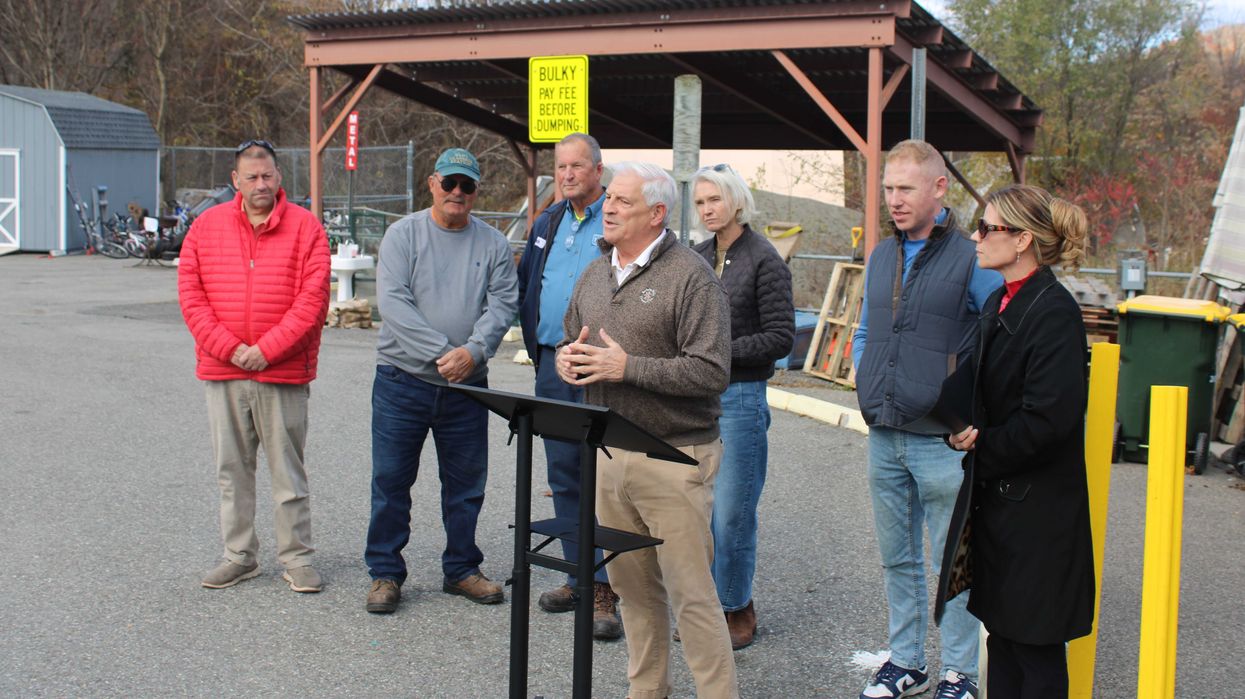
Outgoing first selectman Marty Lindenmayer thanks Kent’s leaders and employees for their commitment to waste management. Behind, from left: First Selectman-Elect Eric Epstein, transfer station staff Rob Hayes and Rick Osborne, State Rep. Maria Horn (D-64), State Sen. Stephen Harding (R-30), and HRRA Executive Director Jennifer Heaton-Jones.

Alec Linden

KENT — The Kent Transfer Station is set to undergo a series of major renovations meant to modernize and streamline its waste management operations after receiving a state grant of $408,500 in a recent round of funding.

Town, state and regional officials gathered at the facility on Tuesday morning, Nov. 4, to celebrate the award and discuss the future of recycling, composting and waste reduction in Kent and across western Connecticut.

Among the speakers was Jennifer Heaton-Jones, executive director of the Housatonic Resource Recovery Authority (HRRA), a regional government agency that manages waste and recycling programs for 14 municipalities in western Connecticut. “Waste is not a partisan issue — it affects all of us every day,” she told the assembled group.

The funding will support key infrastructure upgrades designed to improve the transfer station’s efficiency and safety. Planned improvements include the construction of a retaining wall to separate waste streams and reduce cross-contamination, a new shed to safely store motor oil, paint and shredded paper, and new canopies over waste and recycling containers to improve material quality and reduce litter. The grant will also fund the installation of a new scale to support Kent’s nascent “pay as you throw” unit-based pricing program.

The “pay-as-you-throw” initiative — made permanent last fall after a successful pilot — charges residents by the bag rather than a flat annual fee, incentivizing lower waste generation. Heaton-Jones said the new scale will help “build on that momentum” by providing data to refine the program and expand composting efforts.

Kent’s award represents nearly one-third of the HRRA’s total $1.5 million allocation from the second round of the Department of Energy and Environmental Protection’s Sustainable Materials Management (SMM) grant program. In late October, DEEP announced $7.5 million in total funding to support municipalities and regional waste authorities across Connecticut.

The grant money comes in the midst of what Heaton-Jones described as a “waste crisis” in the state where, since the dissolution of the Hartford MIRA facility in 2022, about 40% of Connecticut’s municipal solid waste is exported to out-of-state landfills and recycling centers.

Heaton-Jones thanked Conservation Commission Chair and former First Selectman Jean Speck, who spearheaded Kent’s earlier waste reduction initiatives, and current First Selectman Marty Lindenmayer, who helped continue and expand them, praising both for their “consistently demonstrated leadership in waste reduction despite limited resources.”

The attendees, which included State Rep. Maria Horn (D-64), State Sen. Stephen Harding (R-30), First Selectman-Elect Eric Epstein, transfer station staff members Rob Hayes and Rick Osborne, and the majority of the Kent Conservation Commission, agreed with Heaton-Jones’s assessment.

During his own speech, Lindenmayer said that Kent had “set the tone in how we can continue to improve.” He thanked Hayes and Osborne for their contributions and ongoing hard work: “These guys do it with humor and good will and in all types of weather.”

Horn similarly lauded Kent’s commitment to waste reduction, describing it as a town “that has really stuck its neck out,” while Harding admired the town’s ability to come together and work as a team with various groups: “It’s a shining example of addressing our waste crisis efficiently.”
Latest News

A new life for Barrington Hall

A new life for Barrington Hall

Dan Baker, left, and Daniel Latzman at Barrington Hall in Great Barrington.

Provided

Barrington Hall in Great Barrington has hosted generations of weddings, proms and community gatherings. When Dan Baker and Daniel Latzman took over the venue last summer, they stepped into that history with a plan not just to preserve it, but to reshape how the space serves the community today.

Barrington Hall is designed for gathering, for shared experience, for the simple act of being together. At a time when connection is often filtered through screens and distraction, their vision is grounded in something simple and increasingly rare: real human connection.

Keep ReadingShow less

Gail Rothschild’s threads of time

Gail Rothschild’s threads of time

Gail Rothschild with her painting “Dead Sea Linen III (73 x 58 inches, 2024, acrylic on canvas.

Natalia Zukerman

There is a moment, looking at a painting by Gail Rothschild, when you realize you are not looking at a painting so much as a map of time. Threads become brushstrokes; fragments become fields of color; something once held in the hand becomes something you stand in front of, both still and in a constant process of changing.

“Textiles connect people,” Rothschild said. “Textiles are something that we’re all intimately involved with, but we take it for granted.”

Keep ReadingShow less

Sherman Players celebrate a century of community theater

Sherman Players celebrate a century of community theater

Cast of “Laughter on the 23rd Floor” from left to right. Tara Vega, Steve Zerilli, Bob Cady (Standing) Seated at the table: Andrew Blanchard, Jon Barker, Colin McLoone, Chris Bird, Rebecca Annalise, Adam Battlestein

Provided

For a century, the Sherman Players have turned a former 19th-century church into a stage where neighbors become castmates, volunteers power productions and community is the main attraction. The company marks its 100th season with a lineup that blends classic works, new writing and homegrown talent.

New England has a long history of community theater and its role in strengthening civic life. The Sherman Players remain a vital example, mounting intimate, noncommercial productions that draw on local participation and speak to the current cultural moment.

Keep ReadingShow less
google preferred source

Want more of our stories on Google? Click here to make us a Preferred Source.

Reimagining opera for a new generation

Reimagining opera for a new generation

Stage director Geoffrey Larson signs autographs for some of the kids after a family performance.

Provided

For those curious about opera but unsure where to begin, the Mahaiwe Theater in Great Barrington will offer an accessible entry point with “Once Upon an Opera,” a free, family-friendly program on Sunday, April 12, at 2 p.m. The event is designed for opera newcomers and aficionados alike and will include selections from some of opera’s most beloved works.

Luca Antonucci, artistic coordinator, assistant conductor and chorus master for the Berkshire Opera Festival, said the idea first materialized three years ago.

Keep ReadingShow less
BSO charts future amid leadership transition and financial strain

Aerial view of The Shed at Tanglewood in Lenox, Massachusetts.

Provided

The Boston Symphony Orchestra is outlining its path forward following the announcement that music director Andris Nelsons will step down after the 2027 Tanglewood season, closing a 13-year tenure.

In a letter to supporters, the BSO’s Board of Trustees acknowledged that the news has been difficult for many in its community, while emphasizing gratitude for Nelsons’ leadership and plans to celebrate his final season.

Keep ReadingShow less
A tradition of lamb for Easter and Passover

Roasted lamb

Provided

Preparing lamb for the observance of Easter is a long-standing tradition in many cultures, symbolizing new life and purity. For Christians, Easter marks the end of Lenten fasting, allowing for a celebratory feast. A popular choice is roast lamb, often prepared with rosemary, garlic or lemon. It is traditional to serve mint sauce or mint jelly at the table.

The Hebrew Bible suggests that the last plague God inflicted on the Egyptians, to secure the Israelites’ release from slavery, was to kill the firstborn son in every Egyptian home. To differentiate the Israelites from the Egyptians, God instructed them to mark their doorposts with the blood of a lamb. Today, Jews, Christians and Muslims generally believe that God would have known who was Israelite and who was Egyptian without such a sign, but views of God’s omnipotence in the Abrahamic faiths have evolved over the millennia.

Keep ReadingShow less
google preferred source

Want more of our stories on Google? Click here to make us a Preferred Source.

google preferred source

Want more of our stories on Google? Click here to make us a Preferred Source.