Darkness ebbs slowly. Especially for a reticent fellow like John Atchley. In recent years this Salisbury resident has suffered fire, losing his house; flood, losing his stored photographs; and, after rebuilding, a plague of carpenter ants. “They were dropping from the ceiling on us. “Biblical,” he called it. Then Atchley did something brave. “I just got over my block about being in public.” He entered a Housatonic Camera Club show, the first photograph he had exhibited in decades. Not that he had quit shooting, of course. It’s just that after graduating from Yale with a master’s degree in photography in 1971, he lost the thread. He had been photographing “rocks and trees and water,” using a big clunky view camera. But for a man who likes the outdoors, graduate school required much too much time indoors. “Two years in a darkroom almost killed me.” Also, he had no interest in commercial photography, so he considered the kind of work his friends were taking: Teaching. In his case, teaching photography. Not a good move. “I was way too shy,” he says. Also, “I had no tolerance for people who were not like me. Over serious.” So he became a carpenter. A carpenter who stored his photographs of rocks and trees away. That’s the story until photographer Cassandra Sohn saw his work in a couple of area shows and asked Atchley to put an exhibit together for her new gallery in Stockbridge, MA. There had to be a theme, of course, Atchley told me. “You can’t have a show without one.” His: Out of Darkness. Still rocks and trees and water, but more painterly than earlier work, he says, more abstract, more reckoning with movement and light. Most striking is a black-and-white shot of the Housatonic River in Falls Village. Standing on the river’s edge he photographed the falls straight on, a vertical storm of silky white water, hand-holding his Canon 5D MK II and using a slow shutter, a small aperture and a wide lens. The result is, well, abstract. And beautiful. He has color in this show as well, a subdued amber, really. A fine panoramic shot of hills is memorable for a couple of birds overhead. Anyone who shoots knows it’s hard catching birds on the wing. But not so hard in Florida, evidently. “Flamingos just fly into view. They just keep coming,” Atchley says. Now he never leaves the house without a camera, and he is working in his own style, panning with a slow shutter, slipping sideways and vertically to give his shots a lovely, veiled look. “At 64,” he says, “I’m an emerging artist.” “Out of Darkness” runs at Sohn Fine Art Gallery, 6 Elm St., in Stockbridge, MA, through Nov. 19. For information, telephone 917-849-9193 or go to www.cassandrasohn.com.
Latest News

Misty Blues brings its own brand of blues to Egremont
D.H. Callahan
Gina Coleman of the band Misty Blues.
Gina Coleman of the band Misty Blues has been rocking the Berkshires for over 30 years. On Saturday, Nov. 28, she’ll bring her full band to the Buttonball Barn in Egremont for a Thanksgiving weekend show that’s bound to get concertgoers off their feet to shed some of that extra holiday heft.
Coleman had already been a fixture on the Berkshire music scene when she performed as a gospel blues singer who took the stage between scenes for a Williamstown Theatre Festival production of “A Raisin in the Sun” in 1999. The production starred Ruben Santiago-Hudson and eventual EGOT winner Viola Davis. Coleman had been mostly playing her own funky brand of acoustic folk with her band Cole Connection, but when Sentiago-Hudson heard her try her hand at the blues, he encouraged her to pivot.
He gave Coleman a copy of “Men Are Like Streetcars,” a compilation of blues tunes sung by women between 1929 and 1964. Featuring blues pioneers like Sister Rosetta Tharpe, Big Mama Thornton and Billie Holiday, the collection opened her eyes to a new world of musical possibilities. For Coleman and the band, it served as a road map through the history and different iterations of the blues. As they developed their own approach to the genre, Coleman and her band decided to take Santiago-Hudson’s advice. They ditched the old name, plugged in some electric instruments and were reborn as Misty Blues.
In 2019, the band made it to the finals of the prestigious International Blues Challenge in Nashville. This was a huge win for the band and helped earn Misty Blues some hard-earned press. After all, a band from rural Massachusetts isn’t exactly what you expect to see on a Nashville stage, let alone performing in the finals. To keep the momentum going through the shutdown, the band quarantined together and performed live online every Friday night for 63 weeks.
Misty Blues is still going strong today, with 18 albums under its belt and a documentary called “Silver Lining: 25 years of The Misty Blues.” There have been a variety of musicians over those years, with most of the founders recently taking their final bows, but that hasn’t slowed down the music. In fact, one member in particular seems to fuel the band’s perpetual creativity.
Coleman’s son Diego Mongue was in high school when the COVID-19 pandemic shut down schools, forcing students to take classes remotely, and isolate themselves from their friends and the activities so integral to youth. But Mongue took the shutdown as an opportunity to develop his skills. Starting with drums, he would sit in with the band for many of its pandemic livestreams.
As a self-designated Frank Zappa freak, Mongue took a page from his idol’s book and used the time to sharpen his skills. Zappa preached the gospel of musical proficiency as the most righteous way to bring ideas to life. The pandemic gave passionate players like Mongue room to master their instruments. Soon, thanks in part to his studies at Williams College, where Coleman also studied, his skills had become so well-rounded that he could fill in wherever he was needed. After drums, he did a stint as the rhythm guitarist but eventually found his place on the bass.
It’s not quite right to categorize Zappa as blues, but that’s what makes Misty Blues so unique. The band members all come from different musical worlds. They bring their own interests and skills, be they folk, funk or jazz, to the kitchen, mix it all together and come out with their own brand of blues.
“I don’t think I exist without the blues,” Coleman says in “Silver Lining.” Her passion seems to mirror that of everyone in the band.
As an homage to the women who came before her, and perhaps as a nod to the album that started her down the blues road, Coleman and the band have a couple of dedicated projects. “Queens of the Blues” sees Misty Blues interpret the songs of blues legends Big Mama Thornton, Ruth Brown, Bessie Smith and Koko Taylor in a self-contained stage show. This past spring, Coleman released her third solo album, “Uncrowned; A Tribute to Ida Cox.”
For the show at the Buttonball Barn in Egremont, the band will be diving into its arsenal of toe-tappers and booty shakers. Expect to hear Misty Blues originals alongside recognizable classics, all handpicked to make you get up off of your seat and boogie the night away.
For tickets, visit button
ballbarn.com
The littlest reindeer comes home for the holidays
Natalia Zukerman
MacKenzie Cadenhead will read from and sign copies of her debut picture book “Jingle” at Merritt Bookstore in Millbrook on Saturday, Nov. 28 at 11 a.m.
For author and editor MacKenzie Cadenhead, Christmas has long meant Pine Plains. It’s where her family gathers, where she got married and where her father, a retired theatrical producer with a gift for building things, transformed an old farmhouse into a beloved family retreat. It’s also where the children’s book author will return this Thanksgiving weekend, bringing along a new member of the family, at least in spirit: a tiny, determined reindeer named Jingle.
Cadenhead’s new picture book, “Jingle: How the Littlest Reindeer Earned Her Bells,” illustrated by Erin Kraan and published by Random House Studio, follows the North Pole’s smallest reindeer as she competes against bigger, faster and stronger rivals for the chance to fly with Santa. It’s a delightfully sweet tale about finding your way in a world that doesn’t always make room for the little guy. The story grew out of bedtime storytelling, creative collaboration and a particularly difficult chapter in Cadenhead’s own life. On Saturday, Nov. 28, at 11 a.m., she’ll share the book at Merritt Bookstore in Millbrook with a reading and signing on Small Business Saturday.
Although she was raised in New York City, Pine Plains has been a second home for much of Cadenhead’s life. Her parents purchased the property there in the 1990s with her older brother.
“It’s always been a very cool place to go and to sort of consider home, even though I didn’t grow up there, because my parents are so rooted there,” she said.
Family visits have long included movies at The Moviehouse in Millerton, trips to the Trevor Zoo (the red panda is a family favorite) and browsing the area’s independent bookstores.
Art and theater were always part of Cadenhead’s life. After studying English at Haverford College and earning a master’s degree in dramaturgy at Brooklyn College, she worked in theater before finding her way into comic book editing at Marvel. There, she discovered a love for storytelling aimed at younger readers, eventually writing comics, chapter books and novels of her own. She still credits her background in dramaturgy with shaping her approach to comics.
“It was kind of perfect because those dramaturgical skills, they applied perfectly to editing comics,” Cadenhead explained.
That collaborative approach carried over to the creation of “Jingle” as well. Cadenhead describes the work she did with her literary agent, illustrator and editor to bring it to life. “This is, again, this is the dramaturg in me,” she said of the process.
Jingle first appeared during the pandemic, when Cadenhead’s children requested a story about Mrs. Claus. Improvising on the spot, she invented a tale in which Mrs. Claus delivered presents for Christmas in July, accompanied by a miniature reindeer.
Years later, Jingle resurfaced as a supporting character in another holiday story. When Cadenhead’s agent pitched the idea, it was the little reindeer who captured everyone’s attention. A new proposal followed, along with a collaboration with illustrator Erin Cron.
The book’s message of hope and determination took on particular meaning as Cadenhead wrote it during her father’s illness.
“I was looking for light and I was finding it,” she said. “And sometimes I feel like I needed to hear that myself.”
Her father, who died in 2024, was with her when the publishing offers arrived. Her agent called him her good luck charm.
Another cherished moment came when the finished books arrived at her home. Her three children gathered around the box, then took turns reading “Jingle” aloud, passing the book from one to another.
“I just sat there going, ‘Oh, this is probably one of the coolest moments of my life,’” she recalled.
Now Cadenhead gets to share Jingle with a new generation of young readers, including those in the community that has been part of her family’s story for decades.
“There’s pretty much nothing cooler than going to a bookstore and reading your story to kids,” she said.
MacKenzie Cadenhead will read from and sign copies of “Jingle: How the Littlest Reindeer Earned Her Bells” on Saturday, Nov. 28, at 11 a.m. at Merritt Bookstore in Millbrook. For event details and registration, visit merrittbooks.com.

Papier-mâché with Polly
Natalia Zukerman
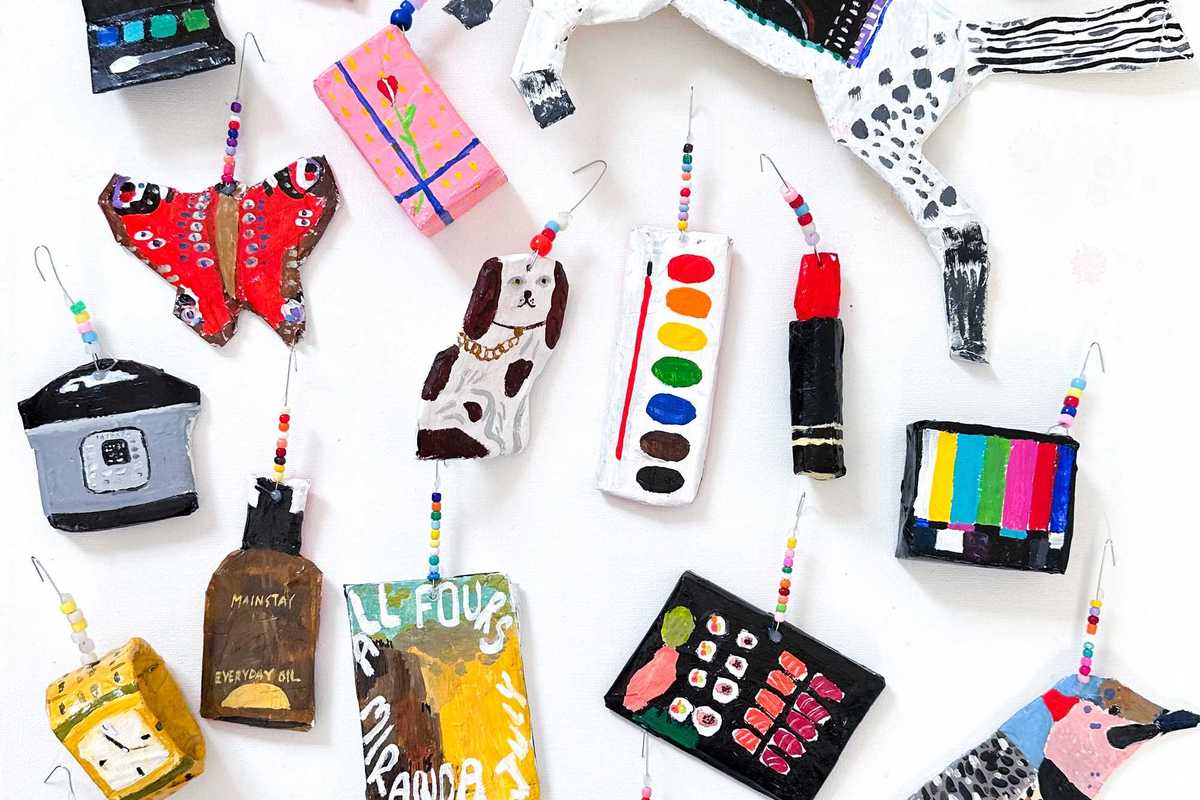
Handmade treasures by Polly Shindler.
Millerton-based artist Polly Shindler has discovered the joy of turning ordinary household materials into extraordinary little objects. On Sunday, Nov. 29, she’ll bring that spirit of playful invention to Troutbeck in Amenia — along with newspaper, glue and a healthy disregard for perfection — for a festive papier-mâché ornament workshop that promises even the most artistically hesitant participants will leave with a handmade treasure to hang on their tree.
With an MFA in painting from Pratt Institute, Shindler has exhibited widely, including solo shows in New York City and at Standard Space in Sharon. Her work has also been featured in The New Yorker, and she was awarded the Martha Boschen Porter Grant in 2023. She is primarily a painter, but her creative practice has always been one of exploration and reinvention. During the pandemic, she began teaching herself new skills through YouTube tutorials, experimenting with quilting, sewing and, eventually, papier-mâché.
“It was just a matter of turning paintings into objects and miniaturizing things, which I love to do,” she said.
Those experiments have resulted in a delightfully whimsical collection of three-dimensional objects, from ice cream trucks and mail trucks to a sewing machine and even a miniature soda dispenser. Often, the inspiration is as simple as wanting to make something she wishes she had.
“I love to make things that I actually want,” she said.
For the Troutbeck workshop, participants will begin by sketching an idea for an ornament, then turning that drawing into a sturdy cardboard template. Layers of torn newspaper, glue and water give the piece its form before it is dried, primed, painted and sealed. A hook and decorative beads provide the finishing touches.
Those who don’t consider themselves artists needn’t worry. Shindler will have simple templates available, including candy canes and stars, and participants are welcome to bring photographs or ideas for something more personal.
“People can bring their dream object with them or the idea of it or a picture of it, and I’ll help them accomplish their dream,” she said.
The process is intentionally simple, and Shindler embraces the unexpected results that come with working by hand.
“It’s not going to come out the way you think it’s going to, but it’s probably going to come out better,” she said.
Shindler’s painting practice has followed a similarly open-ended path. Originally an abstract painter, she spent years creating representational interiors before turning her attention to the landscapes of the Hudson Valley. More recently, she has been moving back toward abstraction, exploring color and natural forms, including plants, seeds, oceans and even comets.
“I don’t want to pigeonhole myself. I want to make what I want to make,” she said.
That spirit of curiosity extends to her teaching. A co-founder of Cottage Courses, a local workshop initiative designed to bring artists and curious beginners together, Shindler has since gone in her own direction. She remains committed to making art accessible to people who might not otherwise consider themselves makers.
“I want people to lean into their idiosyncrasies and the childlike nature of beginners,” she said.
For Shindler, the pleasure of teaching is less about producing a perfect object than helping someone discover an unexpected ability.
“I love showing people that they’re capable of things they didn’t know,” she said.
And while the ornaments may begin as nothing more than newspaper and glue, Shindler says they’re surprisingly durable. Troutbeck’s fireplace will help speed the drying process, giving participants time to enjoy the setting as their creations take shape.
By the end of the afternoon, everyone should have a finished ornament to take home, perhaps still a little tacky from the sealant but full of personality.
“We want it to look handmade. We don’t want it to look polished,” Shindler said. “It’s either for yourself or for someone that you love.”
“Papier-Mâché Ornaments with Artist Polly Shindler” takes place Sunday, Nov. 29, from 1 to 4:30 p.m. at Troutbeck in Amenia. For information and registration, visit troutbeck.com. To see more of Shindler’s work, visit pollyshindlerpainting.com

Want more of our stories on Google? Click here to make us a Preferred Source.
Art and Design in Kent
D.H. Callahan
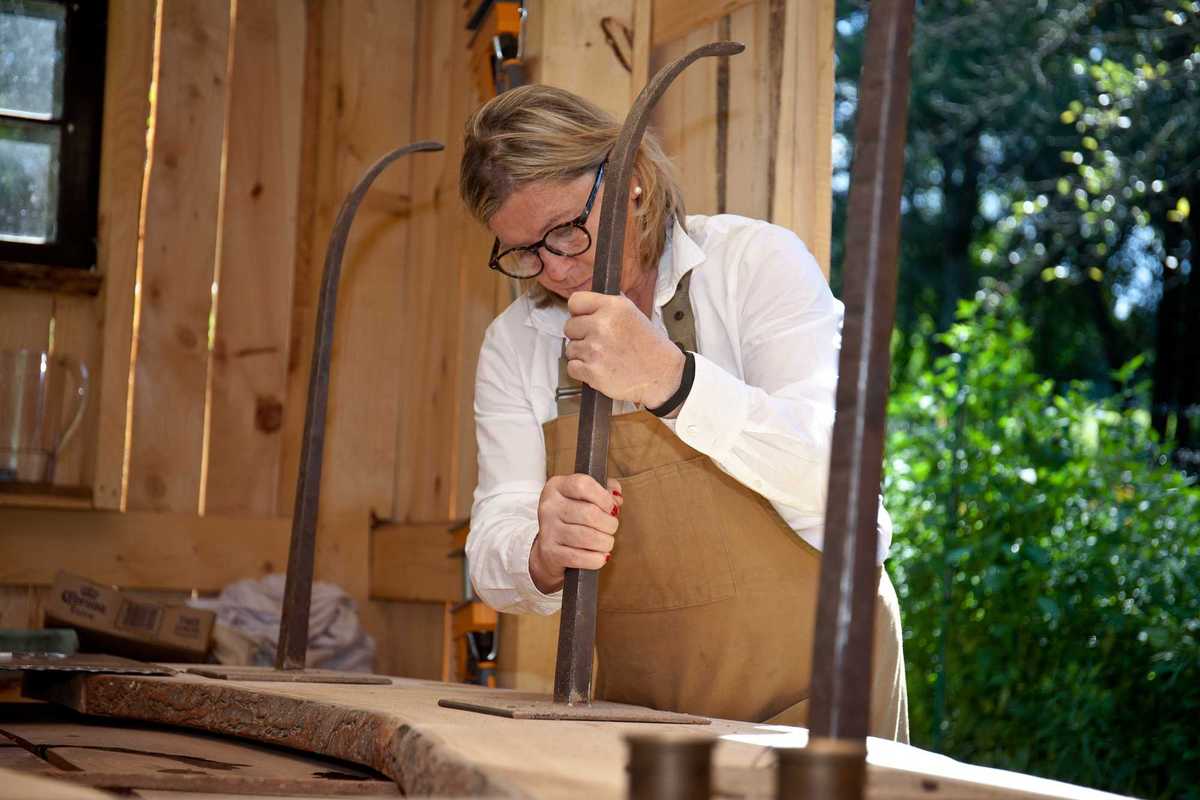
Elizabeth Place is a woodworker who specializes in burl and live-edge work.
Kent, Connecticut, is firmly establishing itself as a notable fine art hub, with five dedicated galleries and seemingly an opening every other weekend. But while those galleries feature art from around the country and the globe, the Kent Art and Design Show is turning its eye back on the arts community in the Northwest Corner itself.
Organized by local artists Ellen Corsell, Alison Palmer and Elizabeth Place, the juried show brings together 15 artists and craftspeople from the region, blending functional crafts with fine art. The three organizers spend much of their time scouting talent at galleries and craft shows throughout the area. With two shows a year, that’s a lot of artists to wrangle.
Their goal is to find a good blend of functional crafts and fine art to cover a wide range of artistic representation. For this show, they have 15 artists and artisans exhibiting their work.
One of the organizers, Alison Palmer, is a ceramicist who specializes in fostering talent in other artists. As a leading member of the Clay Way weekend and the owner of a studio in Kent that hosts a variety of workshops, Palmer seems to be an inspiration for a whole army of artists.
Cornwall-based painter and crafter Magaly Ohika has works that range from abstract paintings to hand-designed lampshades and even stuffed figures inspired by her Puerto Rican cultural background.
Munya Avigail Upin has been making fine jewelry for over 50 years. Beyond her own work, she has taught at the Haystack Mountain School of Crafts, Penland School of Craft as well as a variety of universities.
Margaret Lent is a fiber artist who started out knitting clothes for her barbies as a little girl and hasn’t slowed down, making limited-run and one-of-a-kind garments for her studio, Margaret Lent Handwovens.
It’s hard to pin down exactly what Barbara Graham makes, but it’s easy to tell how full of creativity each piece is, be it a painting, a sculpture or maybe a children’s book.
Northwest Corner native Judish Secco makes photographs that look like paintings, bringing an otherworldly feeling to common scenes with her precise framing and use of contrast.
Elizabeth Place is a woodworker who specializes in burl and live-edge work. She also paints the duck decoys made by her husband, Kevin Place, which are also featured in the show.
Danielle Mailer is a multidisciplinary artist who makes murals and sculptures and is collaborating with the Nutmeg Conservatory to help design the ballet costumes for the company’s 2027 production of “El Colibri.”
Former photographer and graphic designer Deborah Seidman pivoted to ceramics after experimenting with clay in a class 20 years ago and has been exploring the world of ceramics ever since.
Jill Scholsohn’s anthropology background fuels the funky pieces of jewelry which she makes with stones and inspiration from her travels around the globe.
Susan Randel uses a loom to knit her colorful and sometimes whimsical pillow cases and wall art.
Woodworker Robert Pearl specializes in deconstruction, taking fallen trees and limbs from his property, and turning them into works of fine art.
Lina Wilder is a metalsmith and jeweler who specializes in ancient and traditional metalworking practices to create jewelry, plates, bowls and other vessels.
In another life, Michael Sciulli designed shoes for some seriously big brands. Today, he makes stylish, functional knives that are perfect for life in the forests and fields.
Dale Wolfield spends much of his time on the water or in the woods of the greater Hudson Valley area, collecting inspiration for his detailed and disciplined functional stoneware.
The show takes place on Saturday and Sunday, Nov. 28 and 29, at the Kent Community House, and is sponsored in part by the Kent Chamber of Commerce.
David Strathairn brings “Peter and the Wolf” to life at Stissing Center
D.H. Callahan
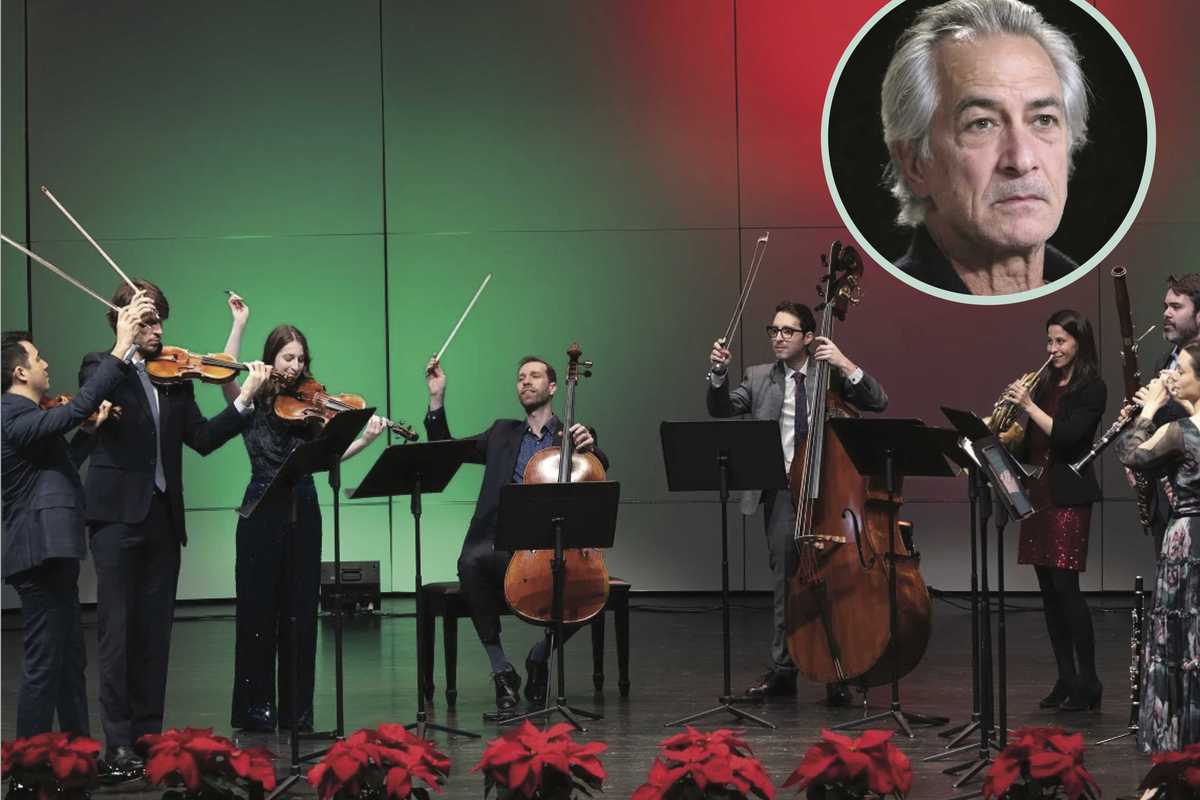
David Strathairn narrates “Peter and the Wolf” with the Frisson Ensemble at Stissing Center.
“Peter and the Wolf” is an enduring work of musical theater that has managed to teach children about classical music in a playful, if not dramatic, way for 90 years. On Saturday, Nov. 28, The Frisson Ensemble will bring the Russian educational classic to life at Stissing Center in Pine Plains with the help of Oscar-nominated actor David Strathairn.
Created to help children learn the parts of the orchestra, as well as the power of different sounds and musical modes, the symphonic tale for children, as it’s classified, has helped generations of curious kids fall in love with music.
The idea for the work came in 1936 from Natalya Sats. At the young age of 20, Sats was appointed to lead the Central Children’s Theatre in Moscow following the departure of the theatre’s first director, who refused to bow to the political demands of the emerging Soviet Union.
The Children’s Theatre was a point of pride for Russian and then Soviet artists, including composer Sergei Prokofiev, who frequently attended performances with his children. Sats enlisted Prokofiev to bring her idea to life, hiring Nina Sakonskaya to write the libretto, or story and lyrics, for the orchestral work.
Prokofiev was already a cosmopolitan success with worldly tendencies that extended beyond the borders of politically volatile Russia. He wrote librettos in French. He drew inspiration from Italian literary classics. He even performed his own works in New York City, something remarkably rare for a Russian at the time.
With the fall of the Russian Empire, however, Prokofiev began to focus his efforts on Russian themes. He composed works based on great Russian authors, including his opera “The Gambler,” based on the short novel of the same name by Fyodor Dostoyevsky.
“Peter and the Wolf,” too, has many deep Russian and Soviet cultural themes, like man’s triumph over nature and the counterproductive stubbornness of the non-Bolsheviks, represented by Peter’s grandfather and the bassoon.
Representation is the name of the game when it comes to “Peter and the Wolf.” To help children learn the parts of the orchestra, Prokofiev assigned instruments and musical themes to the characters in the story. The light and airy instruments are the protagonists and usually play more whimsical or uplifting themes. Peter’s famous tune played by the strings. The dark and discordant tones are reserved for the old and the evil.
One of the most important instruments is the voice of the narrator. Prokofiev didn’t like the original story written by Sakonskaya, so he rewrote it all to fit his music and vision. This gave the narrator an outsized role, leading the tone of the orchestra and introducing the children to all its parts. Sats was slated to narrate the piece herself at the 1936 premiere alongside the Orchestra of the Moscow Philharmonic Society, but fell ill and had a substitute fill in. It wasn’t until her first performance that the work gained the sort of reception it deserved.
Sats would also miss out on her chance to perform when “Peter and the Wolf” came to the United States in 1938, as she had been sent to the Gulag following the execution of her lover, a former Soviet Red Army general.
Since then, the narrator’s role has been taken on by such memorable performers as Viola Davis, David Bowie and even Frankenstein’s Monster himself, Boris Karloff. Strathairn, an alumnus of Williams College, has captivated audiences for decades with memorable performances in film and television projects like the “The Sopranos,” “L.A. Confidential,” “The River Wild,” “A League of Their Own” and “Good Night and Good Luck,” for which he received a best actor Oscar nomination in 2006.
Strathairn will lead the New York City-based Frisson Ensemble. Featuring musicians who have played on stages like Carnegie Hall, Frisson is known as “the classical group that does it all.” The ensemble can expand or contrast to fit a performance’s programming. This allows it to stay small and nimble for certain performances, whittling its numbers down for piano trios or string quartet performances. But when it comes to Frisson’s acclaimed rendition of “Peter and the Wolf,” the ensembale expands to a robust 10-piece group.
For tickets to “Peter and the Wolf,” visit thestissingcenter.org.
Dreams, memory and healing in the art of Francie Lyshak
Natalia Zukerman
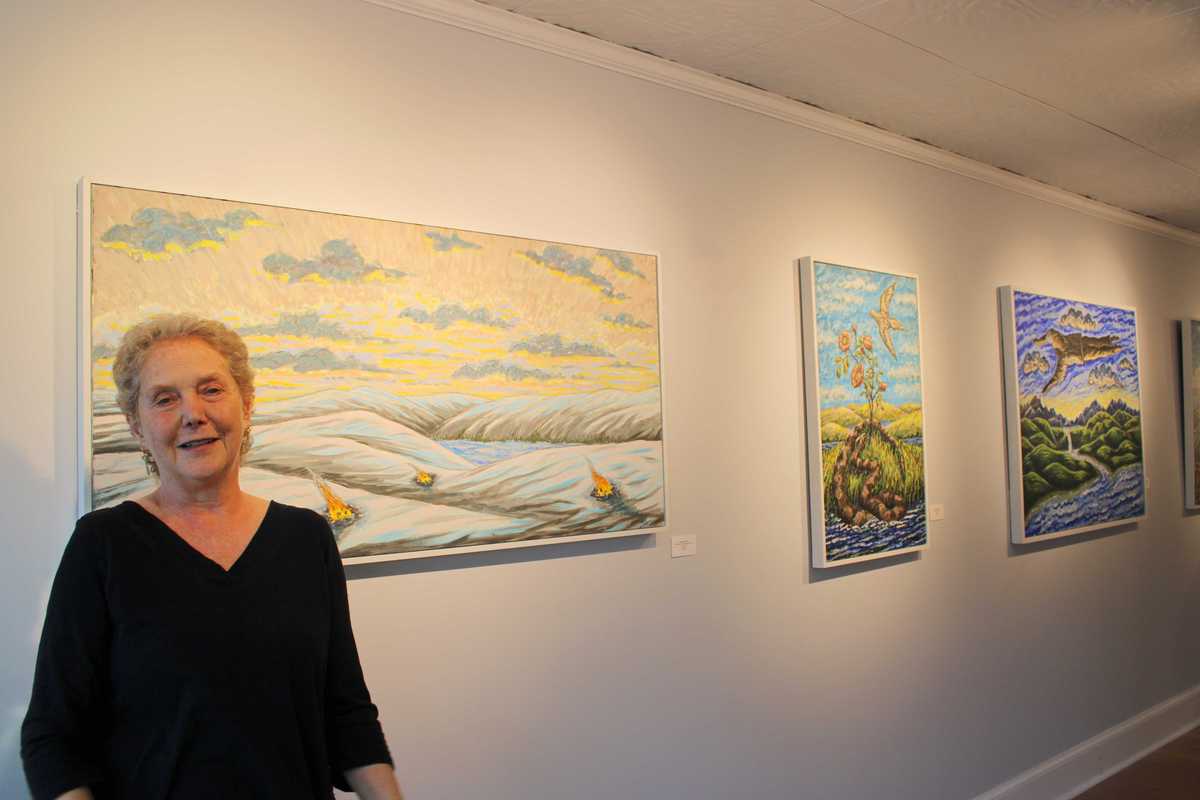
Artist Francie Lyshak at her exhibition “Dreamscapes” at Mad Rose Gallery in Millerton.
Dreams often bring to the surface what our waking minds work hard to conceal. For artist Francie Lyshak, the strange and sometimes unsettling imagery of dreams became a language through which she could explore her inner life, confront buried memories and ultimately find a path toward healing.
Her exhibition, “Dreamscapes,” at Mad Rose Gallery in Millerton, revisits an earlier chapter of her career, bringing together recently unearthed, large-scale oil paintings filled with symbolic animals, mysterious landscapes, dolls, toys and figures navigating worlds that feel both fantastical and hauntingly familiar.
Lyshak, who grew up in Detroit before finding her way to New York City’s East Village art scene in the 1970s, was part of a vibrant community of artists, performers and outsiders. Theater became a significant influence on her work.
“They’re all a little bit like theater,” she said of the paintings. “It’s like a shot of one scene in a psychological, emotional life of being human.”
Some of the compositions recall mise en scéne, the staged tableaux popular in the Victorian era, with figures, objects and landscapes carefully arranged to suggest a larger story. But rather than telling a complete narrative, Lyshak captures a single emotionally charged moment, inviting viewers to imagine what came before and what might happen next.
And though the exhibition’s title suggests dreams, Lyshak explained that the paintings weren’t necessarily drawn from actual dreams. Rather, they emerged from ideas, memories and emotional states she was trying to understand.
In “Snowscape with Signposts,” a thinly dressed woman stands alone in a snowy landscape. Fires mark her path, and a glorious sunset suggests the possibility of something beyond her immediate circumstances.
“Conditions are not good, but it’s not a hopeless situation,” Lyshak said. “And there’s maybe a future.”
Trained as both a fine artist and an art therapist, Lyshak has long understood symbolism as a language for expressing what words often cannot. Lyshak is open about her history of childhood abuse and how the process of uncovering those experiences profoundly shaped her imagery. She is equally clear about art’s capacity to illuminate hidden emotional states and create pathways toward healing, transformation and renewal.
Today, Lyshak’s paintings have evolved from richly populated narrative scenes into restrained, textured, monochromatic abstractions, open fields of color and gestural marks. Yet the emotional inquiry remains. Seeing these earlier paintings together again has been unexpectedly affirming.
“I feel I accomplished something by seeing them like this,” she said.
More than anything, she hopes viewers recognize something of themselves in the work.
“We’ve all been afraid, maybe of different things,” she said. “I hope that someone will walk in here and feel a connection, and connecting is a good thing for us.”
“Dreamscapes” is on view at Mad Rose Gallery in Millerton through Jan. 31.

Want more of our stories on Google? Click here to make us a Preferred Source.