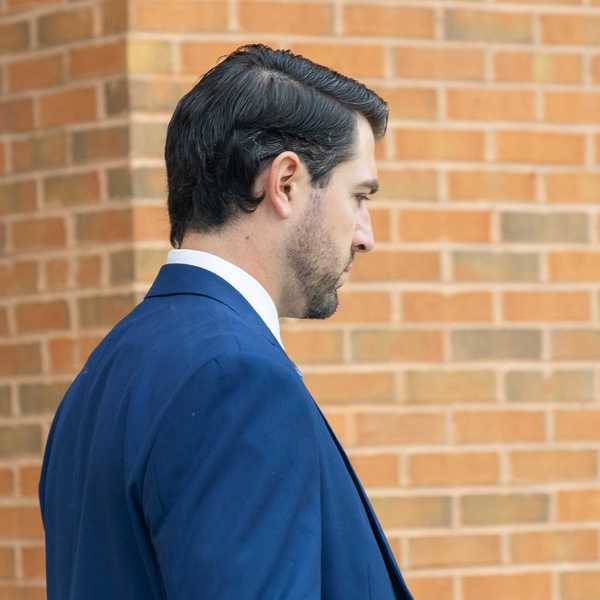
North Canaan smoke shop owner arrested on drug charges

The storefront of Smoker’s Choice, which sits between Stateline Wine and Spirits and Family Dollar within the North Canaan East Main Street shopping center.
Alec Linden

The storefront of Smoker’s Choice, which sits between Stateline Wine and Spirits and Family Dollar within the North Canaan East Main Street shopping center.
NORTH CANAAN — The owner of the smoke shop Smoker’s Choice was arrested on March 11 for allegedly selling recreational marijuana products without a license from his East Main Street store.
Town Resident Trooper Spencer Bronson, who coordinated the enforcement effort, shared an official Facebook post on March 14 announcing that Mohammad Rahman, 47, of Litchfield had been taken into custody.
The arrest follows an investigation into the business that began with an unannounced search of the store on Jan. 16 which yielded several pounds of illegal cannabis products.
The charges against Rahman are for possession of illicit substances of over 1 kilogram with intent to sell, and for operating a drug factory – the statutory term for any place where drug packaging products are found.
The initial investigation was reportedly instigated due to complaints from residents that illegal merchandise was being sold on the premises, as well as concern that age identification was not being adequately checked.
Multiple “high THC” products, exceeding the legal limit of the psychoactive substance for an unlicensed establishment in Connecticut, were seized during the search, including vapes, edibles and cannabis flower totaling just over 5 pounds, according to the arrest warrant.
Rahman was held on a $100,000 surety bond and faced arraignment the same day as his arrest.
The legal retail of recreational cannabis products in North Canaan narrowly passed a town vote in 2023, but state statute only allows for licensed dispensaries to sell high THC products. Smoker’s Choice does not possess such a license.

Aly Morrissey
Robin Wall Kimmerer inspired the audience with her grassroots initiative “Plant, Baby, Plant,” encouraging restoration, native planting and care for ecosystems.
Robin Wall Kimmerer, the bestselling author of “Braiding Sweetgrass” and a member of the Citizen Potawatomi Nation, urged a sold-out audience at the Cary Institute of Ecosystem Studies on Friday, March 13, to rethink humanity’s relationship with the natural world through gratitude, reciprocity and responsibility.
Introduced by Cary Institute President Joshua Ginsberg, Kimmerer opened the evening by greeting the audience in Potawatomi, the native language of her ancestors, and grounding the talk in a practice of gratitude.
“Gratitude is the doorway to reciprocity,” Kimmerer said.
Kimmerer, also a mother, botanist and professor, said that Indigenous wisdom does not have to be at odds with Western science, but rather it can help humans reframe the way they understand the Earth.
She also reflected on the personal journey that led to her lifelong commitment to promoting a lens of Indigenous wisdom in Western science. As a young woman entering the field of botany — then largely dominated by men — she said her path in academia was not always welcoming as a female Native scientist.
“It has been a lifelong journey,” she said. “I was born a botanist.”
Throughout the lecture, Kimmerer described how Indigenous ecological knowledge — rooted in observation, experience and ethical responsibility — can complement scientific inquiry and help solve today’s environmental crises.
She pointed to global data showing that about 80 percent of the planet’s remaining biodiversity is found on lands stewarded by Indigenous peoples, many of whom remain under threat from continued colonization and development.
A central theme of the evening was the concept of the “Honorable Harvest,” a code of practical ethics that governs what humans take from the natural world. Its principles include never taking the first one, always asking permission, taking only what is needed, minimizing harm and giving something back.
“Science is a great way to listen for the answer,” Kimmerer said, referring to the practice of asking permission of the natural world and paying attention to ecological limits.
By the end of the talk, Kimmerer turned to the question she said she hears most often: “What can I do?”
Her answer included a call to reciprocity and action. She urged audience members to consider their own “human gifts” and how those gifts might be used in service of the Earth. For example, Kimmerer said she uses her own gift of storytelling to distill complex information and inspire people to think differently about the living world.
“The Earth asks us to change,” she said.
Kimmerer left the audience with a call to action through her latest initiative. In contrast to the slogan “drill, baby, drill,” she said she has helped launch “plant, baby, plant,” a grassroots initiative that encourages people to support the living world through restoration, native planting and care for ecosystems.
D.H. Callahan
"There is no better feeling than working through something with your own brain and your own hands." —Melissa Gamwell
In an age of automation, Melissa Gamwell is keeping the human hand alive.
The Cornwall, Connecticut-based calligrapher is practicing an art form that’s been under attack by machines for nearly 400 years, and people are noticing. For proof, look no further than the line leading to her candle-lit table at the Stissing House Craft Feast each winter. In her first year there, she scribed around 1,200 gift tags, cards, and hand drawn ornaments.
Each piece makes a gift, a note or even a Christmas tree seem more personal, more considered, and more connected to humanity. Since then, demand for her personalized, hand-lettered tags, ornaments and cards has only grown, appearing in mailboxes across the region and at shops like the Cornwall Whale and Marton & Davis in Chatham, New York. Her precision is remarkable, and to watch her create these one-of-a-kind pieces is an art all unto itself.
In recent months, we’ve seen a deluge of stories on digital replacement. Data managers, bankers and even therapists are being replaced by computer programs in mass waves of layoffs. But what many still find surprising about the proliferation of nonhuman competitors in the job market is how it’s affecting the arts. Illustrators, animators, photographers, musicians and even on-screen actors are being supplanted by bots touted as “artificial intelligence agents.”
But calligraphy — and handwriting in general — has been in the crosshairs of mechanical progress for centuries. There was a time, if you can believe it, when writing anything required ink, paper and sometimes even a living, breathing human scribe. No typewriters, no word processors, no voice-to-text programs.
Then came Gutenberg’s printing press. Sure, it changed the world for the better, ensuring a greater distribution of ideas, and helping spark some of the most important political movements in history. But it also marked one of the first moments when technology replaced the artistic work of the human hand. Over the centuries, printers, designers and technologists have continued to innovate. Today, with Photoshop or Illustrator, an entire universe of alphabets exists, from ornate and embellished to precise and futuristic — all designed to replace the human hand.

Yet, despite this centuries-long assault from technology, Gamwell has found her own way to thrive. Largely self-taught, she combines her drawing and industrial design background with an old-school New England childhood in Maine that involved “very tangible, hands-on, creative problem-solving using many materials.” Raised by “parents who loved antiquarian books, often filled with hand-written dedications,” hers was the kind of upbringing in which “traditional practices were cherished and flaunted” — a time and place with “hand-painted lettering on churches, street signage, the stones in beautiful churchyard cemeteries, and log books.”
Those early impressions have stayed with her, heightening her appreciation of sometimes overlooked details.
“There’s so much ephemera floating around with traces of beautiful handwriting to see everywhere, even now in Connecticut,” she said.
Even in a digital age, she keeps technology at a distance.
“You will not find ChatGPT on my phone, and you will usually not find my phone on me,” she said. Instead, she opts for a notebook, a scrap of paper or the back of a receipt. Sometimes, she goes even further, gathering black walnuts from trees on her property to make the specialized ink for her practice.
Gamwell’s approach to her craft is also philosophical. “There is no better feeling than working through something with your own brain and your own hands, even if you find it less exemplary than you would hope. And it only uses the water you’re already consuming. Do you need to convey an idea? Draw it, however horrific or childish. Write it, even if you never learned proper grammar — because you’ve always had programs do it,” she said.
“Sometimes I think that everything I like is ‘historic’ but it’s really that I just find more value in the traditional methods, which are still alive and well, and desperately in need of stewards for the future.”
After nearly 400 years of pressure, it’s encouraging to see handwriting — an art form that once seemed destined for obsolescence — still thriving, one careful stroke at a time. And thanks to Gamwell, perhaps there’s a new generation of observers, collectors and future calligraphers ready to carry it forward.
D.H. Callahan is a voice actor, creative director and trail steward. He lives with his wife, artist Lane Arthur, in West Cornwall, Connecticut.
Natalia Zukerman
The cast of “The Addams Family” from Northwest Regional School District No. 7 with Principal Kelly Carroll from Ann Antolini Elementary School in New Hartford at Botelle Elementary in Norfolk.
Nearly 50 students from across the region are helping bring the delightfully macabre world of “The Addams Family” to life in Northwestern Regional School District No. 7’s upcoming production. The student cast and crew, representing the towns of Barkhamsted, Colebrook, New Hartford and Norfolk, will stage the musical March 27 and 28 at 7 p.m., with a 2 p.m. matinee on March 29 in the school’s auditorium in Winsted.
Based on the iconic characters created by Charles Addams, the musical follows Wednesday Addams, who shocks her famously eccentric family by falling in love with a perfectly “normal” young man. When his parents come to dinner at the Addams’ mansion, two very different families collide, leading to an evening of secrets, surprises and unexpected revelations about love and belonging.
For director Ann DeCerbo, the show’s mix of humor, spectacle and heart made it an ideal choice for a high school production.
“It’s funny and a little spooky, but underneath that it’s really about family, acceptance and learning to embrace what makes us unique,” she said.
The large cast and crew also made the musical a good fit for the school’s thriving theater program.
“What’s impressed me most is the level of commitment,” DeCerbo said. “These students are balancing school, sports, work, family, lessons, driver’s ed. The list goes on and on. But they show up ready to work and to support each other.”
Senior Gustavo Zurita stars as Gomez Addams opposite Ivy Wallace as Morticia. The cast also includes Kaileigh Grant as Wednesday and Domonic Salz as her love interest Lucas Beineke, along with Maribelle Roach as Uncle Fester, Violet Swanson as Alice Beineke, Levi Swanson as Mal Beineke, Krystal Janak as Grandma Addams, Lorelai DeCerbo as Pugsley Addams and Juan Pablo Urbina Labarrere as Lurch.
Behind the scenes, students are also responsible for set construction, lighting, sound, costumes and stage management, essential elements in creating the Addams family’s famously eerie home.
“We started by really embracing the color palette for the show,” said DeCerbo. “Black and white with very purposeful pops of color. This is the biggest set we’ve had on the NWR7 stage in as long as I can remember.”
While the story is packed with humor and gothic charm, DeCerbo said its message resonates strongly with teenagers.
“High school can be a time when people feel pressure to fit in and meet external expectations,” she said. “This show does a great job of showcasing how much we all have in common while also celebrating individuality.”
That spirit, she added, is part of what makes theater such an important space for students.
“One of the things I appreciate most about theater is that it offers a really welcoming environment where students feel comfortable being exactly who they are,” she said.
Ultimately, DeCerbo hopes audiences come ready to laugh and leave with a reminder that every family has its quirks.
“First and foremost, I hope they have fun,” she said. “But beyond that, I hope audiences leave with a reminder that families and communities don’t have to look the same to work. There’s a lot of joy in celebrating what makes people unique.”

Want more of our stories on Google? Click here to make us a Preferred Source.
Robin Roraback
Garth Kobel, Art Wall Chair, Mary Randolph, Frank Halden, Ruth Giumarro, Project Chair, Maria Bulson, Barbara Lobdell, Sherry Newman, Elizabeth Frey-Thomas, Donna Heinz around “The Green Man.”
In honor of National Quilt Day, a tradition established in 1991, Hunt Library’s second annual quilt show, “Quilts of Many Colors,” will open Saturday, March 21, with a reception from 5 to 7 p.m. The quilts, made by members of the Hunt Library Quilters, will be displayed through April 17. All quilts will be for sale, and a portion of each sale goes to the library.
At the center of the exhibit is a quilt the Hunt Library Quilters collaborated on called the “Quilt of Many Colors,” inspired by Dolly Parton’s song”Coat of Many Colors.” Each member of the Hunt Library Quilters made two to four 10-inch squares for the twin-size quilt, with Gail Allyn embroidering “The Green Man” for the center square. The Green Man, a symbol of rebirth, is also a symbol of the library, seen carved in stone at the library’s entrance. One hundred percent of the sale of this quilt benefits the library.
Ruth Giumarro, who led the Hunt Library Quilters in this project, explained that the quilting group started last year with the theme “Playing With Art,” which was inspired by children’s book illustrator Eric Carle. Giumarro said, “We had so much fun last year that everyone said, ‘Let’s do it again!’”
“This has been exciting,” said Giumarro. “We started off small with seven people. This year more people came, and there are more who want to come.” The range of experience varies from none to years of sewing and quilting. All are welcome; be a resident of Falls Village is not required.
“It’s all practice,” explained Giumarro, who has been sewing since she was in seventh grade. “Getting a straight line is hardest.”
On March 6, the quilters gathered at Hunt Library to bring their own creations for the show and admire the finished “Quilt of Many Colors.” After looking at each other’s quilts and pricing them, they celebrated with cake.
The Hunt Library is located at 63 Main St. in Falls Village. More information is available at huntlibrary.org
D.H. Callahan
New works on display at Kenise Barnes Fine Art in Kent
Since 2018, Kenise Barnes Fine Art in Kent has been displaying an impressive rotation of works across a range of artists and mediums. On Saturday, March 14, art enthusiasts arrived to see a new exhibition at the gallery featuring a wide variety of new pieces.
Large-scale paintings by David Collins and Melanie Parke alongside small 3-by-3 inch oil-on-panel works by Sally Maca.
An intricate woodcut print by Eve Stockton and the organized chaos of Margaret Neill’s abstract drawings dazzled the eye. But much of the show’s distinctive texture came from its sculptural works.
Catherine Latson’s wire structures, tightly wrapped in hand-dyed threads, bring to mind pastel- hued sea anemones and become more impressive upon closer inspection. Translucent, hanging cast-resin vampire bats by Tristan Fitch blend into the ceiling until viewed up close, when they become an inescapable presence.

An intriguing sculpture by Julie Maren features acorn caps affixed to the wall, filled with vibrant, shimmering colors.
Paintings and a sculpture crafted from reclaimed wood by Maine-based artist Matt Barter demonstrated the range of mediums represented by a single artist.
While some of the works are already spoken for, all are on view through late April.
For more information, visit kbfa.com
Jennifer Almquist
Harriet Newman Cohen
Harriet Newman Cohen weathered many storms in her five-decade-long journey to become one of the nation’s most celebrated divorce attorneys. Voted one of the top 100 attorneys in New York for many years, Cohen served as president of the New York Women’s Bar Association and has been a champion of divorce reform. She and her co-author, journalist David Feinberg, will give a book talk about her memoir, “Passion and Power: A Life in Three Worlds,” at the Norfolk Library on Sunday, March 22 at 2 p.m.
What began as a personal record of her life, intended for her family, grew into a memoir that journalist Carl Bernstein describes in his endorsement as “wise and riveting.” Born in 1932 in Providence, Rhode Island, to parents who immigrated in 1920 from Ukraine and Poland, Cohen traces the arc of her life and the challenges she faced entering a legal profession that was overwhelmingly male at the time, leading to her success as a maverick divorce attorney fighting for women’s rights and equity in the law. She received her Juris Doctor, cum laude, from Brooklyn Law School in 1974, one year after Roe v. Wade was decided. She is a founding partner of Cohen Stine Kapoor LLP in New York City, a family and matrimonial law firm she formed in 2021, at age 88, with her daughter Martha Cohen Stine and Ankit Kapoor.

Cohen writes fearlessly, with a good dose of wry humor, about her own struggles balancing marriage and divorce, raising four daughters, entering Brooklyn Law School in 1971 at age 38, and her ensuing legal career. According to Bernstein, “Passion and Power” is as much about the reshaping of American cultural norms as it is about one remarkable woman’s role at the forefront of legal and social transformation.
Cohen’s work in the legal profession has been pivotal to social change. A 2021 HBO documentary, “Nuclear Family,” directed by Ry Russo-Young, chronicles the landmark custody struggle of Russo-Young’s parents, a queer couple who hired Cohen as their lawyer.
Cohen is an honest storyteller, unflinching in admitting her mistakes and rightly proud of her accomplishments. Her story ranges from tales of her father’s fortune made producing the Hula-Hoop to her memory of schoolmate Kiki Bader — Ruth Bader Ginsburg — as a cheerleader waving pom-poms in Brooklyn. She also writes of her deep love of family, the stultifying suburban life of her first marriage, mentorship by legal icon Louis Nizer and riding the wave of social revolution that buoyed her career.
Norfolk author Gillian Linden writes of her step-grandmother, “Harriet Newman Cohen is a funny, edifying guide — precise, curious, warm. Entirely unsentimental. Marriage and its many paths is rich territory. This book is filled with the strange, glamorous, desperate and sadistic characters you hope to meet in the very best novels.”
For details, visit norfolklibrary.org

Want more of our stories on Google? Click here to make us a Preferred Source.

Want more of our stories on Google? Click here to make us a Preferred Source.