The headlines came quickly after President Obama concluded the deficit-debt deal with the Republicans Sunday evening. There were few shades of gray. The New York Times editorial was titled “To Escape Chaos, a Terrible Deal: Democrats won almost nothing they wanted except avoiding default.”It was truly, as the Times pointed out, “a political environment laced with lunacy.” But don’t blame it all on the Republican “mad dogs” on Capitol Hill playing chicken with the economic plight of the American people and its wobbling economy. It was President Obama who surrendered.In one of the most inept episodes of presidential-congressional relations, Mr. Obama managed to give the Republicans more than they expected and leave the Democrats with less than the Republicans offered. The Republicans never expected Mr. Obama to give in entirely on tax increases on the wealthy, on the reviled oil industry giants and other corporate tax escapees. The Republicans even agreed to $800 billion in new revenue over 10 years. Obama fumbled the ball day after day, and with the Aug. 2 debt ceiling deadline looming, he fell to the extortionists. Unlike Presidents Roosevelt, Truman, Eisenhower, Kennedy, Johnson, Nixon, Ford, Carter, Reagan, Bush, Clinton and Bush II, who routinely expected and got debt ceilings raised without conditions. President Obama’s disaster began months ago when he agreed to tie raising the debt ceiling to a grand bargain with the Republicans regarding deficits and revenues instead of demanding a debt ceiling raise while he was caving on extending Bush tax cuts for the wealthy. That immediately gave the “fanatic” Republicans a veto power over the “establishment” Republicans in Congress. And fanatics don’t blink. Especially those fanatics who, elected last year, say they don’t care about being re-elected.So Obama accepted about $2.5 trillion in spending cuts over the next decade, got no revenue-producing tax increases and therefore made it nearly impossible to create a public works jobs program to uplift a sliding economy.With economic indicators registering more trouble in recent days for American workers, Mr. Obama has no cards left. Interest rates cannot be driven any lower by the Federal Reserve. He didn’t get even a renewal of the extension of unemployment benefits. Consumer spending — two-thirds of the economy — is stagnant. Without consumer demand, new investment is sluggish. Unemployment is rising, and without jobs, workers can’t increase their consumer spending. State, local and federal government spending cannot increase under the yoke of the just agreed-upon cuts. The weaker dollar may increase exports, but the United States still has a continuing massive trade deficit, especially with China. Europe’s financial problems will curb orders of U.S. goods and services.So what can Mr. Obama do? He can propose a public works program, paid for by the tax increases on the wealthy and the corporations. Both are getting richer. The large corporations are reporting very good second-quarter profits, further disconnecting their affluence from that of their workers and labor in general. He could, if he wanted, make a very strong case for repairing America’s infrastructure and bring the soldiers back from Iraq and Afghanistan, as a majority of the American people and the most mayors of our cities desire.First, however, he has to take the offensive by showing that the bulk of the deficits since 2002 were caused by the Bush tax cuts, mostly for the wealthy, and Bush’s two wars. Obama also has to hold the Republicans accountable for their hostage-taking of the American economy so they cannot impede public works proposals in an election year.Amazingly, as a Harvard-trained lawyer, he was quick to compromise from the get-go. Consequently, he painted himself into a corner. So, since he is not a leader, maybe he can become a pleader.Given that non-financial companies are sitting on $2 trillion of inert cash and other liquid assets, maybe he can appeal to these companies to disgorge 10 percent in immediate special dividends to their long-parched shareholders who are, after all, their owners. Loosening the executive locks on this hoard of money would provide $200 billion for more likely spending in the marketplace. Companies like Apple, Google, Cisco, Intel and Microsoft alone are sitting on well over $200 billion cash. To these coddled, indentured U.S. companies he can invoke President John F. Kennedy’s challenge — “Ask not what your country can do for you, ask what you can do for your country.”Second, he can plead with those very profitable corporations that have benefited from the government bailout, or pay little or no federal income taxes, to voluntarily contribute to a public works fund.Companies like GE, Verizon, Exxon Mobil, Boeing, IBM, Wells Fargo, DuPont, American Electric Power, FedEx, Honeywell, Yahoo and United Technologies as a group made $171 billion in U.S. profits over three years and paid zero federal income tax with a $2.5 billion negative advantage. And that, says Bob McIntyre, director of Citizens for Tax Justice, is “just the tip of an iceberg of widespread corporate tax avoidance.”Is such pleading just Pollyannaish? Maybe. But it will resonate with the American people’s sense of injustice. Those feelings of indignation can reverberate and cause members of Congress to start remembering who sent them to Washington.Consumer advocate and former presidential candidate Ralph Nader grew up in Winsted and is a graduate of The Gilbert School.
Latest News
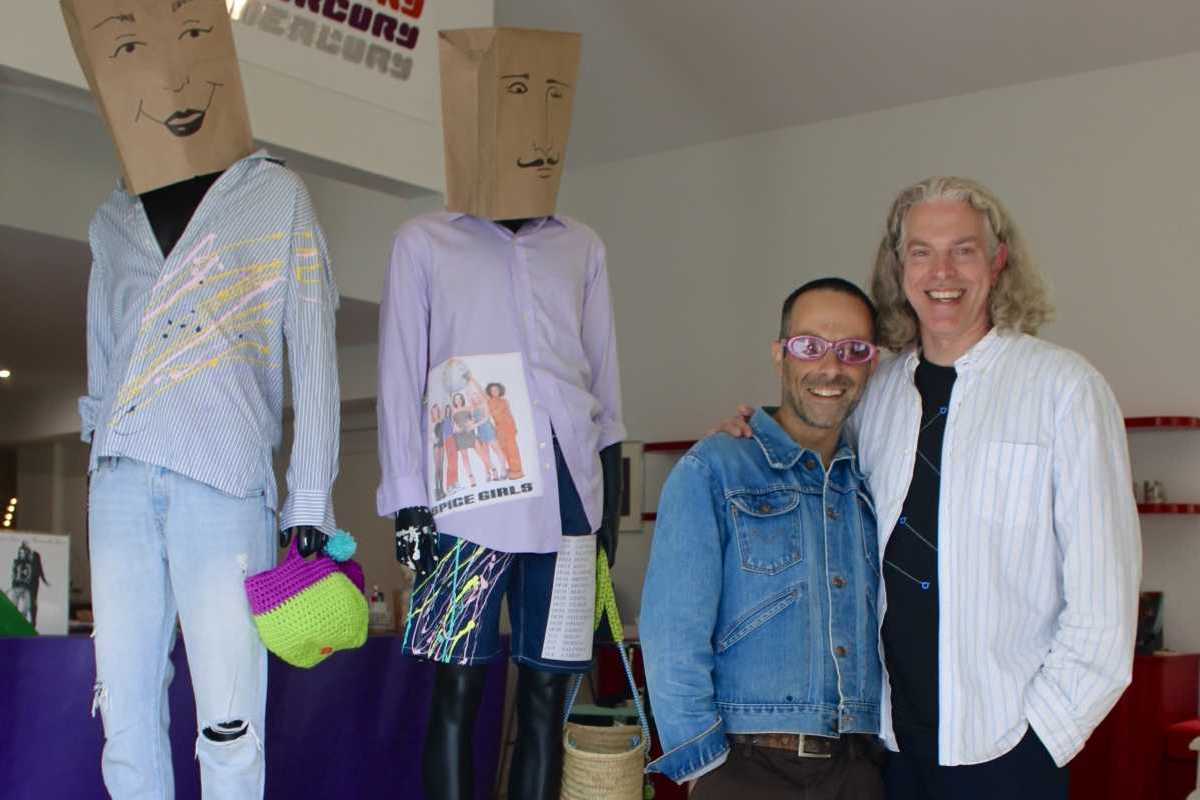
Greg Fricke and James Boehmer, co-owners of Peggy Mercury in Kent, recently launched their first fashion line, “Imaginary Concerts.”
Provided
Fricke and Boehmer are not there to stock their shelves with the same products customers find at standard makeup retailers. They’re there to help customers find what works for them. That usually means asking customers about themselves and learning about their beauty habits, skin, style and the way they like to present themselves. Fricke and Boehmer believe it’s their job to help customers bring out the qualities that suit them and determine what works best for their look.
So much of the Peggy Mercury world is about emboldening people to become more creative, and possibly bolder, versions of themselves. Some of this comes through the store’s creative collaborations with artists, designers and stylists.
It’s part of an ethos that encourages them and their friends to use the shop as a kind of laboratory, trying out new creative experiments without knowing how they might turn out. Whether in fashion, painting, fiber arts or photography, the projects almost always turn out marvelously.
A line of sterling silver charms they sell started as a small project by their friend Nolan Percival. In the beginning, the pieces were for close friends and loved ones. But Boehmer and Fricke encouraged Percival to get a little more serious about the project and create a whole line for the store. Today, it’s one of their top-selling collections.
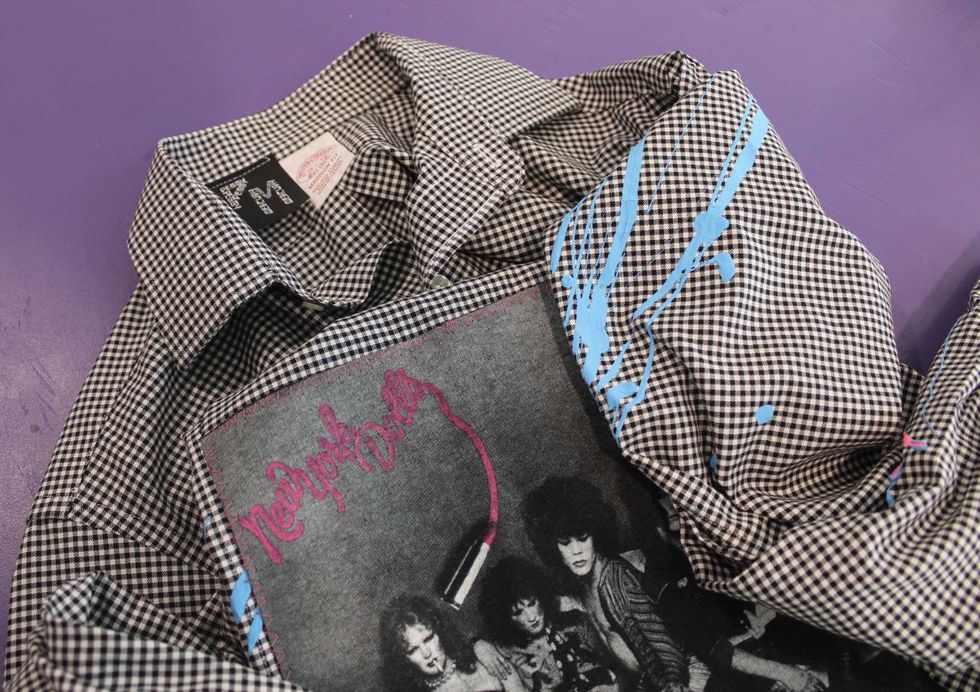 Classic styles, bold colors, and creative concerts make up the “Imaginary Concerts” line at Peggy Mercury.Provided
“Imaginary Concerts” has the duo taking their own advice.
The project started as a way for Boehmer to connect with his mother, who had been diagnosed with Alzheimer’s disease. Taking old concert shirts from his own collection, Boehmer and his mother began cutting out the graphics with the idea that they would make a quilt together. Unfortunately, she died before they could complete the project in 2025. The pieces, which were ready for production, were put on the back burner as Boehmer and Fricke dealt with their loss and the whirlwind of projects that never seemed to cease at Peggy Mercury.
But the harsh winter of 2026 presented an opportunity to take some time and focus on themselves. Part of that meant revisiting and redefining the concert T-shirt project. This time, instead of looking to the warmth and comfort of a quilt, they turned to another passion — fashion.
Taking a page from their own book, they wanted to create something that felt comfortable to them. They took two disparate loves — one rooted in simple preppy style, with clean lines and classic silhouettes, and the other in the nitty gritty worlds of punk rock and pop — and blended them together to create something entirely new. Pulling from the staples of vintage Brooks Brothers and Charvet collections, they applied the graphic elements with bold stitching reminiscent of punk jackets of the ‘70s and ‘80s, but with a much more sophisticated air.
But the remixing isn’t just the pairing of prep and punk. The pieces are not canon. They take liberties with the realities of concert tours, combining one band’s dates with another band’s logos, mixing them all up until the reality is lost and imagination is the only truth.
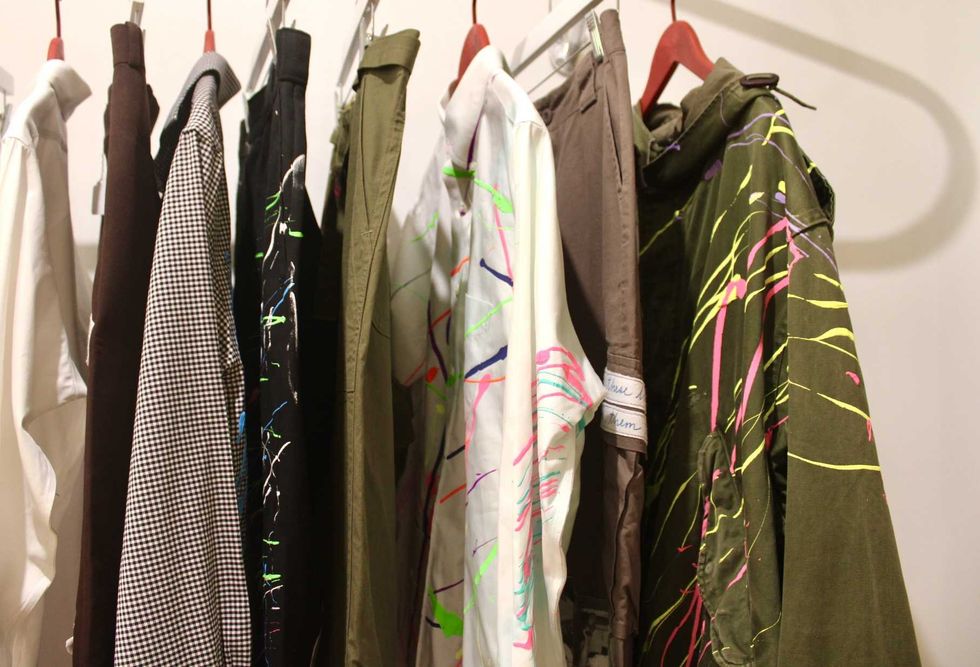 Shirts from Peggy Mercury’s first fashion line, “Imaginary Concerts,” hang on display.Provided
Adding to the mix is an element of perpetual creativity. Art can be messy, both figuratively and literally, and many of Fricke and Boehmer’s artist friends carry evidence of their work on them at all times. As a nod to these tireless creatives, the duo added haphazard splashes of bright color, giving the line an even more distinctive feel.
For them, “Imaginary Concerts” passes the “Peggy Test.” The mythical Peggy Mercury is a fictional figurehead for the company, a character who thrives on creativity and change. The name, much like the clothing line, is a mixture of interests: Mercury is a planet, a deity and an elusive, transformative element, while Peggy is the wonderfully stylish and boundary-pushing Peggy Guggenheim.
Everything Fricke and Boehmer put in their store has to pass this test: Would Peggy Mercury approve? For their first collection, the answer is a resounding yes.
Peggy Mercury is at 9 Maple St., Unit 2, Kent.


Want more of our stories on Google? Click here to make us a Preferred Source.