Hector Peart Prud’homme


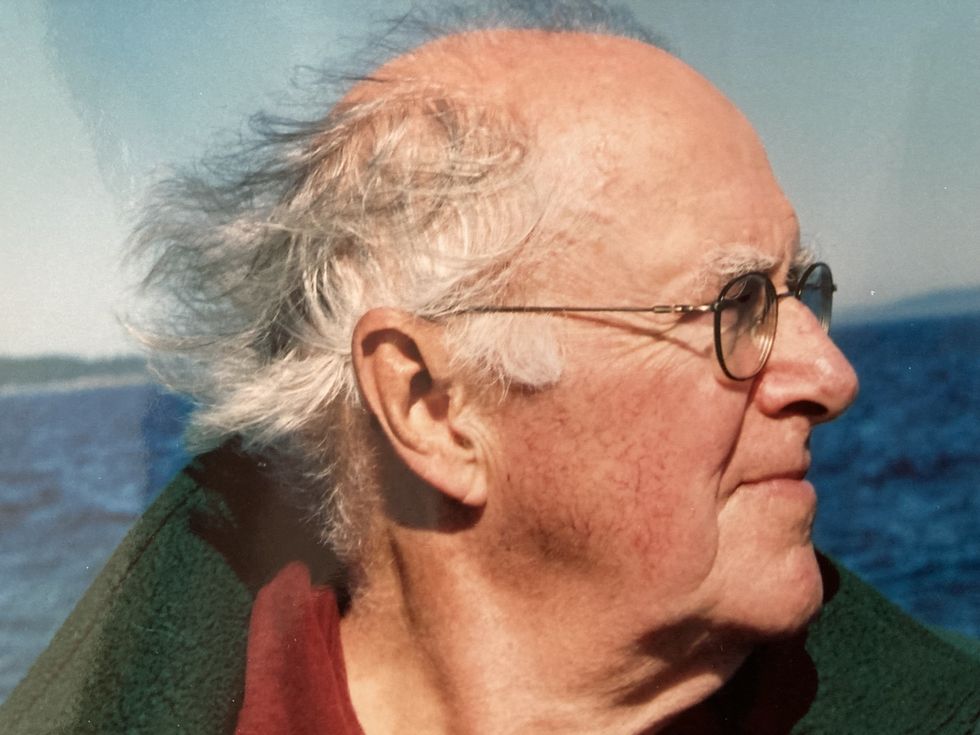
WEST CORNWALL — Hector Peart Prud’homme, of West Cornwall died Sept. 22, 2021, of congestive heart failure at age 90. As he passed away at home, he held the hand of his wife of 63 years, Erica (Child) Prud’homme.
Hector was born on July 7, 1931, at the American Hospital in Paris, France, the eldest of three sons of the late Anne Carolyn (Bissell) and Hector C. Prud’homme. Hector C. moved his family to the U.S. and raised his family in Farmington and Canton, Conn. For junior high school, Hector P. attended the Brooks School in Massachusetts, and in high school he graduated from the International School of Geneva, Switzerland. In 1954 he graduated from Yale University with a B.A. in history and was a member of the Elihu society.
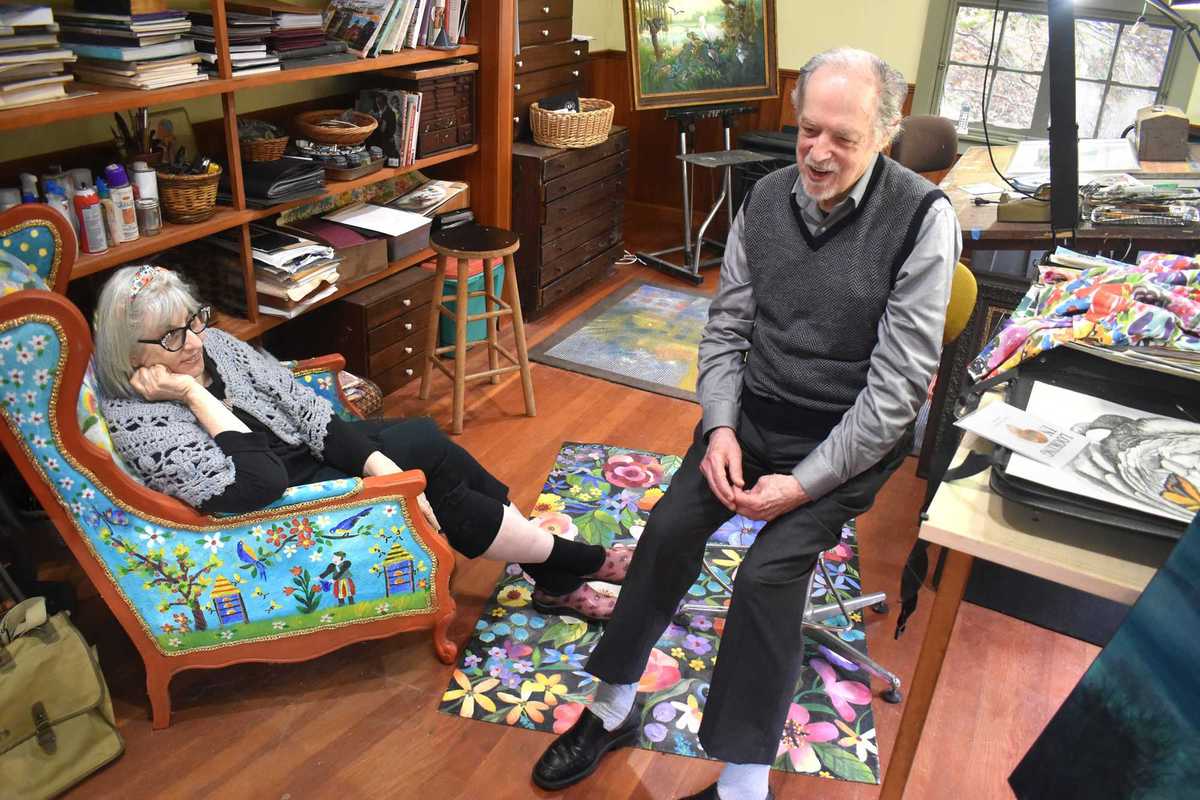
On May 31, 1958, he married Erica Child, an artist, and they raised their three children in New York City and Cornwall.
Fluent in French, Hector served as a U.S. Army intelligence officer at a NATO base in St-Jean d’Angely, France, from 1954-1956. Upon returning to the U.S. in 1956, he joined the private bank Brown Brothers & Harriman in New York City, as a trainee. Developing a specialty in commercial banking, he focused on foreign currency and foreign bank relations, and spent his entire career at the firm. In the late 1970s, he established the bank’s first business relations with China, and later ran Brown Brothers Foreign Exchange Advisory Service, a currency consulting business with Fortune 500 companies as clients. As a general partner at Brown Brothers for over a decade, Hector traveled extensively in Europe and Asia.
Upon his retirement from banking in 1984, Hector embarked on a second, fulfilling career in the nonprofit world. An active volunteer and generous philanthropist, he was a trustee or board member of the New Amsterdam Singers and the Citizens Budget Commission, and carried out projects for the National Executive Service Corps, in New York.
Inspired by the health and environmental problems he had witnessed in developing countries, he served Planned Parenthood of Greater New York as treasurer, president and honorary director over the course of 37 years.
At his home in Connecticut, Hector was devoted to the Cornwall Conservation Trust, where he served as president for nine years and was on the board for 33 years. During his tenure, the CCT conserved over a thousand acres of forest, farmland and watershed, and Hector was a trusted mentor and advisor to dozens of people. Acknowledging his careful, quiet work to build consensus on sometimes difficult questions, the town of Cornwall granted him its Citizen of the Year Award in 2017, an honor he was especially proud of.
Though he spent much of his life in Manhattan, Hector thought of himself as a “country gent” at heart. He found great solace in gardening, birdwatching, walking and —perhaps most of all — mowing and snowplowing with his blue Ford tractor.
Hector is survived by his wife, Erica; a son, Alex; two daughters, Merida and Olivia; and six grandchildren, Rosetta, Asa, Hector C., Sophia, Jules and Didi. Hector was predeceased by brothers Anthony and Richard.
In lieu of gifts or flowers, memorial contributions can be made to Planned Parenthood of Greater New York (www.plannedparenthood.org/planned-parenthood-greater-new-york) and the Cornwall Conservation Trust (www.cornwallconservationtrust.org).
Alec Linden
WATERBURY — A former Kent School employee arrested in 2024 for accessing the private photos and sensitive files of 81 students and staff will avoid prison under a plea agreement reached Monday, March 16.
Daniel Clery, 49, of Brookfield, a former IT staff member at the boarding school, agreed to a plea deal that includes a 10-year suspended sentence, five years of probation and a requirement to register as a sex offender for 10 years.
Clery pleaded no contest to two counts of first-degree computer crime. Superior Court Judge Corinne Klatt found him guilty and accepted the terms of the agreement.
The plea deal came days after a Waterbury Superior Court judge allowed portions of a class-action lawsuit filed on behalf of 81 current and former Kent School students and staff to proceed.
Judge Daniel Klau ruled that the school may be held liable for negligence, finding it failed to properly supervise Clery and allowed him to exploit the school’s software systems to access personal photographs and files, primarily belonging to female victims.
Clery had been employed by the school for 23 years before being terminated in 2023. His dismissal followed two complaints from a staff member who reported that he had accessed her personal information. The first complaint was filed in 2022, but no action was taken until a second report was made eight months later.
Klau determined that while the case can move forward on liability, damages must be assessed individually, requiring separate hearings for each plaintiff. He also dismissed portions of the lawsuit, including claims of invasion of privacy, computer crimes and negligent infliction of emotional distress against the school.
Kent School did not respond to requests for comment.
The lawsuit was filed in February 2025 by the law firm Silver, Golub & Teitell on behalf of the aggrieved students and staff.
Attorney Jennifer Sclar, who represents the plaintiffs along with Jennifer Goldstein, said the ruling ensures victims can pursue accountability.
“The Court’s decision allowing this action to move forward on a class basis will ensure that every student who had their private and sensitive photos and information stolen by Daniel Clery will be able to seek accountability from Kent School for its negligence and recklessness in allowing Clery to operate with little to no supervision and with inadequate computer safety protocols for almost a decade.”
Clery remains free on $25,000 bond and is scheduled to be sentenced June 29 in Waterbury.
Lakeville Journal
Legal Notice
Notice of Decision
Town of Salisbury
Planning & Zoning Commission
Notice is hereby given that the following action was taken by the Planning & Zoning Commission of the Town of Salisbury, Connecticut on March 16, 2026:
Approved — Special Permit Application #2026-0310 by owner Congregational Church of Salisbury, Inc., for a use rendering more than 30% of the total lot area in impervious surfaces and retaining less than 30% of the total lot area in vegetative ground cover associated with sidewalk construction in accordance with Sections 403.4.c. and 403.4.d of the regulations. The property is shown on Salisbury Assessor’s Map 54 as Lot 78 and is located at 30 Main Street, Salisbury.
Any aggrieved person may appeal these decisions to the Connecticut Superior Court in accordance with the provisions of Connecticut General Statutes §8-8.
Town of Salisbury
Planning & Zoning Commission
Robert Riva, Secretary
03-26-26
Lakeville Journal
The Hotchkiss Library of Sharon: seeks a motivated, tech-savvy, creative Community Engagement Coordinator to implement our marketing and communications strategy and assist with programming and events. Must demonstrate graphic design experience, strong technology skills, excellent spoken and written communication, an attention to detail, and ability to prioritize. Must work well independently, with a team, and with the public. 20-24 hours per week. Send cover letter, resume, and writing and graphic design samples to ghachmeister@hotchkisslibrary.org.
Gardeners needed for native plant design business: March 15- December 1st. Must be physically fit and dependable. Call for interview 347-496-5168. Resume and references needed.
Want to join our team?: Wyantenuck Country Club is seeking Bartenders, Dishwashers, Line/Prep Cooks and Waitstaff. Positions start the last week of April/beginning of May. We offer a competitive pay with flexible shifts on weekdays and/or weekend daytime or evening shifts. Please send resumes to: brandon@wyantenuck.org, call 413-528-0350 or stop by in person.
GARDENING: Spring and Fall Cleanup and Stone W alls. 845-444-4492.
Hector Pacay Landscaping and Construction LLC: Fully insured. Renovation, decking, painting; interior exterior, mowing lawn, garden, stone wall, patio, tree work, clean gutters, mowing fields. 845-636-3212.
PUBLISHER’S NOTICE: Equal Housing Opportunity. All real estate advertised in this newspaper is subject to the Federal Fair Housing Act of 1966 revised March 12, 1989 which makes it illegal to advertise any preference, limitation, or discrimination: based on race, color religion, sex, handicap or familial status or national origin or intention to make any such preference, limitation or discrimination. All residential property advertised in the State of Connecticut General Statutes 46a-64c which prohibit the making, printing or publishing or causing to be made, printed or published any notice, statement or advertisement with respect to the sale or:rental of a dwelling that indicates any preference, limitation or discriminationbased on race, creed, color, national origin, ancestry, sex, marital status, age, lawful source of income, familial status, physical or mental disability or an intention to make any such preference, limitation or discrimination.
MT RIGA LAKEFRONT CABIN: Private beach, canoe, kayaks, fishing $1,275 / Week 585-355-5245.
Sharon, 2 Bd/ /2bth 1900 sqft home: on private Estate-Gbg, Water, Mow/plow included. utilities addtl. $2300.00. Please call: 860-309-4482.
64 year old single female seeking: private room and bath for long term rental. Excellent business, personal and landlord references. Lauramoore1965@gmail.com.
The CT Appalachian Trail Committee: is seeking +/-500 ft-sq of space to store our tools, signs, and equipment. Ideally located between Kent and Falls Village. trails@ct-amc.org.

Want more of our stories on Google? Click here to make us a Preferred Source.
Aly Morrissey
Robin Wall Kimmerer inspired the audience with her grassroots initiative “Plant, Baby, Plant,” encouraging restoration, native planting and care for ecosystems.
Robin Wall Kimmerer, the bestselling author of “Braiding Sweetgrass” and a member of the Citizen Potawatomi Nation, urged a sold-out audience at the Cary Institute of Ecosystem Studies on Friday, March 13, to rethink humanity’s relationship with the natural world through gratitude, reciprocity and responsibility.
Introduced by Cary Institute President Joshua Ginsberg, Kimmerer opened the evening by greeting the audience in Potawatomi, the native language of her ancestors, and grounding the talk in a practice of gratitude.
“Gratitude is the doorway to reciprocity,” Kimmerer said.
Kimmerer, also a mother, botanist and professor, said that Indigenous wisdom does not have to be at odds with Western science, but rather it can help humans reframe the way they understand the Earth.
She also reflected on the personal journey that led to her lifelong commitment to promoting a lens of Indigenous wisdom in Western science. As a young woman entering the field of botany — then largely dominated by men — she said her path in academia was not always welcoming as a female Native scientist.
“It has been a lifelong journey,” she said. “I was born a botanist.”
Throughout the lecture, Kimmerer described how Indigenous ecological knowledge — rooted in observation, experience and ethical responsibility — can complement scientific inquiry and help solve today’s environmental crises.
She pointed to global data showing that about 80 percent of the planet’s remaining biodiversity is found on lands stewarded by Indigenous peoples, many of whom remain under threat from continued colonization and development.
A central theme of the evening was the concept of the “Honorable Harvest,” a code of practical ethics that governs what humans take from the natural world. Its principles include never taking the first one, always asking permission, taking only what is needed, minimizing harm and giving something back.
“Science is a great way to listen for the answer,” Kimmerer said, referring to the practice of asking permission of the natural world and paying attention to ecological limits.
By the end of the talk, Kimmerer turned to the question she said she hears most often: “What can I do?”
Her answer included a call to reciprocity and action. She urged audience members to consider their own “human gifts” and how those gifts might be used in service of the Earth. For example, Kimmerer said she uses her own gift of storytelling to distill complex information and inspire people to think differently about the living world.
“The Earth asks us to change,” she said.
Kimmerer left the audience with a call to action through her latest initiative. In contrast to the slogan “drill, baby, drill,” she said she has helped launch “plant, baby, plant,” a grassroots initiative that encourages people to support the living world through restoration, native planting and care for ecosystems.
D.H. Callahan
"There is no better feeling than working through something with your own brain and your own hands." —Melissa Gamwell
In an age of automation, Melissa Gamwell is keeping the human hand alive.
The Cornwall, Connecticut-based calligrapher is practicing an art form that’s been under attack by machines for nearly 400 years, and people are noticing. For proof, look no further than the line leading to her candle-lit table at the Stissing House Craft Feast each winter. In her first year there, she scribed around 1,200 gift tags, cards, and hand drawn ornaments.
Each piece makes a gift, a note or even a Christmas tree seem more personal, more considered, and more connected to humanity. Since then, demand for her personalized, hand-lettered tags, ornaments and cards has only grown, appearing in mailboxes across the region and at shops like the Cornwall Whale and Marton & Davis in Chatham, New York. Her precision is remarkable, and to watch her create these one-of-a-kind pieces is an art all unto itself.
In recent months, we’ve seen a deluge of stories on digital replacement. Data managers, bankers and even therapists are being replaced by computer programs in mass waves of layoffs. But what many still find surprising about the proliferation of nonhuman competitors in the job market is how it’s affecting the arts. Illustrators, animators, photographers, musicians and even on-screen actors are being supplanted by bots touted as “artificial intelligence agents.”
But calligraphy — and handwriting in general — has been in the crosshairs of mechanical progress for centuries. There was a time, if you can believe it, when writing anything required ink, paper and sometimes even a living, breathing human scribe. No typewriters, no word processors, no voice-to-text programs.
Then came Gutenberg’s printing press. Sure, it changed the world for the better, ensuring a greater distribution of ideas, and helping spark some of the most important political movements in history. But it also marked one of the first moments when technology replaced the artistic work of the human hand. Over the centuries, printers, designers and technologists have continued to innovate. Today, with Photoshop or Illustrator, an entire universe of alphabets exists, from ornate and embellished to precise and futuristic — all designed to replace the human hand.

Yet, despite this centuries-long assault from technology, Gamwell has found her own way to thrive. Largely self-taught, she combines her drawing and industrial design background with an old-school New England childhood in Maine that involved “very tangible, hands-on, creative problem-solving using many materials.” Raised by “parents who loved antiquarian books, often filled with hand-written dedications,” hers was the kind of upbringing in which “traditional practices were cherished and flaunted” — a time and place with “hand-painted lettering on churches, street signage, the stones in beautiful churchyard cemeteries, and log books.”
Those early impressions have stayed with her, heightening her appreciation of sometimes overlooked details.
“There’s so much ephemera floating around with traces of beautiful handwriting to see everywhere, even now in Connecticut,” she said.
Even in a digital age, she keeps technology at a distance.
“You will not find ChatGPT on my phone, and you will usually not find my phone on me,” she said. Instead, she opts for a notebook, a scrap of paper or the back of a receipt. Sometimes, she goes even further, gathering black walnuts from trees on her property to make the specialized ink for her practice.
Gamwell’s approach to her craft is also philosophical. “There is no better feeling than working through something with your own brain and your own hands, even if you find it less exemplary than you would hope. And it only uses the water you’re already consuming. Do you need to convey an idea? Draw it, however horrific or childish. Write it, even if you never learned proper grammar — because you’ve always had programs do it,” she said.
“Sometimes I think that everything I like is ‘historic’ but it’s really that I just find more value in the traditional methods, which are still alive and well, and desperately in need of stewards for the future.”
After nearly 400 years of pressure, it’s encouraging to see handwriting — an art form that once seemed destined for obsolescence — still thriving, one careful stroke at a time. And thanks to Gamwell, perhaps there’s a new generation of observers, collectors and future calligraphers ready to carry it forward.
D.H. Callahan is a voice actor, creative director and trail steward. He lives with his wife, artist Lane Arthur, in West Cornwall, Connecticut.
Natalia Zukerman
The cast of “The Addams Family” from Northwest Regional School District No. 7 with Principal Kelly Carroll from Ann Antolini Elementary School in New Hartford.
Nearly 50 students from across the region are helping bring the delightfully macabre world of “The Addams Family” to life in Northwestern Regional School District No. 7’s upcoming production. The student cast and crew, representing the towns of Barkhamsted, Colebrook, New Hartford and Norfolk, will stage the musical March 27 and 28 at 7 p.m., with a 2 p.m. matinee on March 29 in the school’s auditorium in Winsted.
Based on the iconic characters created by Charles Addams, the musical follows Wednesday Addams, who shocks her famously eccentric family by falling in love with a perfectly “normal” young man. When his parents come to dinner at the Addams’ mansion, two very different families collide, leading to an evening of secrets, surprises and unexpected revelations about love and belonging.
For director Ann DeCerbo, the show’s mix of humor, spectacle and heart made it an ideal choice for a high school production.
“It’s funny and a little spooky, but underneath that it’s really about family, acceptance and learning to embrace what makes us unique,” she said.
The large cast and crew also made the musical a good fit for the school’s thriving theater program.
“What’s impressed me most is the level of commitment,” DeCerbo said. “These students are balancing school, sports, work, family, lessons, driver’s ed. The list goes on and on. But they show up ready to work and to support each other.”
Senior Gustavo Zurita stars as Gomez Addams opposite Ivy Wallace as Morticia. The cast also includes Kaileigh Grant as Wednesday and Domonic Salz as her love interest Lucas Beineke, along with Maribelle Roach as Uncle Fester, Violet Swanson as Alice Beineke, Levi Swanson as Mal Beineke, Krystal Janak as Grandma Addams, Lorelai DeCerbo as Pugsley Addams and Juan Pablo Urbina Labarrere as Lurch.
Behind the scenes, students are also responsible for set construction, lighting, sound, costumes and stage management, essential elements in creating the Addams family’s famously eerie home.
“We started by really embracing the color palette for the show,” said DeCerbo. “Black and white with very purposeful pops of color. This is the biggest set we’ve had on the NWR7 stage in as long as I can remember.”
While the story is packed with humor and gothic charm, DeCerbo said its message resonates strongly with teenagers.
“High school can be a time when people feel pressure to fit in and meet external expectations,” she said. “This show does a great job of showcasing how much we all have in common while also celebrating individuality.”
That spirit, she added, is part of what makes theater such an important space for students.
“One of the things I appreciate most about theater is that it offers a really welcoming environment where students feel comfortable being exactly who they are,” she said.
Ultimately, DeCerbo hopes audiences come ready to laugh and leave with a reminder that every family has its quirks.
“First and foremost, I hope they have fun,” she said. “But beyond that, I hope audiences leave with a reminder that families and communities don’t have to look the same to work. There’s a lot of joy in celebrating what makes people unique.”

Want more of our stories on Google? Click here to make us a Preferred Source.

Want more of our stories on Google? Click here to make us a Preferred Source.