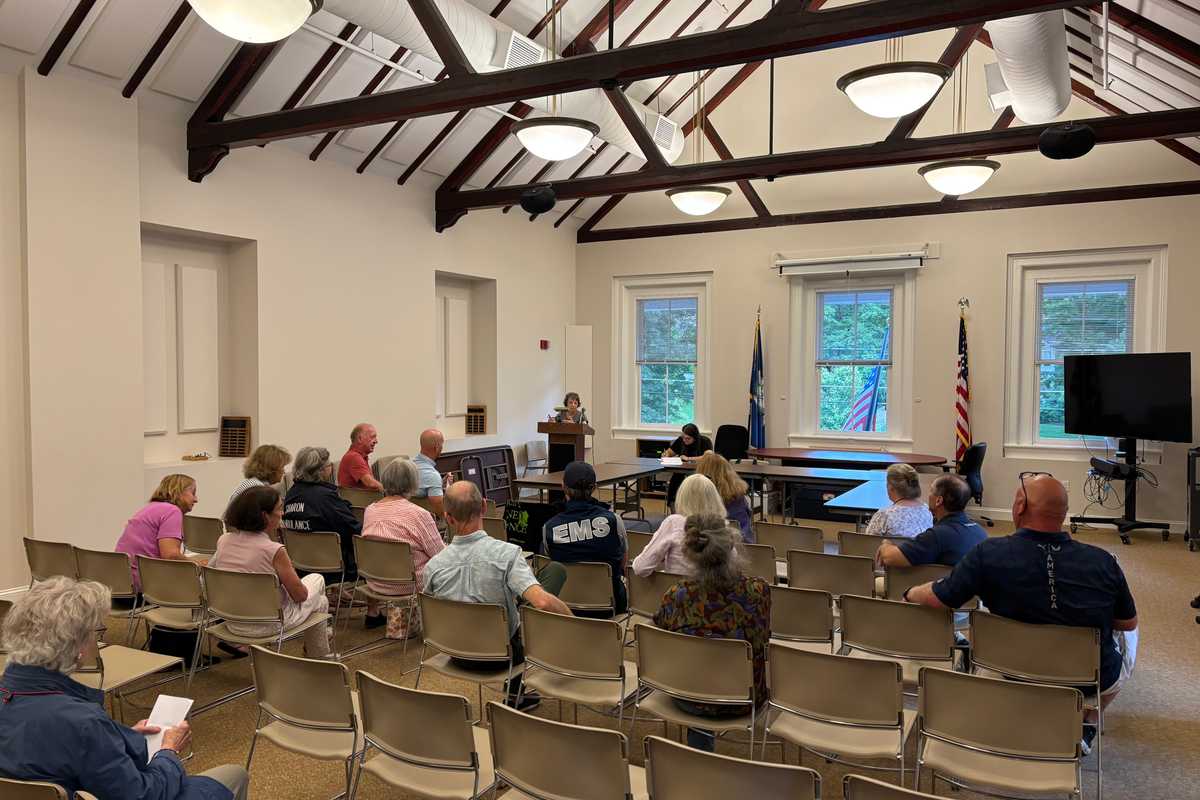
SALISBURY — Selectman Mark Lauretano continued his push for adopting a code of ethics and establishing an ethics commission at a meeting Saturday morning, Feb. 2, at Town Hall.The selectman said, as he has at previous meetings, that the proposed ordinance concerning the code and its enforcement is a work in progress and that he welcomes suggestions.Attending the meeting were Town Clerk Patty Williams, Claude Rolo from the Board of Education, Assessor Barbara Bigos, Fred Schmidt from the Planning and Zoning Commission, Selectman Jim Dresser and First Selectman Curtis Rand. In all, there were about 25 people present, not including press.Lauretano spent the first part of the meeting working off the same PowerPoint presentation he used at the last meeting on this subject, in December. He offered a timeline, beginning with the adoption of a code of ethics Nov. 1, 2005, when Val Bernardoni was first selectman. He said the code was supposed to go into effect Jan. 1, 2006.Lauretano said that when Curtis Rand took over as first selectman, the code of ethics was “shelved.”And he said that this year, when he tried to revive the idea, both Rand and Dresser objected, in part, they said, because there was no enforcement mechanism.Lauretano repeated his statement that he had tried to define “ethics, not feelings,” and emphasized that he had drawn heavily on ethics codes from other towns.“I’m not reinventing the wheel here.”Lauretano reiterated that the proposed code does not conflict with existing labor contracts (with Salisbury Central School teachers and with unionized employees at the town garage).And he said the code of ethics, and the ethics commission, were not to be used for “frivolous” purposes, nor to resolve everyday administrative issues.Lauretano gave, again, four examples of potentially unethical conduct, using himself — by name — as the town official in question.In the first example, “Selectman Lauretano” is the owner of the Black Goose restaurant, and also sits on a “road projects committee,” which is considering redesigning and repaving the street in front of the business. He said it could appear that the selectman is using his influence to enhance his business.In the second example, the hypothetical selectman, a real estate broker, is also a member of a housing commission. He learns of a land transaction that only a member of the commission would know about, and appears to use his influence to benefit his employer.In the third example, “Selectman Lauretano” pays expenses for a project from his own pocket, expects to be reimbursed, and does not follow procedures for the preservation of public documents, thus giving “the appearance of using his position to do whatever he likes.”The fourth example has “Selectman Lauretano” also sitting on a “home heating commission” and voting in seemingly contradictory ways on the same issue in the commission and on the Board of Selectmen, thus “misleading the applicant.”Examples two, three and four are very similar to situations involving Bob Riva, Dresser and Rand that Lauretano has brought up repeatedly during his first year on the Board of Selectmen.Lauretano said that he had changed the section on when or if town employees can accept gifts. The new language states that employees could accept “gifts or meals valued at not more than $100, at the end of a project, at the time of retirement, a promotion or at public occasions held to honor an official or employee … The cumulative value of such gifts and meals from any one source should not exceed $300 in any one calendar year.” Ethics commissionSection 4 of his proposal, which deals with establishing an ethics commission, recommends that the chairmen of the two major party town committees (Democratic and Republican) submit two members and one alternate apiece. The nominees would then be appointed by the first selectman. A vote of three members would be required when establishing by-laws and procedures, to avoid a political stalemate.At the last meeting, this arrangement was criticized for leaving out unaffiliated voters. Lauretano’s latest draft provides for an uaffiliated person wishing to serve to approach the chairman of one of the two major parties to be nominated as a member of that party.The ethics commission would not be “for witch hunts or personal or political vendettas,” he said.The commission would have broad powers, including subpoena powers. He said complaints would have to be signed, witnessed and notarized. Appeals would go to the state court system.He said that having the Board of Selectmen handle ethics complaints is inadequate, because there is no entity to hold the selectmen accountable.He also cited the structural imbalance of political power on any board of selectmen, and said that appointing a temporary ethics commission to deal with a specific issue would be ineffective. “There is too much to know” for members of a quickly assembled committee.Lauretano said the ordinance establishing the ethics commission and adopting the code would take effect 15 days after passing and apply only to matters that come up after that date. “It is not retroactive,” he said. The meeting then moved into questions and comments. Bigos began, asking if hearings before the ethics commission would be open, public meetings.Lauretano said hearings would be confidential, similar to executive sessions which are closed to the public and the media. He said that in the course of his research he had not spoken with anyone who had held a public ethics hearing.Subpoena powerBetty Tyburski said she thought Lauretano had “done a good job, to a certain point.”“But subpoena power really bothers me,” she continued. She said in a small town like Salisbury, individual reputations could be easily damaged.“It’s scary. I’m afraid people could get hurt badly if we handle this wrong.”Lauretano said he understood Tyburski’s concerns but added that a subpoena request has to go before a Superior Court judge, and that the request is not automatically granted.He was then contradicted by Charles Vail, an attorney and former Probate Court judge, who said a subpoena request goes to a clerk, not a judge, and the standard is whether or not the subpoena will produce evidence. “It’s a low standard,” he said.Vail continued, saying the structure and membership of the ethics commission, based on recommendations from political party chairmen, is problematic.“I’m with the Democratic Town Committee,” he said. He said having the town party committees choose the ethics committee members “is introducing politics into a quasi-judicial system. It’s too big for this town.”He raised the prospect of “four partisan people with subpoena power” and said “I am totally opposed to it.”He concluded by recommending the entire section establishing the ethics commission be eliminated, and said that the town could hire independent counsel to investigate individual ethics problems as they arise.Others also criticized the idea. One woman said she thought that a standing ethics commission, “politically based,” would create more more problems than it would solve.Peter Oliver, a former selectman, said he thought Lauretano was equating being on the losing side in votes on the Board of Selectmen with ethical violations.“The ultimate grievance occurs every two years,” during municipal elections, he said.Oliver said that in the town meeting-board of selectmen form of town government, “the town meeting is the forum for any grieveance. If the board of selectmen is acting improperly the town meeting has authority. That form of redress is always available.”A woman said that as an unaffiliated voter, “I don’t want to go begging to a party” to be nominated to the ethics commission.Another person suggested electing the ethics commission.“That’s a great idea,” said Lauretano.Al Ginouves said he thought Lauretano’s “solution is bigger than the problem.”Vail reiterated his idea that independent counsel be hired if necessary to investigate complaints, and cited the hiring of land-use consultant Donald Poland in 2010 to review the town’s planning and zoning regulations as an example of the town seeking independent advice on a major issue.“I’m going to give you a backhanded compliment,” Vail continued. “You’ve designed something that cannot be supported.”Another man then said, “I’m going to give you a forehanded compliment” and thanked Lauretano for his efforts. “I think you’re a stand-up guy.”Dresser’s objectionsDresser said he had planned to remain silent, but wanted to “make corrections.”He said that efforts had been made to get the Northwestern Connecticut Council of Governments (COG) to create a regional ethics commission, but the efforts were unsuccessful. The COG is an organization made of the first selectmen from nine Litchfield County towns, including all six towns in the Region One School District.And he said it was unfair for Lauretano to say that he and Rand had not cooperated. Dresser said that after all three selectmen attended a code of ethics workshop, Lauretano expressed the desire to work on it, and the other two agreed.“This is a town meeting issue, not a Board of Selectmen issue,” Dresser said, noting that the meeting was the fourth Lauretano had held on the subject, which he said was “appropriate.”Vivian Nasiatka said she thought a regional ethics commission would be “far better” than a town ethics commission, which would “pit people against each other.”
Latest News
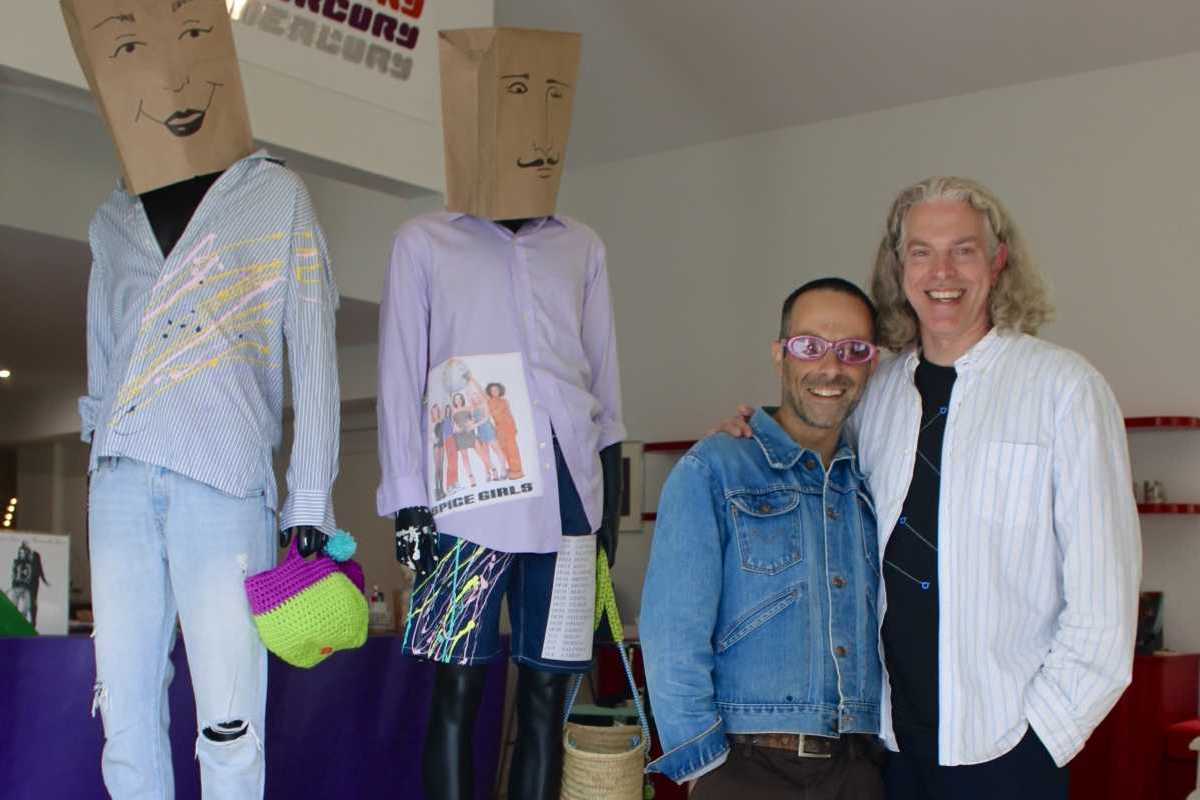
Greg Fricke and James Boehmer, co-owners of Peggy Mercury in Kent, recently launched their first fashion line, “Imaginary Concerts.”
Provided
Fricke and Boehmer are not there to stock their shelves with the same products customers find at standard makeup retailers. They’re there to help customers find what works for them. That usually means asking customers about themselves and learning about their beauty habits, skin, style and the way they like to present themselves. Fricke and Boehmer believe it’s their job to help customers bring out the qualities that suit them and determine what works best for their look.
So much of the Peggy Mercury world is about emboldening people to become more creative, and possibly bolder, versions of themselves. Some of this comes through the store’s creative collaborations with artists, designers and stylists.
It’s part of an ethos that encourages them and their friends to use the shop as a kind of laboratory, trying out new creative experiments without knowing how they might turn out. Whether in fashion, painting, fiber arts or photography, the projects almost always turn out marvelously.
A line of sterling silver charms they sell started as a small project by their friend Nolan Percival. In the beginning, the pieces were for close friends and loved ones. But Boehmer and Fricke encouraged Percival to get a little more serious about the project and create a whole line for the store. Today, it’s one of their top-selling collections.
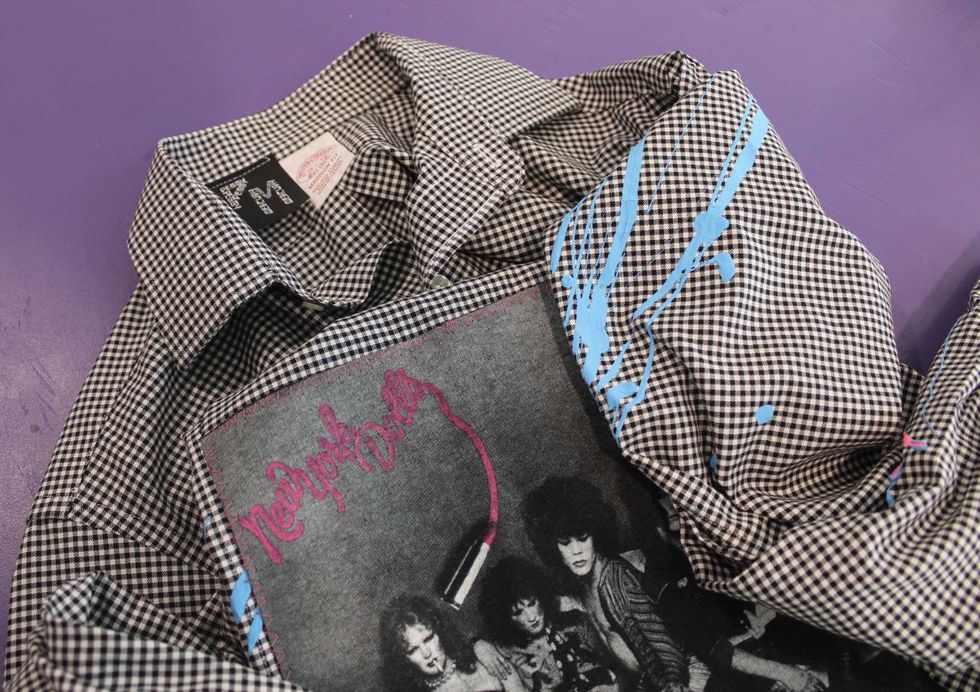 Classic styles, bold colors, and creative concerts make up the “Imaginary Concerts” line at Peggy Mercury.Provided
“Imaginary Concerts” has the duo taking their own advice.
The project started as a way for Boehmer to connect with his mother, who had been diagnosed with Alzheimer’s disease. Taking old concert shirts from his own collection, Boehmer and his mother began cutting out the graphics with the idea that they would make a quilt together. Unfortunately, she died before they could complete the project in 2025. The pieces, which were ready for production, were put on the back burner as Boehmer and Fricke dealt with their loss and the whirlwind of projects that never seemed to cease at Peggy Mercury.
But the harsh winter of 2026 presented an opportunity to take some time and focus on themselves. Part of that meant revisiting and redefining the concert T-shirt project. This time, instead of looking to the warmth and comfort of a quilt, they turned to another passion — fashion.
Taking a page from their own book, they wanted to create something that felt comfortable to them. They took two disparate loves — one rooted in simple preppy style, with clean lines and classic silhouettes, and the other in the nitty gritty worlds of punk rock and pop — and blended them together to create something entirely new. Pulling from the staples of vintage Brooks Brothers and Charvet collections, they applied the graphic elements with bold stitching reminiscent of punk jackets of the ‘70s and ‘80s, but with a much more sophisticated air.
But the remixing isn’t just the pairing of prep and punk. The pieces are not canon. They take liberties with the realities of concert tours, combining one band’s dates with another band’s logos, mixing them all up until the reality is lost and imagination is the only truth.
 Shirts from Peggy Mercury’s first fashion line, “Imaginary Concerts,” hang on display.Provided
Adding to the mix is an element of perpetual creativity. Art can be messy, both figuratively and literally, and many of Fricke and Boehmer’s artist friends carry evidence of their work on them at all times. As a nod to these tireless creatives, the duo added haphazard splashes of bright color, giving the line an even more distinctive feel.
For them, “Imaginary Concerts” passes the “Peggy Test.” The mythical Peggy Mercury is a fictional figurehead for the company, a character who thrives on creativity and change. The name, much like the clothing line, is a mixture of interests: Mercury is a planet, a deity and an elusive, transformative element, while Peggy is the wonderfully stylish and boundary-pushing Peggy Guggenheim.
Everything Fricke and Boehmer put in their store has to pass this test: Would Peggy Mercury approve? For their first collection, the answer is a resounding yes.
Peggy Mercury is at 9 Maple St., Unit 2, Kent.


Want more of our stories on Google? Click here to make us a Preferred Source.