Since George W. Bush has exited the stage, it’s suddenly hip again to be an American, so I have been spending a lot of time in France fulfilling an old artist fantasy.
Because the euro has proven to be such a formidable currency against the dollar, chances are you may actually find only one American in Paris these days, but who cares. I spend time with friends, look, listen, write, make art. It’s not really work, since I love what I do, and therefore I always hesitate when, freshly after landing, I expect to be questioned about the purpose of my visit: “Business or pleasure?�
Once, I belonged to the “Other Europe,� the one behind the Iron Curtain, a cement-like, gray, cold, unfriendly place, where books were censored and people waited days in line for food. My mother trained as a fashion designer at the Academy of Fine Arts in Bucharest, spoke French fluently, had dreams of moving to Paris and opening a fashion design house. Instead, the Soviet occupiers forced her to work as a factory seamstress for 20-something years. She was never able to leave the country except for a weekend trip to neighboring Communist Bulgaria.
That Europe, of power abuses, food shortages, secret police and unspeakable crimes, is now pretty much gone. Coming to the United States from Romania, I wanted to find a place I could call home and become someone else. Since my arrival here 19 years ago, I have always been divided between the two sides of the ocean, trying out cultural identities the way you try different coats.
We immigrants, despite claims of finally belonging to a place, are never at home. Plagued by a chronic need to belong, despite our accomplishments we end up being eternal beggars, and strangely, we are grateful for the right to feel that way. Maybe 19 years is not a long time for someone constantly searching for an identity.
u u u
I received my American citizenship in 1995, and rarely looked back. I came here trying to forget that I was born and lived in one of the most unfortunate parts of Europe. I tried shedding my accent. I cut all the ties with my past. My passport was like a bullet-proof tent under which I could safely rebuild myself.
My first trip abroad as an American, back in the summer of 1996, was to Canada. I remember staying at a friend’s house in upstate New York, making elaborate plans for crossing the bridge over the St. Lawrence River like preparing for a ceremonial landing on the moon. It took me days to gather the courage to do it, and once on the Canadian side, I felt like hopping back-and-forth just to prove to myself I had accomplished something important.
When I left Romania, I decided never to return. I have always wanted to return to Europe though, to my mother’s broken French dream, to civilization, to everything that several thousand years of history and culture still had to teach me. I wanted to become a better American by listening to what Europe still had to tell me.
Twenty-first century “Old Europe,� as our departed Secretary of Defense Donald Rumsfeld once notoriously called it, is a vibrant, young, exciting place. Probably 10 years too early Romania has made its way into the Union. All of us who left more or less legally back in the ’90s have now the right to obtain a European passport, but most of us don’t bother getting one.
I don’t keep in touch with anyone except with a handful of elementary school classmates scattered all over the globe: one is an Australian psychiatrist; one became a respected stage designer and lives in Vienna; another has a flourishing mural painting and interior decorating business in New York City. Like my friends, today I am confident moving back and forth between two continents, both as an American and as a citizen of the world, a Euro-American if you’d like. We are all part of the planetary web, deeply and happily embedded into the global village.
u u u
I am looking forward to my summer. In a few days, I will be driving from Southern France to Spain, an accomplishment of no particular importance, yet, for someone whose former country banned most travel to the Western world, the new, invisible borders of the European Union could be quite fun to cross. Since I started to travel outside my adopted country, every border crossing feels like a birthday party.
After boarding the brand new Boeing 777 to Paris, I receive a quick official smile from a tall, dark flight attendant about to join me across from my bulkhead seat. She asks me in French if I am switching planes in Paris, and when I say yes, she confesses that she is Moroccan, and that she, too, has been spending a lot of time in Southern France.
On the TV monitor above my head flash quick emergency landing instructions mixed with the news about a recent bombing in Asia, followed by (live?) images of the ocean beneath us. For a few seconds, I have the illusion that I am looking at an inverted sky. I smell food and am suddenly in a comfort zone. Knowing the French, it wouldn’t be hard to imagine an entire team of busy chefs arguing backstage about recipes.
Sections of the plane are separated by dark-blue curtains. I close my eyes and picture the crew quickly changing backstage and coming up in new, colorful costumes: the captain, an unwilling Pierrot, surrounded by a group of giddy Columbines wearing loud makeup; jugglers, coin benders, Moulin Rouge girls, and (oh, my God!) even fire-throwers. The proverbial French joie de vivre is about to start as we reach 30,000 feet above the Atlantic.
After a while, the Moroccan flight attendant closes the curtain between first and economy class, so we won’t envy those fortunate passengers who paid extra for the privilege of watching Will Ferrell and Jack Black — at the moment our most valuable exports to Europe.
The physical part of the flight is only a formality, because in my mind, the moment I leave my house in the States, I am already in France. I am excited because everything feels new. I tell myself that there are few places to hide in the world these days, yet, so many to discover.
I love Paris, but I am especially grateful for escaping to a tiny medieval village, population 40, three hours south of the capital. I turn off my TV for several months before leaving, bring along plenty of books, bright white cotton shirts and comfortable sandals, and choose to feel untouched by financial or political turmoil. I spend my days in Van Gogh and Lawrence Durrell’s old surroundings, chasing scorpions off a 400-year-old stone porch overlooking endless waves of green hills. When I don’t write, I cool off in the Mediterranean or attend endless informal lunches and formal dinners under canopies burdened by heavily scented flowers.
I meet new people, mostly ex-pats: a former portrait painter for the Queen of England; a Parisian New Zealander and his wonderful family spending the summer in the local vineyards; a famous rocket scientist doing charity work in Africa; a painter and his wife from Pennsylvania and their son, a Pittsburgh musician. We discuss books, music and sometimes, even politics.
I assume that all of us are pretty comfortable in our destined or chosen skins, but we flirt with shifting places for a while and become someone else, our identities constantly liquefying.
u u u
As much as I love who I am, where I live, and what I do back in the States, I have no trouble imagining living here full time. I am not sure if the French want to be like us as much as we secretly dream of being like them, but I like the French a lot, and not only because they have libraries on their nudist beaches.
I like the French because they carve their lovers’ names on the silver birch trees along the Seine and make out in public. I like the French because they are friendly, sexy, cultured and play Miles Davis and Sidney Bechet in their Parisian McDonalds. (Famed jazz masters always found solace, a great audience and a place to die here. Not that Paris is a cemetery for old American musicians, but over there culture is still central to people’s existence.)
I like the French because they take to the street every time their government screws up. I like the French because they equally revere and despise their public intellectuals. I like the French because they shampoo their streets, love good food, books and see fashion as a gift to society. (Only in Paris could tanned, beautiful women of all ages wear fur-lined winter boots in the middle of July and get away with it). I like the French because even their ultra-skinny, Matrix-musketeer flight attendants have a touch of Piaf and Coco Channel in their allure. I like the French even though they think Jerry Lewis is the funniest man on the planet.
u u u
The plane is an international mélange: next to me, a Romanian shepherd whose daughter goes to Juilliard; a 12-year-old American flying alone, eager to see his French grandmother; a group of chatty Spanish high-school kids wearing similar T-shirts (native Spaniards probably, because New Yorkers don’t wear I Love NY T-shirts), laughing loudly on their way to the lavatory.
I spend the hours between JFK and Charles de Gaulle listening to my iPod, working on this article, or reading today’s Libération. (Today’s front page: “Automobile — La fin du mythe.� ) I close my eyes. I think of my mother, who died without seeing Paris. I think about how, at some point in our lives, we all fly on other people’s wings in order to get where we need to.
After seven quick hours (and in the end, several long minutes of severe turbulence), we have landed, safely. The flight attendant, her carefully lined up knees a few inches from mine, stands up and delivers the news through a grey phone receiver. Upon hearing it, the crowd cheers and gives her a long round of applause.
“Chaque fois que cela m’arrive,� says the flight attendant to me, “ j’ai l’impression d’être une vedette américaine sur le tapis rouge.�
“Every time this happens, I feel like an American movie star on the red carpet.�
Florin Firimita is an artist who lives in Winchester. He was featured in last week’s Towns & Villages.
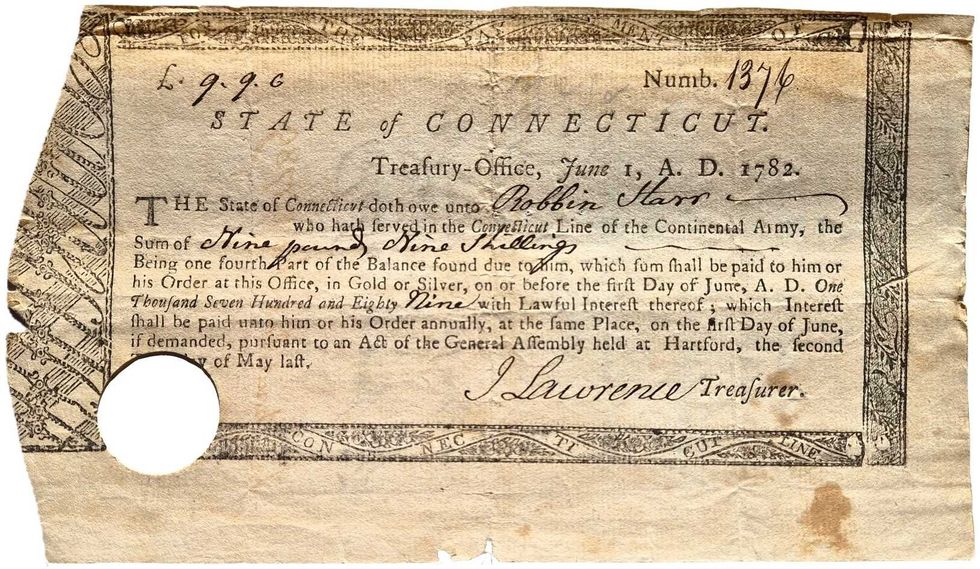 Pay Bill for Robin Starr’s service in the Continental Army.Courtesy the Alex Breanne Corporation
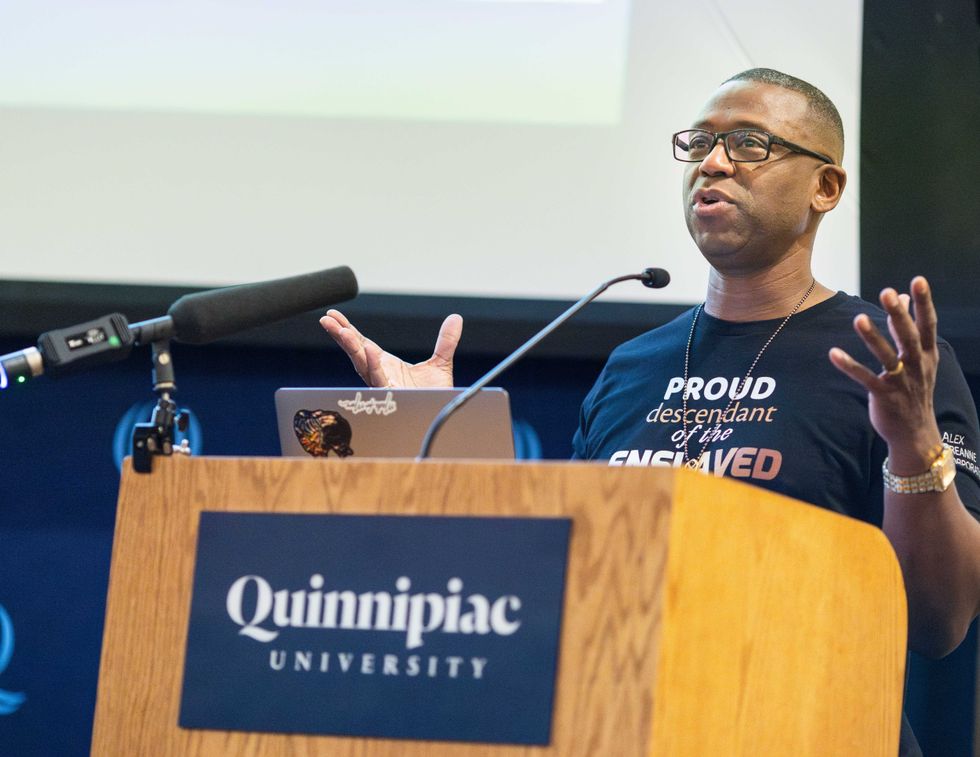 John Mills speaking at Quinnipiac University.Courtesy the Alex Breanne Corporation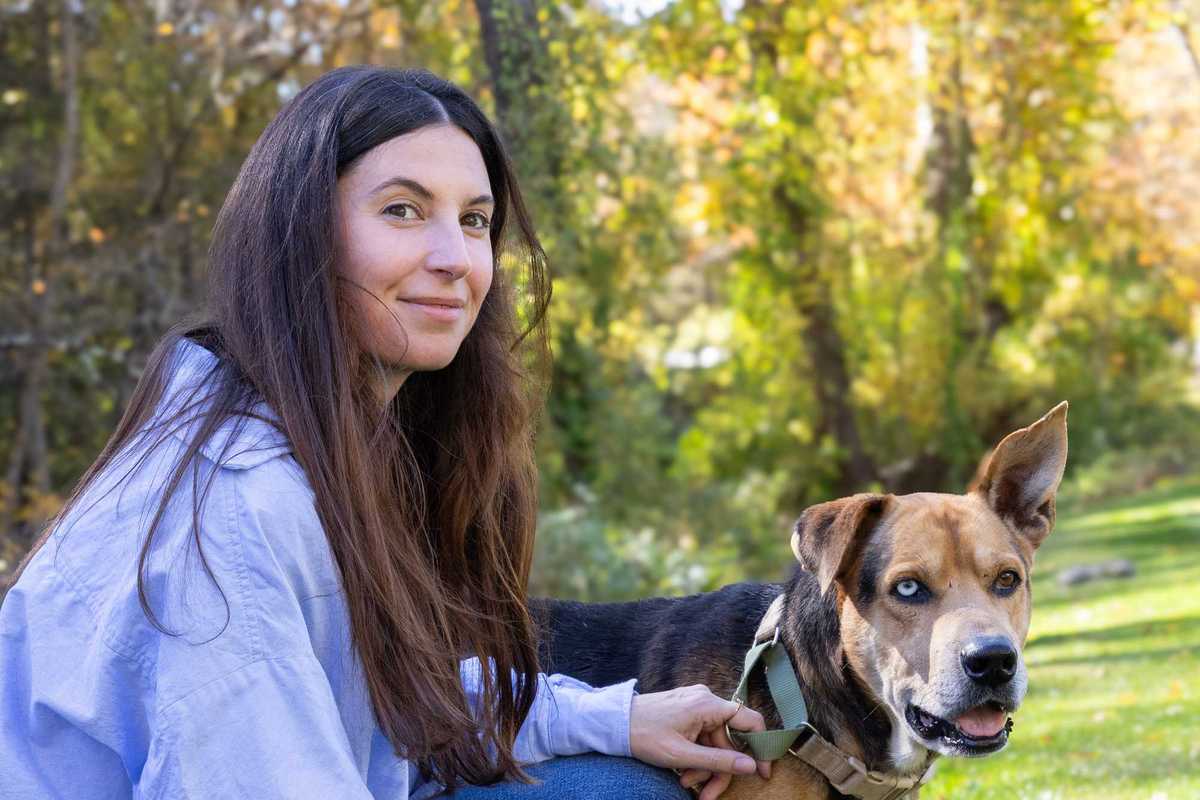
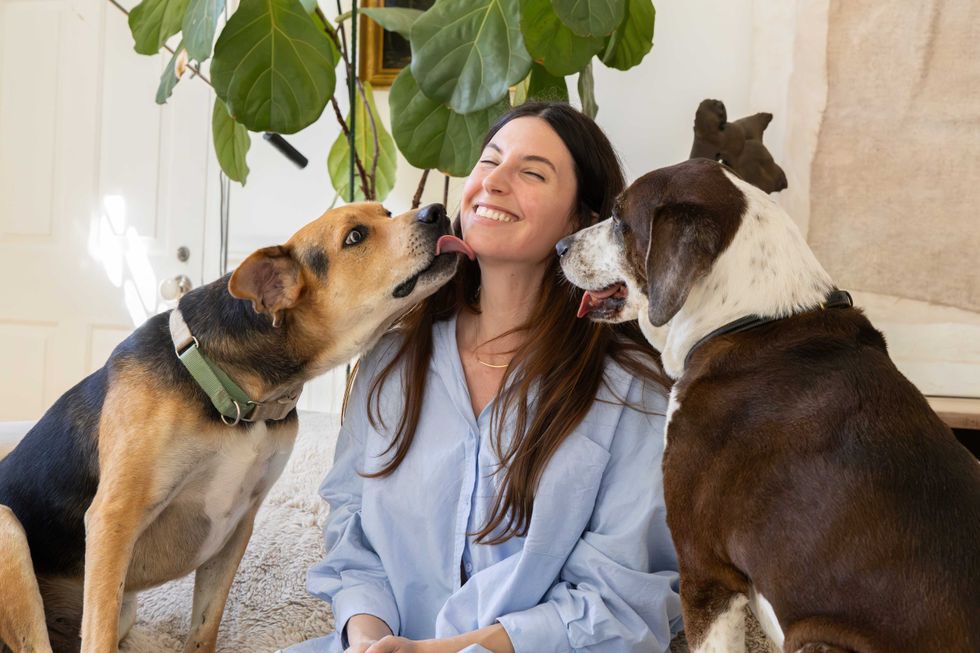 Stephanie Saetta,with her rescue dog George and Blue (left), a shepherd mix awaiting his forever home.Madi Long
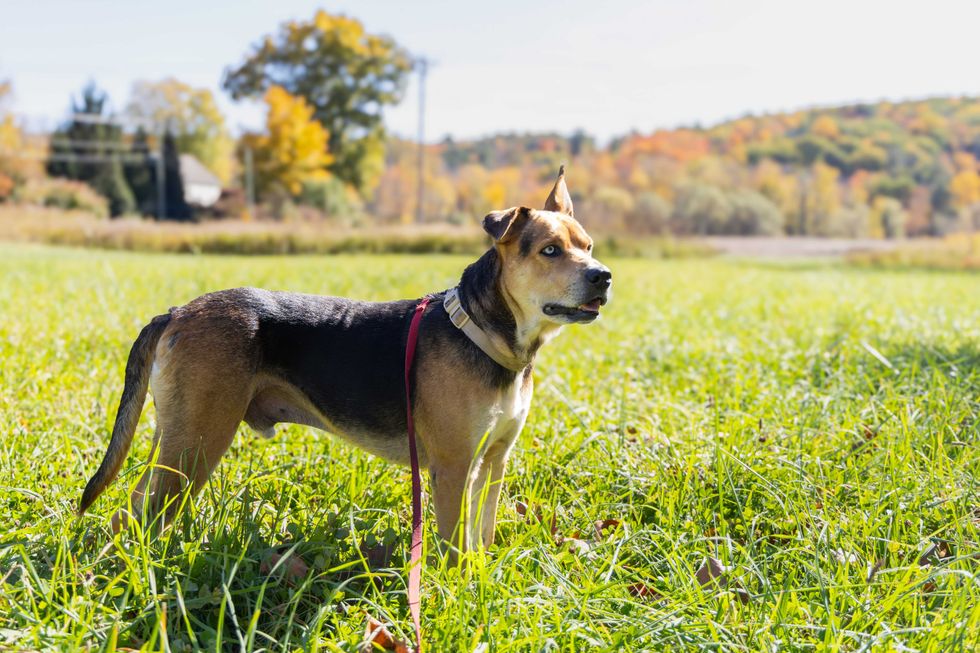 Blue, a 7 year-old Shepard mix, is waiting for his forever home. Madi Long