Questions, answers on affordable housing

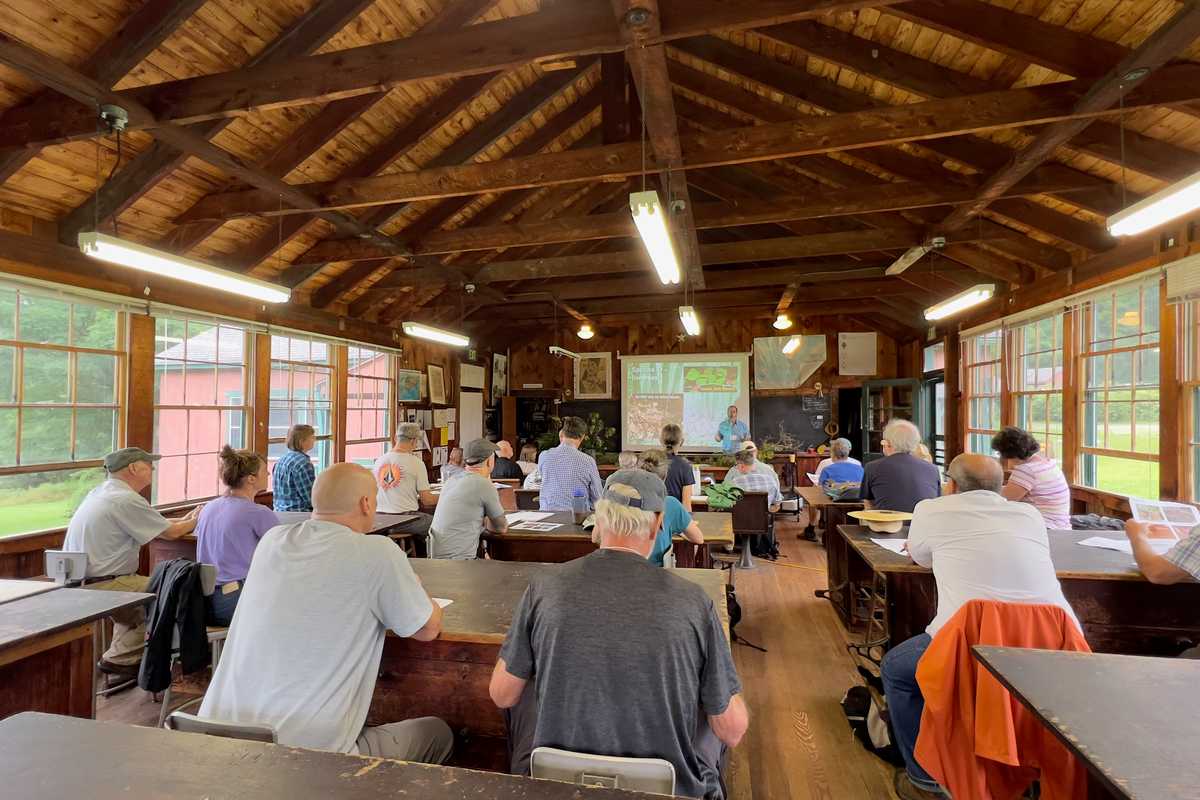
SALISBURY — More than 70 people crowded into the upstairs meeting room at Town Hall, on Saturday morning, Jan. 17, for an information meeting on the proposal from the Women’s Institute for Housing and Economic Development for a “workforce” housing development off Railroad Street in Salisbury village.

First Selectman Curtis Rand thanked everyone for turning out on a holiday weekend and noted that Selectman Jim Dresser, who has donated the land off the Rail Trail for the project, has recused himself from voting on the matter.

Charlie Vail, who with Emily Vail is representing the Women’s Institute, began with a timeline of events: The idea of the development itself, and the request for a right-of-way from the town to build an access road, first came to the selectmen at their meeting on Dec. 5, 2014.

The Women’s Institute made an informal presentation to the Conservation Commission the following evening, Dec. 6. There was an information meeting at Town Hall Dec. 18. The matter was on the selectmen’s agenda Jan. 5, and the Women’s Institute made informal presentations to the Planning and Zoning Commission on Jan. 6 and to the TriState Chamber of Commerce on Jan. 15.

There is another information meeting Tuesday, Jan. 27, at 7 p.m. at Town Hall.

Chicken and egg

Vail said at all these meetings he has emphasized the “unusual situation,” and he employed the “chicken-and-egg” metaphor — a recurring image throughout the meeting.

Vail said, “What we are presenting is in conceptual form, which is as far as we can go right now.”

Until the Women’s Institute obtains the right of way along the town-owned Rail Trail, it cannot proceed with raising funds and paying for plans with the kind of details required for an application before P&Z and the Conservation Commission — and specific answers to many of the questions raised by the public about the project.

(Hence the chicken-and-egg metaphor.)

“We need to provide a private drive over the Rail Trail, owned by the town. That would put the chicken in the coop.”

Mollye Wolahan, deputy director of the Women’s Institute, gave an overview of the organization’s projects in Massachusetts and Connecticut. She said the Women’s Institute has about 1,400 units of housing spread out over 100 properties in the two states, and the organization anticipates adding 900 units to the total by the end of 2017.

Projects are financed with funds from a variety of sources, such as state and federal loan programs, private funds, tax credits.

She said the full name of the organization “reflects our history and past” since its founding in 1983, “when we were focused on female heads of households. 

“We have since moved beyond what the name implies.”

Wolahan said the Women’s Institute functions both as developer and consultant, and owns some of the properties itself, such as the Lakeview Apartments in Lakeville.

The organization’s projects include new construction and rehabilitation of existing housing. “We don’t have a cookie-cutter approach.”

“Our ultimate goal is to create housing for people who live and work” in the town.

She said the proposed development would be managed by a professional property management company, and applicants would have to be employed and pass a background check, a credit check, be able to pay rent and to follow the rules. The Women’s Institute prefers one-year leases.

She said there can be a way to give preference to local workers, provided it doesn’t conflict with state or federal fair housing laws.

And she cautioned, “If I don’t have specific answers it is not because the questions aren’t important.”

Then she invoked the chicken and egg.

Still just a concept

Architect Tom Arcari referred to the development as “Salisbury Commons” and reiterated that the drawings and images he showed the audience were “very conceptual in nature.”

He said the development would be “a small pocket neighborhood,” designed to encourage walking to the business district.

He said the structures would be small, each containing between two to five units, and would be on a similar scale to a residential home.

Most of the development faces inward, with the exception of one building, which Arcari said would match the scale of nearby homes.

He said the Women’s Institute was thinking in terms of 30 units, a mix of mostly one- and two-bedroom apartments, with a few three-bedrooms.

He described the project as “small in stature, personal in scale.”

Traffic through the development would be one way, with parallel parking on the street.

“The idea is to park in front of the unit and walk up.”

Engineer Pat Hackett said the access area has been flagged. The pink flags show the 20-foot road; the blue flags indicate the Rail Trail; the orange flags show the 66-foot railroad right of way owned by the town.

He said the right of way is relatively flat and would require minimal grading and cutting down a few trees.

He said the part of the site in question is “viable,” and the soil is sand and gravel

“It is well-drained, and lends itself to low-impact development.”

Questions need addressing

Sally Spillane, who lives on Railroad Street and is the immediate abutter, said she had submitted a list of questions and did not think they had been adequately addressed.

“It is our neighborhood that bears the onus,” she said. “We will be the greeting committee.”

She said she believed her questions should be answered regardless of any chicken-and-egg discussion.

Spillane wanted to know:

• What is the difference between “workforce” and “affordable” housing?

• What is the system that gives preference to local residents and/or workers?

• What are the layouts of the units?

• Why are there no garages?

• How would issues between tenants, or between tenants and neighbors, be handled?

Wolahan said she didn’t mean “to gloss over” any of these questions.

“We have concepts but they are not refined. The exact unit count has not been determined.”

Spillane pressed, saying that it seemed to her that the Women’s Institute would be making all the decisions about what the development would ultimately be.

Wolahan said it might be better to explain the concept in terms of income levels. She said the benchmark is the median income in the area, and people making 80 percent or less of that figure would be eligible for the new housing.

This translates into an income of $64,000 or less for a family of four, using the median income in Litchfield County.

(Note: A median is that point in a set of numbers where half of the figures are above the median, and half below. It is not the same as an average.)

Wolahan said at this point she could not speculate on what the rents would be, but added that nobody would pay more than 30 percent of their income for rent.

Emily Vail said that while the median income in the county for a family of four is actually $89,000, the figure is capped at $64,000 for purposes of defining affordable housing. Thirty percent of $64,000 is $19,200. Thus, a family of four currently paying more than $19,200 a year for housing would qualify, in theory, for the new housing.

Not federal housing

Project manager Brock Williams said that the initial tenants would be required to report any changes in income when renewing their leases, and the rents would be determined on a sliding scale.

Wolahan said the development would not be run like federal housing (Section 8), with government subsidies.

One person said she thought parallel parking would be hard to manage in winter, when plows would block cars.

“I’m questioning that too,” said Wolahan.

Several residents wondered about the 1.5 parking spaces for 30 units (for a total of 45 spaces) part of the plan.

Emily Vail said the 1.5 parking spaces is part of the town’s zoning regulations for cluster developments.

Asked about the half of the 5-plus acre property that is not included in the housing development proposal, she said that portion of the property has vernal pools and cannot be developed. She added that the Women’s Institute has not discussed placing that portion of the property in some form of conservation status.

Sue Morrill asked if there is an open space requirement for cluster developments.

Emily Vail said the Women’s Institute plans to go ahead with a special permit for affordable housing (assuming the access question is satisfactorily resolved), which does not have an open space requirement.

Mac Gordon said he thought the architectural design “unfortunate” and “bland,” and wondered about issues of who owns the development, and for how long.

Wolahan said the Women’s Institute would remain in ownership with deed restrictions on continuing affordability (which are often a requirement of the funding sources). In response to a follow-up question, she said the Women’s Institute typically stays in charge of a project for 15 to 30 years.

“Our mission is to make this work. We don’t go anywhere. We can’t walk away.”

Arcari said, “The comments on the architecture are quite fair. At this point we’re just throwing a dart at it.”

He added the organizations that provide funding are often quite specific about what sort of materials may be used.

“No vinyl siding, for instance.”

And he added that if the access road is approved and the actual application is filed, the Women’s Institute has to appear first before the Conservation Commission and go through a public hearing; then the P&Z takes its turn, with a public hearing.

“So there are going to be many checkpoints,” Arcari said. “We’re not trying to impose an architect’s vision here. It’s not going to be approved if it’s something the public doesn’t like.”

Inge Dunham asked how the 30-unit figure was derived.

Emily Vail said that 30 units was less than the density allowed by regulation but enough to make “this kind of development successful.”

Asked if the Women’s Institute is willing to reduce the number of units, Wolahan said she couldn’t give an immediate yes or no answer.

She said that smaller projects are harder to fund, operate and manage.

“Thirty is a great number for us.”

She said if the number of units turned out to be 28, “we wouldn’t walk away.

“But eight would be a problem.”

After almost two hours, Rand wrapped up the meeting.

He said he had written down all the questions and advised that if residents go to the site to look at the flags, there is a series of wooden posts that denote the actual center of the town’s right of way.

He said the proposal would be on the agenda for the Feb. 2 selectmen’s meeting and that no date had been set for a town meeting on the access question.

Phil Oppenheimer said, “The need for affordable housing is so urgent, so overwhelming, that many other issues should fall aside.”

Rosina Rand noted that the bike path (aka Rail Trail) is “a jewel of the community.”

And Curtis Rand again thanked everyone for spending two hours on a holiday weekend on the subject.

Latest News

Mountaineers keep kicking in state tournament

Ava Segalla, Housatonic Valley Regional High School's all-time leading goal scorer, has takes a shot against Coventry in the Class S girls soccer tournament quarterfinal game Friday, Nov. 7.

Photo by Riley Klein

FALLS VILLAGE — Housatonic Valley Regional High School’s girls soccer team is headed to the semifinals of the state tournament.

The Mountaineers are the highest seeded team of the four schools remaining in the Connecticut Interscholastic Athletic Conference Class S playoffs.

Keep ReadingShow less
Legal Notices - November 6, 2025

Legal Notice

The Planning & Zoning Commission of the Town of Salisbury will hold a Public Hearing on Special Permit Application #2025-0303 by owner Camp Sloane YMCA Inc to construct a detached apartment on a single family residential lot at 162 Indian Mountain Road, Lakeville, Map 06, Lot 01 per Section 208 of the Salisbury Zoning Regulations. The hearing will be held on Monday, November 17, 2025 at 5:45 PM. There is no physical location for this meeting. This meeting will be held virtually via Zoom where interested persons can listen to & speak on the matter. The application, agenda and meeting instructions will be listed at www.salisburyct.us/agendas/. The application materials will be listed at www.salisburyct.us/planning-zoning-meeting-documents/. Written comments may be submitted to the Land Use Office, Salisbury Town Hall, 27 Main Street, P.O. Box 548, Salisbury, CT or via email to landuse@salisburyct.us. Paper copies of the agenda, meeting instructions, and application materials may be reviewed Monday through Thursday between the hours of 8:00 AM and 3:30 PM at the Land Use Office, Salisbury Town Hall, 27 Main Street, Salisbury CT.

Keep ReadingShow less
Classifieds - November 6, 2025

Help Wanted

Weatogue Stables has an opening: for a full time team member. Experienced and reliable please! Must be available weekends. Housing a possibility for the right candidate. Contact Bobbi at 860-307-8531.

Services Offered

Deluxe Professional Housecleaning: Experience the peace of a flawlessly maintained home. For premium, detail-oriented cleaning, call Dilma Kaufman at 860-491-4622. Excellent references. Discreet, meticulous, trustworthy, and reliable. 20 years of experience cleaning high-end homes.

Keep ReadingShow less