
Thank you!
Your support is sustaining the future of local news in our communities.

Reminiscing with John Potpolak


The Colebrook Historical Society recently discussed Colebrook River, the portion of our town now deep beneath the waters of Colebrook River Lake, at a February potluck dinner. One of the important components of "The River" was the area known as "Happy Valley," the recreation site of the Gilbert Home residents from Winsted.

Happy Valley was located just up stream from the Colebrook River Dam. It lies beneath the waters of the embayment on the west, or left side when observed from the dam. The institution that was the Gilbert Home provided a home for children whose parents (if they existed) needed a helping hand for whatever reason.

Of all the memories the alumni of this exclusive club hold dear, none ranks higher than those gathered from their summer stay at Colebrook River. Today, their ranks have been greatly thinned by the march of time, but a few are still among us, one being a friend of mine, whom I have known for several decades, by the name of John Potpolak.


u u u


John and fellow Gilbert Home alumnus Larry Robertson organized several of the last annual get-togethers for the former home residents, and the number of photographs and documents they were able to gather in preparation of this event always impressed me. There aren’t enough survivors to hold these gatherings any more, and I guess John needed someone to reminisce with when he shared with me his personal collection of memorabilia. These fall into two main categories: clippings and photos from Happy Valley, and an aspect of his life that I had been unaware of, namely books and documents depicting his military service during World War II.

He had mentioned that he had been a paratrooper in the Pacific Theater during the Second World War, but not much more than that. Now that I have read the history of his outfit, I realize that here is another of those quiet, unassuming veterans whose military exploits generally are never spoken of, but who was directly responsible for far-reaching international consequences.

John was an original member of the 11th Airborne Division, activated in February 1943, one of 20,000 volunteers who, by the end of training, would number only half that. They arrived in New Guinea in May 1944, and began jungle training in anticipation of the liberation of the Philippines.

They stormed ashore on Leyte Beach Nov. 11, to become the first airborne unit to make an amphibious assault. The Leyte campaign was to last three months, during which time they killed almost 6,000 Japanese while suffering only light casualties. They went back to New Guinea for a short rest, and on Jan. 26, 1945, chalked up the second amphibious landing at Nasugubu Beach, Luzon, and started an unbelievably rapid drive toward Manila. They averaged taking 14 miles of enemy real estate a day, going over some of the most heavily defended terrain in the Pacific.


u u u


A Philippine scout brought word that the Japanese commandant of a prison camp at Los Banos was preparing to massacre the 2,147 allied internees held there. Realizing that time was of the essence, members of the 511th stealthily surrounded the camp.

At dawn most of the Japanese were in formation holding reveille. Another group guarded some of the POWs, who were digging a huge trench, presumably for a mass grave. Suddenly there was a roar of aircraft, and prisoners and guards alike stood dumbfounded as a column of C-47s came in at 300 feet. Troopers tumbled out the doors, hitting the ground almost simultaneously with the opening of their chutes.

They opened fire from where they landed, still wearing the cumbersome parachute harness. The support group outside the fence joined the fight and in a matter of seconds, the entire enemy garrison was annihilated.

A strange silence settled over the compound. Suddenly one voice was heard. An American nurse who’d been held prisoner started sobbing with relief. "Oh look at those angels — look at those beautiful guys — they’re angels!" Over and over she repeated the phrase. The paratroopers shuffled their feet in embarrassment, took off their harnesses and began handing out candy and cigarettes to the prisoners. From that day forward, the 11th has been known as The Angels From Hell.


u u u


It is believed that the precision and bravery with which the troops executed the Los Banos rescue are in keeping with the very highest tradition of the United States Army, worthy as an example for the emulation of all soldiers, and worthy of citation. As general of the Army, Douglas MacArthur radioed to the division: "An operation such as that performed today will gladden the hearts of soldiers throughout the world."

Two humorous anecdotes are told of the historic raid. The first involves a little old lady who seemed sad as the soldiers entered the camp — though she was packed and ready to leave. Questioned on her lack of enthusiasm, she glumly replied: "Night after night I’ve dreamed of this day, and in all my dreams I was rescued by Marines. You’re not Marines!"

The other tells of one quite opposite lady who joyfully threw her arms around the neck of the first paratrooper she saw and commenced to thank him profusely. The busy soldier gave one short hug and said: "Hold your horses a second sister, and I’ll be right back." As the excitement died down, the soldier, a devout Catholic, turned to greet the now shy nun who had greeted him so happily and bestowed upon him such un-nun-like affections.

By June 1945, all but mop-up action against the Japanese was completed on Luzon, and their eyes turned toward the main islands of Japan, where the most intense fighting of the war was sure to occur. Then we dropped an atomic bomb, followed immediately by another. It seemed to be even rougher on the Japanese than the Angels. There was general relief that no parachute jumps would be necessary on the Japanese home islands.


u u u


The 11th Airborne, because of their outstanding battle records while liberating the Philippines, were assigned the honor of being the first unit to occupy and secure Japanese territory. They supplied the honor guard for General MacArthur when he arrived at Atsugi Airdrome outside of Tokyo. Eventually they, and other units of the American armed forces, occupied all the territory of the Japanese home islands, where they remained until occupation ended and Japan ratified a new democratic constitution in 1947.

Most of you probably have never seen or heard of John Potpolak, a quiet man living with his daughter in Winsted, but whether you know him or not, we all owe him a vote of gratitude for a life well spent and a job well done.

Latest News

‘So Little to Do,’ so much to discover at James Barron Art

Curator Deborah Goodman Davis reads the Emily Dickinson poem “The Grass So Little Has to Do.” Spencer Finch’s “Following Three Bees (Zinnias)” buzzes in the background.

Photo by Natalia Zukerman

“The Grass Has So Little to Do,” on view at James Barron Art in Kent, takes its title from Emily Dickinson’s poem “The Grass So Little Has to Do,” written in 1862:

“The Grass so little has to do—
A Sphere of simple Green—
With only Butterflies to brood
And Bees to entertain—”

Keep ReadingShow less

Marina Kotchoubey is not a woodworker

Marina Kotchoubey is not a woodworker

Marina Kotchoubey at the Ian Ingersoll Cabinetmakers showroom in West Cornwall.

Photo by D.H. Callahan

After 40-something years navigating the world of custom fine furniture, Ian Ingersoll was getting ready to retire. Starting off with a little dovetail stool that he sold at a shop in West Cornwall in the 1970s, he’d grown his skill and his business into something he — and the whole town — could be proud of. Shutting down that business was not an option.

Ingersoll built Ian Ingersoll Cabinetmakers, which produced mainly classical Shaker furniture, on passion: the passion he had to make a living through creative challenges and the passion of his employees, who all seem deeply in love with their craft.

Keep ReadingShow less
A legacy of giving at Norfolk Chamber Music Festival

One hundred and twenty years ago, Carl and Ellen Stoeckel commissioned New York architect E.K. Rossiter to design The Music Shed in Norfolk, Connecticut. After nearly a decade of entertaining their friends and neighbors with the finest music of the day, they built a permanent home for their beloved Litchfield County Choral Union.

The commission and full funding of the construction was not unheard of in an era when great fortunes led to public enrichment. Railroad tycoon John D. Rockefeller was instrumental in funding institutes of higher education. Steel baron Andrew Carnegie was building libraries all over the country, and famously said that a man who dies rich is a disgrace, challenging his peers to give their fortunes back to the people.

Keep ReadingShow less
google preferred source

Want more of our stories on Google? Click here to make us a Preferred Source.
Two unique exhibitions at Geary Gallery

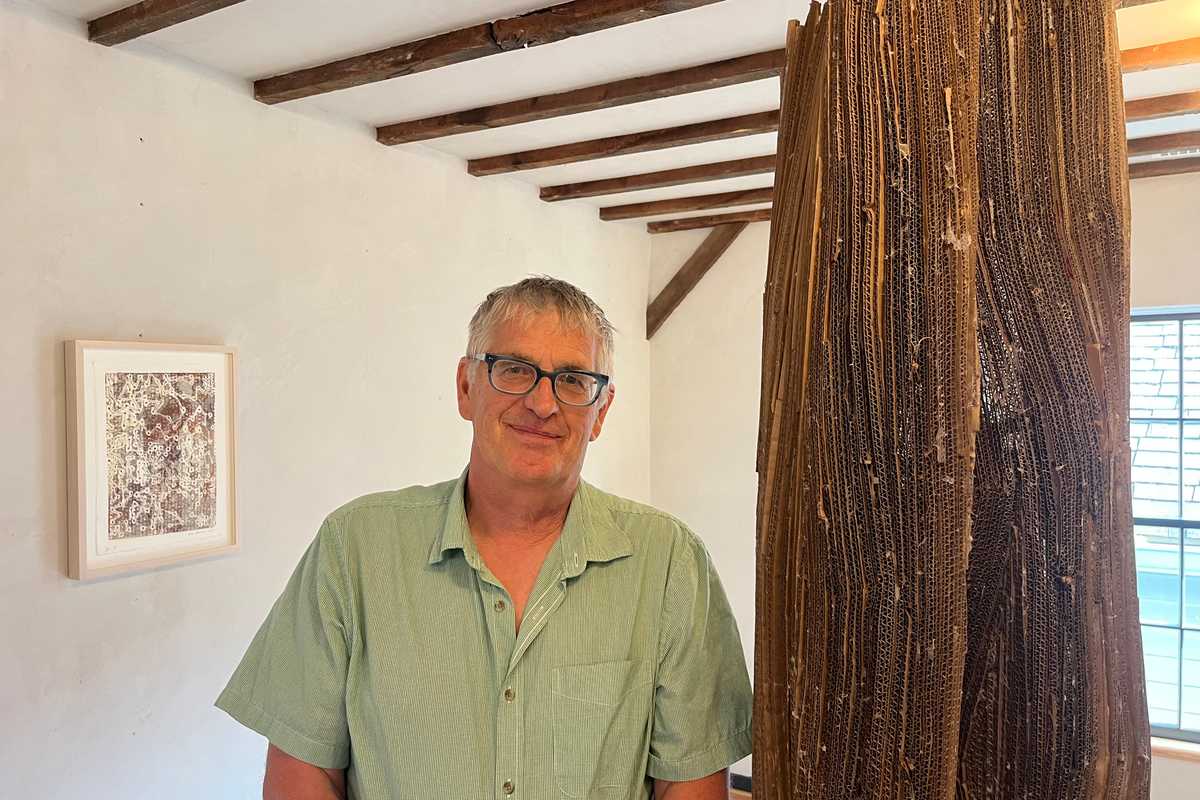
Henry Klimowicz with his sculpture, “Partial Pillar 1”

Photo by D.H. Callahan

On Saturday, Aug. 1, Geary Gallery opened its doors in Salisbury for two unique shows in its first- and second-floor gallery spaces. Art lovers flooded both floors over the course of the afternoon, giving the events a vibrant feeling that enhanced the importance of the art.

On the first floor is a show by Chicago-born, Colorado-based photographer Summers Moore, titled “Lobitos: Pueblo Fantasma,” or “Lobitos: Ghost Town.” The work centers around her daughter’s current hometown in Peru. Moore herself found a home away from home in Colorado in the mid-1980s and encouraged her children to seek out new places outside of their comfort zones.

Keep ReadingShow less

Writer’s retreat in the woods

Writer’s retreat in the woods

Participants in a 2024 Great Mountain Forest Woodland Academy workshop at Yale Camp.

Photo by Mike Zarfos

Great Mountain Forest (GMF) will host its first Nature Writing Retreat at the historic Yale Camp in Falls Village from Aug. 7-9, 2026. Writers of all levels are invited to draw inspiration from one of New England’s most notable forest landscapes. GMF envisions the retreat becoming an annual event celebrating writing, conservation and the relationship between people and forests.

This immersive three-day retreat reflects on the legacy of Hal Borland, the American writer and New York Times nature columnist whose work was deeply connected to this landscape. The retreat explores how wilderness shapes language, strengthens close observation and fosters environmental consciousness.

Keep ReadingShow less
From Cornwall to Rome, Adam Van Doren at Berkshire Botanical Garden

Artist Adam Van Doren and curator Donna Hassler talk to a group of visitors at the Berkshire Botanical Garden. A Stephen Proctor vessel sits to their left.

Photo by Natalia Zukerman

This summer, the Berkshire Botanical Garden in Stockbridge has hosted “Grounded in Nature: Paintings by Adam Van Doren,” an exhibition exploring the intimate relationship between architecture and the natural world.

On view for only a few more weeks in the Leonhardt Galleries, the exhibition features more than 35 watercolor and oil paintings by the New York-based artist, architect, author and Yale professor, curated by art historian Donna Hassler, director emerita of Chesterwood. The works span three distinct places that have shaped Van Doren’s artistic practice: New York City, Cornwall, Connecticut, and his travels throughout Europe.

Keep ReadingShow less
google preferred source

Want more of our stories on Google? Click here to make us a Preferred Source.
google preferred source

Want more of our stories on Google? Click here to make us a Preferred Source.