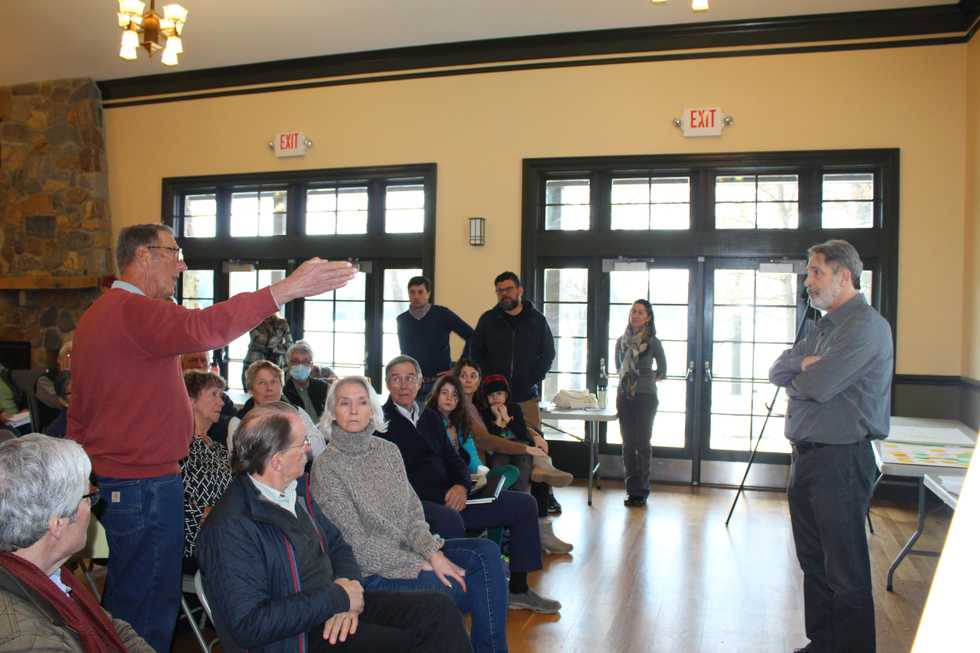
LAKEVILLE — Lakeville residents heard and discussed several ideas for revitalizing the Lakeville village area at a forum sponsored by the Salisbury Planning and Zoning Commission at the town Grove Saturday, March 18.
The presenters were from Colliers Engineering and Design of Madison. They were Gerald DeFelicis, who spoke mostly about parks and pathways, Rich D’Andrea, a traffic specialist, and Debbie Alamo Lawlor, who acted as facilitator.
Abby Conroy, Salisbury’s land use director, was also on hand.
The idea was to give residents an overview of the Colliers planning study and receive feedback.
The crowd of about 100 people were asked to sign in and then give brief answers about their travel and activity habits in Lakeviile.
Then the audience was split into two groups, with presentations at either end of the big meeting room. About halfway through, the presenters switched sides.
DeFelicas handled connectivity and parks.
One proposal is to change “Community Field” into “Community Park.” This involves creating a parking area on the current Community Field, behind the Patco gas station, with room for 30 to 40 vehicles.
The parking area would be used for daytime activities such as summer softball, and in the evening serve as overflow parking for nearby restaurants.
The informal parking area off Pettee Street, next to the tennis courts, would be closed off. DeFelicis said much of that area is actually the property of the Aquarion Water Company, including one of the three tennis courts, and “there’s no definition” between Aquarion and town property.
DeFelicas also advocated for improving the Rail Trail, especially where it ends in Community Field and for reconfiguring the entrance to the Grove to allow for a pedestrian or bicycle pathway along Factory Pond.
D’Andrea discussed traffic flow, particularly reconfiguring the intersection of Routes 44 and 41. He floated the idea of an all-way stop, a standard traffic light, or a roundabout.
Salisbury First Selectman Curtis Rand interjected, saying the state Department of Transportation has ruled out a roundabout because of the topography.
The conversation turned to traffic speed, and how to get drivers to slow down. One suggestion from the audience was to reduce the speed limit to from the current 30 to 20 miles per hour, but how this could be enforced remained an open question.
State Representative Maria Horn (D-64) chimed in, suggesting the use of traffic cameras.
Asked about accidents, D’Andrea said after looking at data he found there were fewer accidents in Lakeville “than I anticipated.”
The Colliers “Lakeville Village Planning Study” is available on the town website’s landing page (go to www.salisburyct.us).