SALISBURY — As Connecticut’s state Legislature grapples with how best to provide broadband internet service to areas like the Northwest Corner, historian Bernard Drew told the tangled tale of how electricity was brought to the area in the late 19th and eary 20th centuries.
Drew is a Great Barrington resident and former Lakeville Journal writer and editor.
Drew spoke via Zoom at a presentation, “Local Skirmishes on the Road to Electrification More Than a Century Ago: Great Barrington and Salisbury,” on Saturday, Feb. 13. The talk was sponsored by the Scoville Memorial Library.
Furnishing electricity in the 1880s meant deciding whether to go with direct current (DC), as championed by Thomas Edison, or alternating current (AC), as promoted by George Westinghouse. (Westinghouse ultimately prevailed.)
William Stanley Jr., whose name still adorns insulated bottles, worked for Westinghouse, and in March 1886 wired up part of the northern section of Main Street in Great Barrington for a demonstration of AC power.
Meanwhile Mary Frances Sherwood Hopkins, widow of railroad tycoon Mark Hopkins, was wiring up her end of Main Street with DC power, from her base at what is commonly referred to as Searles Castle.
The two demonstrations occurred within a couple days of each other.
Stanley held another demonstration on April 16, 1886, with Westinghouse in attendance. The latter approved and went back to Pittsburgh, leaving Stanley to continue his work in Great Barrington.
Stanley stayed in western Massachusetts, making transformers, wattage meters and setting up generating facilities.
Drew said that while Stanley was a talented electrical engineer, his business acumen was lacking.
Along the way Stanley invented a welding process that resulted in the familiar insulated thermos-type bottle.
The Roraback plan
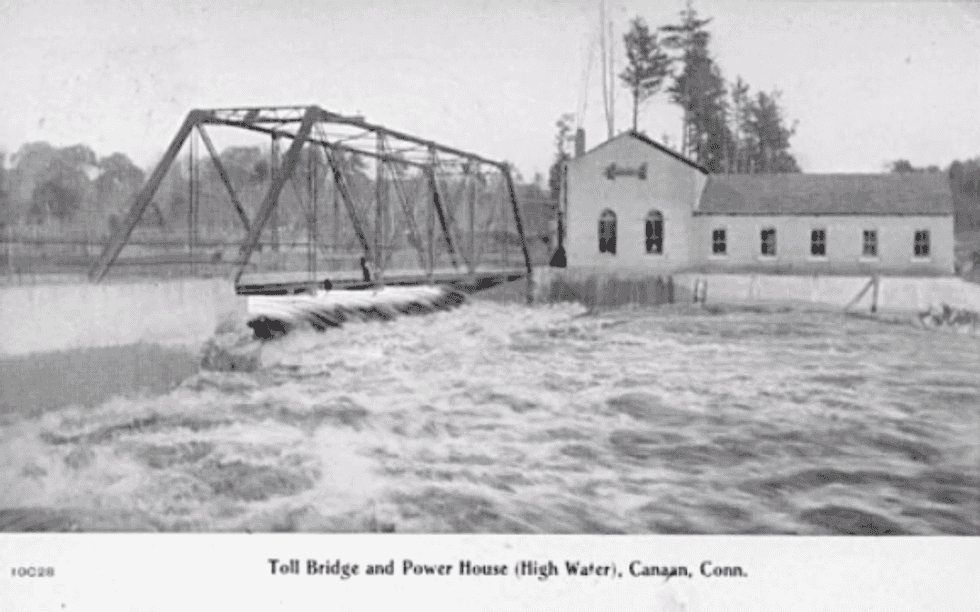
In Connecticut, John “Boss” Roraback, operating out of North Canaan, was a political figure, an attorney and entrepreneur. In the latter capacity he set about bringing electric power to his neck of the woods, starting with the purchase of a small electric utility in Norfolk and establishing the Berkshire Power Company in 1905.
The company built a dam on the Housatonic River between North Canaan and the Weatogue section of Salisbury for power generation.
Unfortunately for the farmers upstream in Sheffield, Mass. (where Roraback grew up), the resulting backup flooded their fields.
There was some negotiation and financial compensation between the power company and the farmers, but it wasn’t enough.
“The farmers wanted their land back,” said Drew.
The Massachusetts Legislature got involved, setting off a lengthy legal dispute that, ultimately, retained the status quo.
“The result was no satisfaction for the farmers.”
Roraback sold his company to Connecticut Light and Power in 1913, and the facility between North Canaan and Salisbury continued to generate power until the dam and hydroelectric plant downstream in Falls Village was built.
Roraback committed suicide in 1937, and in 1938 the Weatogue dam blew out during a massive flood.
Its remnants can still be seen from Weatogue Farm, “with permission,” Drew noted.