Schoolgirl samplers featured at Salisbury Association show

On display at Salisbury Historical Society’s new exhibit.
Patrick L. Sullivan


On display at Salisbury Historical Society’s new exhibit.
SALISBURY — A new exhibit from the Salisbury Association Historical Society opened Saturday, Feb. 15.
“Birth, Death and Alphabets: The Enduring Legacy of Schoolgirl Needleworks before 1850 with Alexandra Peters” features samplers from Peters’ collection, including one that dates back to 1698.
Peters is giving a talk on the subject Saturday, Feb. 22, at 4 p.m. at the Scoville Memorial Library. The talk is in-person and online. To register go to www.scovillelibrary.org and click on “events.”

Nora Kallusky
Spending a week at the Foundation for Individual Rights and Expression (FIRE) forum at American University changed how I think about free speech, especially in difficult moments like the aftermath of Charlie Kirk’s killing. In the days that followed, people were fired or punished for comments seen as insensitive or supportive of the violence. What stood out to me was not just what people said, but how quickly reactions shifted depending on who was speaking. People who often criticized cancel culture suddenly supported consequences for speech they found offensive. It made me question whether free speech is truly a principle we believe in, or something we defend only when it is convenient.
That question feels personal to me. My grandparents lived in Argentina during the military dictatorship in the early 1970s, when speaking out against the government was dangerous. People who spoke out were not just silenced socially, they were arrested, and many were tortured or killed. Some simply disappeared. My mom was born during this time, and her family fled when she was just one year old. Growing up, I have heard these stories not as distant history, but as something that shaped my family’s life. Because of that, I cannot think about free speech as an abstract idea. I see what can happen when it is taken away.
With that perspective, my time at FIRE helped me better understand why the First Amendment is written the way it is. It is not designed to protect speech that is widely accepted or easy to hear. It exists to protect speech that people may strongly dislike. One of the most impactful moments of the forum was hearing from Daryl Davis, a black musician and activist,who spent years engaging directly with members of the Ku Klux Klan. Instead of shutting down conversations with people who held deeply racist beliefs, he chose to talk with them, listen, and challenge them through dialogue. Over time, many of those individuals left the Klan, not because their opinions were silenced, but because their views were confronted and changed through conversation. These conversations eventually helped build long lasting relationships, to the point where Davis stepped in to walk a former Klansman’s fiancé down the aisle. His experience showed me that allowing speech, even when it is offensive, can create opportunities for understanding and change in ways that punishment or censorship cannot.
The First Amendment should protect people from being punished by the government for what they say, except in cases of inciting violence or real threats. If we only defend free speech when we agree with it, then it is no longer something we can all rely on. It becomes something we apply selectively, depending on who is speaking.
My family’s history makes that danger feel real. Once speech began to be controlled inArgentina, it no longer mattered what people believed or said. The system decided who wasallowed to speak and who was not. That is why I believe the legal limits on speech should benarrow. At the same time, I believe we all carry responsibility in how we use our words. Freespeech gives us the right to speak, but it also challenges us to use that right thoughtfully.
Protecting speech, even when it is uncomfortable, is not easy. But from what I havelearned, both from my family and from my experience at FIRE, it is necessary.
Nora Kallusky is a 12th grader at Ridgefield High School
Each year, the Connecticut Foundation for Open Government sponsors an essay contest open to all high-school students in the state. The contest focuses on First Amendment and open information issues. This year, students chose from three prompts (edited here for space constraints): 1.) the potential limitations on hate speech following the fatal shooting of conservative activist Charlie Kirk; 2.) the arrest and revocation of the student visa of a Tufts University Ph.D. student from Turkey who had written an opinion piece for the school newspaper critical of the university’s position on the war in Gaza; 3.) the banning of the Associated Press from Oval Office events and Air Force One following its refusal to refer to the Gulf of Mexico as the Gulf of America, which is President Trump’s preferred name.
The Lakeville Journal has obtained permission to publish the 2026 top three winners out of 70 entries from across Connecticut. First place went to Nora Kallusky, a senior at Ridgefield High School. There was a tie for Second Place, so Mayumi Iwai, a junior at Greenwich High School, and Prithika Venugopal, a senior at Rocky Hill High School, both received that honor.
Christian Murray
SALISBURY – Salisbury has appointed a new resident trooper, with traffic enforcement and community engagement among her top priorities.
Trooper Katie Begley, 26, officially began serving as Salisbury’s resident trooper on April 9 after spending the first two-and-a-half years of her state police career assigned to Troop B in North Canaan.
Begley succeeds Trooper Ryan Cooper, who was appointed as Salisbury’s resident trooper late last year but left the post weeks later to pursue another opportunity. Town officials said they hope Begley’s appointment will bring stability to the position as they continue addressing longstanding concerns, including speeding on state roads.
Begley was introduced to town officials during the Board of Selectmen’s June 1 meeting. First Selectman Curtis Rand said reviewing speed limits on Routes 41, 44 and 112 remains a priority. The issue had been discussed with previous resident troopers, he said, but they “didn’t stay around long enough to do it.”
Rand said speed limits on state roads can be confusing and inconsistent, with some stretches posted at 30 mph and others at 40 mph.
During the meeting, Begley spoke about her desire to be accessible to residents.
“You’ll probably see my cruiser parked in front of town,” said Begley, who has an office in Town Hall. “I’m very honored to be working for the town of Salisbury. If you see me around town, please feel free to stop me and say hello..”
Begley also told selectmen that Troop B is exploring a proposal that would periodically bring resident troopers from neighboring communities into Salisbury for concentrated traffic enforcement details.
Under the tentative plan, resident troopers would rotate among Troop B communities, including Salisbury, North Canaan and Norfolk, creating a larger police presence in a different town each week.
Begley said the opportunity to become involved in a single community was one of the reasons she was drawn to the resident trooper program.
“When you’re just working patrol, you’re kind of torn between three to potentially six different towns. I like being the friendly face that people can come up to throughout the day.”
Since arriving in Salisbury, Begley said speeding complaints have been among the most common concerns she has heard from residents.
“A lot of people have come up to me. They have been touching on speed enforcement,” she said. “That’s something I’m looking to do.”
She identified Routes 44 and 112 as areas where speeding concerns are frequently reported, particularly along Route 112 near Lime Rock Park.
Begley comes from a family of public servants. Her father served as a captain with the Manchester, New Hampshire, Police Department, while her mother worked as a nurse.
“I’m just looking to carry on the legacy and do the best I can for the town,” she said.
So far, she said, Salisbury residents have made her feel welcome.
“They’ve been very, very respectful and taken me in with open arms,” Begley said. “That’s something I’ve really loved about this town. I’m happy to be here.”

Want more of our stories on Google? Click here to make us a Preferred Source.
Norma Bosworth
125 years ago — June 1901
A heavy storm that was a near approach to a cloudburst caused much damage at Norfolk Saturday night. The track of the C.N.E. railroad for a distance of a mile each side of the station was undermined in scores of places by the rush of swollen streams and two bad washouts occurred, delaying trains for hours. Two highway bridges were swept away, and roads were badly damaged, while even farms suffered serious injury, some entire gardens being ruined.
Miss Mary E. Robbins is in Brookline, Mass. She will be in that city several months, engaged in classifying the public library of over 60,000 volumes. Miss Robbins is considered an expert in this line and receives calls from all parts of the United States.
It costs the state $22,500 to transport the members of the general assembly and the officials, doorkeepers and messengers to and from their homes while attending session.
100 years ago — June 1926
Tuesday morning Officer Stanton became suspicious of a truck, obviously loaded with household goods, going through Salisbury. He stopped it near Salisbury School. Examination revealed five hundred gallons of alcohol also included in the load. Officer Stanton also arrested in Sharon on Wednesday a Springfield, Mass. man driving a Reo Speed Wagon with three hundred and ninety gallons of liquor on board. He was tried in Sharon.
50 years ago — June 1976
Lime Rock Park’s Memorial Day auto races drew a near-record crowd, estimated by State Police and track officials at between 25,000 and 30,000. Despite the biggest crowd in recent years, police managed to keep traffic moving, avoiding tie-ups such as those in recent years which blocked traffic for miles up and down Route 7 east of Lime Rock.
Former Col. Arnold Whitridge, a veteran of both world wars and author of Salisbury’s new town history, marched beside former Marine Corps Brig. Gen. Guido Verbeck Monday at the head of Salisbury’s Bicentennial Memorial Day parade. Parade Marshal Dick Barton followed. Many of the Salisbury veterans, some of whom had not worn their uniforms in years, also turned out to march in the parade.
SALISBURY — First Selectman Charlotte Reid reported to a selectmen’s meeting Tuesday that, as a result of a random sampling at her request, high sodium levels have been found in two out of nine wells tested in the town of Salisbury. She said that town sanitarian Joseph Pinkham found an unsafe level of salt in samples taken at Smith Hill and Ore Hill.
SALISBURY — A 1947 grader may have to be replaced at a cost of $68,000, and for this reason Salisbury selectmen voted Tuesday night to delay action on three bids to replace a 1969 truck. Selectman George Kiefer said that in view of the new crisis, the town could probably “squeeze another year out of the ‘69 vehicle.”
CANAAN — It has been nearly 58 years since the close of World War I — a half century that has seen dramatic technological advances and corresponding changes in attitudes and lifestyles. Nothing so clearly underlines the many changes in attitude that have taken place as reading the letters written home by Canaan men who served in the first global war. A scrapbook containing printed letters written by these earlier warriors was recently donated to the Canaan VFW by the family of William and Luella Blass. Mrs. Blass, a World War I bride, faithfully clipped the letters printed in the local newspaper and preserved them in the scrapbook.
Laura Perkins of the Cranford Club presented a Bicentennial quilt last Wednesday to Oliver Eldridge of the Falls Village- Canaan Historical Society. The quilt was a Bicentennial project made by club members and will be displayed in the society’s museum.
Users of the Falls Village town landfill have been invading the privacy of the residents of a house near the town landfill, according to the Falls Village Board of Selectmen. The house is leased by the town to private persons. First Selectman David Domeier told The Lakeville Journal that town residents have been disturbing occupants of the house by using the main driveway to the house and walking around its grounds. There is a separate driveway to the landfill which should be used for that purpose, Domeier pointed out.
25 years ago — June 2001
Further cuts to the Region 1 budget for 2001-02 will be made at a special meeting of the Board of Education on June 4 at 7 p.m. in the library at Housatonic Valley Regional High School. Not a single town voted in favor of the Region 1 budget last Thursday as it went before residents for a second time. A total of 1,039 votes were cast against the $10,138,757 plan and only 534 in favor.
“A Son’s Confession,” an examination of the controversial and unsolved 1973 Barbara Gibbons murder case in Falls Village, will air on the cable network A&E’s American Justice series Wednesday June 6 at 9 p.m. The victim’s son, Peter Reilly, was initially charged with the crime and later cleared of any involvement.
These items were taken from The Lakeville Journal archives at Salisbury’s Scoville Memorial Library, keeping the original wording intact as possible.
Alec Linden
SHARON – Access stickers for the Town Beach at Mudge Pond are now available at Sharon Town Hall, several weeks ahead of the planned June 19 season opening. The beach will officially open for the summer after Region One schools let out.
Mudge Pond, a seasonal destination for residents and visitors alike, offers docks, rafts and swimming lanes, along with a changing pavilion, picnic tables, grills, a playground and a sand beach.
This year, a vehicle sticker costs $30 for residents, with additional vehicles in the same household costing $15. Stickers for seniors, age 65 and over, cost $10. Property owners of Airbnb’s can purchase season stickers for $50. Stickers for non-residents cost $150.
Boating, kayaking and stand-up paddle boarding stickers can be purchased for an additional $20 per person, and a waiver must be completed by each individual who will be using the watercraft.
Stickers may be requested through mail using an online form available on the town’s website, or by picking up a paper form at the back entrance at Town Hall.
For seasonal renters, proof of residency is required in the form of a lease, confirmation note from the landlord or a utility bill in the renter’s name at the Sharon address.
Ruth Epstein
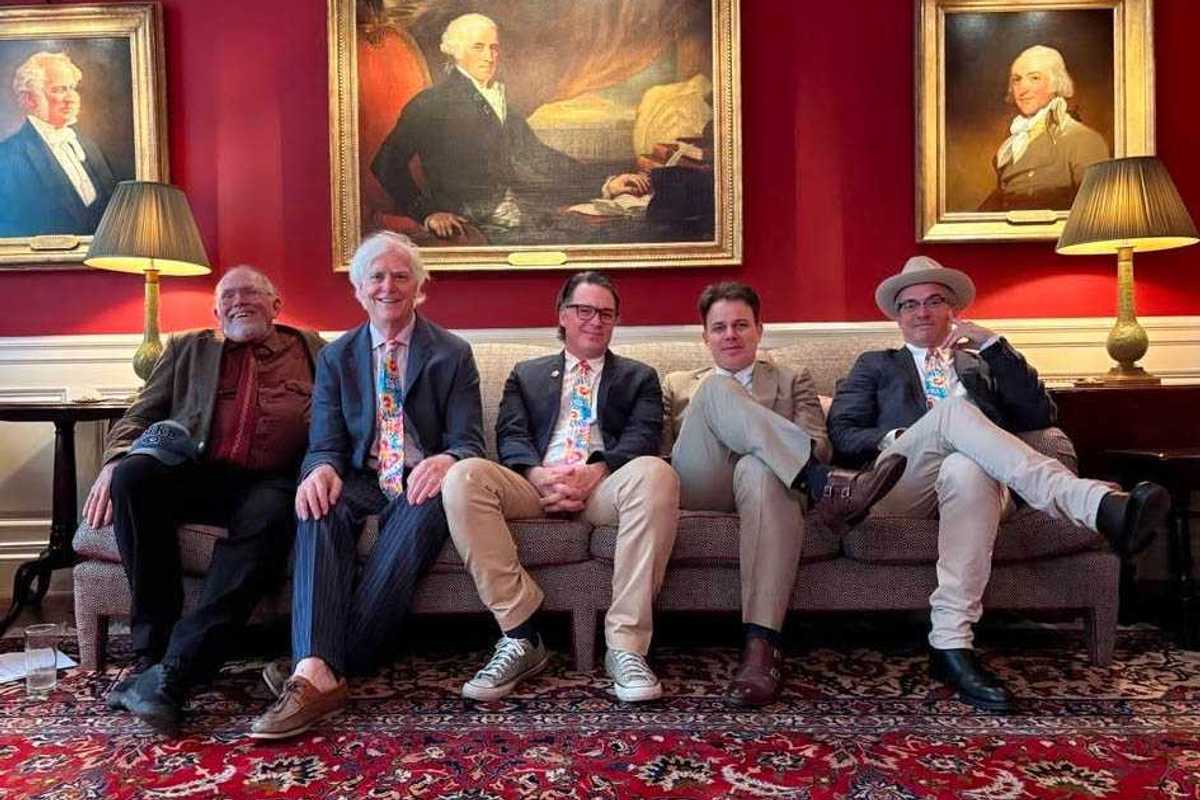
Dressed as a colonial officer, local historian Tim Abbott discusses local Falls Village residents who served in the Revolutionary War during the Falls Village-Canaan Historical Society's annual dinner meeting May 27.
FALLS VILLAGE – As the nation prepares to celebrate its 250th anniversary, local historian and war reenactor Tim Abbott used stories of soldiers, prisoners of war and ordinary residents to show how deeply the Revolutionary War touched the people of Canaan during the Falls Village-Canaan Historical Society’s annual dinner meeting Wednesday, May 27.
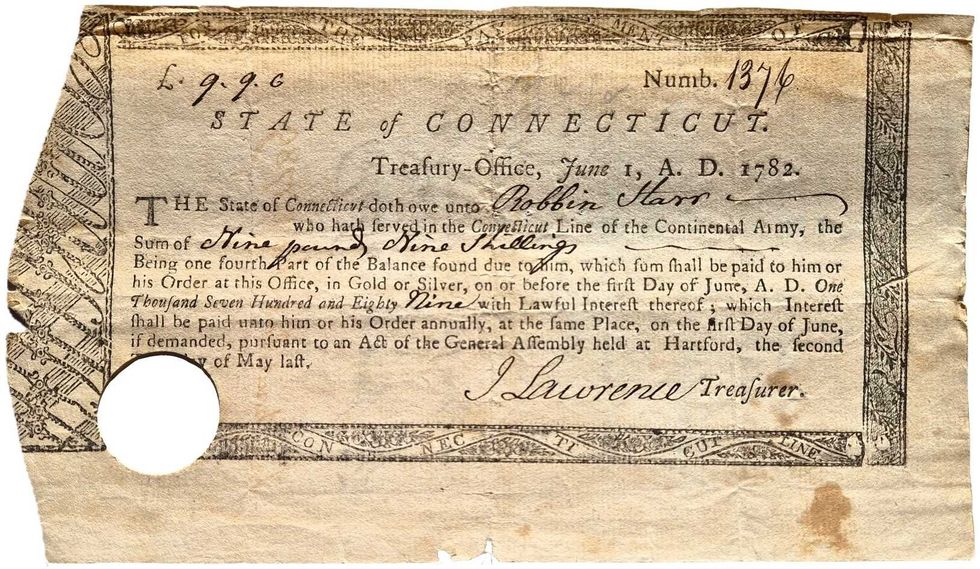
Dressed as a colonial officer from Canaan, Abbott told attendees that 225 men associated with Canaan – which included present-day North Canaan and Falls Village before the towns split in 1858 – fought for independence from Great Britain, a figure he said represented roughly 25% of the town’s population at the time.
“It’s interesting to think about it in those terms,” he said, describing the Revolutionary War as the nation’s first civil war.
The Continental Army had a difficult time finding men to serve, Abbott said. Regiments were often made up of farmers, enslaved people and the poor, while wealthier people could pay others to take their place in military duty.
Abbott’s research materials include primary sources, such as payroll and muster lists. He also used compilations by the Daughters of the American Revolution, cemetery inscriptions and town records. His rule in research, he emphasized, is, “Trust, but verify.”
As with all wars, said Abbott, the Revolutionary War affected everyone – both on the battlefield and at home.
Nearly half of the 4th Connecticut Regiment was made up of men from Canaan. Abbott highlighted local soldiers, including Capt. John Watson, Benjamin Stevens and Charles Burrall.
One of the most tragic moments for Canaan was the Battle of the Cedars near Montreal in 1776, when thirty-seven locals fought – some of whom were killed – and all were captured.
A large contingent of area soldiers – from Salisbury, Cornwall and Canaan – were also at the Battle of Long Island and at Kips Bay, while records also place local men at Fort Mifflin near Philadelphia, where they battled in water up to three feet deep.
Abbott said that in addition to a Continental Army – the national army under George Washington – there were also local militias and state troops. State troops were often raised from militia units for short periods of service. For example, in November 1778, when British prisoners of war were being taken to Virginia from Massachusetts, Northwest Corner militia members escorted them for 14 days, handing them off to New York authorities in Sharon.
Abbott also explained the history of his uniform, which included a heavy dark brown wool coat with a red sash. The sash signified an officer’s rank, and was discontinued when the Americans adopted more conventional military uniforms with epaulets that held badges of rank.
On July 4, Abbott will be rowing across Lake Champlain from Crown Point to Fort Ticonderoga. “I know that my weekend will approximate only a fraction of what those soldiers endured.”

Want more of our stories on Google? Click here to make us a Preferred Source.

Want more of our stories on Google? Click here to make us a Preferred Source.