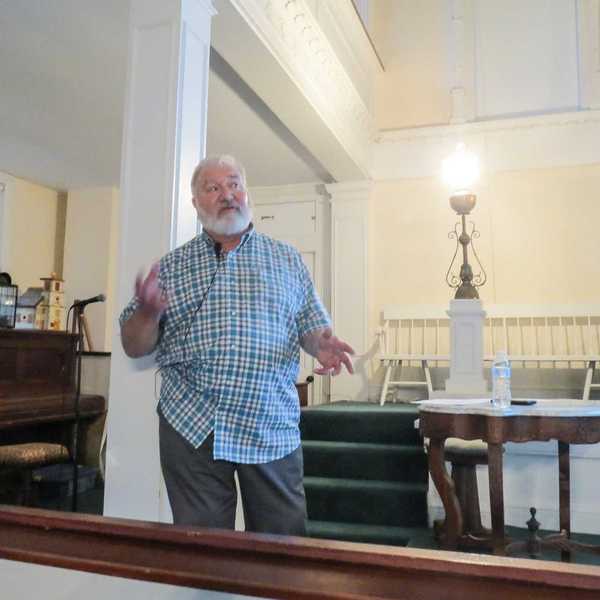
FALLS VILLAGE – As the nation prepares to celebrate its 250th anniversary, local historian and war reenactor Tim Abbott used stories of soldiers, prisoners of war and ordinary residents to show how deeply the Revolutionary War touched the people of Canaan during the Falls Village-Canaan Historical Society’s annual dinner meeting Wednesday, May 27.
Dressed as a colonial officer from Canaan, Abbott told attendees that 225 men associated with Canaan – which included present-day North Canaan and Falls Village before the towns split in 1858 – fought for independence from Great Britain, a figure he said represented roughly 25% of the town’s population at the time.
“It’s interesting to think about it in those terms,” he said, describing the Revolutionary War as the nation’s first civil war.
The Continental Army had a difficult time finding men to serve, Abbott said. Regiments were often made up of farmers, enslaved people and the poor, while wealthier people could pay others to take their place in military duty.
Abbott’s research materials include primary sources, such as payroll and muster lists. He also used compilations by the Daughters of the American Revolution, cemetery inscriptions and town records. His rule in research, he emphasized, is, “Trust, but verify.”
As with all wars, said Abbott, the Revolutionary War affected everyone – both on the battlefield and at home.
Nearly half of the 4th Connecticut Regiment was made up of men from Canaan. Abbott highlighted local soldiers, including Capt. John Watson, Benjamin Stevens and Charles Burrall.
One of the most tragic moments for Canaan was the Battle of the Cedars near Montreal in 1776, when thirty-seven locals fought – some of whom were killed – and all were captured.
A large contingent of area soldiers – from Salisbury, Cornwall and Canaan – were also at the Battle of Long Island and at Kips Bay, while records also place local men at Fort Mifflin near Philadelphia, where they battled in water up to three feet deep.
Abbott said that in addition to a Continental Army – the national army under George Washington – there were also local militias and state troops. State troops were often raised from militia units for short periods of service. For example, in November 1778, when British prisoners of war were being taken to Virginia from Massachusetts, Northwest Corner militia members escorted them for 14 days, handing them off to New York authorities in Sharon.
Abbott also explained the history of his uniform, which included a heavy dark brown wool coat with a red sash. The sash signified an officer’s rank, and was discontinued when the Americans adopted more conventional military uniforms with epaulets that held badges of rank.
On July 4, Abbott will be rowing across Lake Champlain from Crown Point to Fort Ticonderoga. “I know that my weekend will approximate only a fraction of what those soldiers endured.”