Brass band concert draws audience to Hunt Library lawn

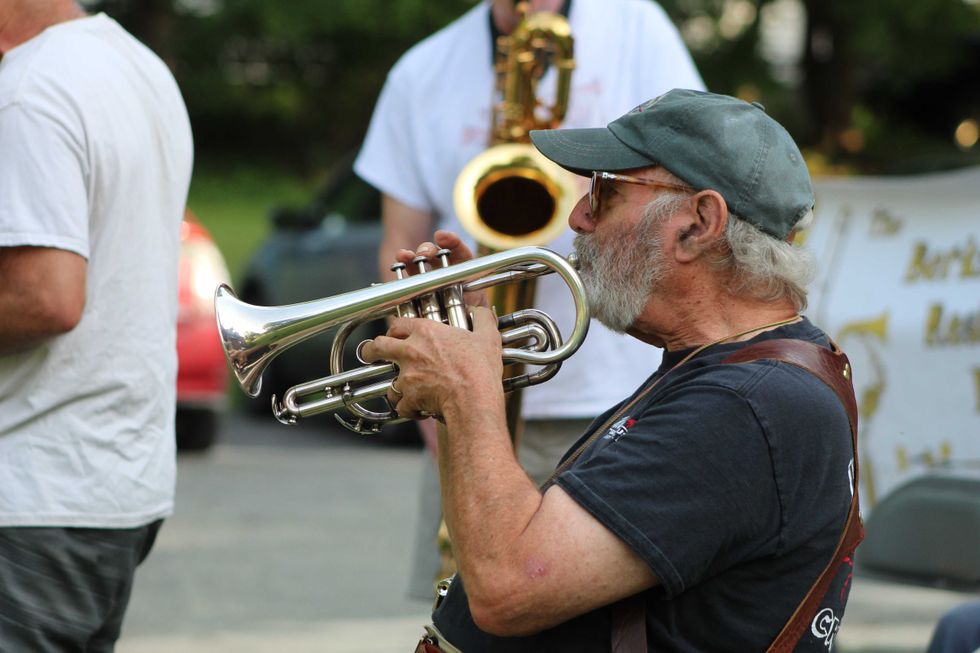
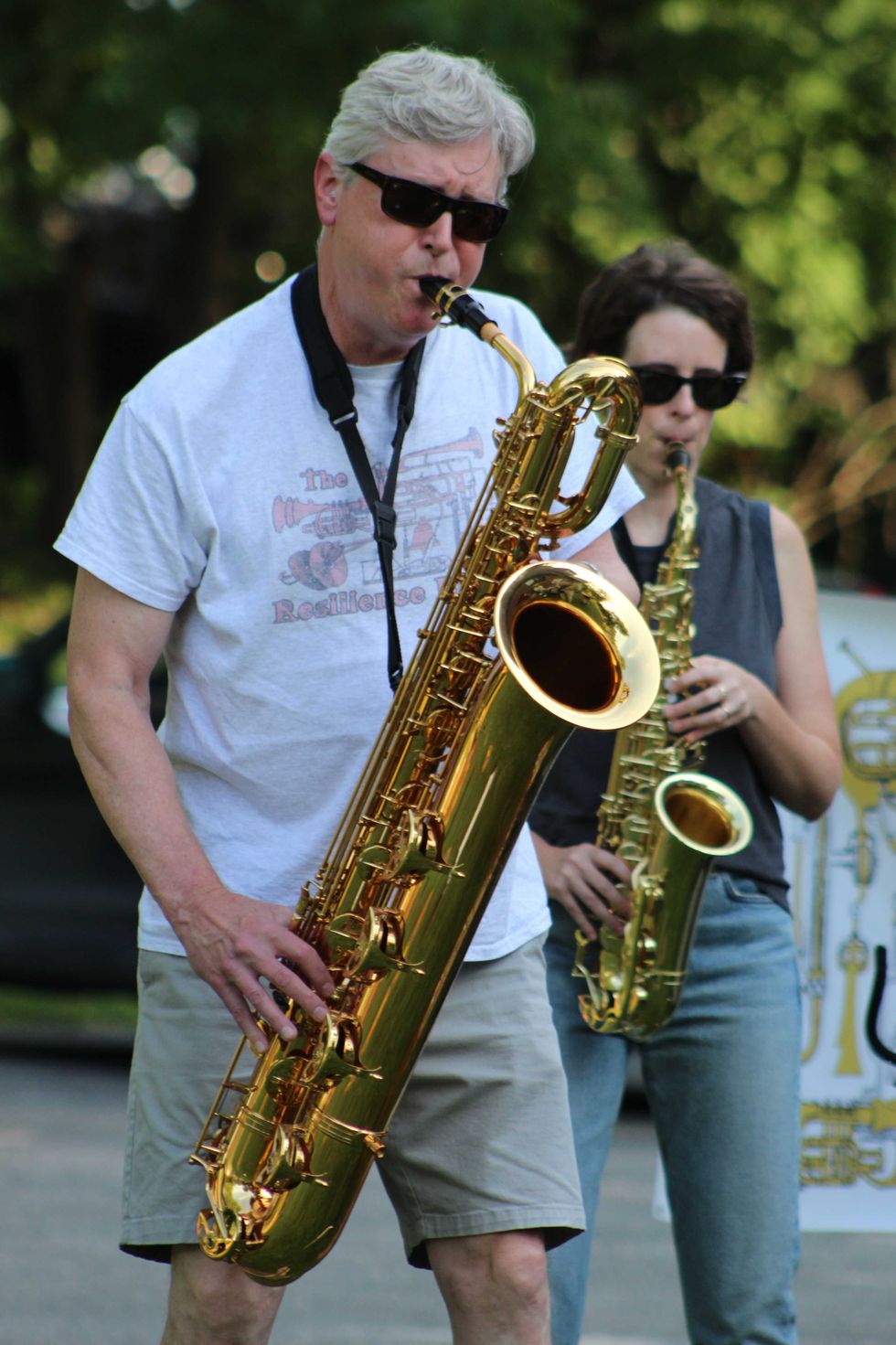
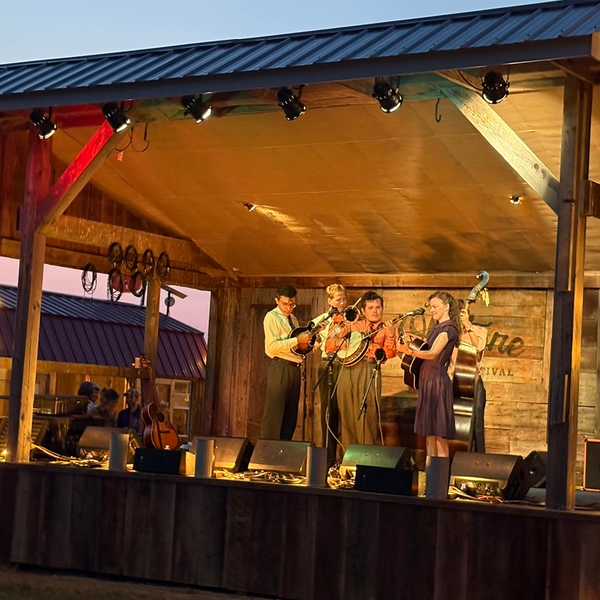
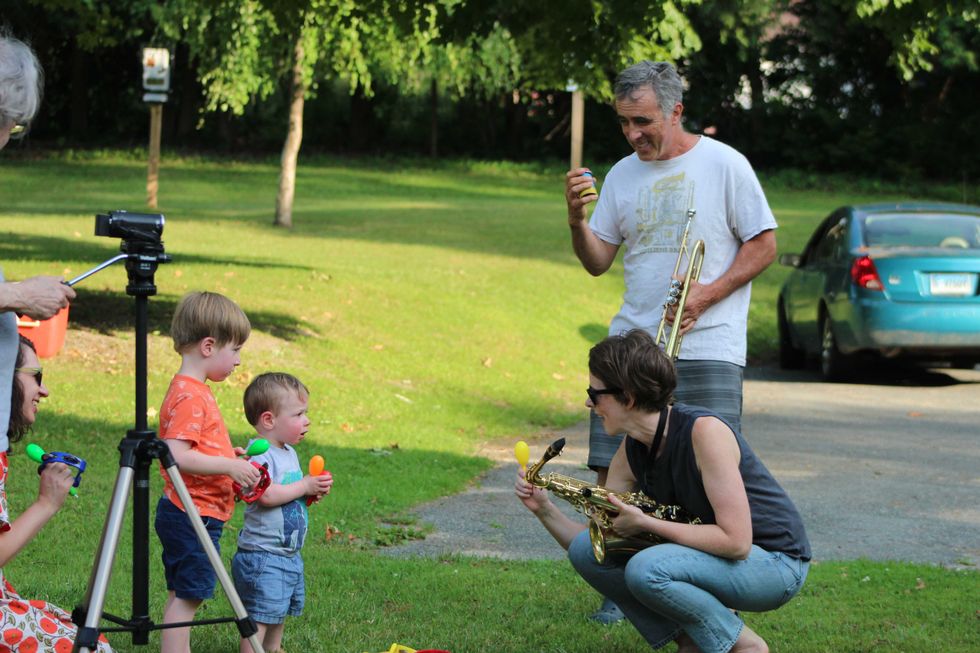
The Berkshire Resilience Brass Band brought lively brass and jazz-inspired music to the lawn at the David M. Hunt Library on Friday evening, July 24.
Patrick L. Sullivan


The Berkshire Resilience Brass Band brought lively brass and jazz-inspired music to the lawn at the David M. Hunt Library on Friday evening, July 24.
FALLS VILLAGE — The Berkshire Resilience Brass Band brought lively brass and jazz-inspired music to the lawn at the David M. Hunt Library on Friday evening, July 24, drawing about 30 people at the start of the outdoor concert and more as the evening progressed.
Led by trumpeter Shamu Sadeh, the band’s lineup shifts from performance to performance. Friday’s group included Charlie Kiel on trombonium, Sam Earnshaw on percussion, Eric Loffswold on baritone saxophone, Dathalinn O’Dea on alto saxophone, David Rogers on tenor saxophone, and Peter Peirce on trombone.
Audience members became part of the performance as well. During one number, the horn players switched to percussion, while a basket of rattles and other handheld instruments was available for audience members to play along. Sadeh and O’Dea encouraged several young children to shake along with the music.
The audience continued to grow throughout the evening, including a family who stopped after hearing the music while driving by.
Although the band’s performances sound spontaneous, they begin with a shared musical framework.
“We start with a tune or arrangement,” Rogers said. “Then we do or don’t follow it.”
Rogers estimated that any given performance is at least half improvisation.
It’s not left entirely to chance. O’Dea said the group rehearses once a week, on Sundays.
Richard Feiner And Annette Stover
Jeremy Boviard, General Manager at the Moviehouse in Millerton.
There’s something special about sharing a story in a room full of other people.
— Jeremy Boviard
More than movies: Jeremy Boviard found his calling at The Moviehouse
Spend a few minutes talking with Jeremy Boviard about movies and you’re likely to forget what time it is.
Ask about a favorite film and he’ll happily explain the first time he saw it, how it was made and why it matters. One story leads to another. His enthusiasm is infectious. For Boviard, movies are far more than entertainment – they’re one of the best ways people connect.
That passion has made him the perfect steward of The Moviehouse in Millerton, where, as general manager, he has helped transform the nonprofit theater into a vibrant community gathering place.
“I like bringing people together to share something,” he said. “People come here to enjoy themselves, to learn about the world and themselves, and we’re here to facilitate and enhance that experience as much as possible.”
His path to The Moviehouse, however, wasn’t one he could have imagined.
Raised in Newton, Massachusetts, Boviard grew up immersed in musical theater and developed an early love of cinema. Some of his first memories involve movies. As a toddler, he insisted on watching “E.T.” before deciding the opening scenes were too scary. Today, it’s one of his all-time favorites. He also wore out a VHS recording of the television broadcast of “The Wizard of Oz,” commercials and all.
Cinema was a family affair. His mother, a preschool teacher, would even mail him Siskel and Ebert’s “thumbs up” and “thumbs down” movie reviews while he was away at summer camp, to keep him in the loop.
“I’ve always loved talking about movies,” he said.
After studying communications and media at Northeastern University, Boviard explored a variety of careers. Then, in 2016, his life took an unexpected turn.
He came to northwest Connecticut seeking treatment for alcoholism at Mountainside Treatment Center in Canaan, expecting to stay for only a month or two.
Instead, he found a new beginning.
Nearly a decade later, Boviard remains sober and speaks openly about the experience that changed his life.
“It’s a big part of my identity,” he said. “It’s more than not drinking or doing drugs; it’s about having integrity and being open to others.”
After completing treatment, he stayed in the area and joined the Mountainside staff, eventually becoming a client services lead during the height of the COVID-19 pandemic. The work was demanding, requiring compassion, flexibility and resilience.
“It helped me become — not the best version of myself, because I’m not perfect — but I feel stable and happy with my life in ways that 10 years ago I did not,” he said. “It’s the beginning of a lifelong journey.”
That same outlook shapes the way he approaches his work today.
When friends learned The Moviehouse was looking for a general manager after reopening in 2021, they immediately thought of Boviard. Running an independent movie theater had long been one of his dream jobs.
“It felt like a perfect fit,” he said, “and I am incredibly grateful for the opportunity that [Moviehouse Chair and Vice Chair] Chelsea Altman and David Maltby have given me.”
His days rarely look the same. He helps choose films, organizes special events, oversees fundraising and educational programs, manages staff schedules and payroll, orders supplies — and, if necessary, teaches new team members to change the soda fountain syrup, as he did in the middle of this interview: “There are plenty of moments where you’re doing a little bit of everything.”
He credits Assistant General Manager Tom Cloutier, Public Relations and Marketing Director Helen Seslowsky, and the rest of the team for creating a culture built on trust and teamwork.
“When I’m not here physically, I trust that the people who are here are handling everything well,” he said. “That’s a really good place to be.”

Under Boviard’s leadership, The Moviehouse has expanded well beyond first-run films. Trivia nights, filmmaker discussions, live performances, after-school filmmaking programs and community partnerships have become part of its identity.
His goal is to offer something streaming services can’t.
“There’s something special about sharing a story in a room full of other people,” he said.
In an age when so much entertainment is experienced alone, Boviard believes the real magic of the movies is not confined to the screen. It’s found in the shared experience of watching together, lights dimming and a community discovering, for a couple of hours, that great stories are better when they’re shared.
That commitment extends beyond the theater. As co-chair of the Millerton Business Alliance, Boviard helps organize community events, including free holiday movie screenings and Festival of Lights activities.
He says he still finds himself struck by the quiet beauty of the region he unexpectedly came to call home.
Asked what advice he would give his younger self, Boviard doesn’t talk about career success or favorite films.
Instead, he offered a lesson earned through experience.
“Life’s full of surprises, and things often won’t play out how you expect,” he said. “If you put your best foot forward, stay even-keeled and remain as realistically optimistic as possible, life will lead to some unexpectedly wonderful places.”
Natalia Zukerman
Presenters at the 2025 Berkshire Mushroom Festival.
“Mycelium is Earth’s natural Internet,” says mycologist Paul Stamets. He also calls fungi “the grand recyclers of the planet” and says, “Fungi are the interface organisms between life and death.”
If that sounds like a pretty good argument for paying more attention to what’s happening under your feet, the Berkshire Mushroom Festival is hosting a weekend made for you.
On Aug. 22 and 23, Tam Integration, an online psychedelic community organization, and Lee, Massachusetts-based dispensary Sweetgrass Botanicals will bring together foragers, cultivators, scientists, artists, cooks and curious humans at Dewey Hall in Sheffield, Massachusetts, for a weekend devoted to the remarkable world of mushrooms.
Stamets’ books, including “Mycelium Running: How Mushrooms Can Help Save the World,” have helped inspire a broader fascination with the fungal kingdom, from the role of mycelium in forest ecosystems to the potential of mushrooms in medicine and environmental restoration. Similarly, Michael Pollan’s “How to Change Your Mind” introduced millions of readers to the history and revival of psychedelic research, including scientific investigations into psilocybin, the psychoactive compound found in certain mushrooms. Pollan’s reporting has helped illuminate a field that had moved from the counterculture into laboratories and serious conversations about consciousness and mental health.
This spirit fits the Berkshire festival, whose theme this year is “the mycelial web of nature, creativity, science and magic.” Over the course of the weekend, visitors can explore mushrooms from nearly every conceivable angle: guided walks and species identification, cultivation, cooking, crafts, spore-print art and conversations about medicinal and psychedelic fungi.
Among the presenters is Berkshire native John Wheeler, founder of the Berkshire Mycological Society, who has been foraging for more than 30 years and has identified roughly 1,100 mushroom species. He’ll lead a Sunday foraging workshop and join a panel on foraging and identification with Luke Sarrantonio, founder of Mycophilic. Sarrantonio, who grew up in Rosendale, has built a career around fungal education, cultivation and community projects, including the Catskills’ annual “For the Love of Fungi” mushroom and arts festival.

The festival also goes deep into the increasingly visible world of psychedelic fungi. Daniel Shankin, founder of Tam Integration, is a psychedelic integration coach whose work focuses on helping people incorporate transformative psychedelic experiences into their lives.
“It’s so exciting to be able to bring in such wide-ranging talent,” said Shankin of the speakers and presenters at this year’s festival. “There are people that I’ve been friends with in this community for years that I haven’t gotten to work with in person because they live in Guatemala or the Netherlands or another part of the world, so this is so exciting.”
As the founder of an organization that works with the psychedelic portion of the fungi world, Shankin is also excited to bring the growing consciousness around this modality to more people and train more people to be guides. “Not everybody necessarily needs to do psychedelics,” said Shankin, “but I feel like everybody needs to be able to hold space for somebody who’s on psychedelics.”
Cassandra Purdy, founder of Sweetgrass Botanicals, has spent more than 30 years immersed in the world of plant medicine, shamanism and entheogens. Together with other presenters, they’ll explore psychedelic preparation and integration, spirituality, safety, ethics and the art of creating supportive spaces for psychedelic experiences.
And the weekend’s conversation about fungi extends well beyond psychedelics. Imani Turnbull-Brown, co-founder of the Entheogen Melanin Collective, brings a focus on ancestral healing, Black wellness and making the psychedelic conversation more accessible and inclusive. Other sessions explore soil and regeneration, functional and medicinal mushrooms, cultivation, mushroom-inspired art and the practical business of growing fungi.
“I think people are increasingly suspicious of Western medicine,” said Shankin. “They’re looking for ways to combat the effects of aging and pollution, the effects of toxins in their foods, and they’re interested in taking their health and well-being into their own hands. Learning about functional mushrooms and the healthy lifestyle that goes along with them can go a long way.”
The Berkshire Mushroom Festival offers a particularly enjoyable way to investigate these extraordinary organisms — and to consider whether fungi might even hold some answers to the human-made environmental challenges unfolding around us. As Stamets has put it, “I love a challenge and saving the Planet seems like a good one.” Come see what the fungi have to say for themselves.
The Berkshire Mushroom Festival takes place Aug. 22 and 23 at Dewey Hall, 91 Main St., Sheffield, Massachusetts. For more information and tickets, visit berkshiremushroom
.com
D.H. Callahan
Justin Schwarz and Laura Kleger, founders and directors of Friday Arts.
On Saturday, Aug. 22, Friday Arts will open its new gallery in the Bantam Arts Factory.
In the summer of 2025, former Guggenheim Museum head of digital Laura Kleger and her husband, award-winning filmmaker Justin Schwarz, opened a gallery … kind of. When we usually think of galleries, we might conjure the image of white walls lined with art and littered with sculptures. Some of us might think outside the box and visualize barns and industrial towers, like at the Wassaic Project, or Millerton’s Re Institute. But Friday Arts, as Schwarz and Kleger called it, thought of the space as secondary.
To them, the main idea is to display and promote art and the artists who make it. In that endeavor, they’ve done a whole lot in a single year, including hosting 11 exhibitions, collaborating with 15 artists and producing eight original films, all without a permanent home. They’ve done it at a series of venues, both traditional galleries and unconventional art spaces, including a former dairy factory in Amenia.
In addition to these pop-up galleries, they’ve also hosted art shows online. It’s part of an ethos developed around the concept of making art more accessible to everyday people. To that end, they started the Friday Arts Editions, which features limited runs of sculptures and prints designed for consumption. “We think buying art by living artists is a vote for a certain kind of world — one where creative expertise, imagination and possibility are valued.”
While they plan to continue all these efforts, they’re adding their own gallery space to the mix. And much like their diverse venues of the past, this one is a bit of a mix. Yes, it has white walls like a traditional gallery, but it’s housed in an old switch factory and surrounded by working artists. Moving into a building with a history seems appropriate, as part of their mission statement as an arts group is to foster deeper dialogues with the stories behind the works they present. Part of those efforts come through in interviews with the artists themselves and the subsequent short films posted to their website.
“We often envision a version of our younger selves,” Kleger said, “living outside of a major art center, spending time with [the website] as a helpful resource to inform their own creative journey.”
Their first show, opening on Saturday, Aug. 22 is called “Second Cutting,” based on the second harvest of the summer and “the finer, denser growth a field yields after the ground has already been worked and then returned to.” The show will feature paintings by Rachael Catharine Anderson, Ryan Steadman and Annika Tucksmith, which will work in dialogue with the theme. Kleger and Schwarz will personally lead tours of the exhibition on the two Saturdays after its opening and will offer subsequent tours by appointment.
More information, including videos and contact information for appointments, can be found at friday-arts.com.

Want more of our stories on Google? Click here to make us a Preferred Source.
Natalia Zukerman
(From L to R) Jakob Kerr-Lucero (Jake), Charlotte Wise (Candy), Richie Crane (Joey), Brianna Vivace (Coco), and Vivian Burnham (Stage Manager) in rehearsal for Sharon Playhouse’s “Zombie Prom.”
Jonny is dead. He’s also still dating Toffee. And he has every intention of making it to the prom.
That’s the basic problem at the heart of “Zombie Prom,” the gloriously campy musical comedy coming to the Sharon Playhouse Aug. 21-23.
Set in a candy-colored 1950s high school, “Zombie Prom” has everything a vintage teen musical could want: a sweet girl, a rebellious bad boy, a terrifyingly strict principal, rock ’n’ roll, big dance numbers and enough adolescent angst to power a small town. It also has a dead boyfriend who refuses to let the grave interfere with his love life.
The show is the second annual production of the Sharon Playhouse’s Launchpad Company, a pre-professional program for theater artists ages 15 to 20. This year’s young cast comes from communities on both sides of the Connecticut-New York border, including Alex Wilbur of Lakeville as Eddie Flagrante, Carlo Desy of Fairfield as Jonny, Abby Callaway of Woodbury as Toffee and Callie Audia of Dover Plains as Miss Delilah Strict.

The musical, with music by Dana P. Rowe, lyrics by John Dempsey and a book by Dempsey and Hugh M. Murphy, premiered Off-Broadway in 1996. Sharon’s production has a particularly fun connection to that original run: Director DJ Salisbury was a member of the original Off-Broadway company. He also returns to the Sharon Playhouse, where he directed “42nd Street” in 2011. Michelle Lemon choreographs, and Eric Thomas Johnson is music director.
Expect catchy songs, big personalities, teenage melodrama, zombie shenanigans and enough high camp to make death look like a pretty good time. But underneath all the hairspray and grave dirt, “Zombie Prom” is also a coming-of-age story about love, friendship, refusing to become somebody you’re not and never letting something as minor as death get between you and true love.
“Zombie Prom” runs Aug. 21 and 22 at 7 p.m. and Aug. 23 at 3 p.m. at the Sharon Playhouse, 49 Amenia Road, Sharon. Tickets at sharonplayhouse.org
Jack Sheedy
The flood of 1955 was more than a natural disaster for Winsted, Connecticut. It was a defining event that changed the town forever, according to historian Hamish Lutris, who discussed the flood and its aftermath during a presentation Aug. 7 at the American Mural Project.
“For Winsted, this is really the operative event in their post-World War II history,” Lutris said. “Winsted, for better or worse, has never really been the same since that flood. Half of Main Street got kind of wiped out.”
Lutris’ presentation, “Inundated: Connecticut’s Great Flood of 1955,” was part of the American Mural Project’s “History After Hours” series. The program included sections of the PBS documentary “The Flood of ’55,” narrated by Charlie Bagley, a PowerPoint presentation created by Lutris and photo displays of the flood in Winsted, Unionville, Barkhamsted, New Hartford, Torrington and Canton.
About 75 people attended the event. When people attend a presentation about the flood of 1955, you might expect some of them to talk about how they survived it. But even some people whose homes were not flooded had stories about how it affected their lives.
New Hartford resident Corinne Rebillard said she grew up atop Highland Avenue in Torrington. On Aug. 19, 1955, she and her family were high above the flood, while fellow townspeople in the Naugatuck River Valley below felt its full fury.
“We had no destruction whatsoever,” Rebillard said. “But we lost power, and we had to go to the spring over by Wright’s barn (on Route 4), because we had no running water. I took a bath in a big tub on the patio.”
Of the 200 businesses on Main Street, 170 were destroyed, Lutris said. Contemporary accounts estimated the damage totaled more than $27 million in 1955 dollars, not including public and private utilities. Of the 87 people who died in Connecticut, seven were from Winsted.
It was a one-two punch by hurricanes Connie and Diane, which produced a total of 35 inches of rain, he said. To add insult to injury, Hurricane Ione in October, though lacking the force of Connie or Diane, caused another $20 million in damage and took 17 more lives in the state, he said.
Connecticut’s river systems are beneficial to farming and industry, but they also make the state susceptible to flooding, Lutris said. “We’ve got a lot of water, right? This, of course, is also what created the industrial state of Connecticut, and that is water power, right? And so what happens is, in the 1800s, we’re going to start taking advantage of all of this flowing water that’s going from the north, basically to the south, and that’s where we’re going to start putting factories,” he said.
But the flip side is the risk of flooding. The rains of Connie and Diane brought floods that wiped out 17 major bridges in Connecticut and even caused Winsted’s Highland Lake to overflow, carrying new and used cars from a dealership to float down onto Main Street, he said.
Lutris lives in Winchester and has taught history in several community colleges in Connecticut. He said he lectures on a variety of historical topics at libraries and historical societies and tries to bring history to life for his listeners. Dates of wars and deaths of kings are only the skeleton of history, he said. “You know when the Civil War was, but if you really want to know what it was like, read letters from soldiers,” he said.
Attending the event was Edward Bachman, who said he did not live in the area in 1955 but in 1963 bought a house in Pleasant Valley that had been through the flood. “Water came to the first floor and filled the crawl space with silt,” he said, based on stories he’d heard.
Paul Hart, a member of the Barkhamsted Historical Society, said he learned of a family who became trapped overnight on a bridge in Pleasant Valley. “Trees were coming down and slamming into the bridge,” he said. “They tried to cross to get out of Pleasant Valley, and it was washed out on the east side, and they came back to the west side, and it just washed out, trapping them on the bridge.”
In the December 2024 issue of “Squire’s Tavern Quarterly,” the newsletter of the Barkhamsted Historical Society, Hart writes, “Standing on the bridge, the water was up to their shins. The family was terrified before being rescued by boat the next day.”
AMP’s special photo exhibit, “Inundated: Connecticut’s Great Flood of 1955,” will be available for viewing with regular AMP admission Fridays and Saturdays 10 a.m. to 5 p.m. and Sundays noon to 5 p.m. through Aug. 29. The next “History After Hours” event will be Sept. 11, a live performance of “The Guys,” a one-act play presented by Herstory Theater.
American Mural Project is at 90 Whiting St., Winsted. For more information, visit americanmuralproject.org or call 860-379-3006.
Robin Roraback
Poet, composer and librettist David Proskauer.
Originally from Westbury, Long Island, but a resident of The Berkshires for over 30 years, poet David Proskauer said, “I don’t know when I got the bug about writing. It just happened.”
“I am inspired by nature, people, places, family and my imagination,” he explained. “Partly, my writing has been a way to clarify my mind, heart, body and soul and as a cleansing for any bipolar irritations,” for which Proskauer says he has found success with treatments.
Proskauer recalls an uncle, Melville Crane, whom he met when he was young whom he considers “an unconscious inspiration” to begin writing.
He mentioned another inspiration: “I once met a professor at the University of Pennsylvania, Gary Schmidgall, who wrote ‘Literature As Opera’ which my father gave to me and which has been a big inspiration in my life.”
Proskauer has published three books of poetry, “The Hearth Waits,” “The Oakdale Community” and “Indian Summer,” of which US Review of Books says, “His notable collection, ‘Indian Summer,’ captures the essence of fall and its impending winter.”
Besides writing poetry, Proskauer also composes music and writes lyrics. He began playing piano as a child, while his two brothers played the cello. He recalled, “ When I was very young, me, my brothers and friends put on a Gian Carl Menotti Christmas opera, ‘Amal and the Night Visitors,’ in our attic.”
He muses that it was “maybe an early exploration of things to come,” explaining, “I am in the middle of writing two librettos. One based on my group home,” where he has lived for more than 25 years, “and the other about Madalyn Murray O’Hair, the famous atheist who was considered in her time to be the most hated woman in America, which would make a very good opera.”
“I love setting poems to music.” One of his choral works, “A Quaker Cantata,” was performed and recorded by the world-renowned Gregg Smith Singers.
Proskauer offered an invitation: “Any serious composer who might want to collaborate with me, please get in touch.”
“I also write some prose with an autobiographical, journalistic flavor.” He has written the booklets, “Vineyard Vacation” and “The Empire State.”
For Proskauer, his poetry and music are the perfect answer to expressing his creativity. “Many years ago, I was really into drama. Writing and composing give me another outlet, one that is more individual and expresses the drama in my life.”
The distinction between his two creative worlds comes through in his poem “A Writer’s Almanac,” in which he considers the emotional nature of poetry alongside the more abstract quality of music:
A Writer’s Almanac
by David Proskauer
And each
Poetic verse
Moody and terse
Comes from
Feeling, emotion
And a light
And heavy
Nerve to
Be tested
And nursed
But my music
Non-verbal and
Abstract is
Full of objective
Fact
For Proskauer, the two forms may speak different languages, but both offer a way to make sense of the world — and of himself.
To contact Proskauer about his books or to collaborate, email davidproskauer@gmail.com.

Want more of our stories on Google? Click here to make us a Preferred Source.

Want more of our stories on Google? Click here to make us a Preferred Source.