Thank you!
Your support is sustaining the future of local news in our communities.

Kent audience samples beers while exploring American brewing history

Kent audience samples beers while exploring American brewing history

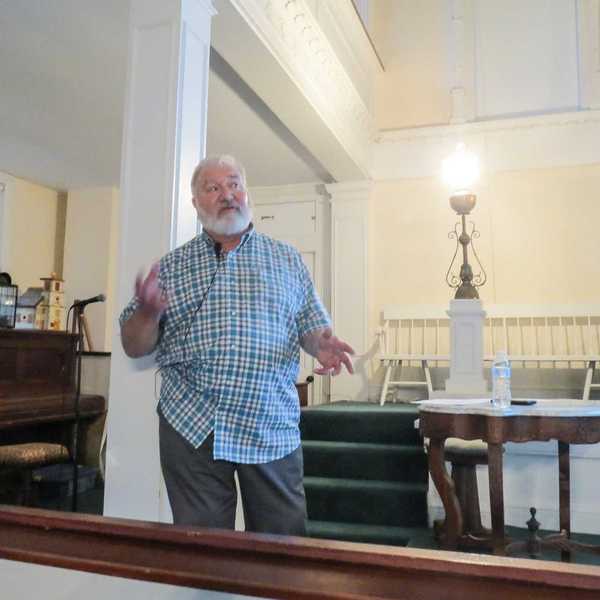
Author Em Sauter pours a sample of beer during her talk at the Kent Memorial Library July 23.

Ruth Epstein

KENT — Cartoonist, author and Connecticut-based beer expert Em Sauter transformed the Kent Memorial Library into a tasting room during her presentation, “The Illustrated 250 Year History of American Beer” on Thursday, July 23. Audience members sampled three beers while learning how brewing shaped American history and culture.

The first sample was called Plucky, Sauter said, before explaining that beer comes from any fermented grain and has been around for millennia. Ancient beer was brewed mainly by women, she added.

Sauter traced the history of the fermented beverage back to Egyptian times, noting that they brewed beer for the pharaohs with the belief they would have it in the afterlife.

“They would drink it through straws because it contained a lot of sediment,” she said.

Sauter then delved into the various types of beer that developed over the centuries. By the 17th and 18th centuries, porter, a dark variety, was popular. Pale lager was first brewed in 1842 in Czechoslovakia. At this time glassware also came into vogue, so imbibers could see what they were drinking.

Sauter said beer brewing can be credited for transformative innovations such as refrigeration and pasteurization.
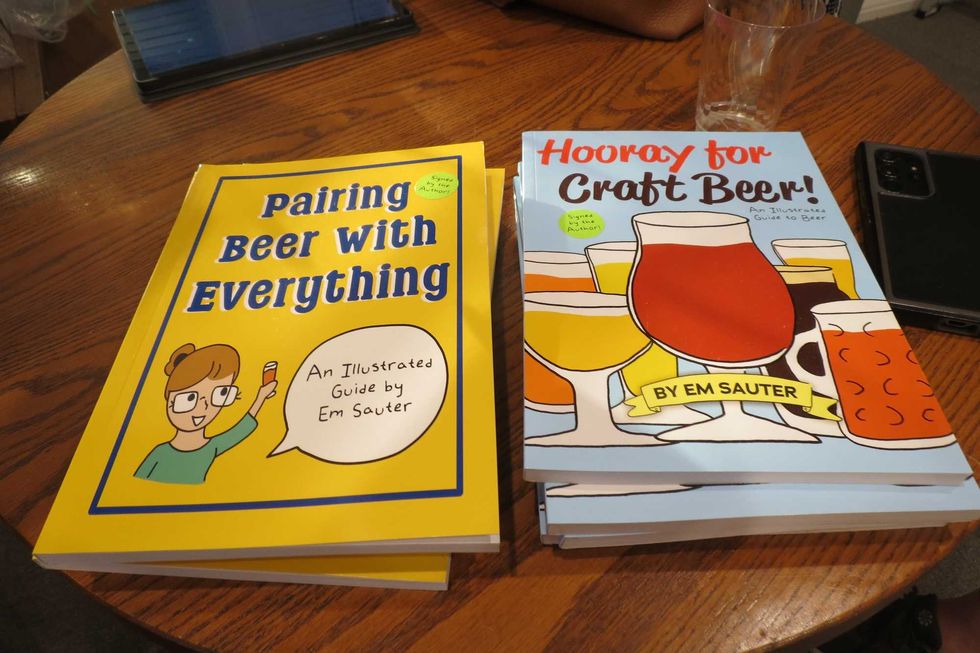
Em Sauter, cartoonist and advanced cicerone — otherwise known as a beer expert — is the author of several books written and illustrated on the topic of beer. Ruth Epstein

Beer brewing probably came to America with the founding of Jamestown in 1609, Sauter said. “Pilgrims drank it for its caloric content and because it tasted good,” she said, dispelling the myth that early English settlers consumed it primarily because the water was unsafe.

Sauter said Native Americans later taught the Pilgrims to brew beer using malt, corn, beans and pumpkins, although she joked “it wasn’t very good.”

As breweries began to sprout up in America, brewery owners became extremely wealthy. Anthony Morris is credited with starting the first brewery in Philadelphia, and many others opened leading up to the Revolutionary War as a way for colonists to show they weren’t going to support the king or British beer.

Sauter noted that many of the Founding Fathers had a connection to beer. George Washington’s Mt. Vernon and Thomas Jefferson’s Monticello had breweries, John Adams had a barley crop and Samuel Adams was a maltster.

Following the Revolutionary War, beer fell out of favor, giving way to hard cider, bourbon and whiskey.

At this point, the second tasting — an American lager called Sway — was distributed.

Sauter said many of the beer companies were founded by immigrants, listing those of Budweiser, Miller High Life and Coors. Yuengling, she said, is the oldest continuing brewery in the United States, located in Pennsylvania.

Turning to Prohibition, which ran from 1920 to 1933, Sauter said breweries used various ingredients to survive, including malted milk, cream, soda and malt.

The first beer can came into existence in 1935 in Richmond, Va. By the mid-20th century, 80% of all beer sold in the United States was sold in either bottles or cans.

The 1950s was the “golden age of advertising for beer,” Sauter said, showing an illustration of “Miss Rheingold,” the face of Rheingold beer who was elected in a voting-based beauty pageant. Diet beer came on the scene in the 1960s.

The third and last sampling, Dwell, was passed out as Sauter described the history of home brewing, which was illegal until 1978 when President Jimmy Carter signed legislation to allow the activity.

Sauter made mention of hops, which brought several questions, but she said the topic is a complex one and needed a session all on its own. She said almost all beer now contains hops because of their preservative nature.

While beer has seen high and low points, in 2018 it really took off and three breweries were opening a day around the country. Lately, there’s been a reduction. Currently there are approximately 9,570 throughout the country.

Sauter ended by imploring listeners to explore beer, drink it, have fun, adding, “But do it responsibly.”
Latest News

Baseball, wine and jazz at Millbrook Winery

Bernie Williams and his Band of Friends at Millbrook Winery in 2025.

Provided

Throughout the history of Major League Baseball, precious few greats have been considered five-tool players. New York Yankee Bernie Williams was one of them.

To be considered a five tool player, one must show exceptional proficiency in five categories: hitting for average, hitting for power, running bases, fielding and arm strength. But there’s another tool Williams possesses that didn’t make it to the back of his baseball card: his mastery of jazz guitar.

Keep ReadingShow less
Lucky Orphans offers sanctuary for horses and healing for people

Deanna Hearn opened Lucky Orphans in 2003.

Provided
If horses could speak, Hearn believes they would offer just one piece of advice: “They’d tell us to slow down.”

From feeding retired racehorses before sunrise to guiding veterans, grieving parents and troubled teenagers through equine-assisted therapy sessions, Deanna Hearn rarely has a quiet day. As founder of Lucky Orphans Horse Rescue in Dover Plains, she oversees the care of more than 40 sanctuary horses while leading a nonprofit whose mission extends far beyond animal rescue.

What began as a childhood love of horses has evolved into a place where healing runs in both directions — for horses and for people. By the time you leave Lucky Orphans, it becomes clear that this place isn’t really about horses. The horses are simply how it begins. For Hearn, every rescued horse represents something much larger: hope, resilience, healing and second chances. The organization’s mission, she says, is simple: “People helping horses heal people.”

Keep ReadingShow less
Weekend in Norfolk returns for four days of art, music and community

A brass quintet at the Yale Music Shed at Weekend in Norfolk 2025.

Jennifer Almquist

Norfolk bursts with activity in midsummer with Weekend in Norfolk (WIN). An all-volunteer committee transforms the town with free public events for all ages. WIN 2026 begins Thursday, July 30, and runs through Sunday, Aug. 2.

Norfolk sculptor Jon Riedeman, the new head of Norfolk Artists and Friends (NAF), organized the group’s 19th annual art exhibition, featuring paintings, sculpture, photography and jewelry by area artists in the Art Barn on the grounds of the Norfolk Chamber Music Festival. Riedeman expanded the show this year by inviting artists from New Marlborough, Massachusetts, to participate. The exhibit opens with a reception Thursday, July 30, from 5 to 7 p.m.

Keep ReadingShow less
google preferred source

Want more of our stories on Google? Click here to make us a Preferred Source.

Laurie Anderson brings four days of music, art and conversation to Tanglewood

Multimedia pioneer Laurie Anderson makes Tanglewood debut with a weekend of performances.

Ebru Yildiz

Musician, composer, performing artist and multimedia pioneer Laurie Anderson is one of the most influential and controversial figures in American contemporary and avant-garde arts. Her ambitious multimedia projects, encompassing music, film, visual projections, dance, and the spoken and written word, have enjoyed great public visibility, and Anderson has been recognized with many honors, including a Grammy Lifetime Achievement Award, as well as the Gold Medal for Music from the American Academy of Arts and Letters and this year’s Kyoto Prize for Arts and Philosophy in the field of music.

Anderson will make her Tanglewood debut in a series of special events and performances Aug. 13-16, along with longtime collaborators and special guests, giving audiences an opportunity to experience her groundbreaking and challenging work, which has been received with both acclaim and confusion for its wit, innovation and interdisciplinary scope.

Keep ReadingShow less
Campus mental health expert to speak at Sharon Book Signing
Author and psychiatrist Mathilde Ross offers help for students navigating campus mental health.
Marissa Fiorucci

As August looms, college students begin to think about the upcoming academic year. Concerns over roommate compatibility or maintaining good grades are common. But for some, mental health challenges can arise in the campus setting.

Author and psychiatrist Mathilde Ross deals with the subject in her book “How to Thrive at College: A Guide to the Ups and Downs of Mental Health on Campus.” Ross, the daughter of Cicily and Joseph Hajek of Sharon, will be among the writers featured at the Hotchkiss Library’s 28th annual Sharon Summer Book Signing on July 31 from 4:45 to 7:30 p.m.

Keep ReadingShow less

The art of bringing travel home

The art of bringing travel home
Bringing the taste of France home with a container of salt.
Kerri-Lee Mayland

Perhaps that’s why summer travel is so irresistible. It isn’t just the promise of sunshine or a change of scenery. It’s the chance to step outside our routines, notice how other people live, taste something we’ve never tasted before, discover a beautiful object made by local hands and come home just a little different than when we left.

The best trips don’t end at the airport or in the driveway. They continue in the way we cook, decorate, entertain and even dress. That’s why I always try to bring a little piece of wherever I’ve been home with me.

Keep ReadingShow less
google preferred source

Want more of our stories on Google? Click here to make us a Preferred Source.

google preferred source

Want more of our stories on Google? Click here to make us a Preferred Source.