Thank you!
Your support is sustaining the future of local news in our communities.

The women who anchored domestic life in Revolutionary Kent come to life in new exhibit

The women who anchored domestic life in Revolutionary Kent come to life in new exhibit

Deborah Shiflett-Fitton operates a "walking wheel," an antique wool spinning device that would have been used by early American homespun fabric makers before more modern designs, like the one operated by Jo Mellis to the right, took over.

Alec Linden

KENT – In celebration of the nation’s upcoming 250th birthday, the Kent Historical Society has opened an exhibit that shifts the focus from the battlefield to the home. The domestic sphere and the women who ran it, the installation argues, were no less important in the cause of American independence than the treaties and military campaigns that dominate U.S. history education.

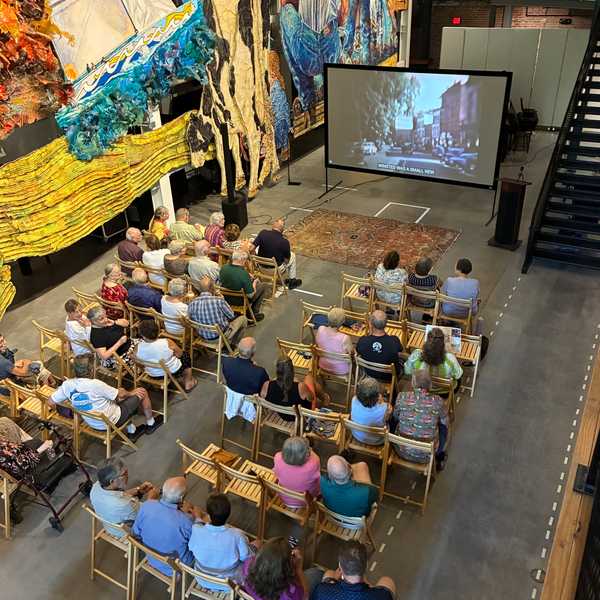
“Homespun Kent: Revolutionary Households” kicked off with appropriate Revolutionary fanfare for an evening reception on Saturday, June 27, at the Historical Society’s Seven Hearths Museum. Approximately 100 history enthusiasts enjoyed the detailed tour of Kent’s home life during the Revolutionary Era, which took full advantage of the preserved interior of the 1751 building.

“Women were the architects of an economic force that encouraged domestic self-reliance,” states an informational video that ran in a cozy parlor at the start of the tour. The homespun fabric movement was a women-led effort to domesticate cloth production in protest of imported British merchandise in the years leading up to the Revolution, which the exhibit professes both helped cultivate a spirit of independence at a crucial moment while also servicing the practical need for wartime supplies.

“It’s more important than tea because you need cloth to wear clothes!” said Deborah Chabrian, board president of the Kent Historical Society.

She explained that beyond the focus on fabrics, the exhibit is meant to amplify a quieter but no less important story of the American Revolution. “I had never really thought deeply about how it affected someone at home,” Chabrian said.

“The women had to be just as strong,” she continued. “They had to hold the country together” while the men were on the battlefield.

The Seven Hearths Museum is an ideal venue for the exhibit as a Revolutionary home itself, explained Christine Adams, executive director of the Historical Society. Built originally as a combined residence and general store, by 1776 it was occupied by Daniel Beebe, Esther Pratt Beebe and their two children.

Daniel and his son Daniel Jr. would both leave to fight for the Patriots, leaving Esther to presumably operate the store, as well as an active fur trading post upstairs and a butchery, by herself as one of the few active supplies purveyors in early “frontier” Kent.

According to an informational pamphlet distributed at the event, Esther is one of many “resilient housewives, mothers, and spinners who labored over spinning wheels, grew and carded flax, and wove wool to clothe their families, effectively anchoring early American domestic life.”

“These were stories I never heard growing up,” Adams said.

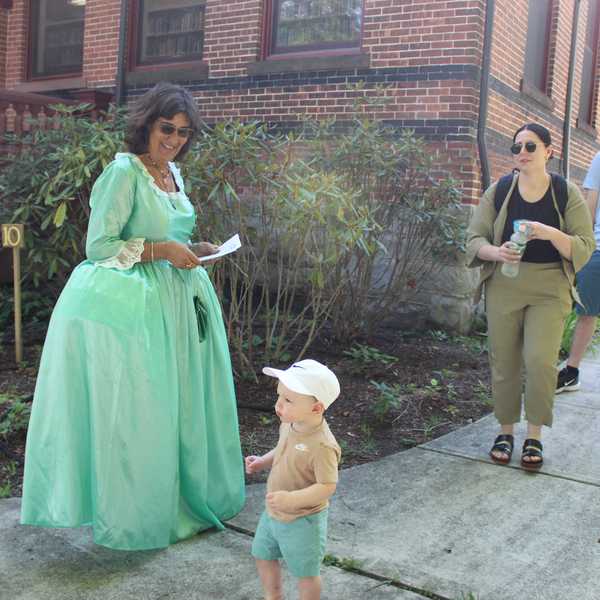
The opening reception also featured several live demonstrations of Revolutionary Era home life. In a sunny corner room, Kent Art Association Executive Director Deborah Shiflett-Fitton, dressed in colonial garb, operated an antique “walking wheel” or wool wheel which would have been used by homespun fabric makers in colonial America.

It had been sitting in the building’s attic for years, she said as she deftly operated the device, and was revived in preparation for the exhibit by accomplished furniture restorer and Historical Society Vice President Roger Gonzales.

In the kitchen, Chabrian, also clad in antique clothing, cooked corn chowder over a wood fire in one of the museum’s namesake hearths. She explained that the soup was thickened with crackers according to an old technique that would have been used by cooks in chowders in the Revolutionary days.

Once finished, the ample pot was emptied in seconds by eager guests. Attendees then moved on to an eclectic selection of small bites that had been brought in colonial potluck fashion, complimented by beer, wine, cider and charcuterie, courtesy of the Historical Society.

Chabrian said that the overarching motivation behind the whole effort, which involved months of researching books, local history accounts and even original 18th century documents still on file at Town Hall, is to “to bring an awareness to the history that we have here,” and hopefully inspire more to help steward it.

“Homespun Kent: Revolutionary Households” is on display until Oct. 31 at the Seven Hearths Museum. The museum is open Saturdays and Sundays from 11 a.m. to 4 p.m. or by appointment.

Latest News

The nature of Upstate Art Weekend

The nature of Upstate Art Weekend
Opening of Upstate Art Weekend at Olana with Helen Toomer, Ellen Harvey, Jean Shin and Gabriela Salazar
D.H. Callahan

On Thursday, June 25, a collection of eager art enthusiasts gathered at Olana State Historic Estate in Hudson to kick off the seventh annual Upstate Art Weekend (UAW).

Helen Toomer, founder, was joined by sculptors Ellen Harvey, Jean Shin and Gabriela Salazar to discuss their work and the legacy of painter Frederic Church. Church, whose 200th birthday is being celebrated this year, is widely credited as one of the founding members of the Hudson River School of painting. The discussion took place at Olana, Church’s grand estate, where the three artists’ installations are on view.

Keep ReadingShow less
Benjamin Reynaert and the art of layered living

Benjamin Reynaert

Jennifer Almquist
Creating a home is, at its core, an act of love.
— Benjamin Reynaert

Benjamin Reynaert is focused on creative direction and interior styling. He is market director at Elle Décor, a design consultant, and author of “The Layered Home: Inspiration for Crafting Cozy, Collected Rooms,” published this year by Clarkson Potter. He co-founded Ticking Tent, a market featuring antiques, luxury items and vintage treasures. The biannual event is held in New Preston, Connecticut, and Bedford, New York.

Adopted from South Korea at 3 months old, Reynaert grew up in Bloomfield Hills, Michigan. He always knew he wanted to be an artist. “I just loved drawing. I loved making things with clay,” he said. “Remembering what it felt like to be creative as kids and applying that to our creativity as adults is essential.” A graduate of the Rhode Island School of Design (RISD), where he earned a BFA and a degree in architecture, Reynaert also studied bookbinding in Rome. His attention to detail and aesthetic sense reflect years of training and a finely tuned eye for objects. “Attending RISD nurtured my creativity and taught me how to problem-solve,” he said.

Keep ReadingShow less
Beneath the surface: Delano Dunn and Mickalene Thomas explore history, memory and art

Mickalene Thomas and Delano Dunn at Wassaic Project.

Lucia Landolo

Before “Echoes in the Margin,” Delano Dunn’s new solo exhibition at Troutbeck in Amenia opened, the artist sat down with curator and artist Mickalene Thomas for a conversation at the Wassaic Project on Wednesday, June 24. Their wide-ranging discussion offered an intimate look into Dunn’s practice while situating the work within broader questions of history, memory and representation.

Presented by the Wassaic Project, the exhibition brings Dunn’s richly layered paintings into conversation with Troutbeck itself, the historic estate long associated with artists, writers and civil rights leaders, including W.E.B. Du Bois, Langston Hughes and many more.

Keep ReadingShow less
google preferred source

Want more of our stories on Google? Click here to make us a Preferred Source.

Local performer Vemilo transforms the Moviehouse

Vemilo performs at the Moviehouse in Millerton.

D.H. Callahan

On Friday, June 26, patrons at the Moviehouse in Millerton were treated to a performance by local artist and musician Vemilo, who returned to the theater’s biggest room for a second full-length show.

Regular patrons will know Theatre Three as the setting for post-screening interviews, Q&As, discussions and the theater’s monthly movie trivia night. Vemilo’s performance entirely reimagined the space. With just a few props and pieces of furniture, the stage was transformed into Vemilo’s sanctuary.

Keep ReadingShow less
After a Hollywood career, Scott Siegler turns failure into fiction

Scott Siegler at his home in Sharon.

D.H. Callahan

Scott Siegler is bored of success stories. But Scott Siegler has had the kind of successful Hollywood career that people write books about.

Before he was 30, he’d earned three degrees. Before he moved to Hollywood, he’d already won an Emmy for one of the nine documentaries he directed and produced. Before he helped launch Netscape, bringing the Internet to the public, he’d already started his own Hollywood studio.

Keep ReadingShow less

Masterclass workshops with Crescendo

Masterclass workshops with Crescendo
Stephen Potter

Crescendo, the Lakeville-based nonprofit specializing in early and rarely performed classical music, is taking a deep dive into the works of Johann Sebastian Bach this summer as artistic director, Christine Gevert, explores the genius of one of history’s greatest composers through a series of public masterclass workshops at Saint James Place in Great Barrington. More information at crescendomusic.org.

google preferred source

Want more of our stories on Google? Click here to make us a Preferred Source.

google preferred source

Want more of our stories on Google? Click here to make us a Preferred Source.