SHARON – More than 50 people gathered at Ellsworth Burying Ground on Saturday, June 27, to honor the town’s Revolutionary War veterans, as historian, teacher and author Peter Vermilyea brought the lives of the soldiers buried there into focus.
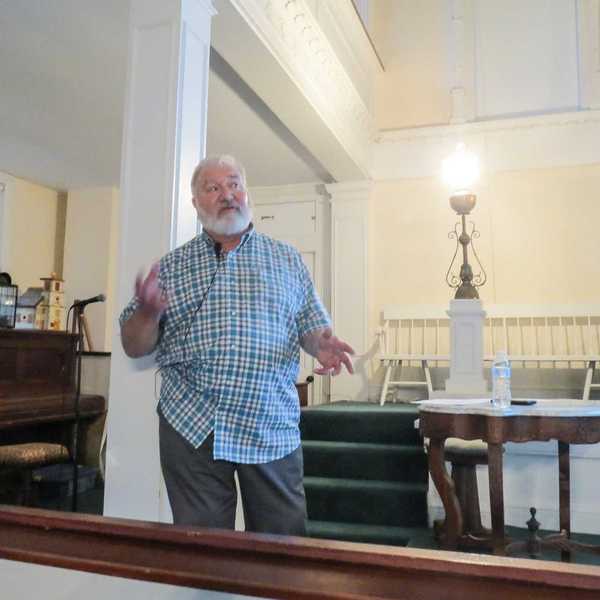
Vermilyea, who spoke for about 40 minutes, told attendees they were surrounded by men “we are here to honor.” Following his talk, many visited the graves of the 21 Revolutionary War soldiers buried at the cemetery, each marked with a small Betsy Ross flag.
“Many pass through cemeteries seeing only dates or names,” Vermilyea said, “Every one of these men lived through one of the most extraordinary moments in human history. Every one of them faced choices that would shape not only their own lives, but the future of a nation.”
Bringing the history of the Revolutionary War close to home, he invoked the names of Sharon citizens who answered the call to serve. Among them were Joseph Bailey, Ebenezer Everitt, Joel Israel Chaffee, Silas, Daniel and Timothy St. John, and Lemuel Young.
Calling on the attendees to rely on their imaginations, Vermilyea asked them to picture the Rev. Cotton Mather Smith, who, in 1775, was the minister of the Sharon Congregational Church. He was preaching one morning when he announced from the pulpit that blood had been shed at Lexington and Concord. “The Revolution had come to Sharon,” Vermilyea said.
The British had imposed the Coercive Acts, and when the colonists rebelled, the Port of Boston was closed. Sharon citizens, like many others, refused to tolerate such action, gathered food and money to send to Boston, while noting, “If it could happen in Boston, it could happen here.”
Most of those who went off to fight were farmers who realized their property went hand-in-hand with liberty. Property made it possible to provide for their families and contribute to their communities. A farm meant independence.
“These men were not fighting for abstract principles alone,” said Vermilyea. “They were fighting for the communities they knew, the land they worked and the future they hoped to leave their children.”
The men could either join local militias, where they were expected to serve for a short period, or the Continental Army, where their future would be much more uncertain.
Vermilyea also highlighted other local soldiers whose names appear on the surrounding tombstones. One was David Downs, who commanded Colonel Charles Burrall’s regiment. Another was Asa Rice, who fought at the ill-fated Battle of the Cedars in Canada.
But while the British were the obvious enemy, Vermilyea spoke of the invisible killer—disease. Smallpox claimed thousands of lives during the war. He painted a bleak picture of the hardships Connecticut men endured during the winter of 1776-77, often fighting without adequate clothes, shoes, blankets or food.
“Their perseverance may have been their greatest contribution to American independence,” he said.
Vermilyea asked the audience to look around at the stones, saying it’s easy to focus on the Founding Fathers when studying the Revolutionary War.
“But the Revolution was won by communities. And by ordinary men. Today we stand among them. Their war is no longer a distant event in a textbook. It is part of the landscape around us. And that is why places like Ellsworth Cemetery matter. They remind us that history remains here.”
The event also highlighted the cemetery itself and the volunteers who work to preserve its history.
“This is one of the oldest burial grounds,” said Carol Ascher, a member of the Ellsworth Burying Ground Committee. The volunteer group, which organized the event, helps maintain and care for the historic cemetery.
She also showed visitors the grave of Joseph Lord, who donated the land for the cemetery to the Ellsworth Society. Originally buried on Tichnor Road, Lord’s remains were moved across the road after flooding made the original burial site unsuitable, making him the first person interred at Ellsworth Burying Ground.

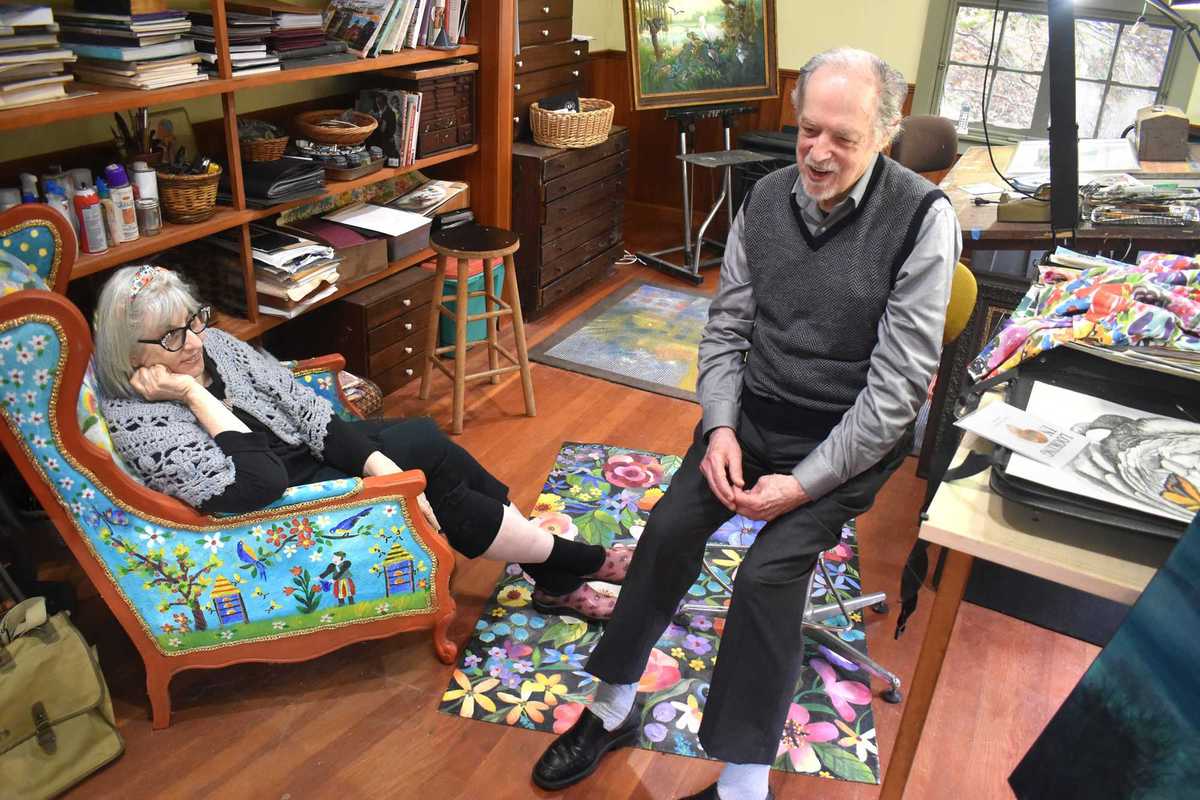
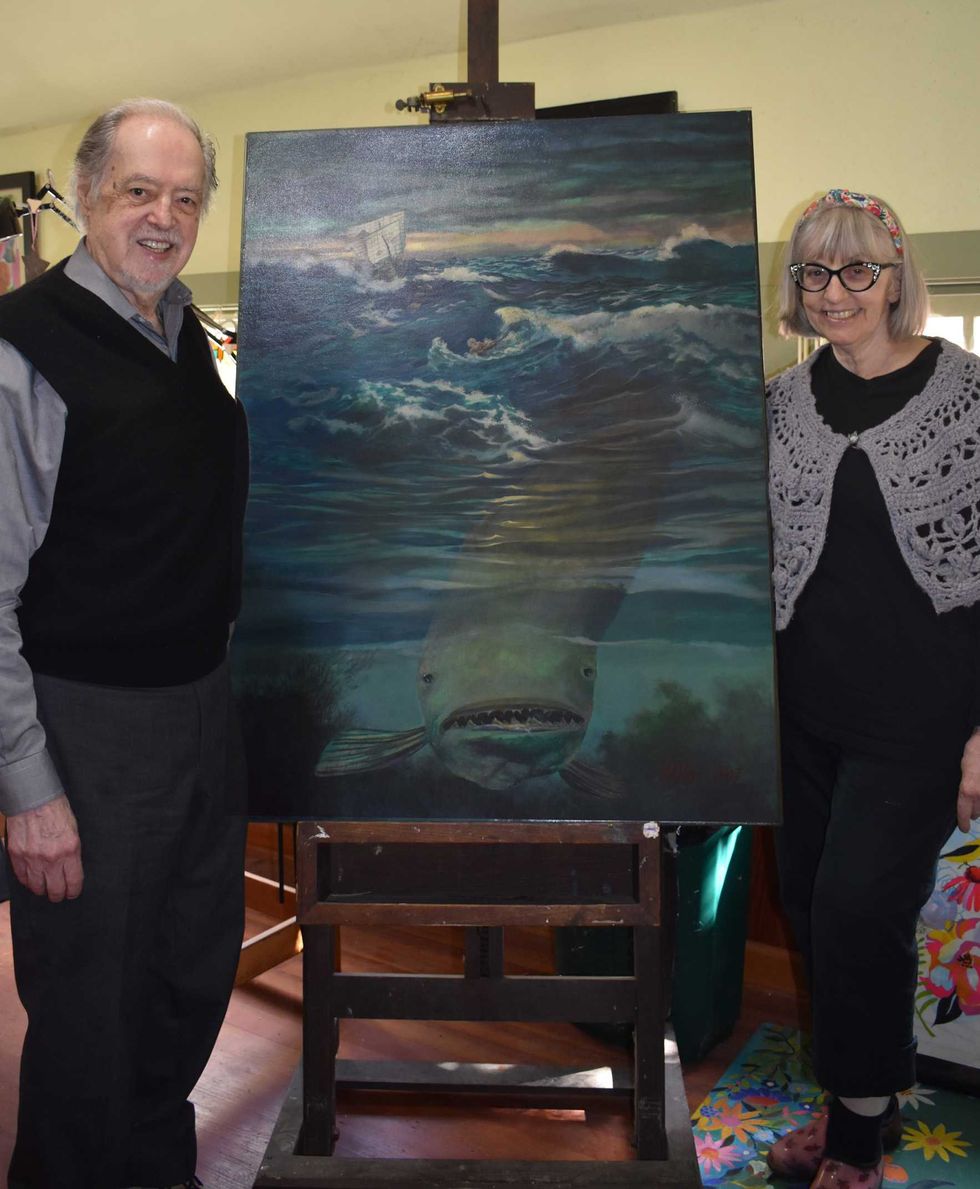 Justine and Victor Valla in their studio with a painting of Victor’s,”Jonah and the Whale.” Robin Roraback
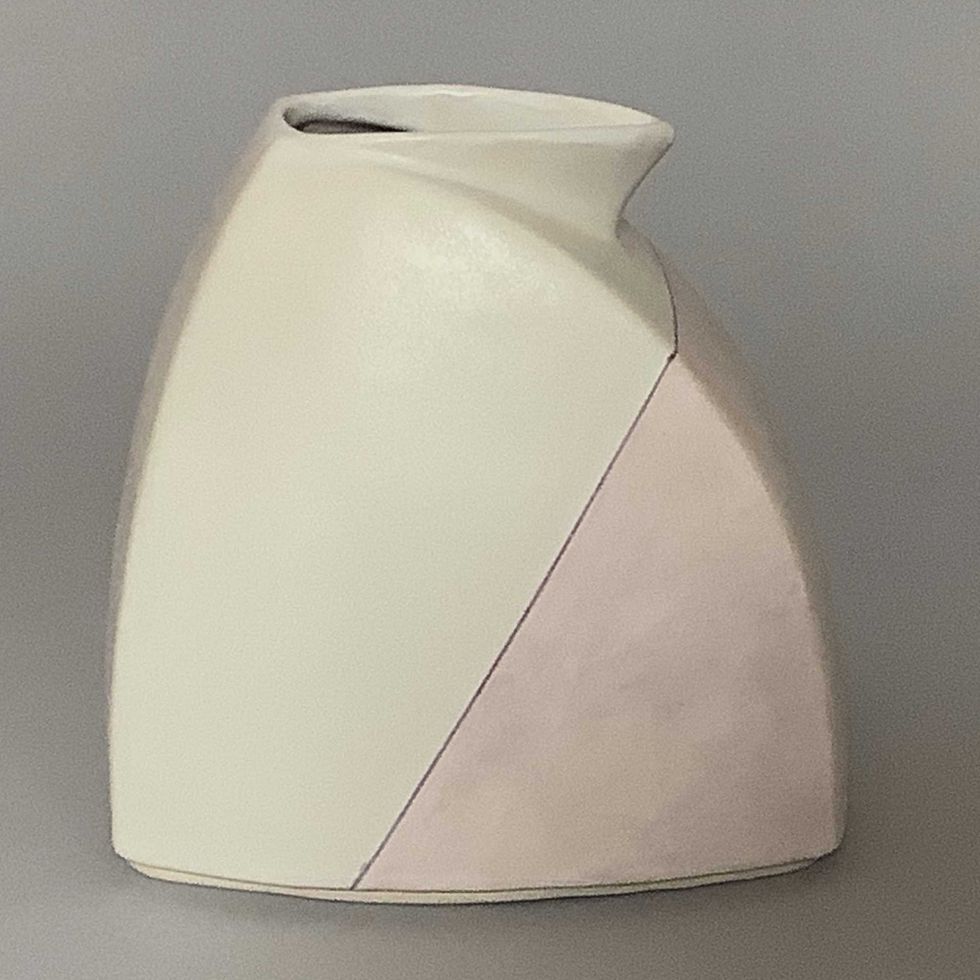 A ceramic vase by Kathleen Heidemann.Provided
 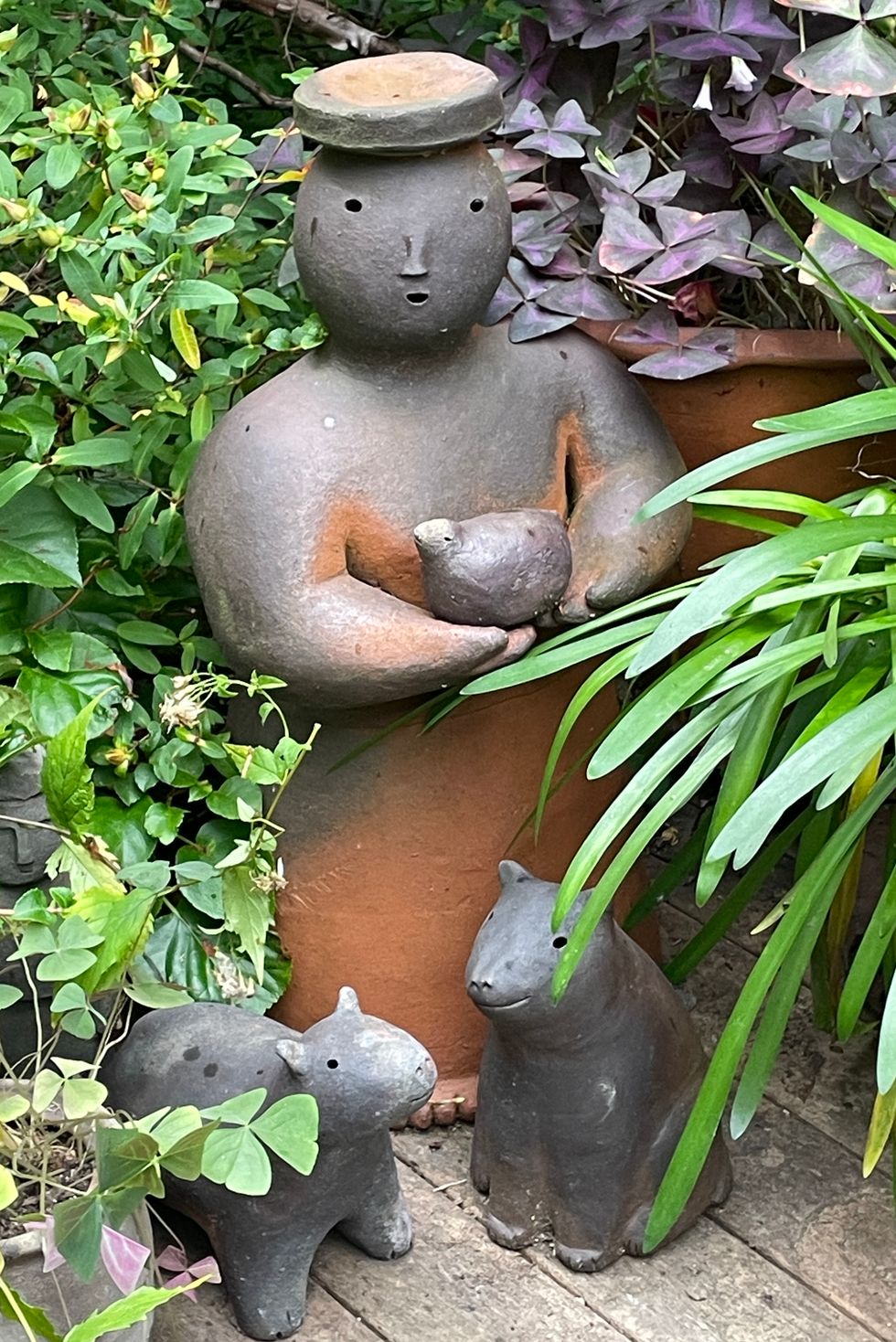 Joy Brown’s delightful ceramic sculptures.Provided