This article is the third in a three-part series by author and Lakeville resident John Neufeld (his latest novel is “April Foolâ€). To find the first two articles, go online to tcextra.com.
SALISBURY — Although it rarely happens this way, even with the weather as unpredictable as it has been, a Northwest Corner blackout could conceivably stretch for hours ... or days, a 10-day blackout in midwinter with impassable roads, fallen trees, downed powerlines and freezing temperatures.
And there are other types of emergencies that could occur in these nervous times, from an outbreak of an epidemic to a terrorist attack. How would the towns of the Northwest Corner cope?
The first article in this series concentrated on preparations at two area retirement communities. The second article concentrated on preparations made by the town of Salisbury — for people as well as for their companion animals.
This article will include information gleaned from Sharon Hospital, which is the medical emergency center for towns in the Northwest Corner of Connecticut as well as for towns in nearby New York State. As with all these institutions, the full list of emergency plans is extensive; this series of articles covers just a portion of them.
Prepare yourself
Anyone who is concerned about what to do in case of disaster should obtain a copy of the Connecticut Guide to Emergency Preparedness, available through the postal service, by e-mail or in almost any town hall (online, go to ct.gov/dph and look on the right side of the page, under “featured linksâ€).
Much of the information is common sense, by now familiar. Family meeting places, a three-day supply of food and water, kitchen tools of all sorts (although not electric), extra batteries, cash on hand, a car emergency kit, etc.
But what may not be familiar to us are the preparations made by our institutions, towns and caregivers in our area.
To stay on top of the state’s requirements and guidelines takes a good deal of money, spent always “on the come,†that is, we prepare ourselves for a worst-case scenario.
And of course Sharon Hospital is at the center of much that happens here in emergencies.
To start, here’s a bit of interesting news. Consumer Reports, recently published results of a reader poll that showed that, of area hospitals, Sharon Hospital’s overall patient rating is highest. It was compared to Hartford Hospital, St. Francis Hospital in Hartford and New Milford Hospital.
Further, Sharon holds its own in the following categories: doctor communication, nurse communication, room cleanliness and attentiveness of hospital staff, and in steps to prevent infection.
Knowing this makes us feel confident about how the hospital would operate in the face of our worst-case scenario: a 10-day blackout with downed lines, no well-water, shrinking domestic supplies, impassable roads and freezing temperatures.
Brian Croghan, director of facilities at Sharon Hospital, maintains the hospital’s level of readiness. He reports that 80 percent of the building is already on generators. The hospital has a 96-hour supply of fuel plus a diesel tank for emergencies. It also has plans for purchasing roll-in generators.
Croghan’s emergency plan is based on a 50-percent occupancy rate. He says the hospital has a five-day supply of food (which could be extended with careful rationing).
The hospital is fully armed for vaccinations of all kinds, has ward-by-ward generators in place, and has amateur (or “hamâ€) radio capabilities for communications in a blackout.
Medical operations would continue under generator power including the operating rooms and the emergency room.
Individual hospital rooms are wired not only for electricity (and heat) but also for oxygen delivery, all operated by generators.
While Essent Corporation (which owns Sharon Hospital) has six hospitals, their units are in widespread locations across the country and cannot share supplies. The hospital is set up, however, to work closely with nearby Sharon Health Care.
Equally important, staff from Sharon Hospital attend and actively participate in seminars of the Department of Emergency Management and Homeland Security, and attend eight meetings annually in the Northwest Corner’s Emergency Planning Region.
Croghan said he assumes the National Guard would be available for assistance (states have the right to call out the Guard in emergencies). Guard members could offer policing and, if necessary, relocation of patients. Sharon Hospital has its own guidelines for moving medication, equipment, staff, and pertinent patient clinical and medication-related information to alternate care sites (such as a state of Connecticut Mobile Field Hospital).
In the scenario outlined in the emergency plan, the hospital would ring its territory with maintenance staff in order to control traffic to one entry/exit. With its extensive space and corridors, storage of supplies and personnel could be handily managed.
Local planning
Jim Hutchison, the hospital’s community health and emergency management coordinator, is optimistic. He believes in the “goodness and imagination and human nature in this country.†The hospital has to be up-to-date and completely in accord with state dictates (not only those of Connecticut, but also those of New York and Massachusetts), and Hutchison is secure in his estimation of what the hospital could and would do in an emergency.
First, he reports, the state of Connecticut does not direct emergency response; those decisions are made locally so that particular needs and situations can be quickly addressed.
The state Department of Public Health sends daily e-mail bulletins to towns and cities about workshops, preparatory classes, unforeseen problems and solutions. This is part of the National Incident Management System (NIMS), which provides federal guidelines for emergency response using simple, clear language. Sharon Hospital staff members who are directly involved in emergency response activities must complete this training.
In the same way, when supplies at the hospital are used up, replacements are ordered immediately and stored for future use. Millions of dollars are spent annually on emergency preparedness, which now include the hospital’s brand-new emergency department which has a negative pressure isolation room and in-house decontamination as an adjunct to its outside portable unit.
Hutchison also noted that the hospital constantly monitors its supplies, ordering in new gear to replace equipment that has been used so that a full supply is always on hand.
There are plans already existing to handle radioactive, biological and further chemical decontamination and isolation.
Moreover, Hutchison divulged that the security badges hospital workers wear around their necks are not only that; inside are lists of codes and resources.
And how will those workers get to the hospital if roads are blocked? Generally, this isn’t a problem. But on some occasions in the past, unofficially, staff members and community residents with heavy-duty transportation (such as fully loaded pickup trucks and SUVs) have offered to share rides. Another example of the “mutual aid†that is so much a part of life here.
Other ways we can help
We are trying to address our worst midnight fears, those that keep us roiling in our beds as the winds whistle at 45 miles an hour in the trees outside. In the face of Mother Nature’s so often implacable terrorism, what can we do to survive? And where do we get help?
We have an outline here of some durable answers.We are blessed in the Northwest Corner with much. What supplies and tools we don’t have are available to us, as we’ve seen in this series, and we know, once more, that preparation is not only up to the institutions designed to assist us, but also to ourselves.
In short, this would be the perfect time to begin planning and purchasing what we can that would, in the long or short term, assist them in assisting us.
The economy may not be in our favor just now. But there are still things we can all do that require less money than inspiration.
And inspiration is overflowing in the Northwest Corner.

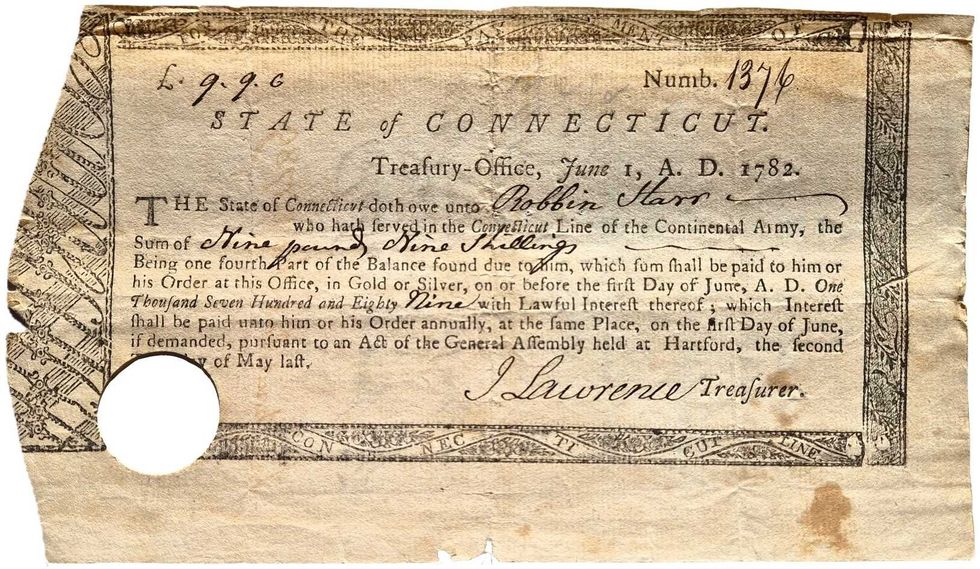 Pay Bill for Robin Starr’s service in the Continental Army.Courtesy the Alex Breanne Corporation
 John Mills speaking at Quinnipiac University.Courtesy the Alex Breanne Corporation
 Stephanie Saetta,with her rescue dog George and Blue (left), a shepherd mix awaiting his forever home.Madi Long
 Blue, a 7 year-old Shepard mix, is waiting for his forever home. Madi Long