Thank you!
Your support is sustaining the future of local news in our communities.

Sap is running at Audubon

Sap is running at Audubon
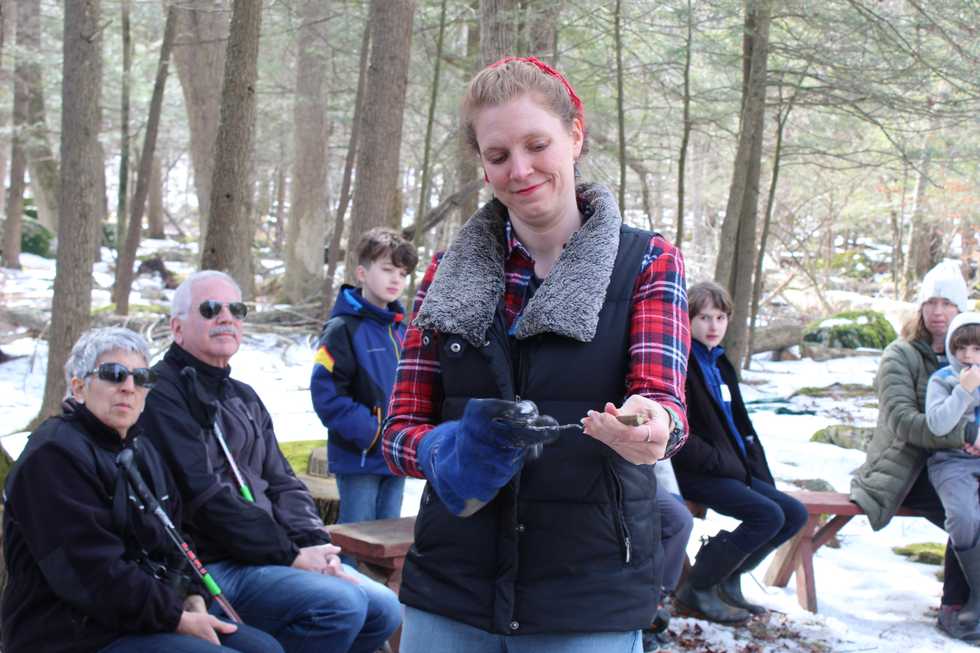
Bethany Sheffer showed  a Sharon Audubon MapleFest audience how to make a spile (a tap for getting sap from sugar maples) out of a piece of staghorn sumac on Sunday, March 12. 
Photo by Patrick L. Sullivan

SHARON — In case you were wondering what to do with your staghorn sumac, Bethany Sheffer of the Sharon Audubon Center’s got you covered.

Sheffer and other Audubon staff and volunteers were out in force on Sunday, March 13, at the center in Sharon for the 2023 MapleFest.

Guided tours went up the trail, pausing at sugar maple trees, adorned with sap collecting buckets.

The penultimate stop was the sugar house, where Wendy Miller roved to and fro amidst the steam from the maple syrup boiling apparatus.

Miller explained it takes about 40 gallons of sap to make one gallon of syrup. The sap boils at 219 degrees Fahrenheit, moving from different areas on the apparatus as the water boils off and the sap gets closer to the magic 67% sugar content needed for proper syrup.

If it continues to cook past that point, you’re getting into maple candy territory, Miller said.

The last stop on the tour was a short walk from the sugar shack into the woods, where Sheffer had a small fire going, with an iron pot containing sap suspended over it.

She explained how European settlers learned how to work with sap from Native Americans, and refined the technique.

About that staghorn sumac: The devices that are inserted into sugar maples to draw out the sap are called spiles. You can use modern spiles, or go the old school route.

Simply heat up a piece of sturdy metal wire in the campfire, and use the hot, sharp wire to hollow out a small piece of staghorn sumac.

Then sharpen one end of the resulting three-to-five inch hollow tube and insert into the nearest sugar maple.

Inside the center building, there were baked goods for sale. The first run of syrup, bottled just days earlier, was on sale in the gift shop.

Volunteers who weren’t leading tours were milling about, chatting with visitors.

It was a pleasant scene, and a reminder that when the sap begins to flow, spring can’t be that far off.


Latest News

Let's Hear It - September 17, 2026

Let's Hear It - September 17, 2026

This Week

As summer comes to an end and the days begin to get a little cooler, signs of fall are starting to appear all around us. The leaves are beginning to change, the evenings are getting shorter, and a new season of activities and traditions is just around the corner.

Keep ReadingShow less

$5,000

$5,000

Letters to the Editor - September 17, 2026

Letters to the Editor - September 17, 2026

Put $1M to work for housing affordability

If I had $1 million to improve housing affordability in Litchfield County, I would create a revolving Housing Opportunity Fund. Instead of spending the entire amount on one or two homes, I would use it to help local housing trusts acquire land or properties, provide down-payment assistance for qualified buyers, convert appropriate existing buildings into housing, and help cover some of the upfront costs that can prevent good housing projects from ever getting started.

Keep ReadingShow less
google preferred source

Want more of our stories on Google? Click here to make us a Preferred Source.

Turning Back the Pages - September 17, 2026

125 years ago — September 1901

LIME ROCK — Matthew Patterson recently received a silver medal from the Canadian government as a token of his services during the Fenian raid in ‘71. The medal is suitably inscribed and is considerably heavier than a silver dollar. It depends from a silk tri-color and pin, and altogether makes a very neat souvenir.

Keep ReadingShow less
Voices from our community about the housing we need for a healthy, vibrant future

Jordan Seibert and Riley Bossi

Shelly Dinelle

There’s a reason people say, “It takes a village to raise a child.” To thrive, a child needs a safe, stable place to call home. That’s the bedrock for health, dignity, and the chance to build a bright future. What kind of “village” does it take to create these homes?

Motivated by compassion and a drive to make housing more accessible, it took the Foundation for Norfolk Living years of hard work to create ten affordable homes at Haystack Woods. The “village” turned out to be a patchwork of support that included financial help from the DOH, a construction mortgage through Northwest Community Bank, and a Community Development Block Grant to purchase the property and pay for the road and infrastructure. The result? Two- and three-bedroom homes reserved for first-time homebuyers earning 60-80% of Litchfield County’s median income, and selling for $159,000 to $261,000. The condominium homes are deed-restricted and net-zero thanks to energy-efficient construction, solar panels, and battery storage, meaning the homebuyers will have no energy costs! Curious? Just Google “Haystack Woods” to learn more. It’s a remarkable accomplishment.

Keep ReadingShow less
Selectmen back $113,000 request for new ambulance

FALLS VILLAGE — The Board of Selectmen approved a request from the Fire Commission for $113,000 toward a new ambulance scheduled for delivery in November.

The selectmen acted during their regular monthly meeting Monday, Sept. 14.

Keep ReadingShow less
google preferred source

Want more of our stories on Google? Click here to make us a Preferred Source.

google preferred source

Want more of our stories on Google? Click here to make us a Preferred Source.