Stir-crazy angler takes first trip of new year

Stir-crazy angler takes first trip of new year

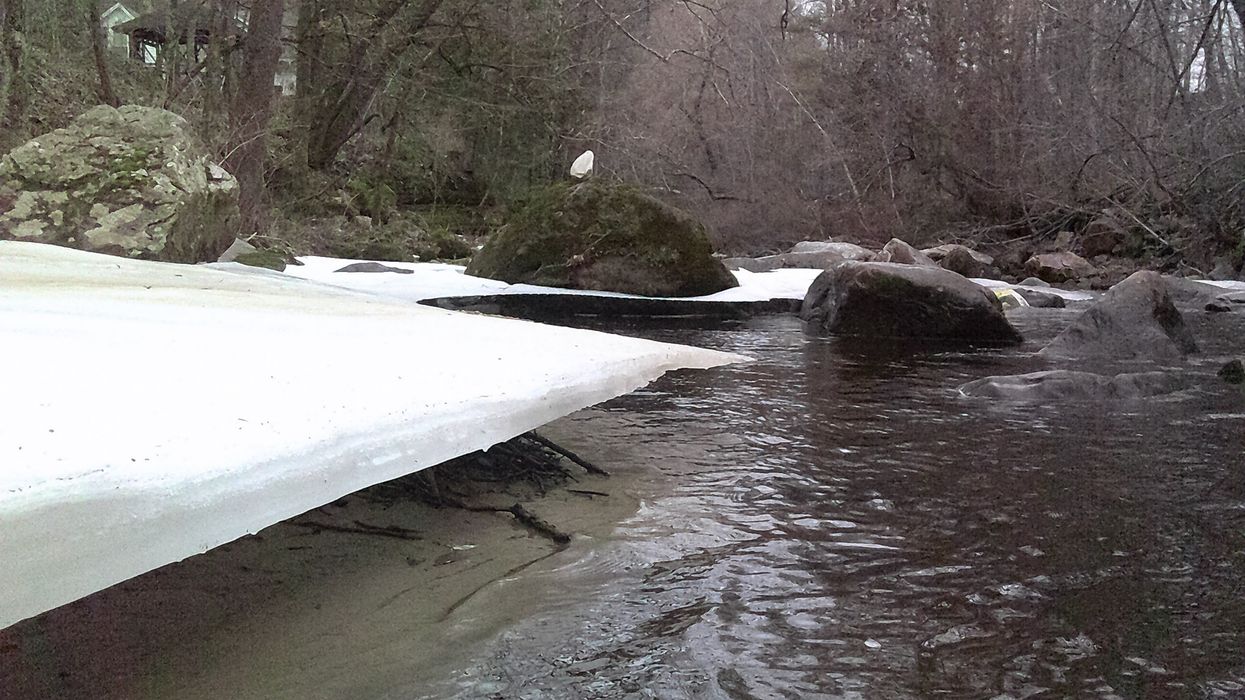
Shelf ice on the Blackberry River last week. Do not stand on shelf ice. It's a great way to get hurt.

Patrick L. Sullivan

I’ve got a bad case of the Shack Nasties.

With a slight change in the weather I ventured out Wednesday and Thursday, March 5 and 6.

First I scouted a couple of little blue lines. No good. Still too much ice and snow for solid footing.

Since I am nursing a rotator cuff injury and my right pinky toe still aches from when I cleverly slammed it into the furniture two months ago, I am not in the mood for adventurous wading.

That left the Blackberry.

At one spot the shelf ice was still in effect. It was theoretically fishable but I kept going to Beckley Furnace, where the big pool beneath the dam was clear.

I pounded it hard, starting with junk flies such as squirmy worms and brightly-colored mops.

Then I got cute with a double-nymph rig: a little black stone on a dropper and a Bread and Butter nymph with a tungsten head on point to drag the whole thing down into the depths.

I managed two bumps. One could have been a hangup but I’m counting it as a bump.

Downstream below the second, smaller dam the shelf ice presented serious challenges.

There’s really only one way to get rid of shelf ice besides waiting for it to melt.

That is to stand on it and break it.

This is an excellent way to break up shelf ice.

It is also an excellent way to sprain or break an ankle.

Maybe it’s old age creeping up on me, but somehow I am not inclined to take the chance.

Imagine really banging yourself up mere weeks before fishing starts in earnest, and then sitting sullenly in a dark room watching old Filipino horror movies as the broken or sprained element heals while outside trout are merrily gobbling up bugs after the long winter.

Thursday I went further afield. Furnace Brook in Cornwall, always an early season favorite, was roaring after the inch-plus of rain we got Wednesday night.

That left Macedonia Brook in Kent, which was actually fishable above the waterfall.

I probed that for a couple hours with a Tenkara rod and a series of darkish nymphs that could be mistaken for an early black stonefly.

Or just something to eat. I doubt any holdover trout in there are all that picky about the menu.

I managed to tickle precisely one small brown trout.

In fact I messed with that little guy for about an hour.

It went like this:

Cast. Drift into strike zone. Lift out before fly gets stuck in brush buildup. Watch bemusedly as little brown trout pecks at nymph on the way up.

Cast three or four more times with no result. Sit on rock. Ponder the infinite. Consider changing fly. Conclude it makes no difference. Watch passenger car slither around on muddy dirt road.

After 10 minutes of this, drift nymph into strike zone and miss fish again. Sit back down on boulder…

Standard operating procedure in these cases is to say, “Oh well. At least it was nice to get out.”

This is baloney. It was cold and windy and nobody with any sense would go out and stand in cold water just for the sake of getting out of the house.

But…

I didn’t injure myself. My waders didn’t leak. I was wondering if I could get an orthotic insert into the wader boot without problems. I could.

I didn’t break or lose any equipment other than a black conehead Wooly Bugger, size 8, which was claimed by the tree that is sticking into the Beckley pool.

And I didn’t get stuck in the mud on the seriously gooey Macedonia State Park road.

So this initial salvo of the 2025 campaign goes in the win column.
Latest News

Swift House committee learns of potential buyer at first meeting

Swift House in Kent.

By Ruth Epstein

KENT — The fate of the Swift House is once again front and center after the newly formed Swift House Investigation Committee held its first meeting Tuesday, Feb. 24 — and learned that a local attorney is interested in buying the historic property.

At the meeting’s outset, committee member Marge Smith said local attorney Anthony Palumbo has expressed interest in purchasing the building. “He loves it and said he’d be honored to buy it and maybe lease part of it back to the town. He would be OK with a conservation easement.” She said he supports several previously proposed uses, including a welcome center and exhibition space.

Keep ReadingShow less
Sharon median home price rises to $710,000 as inventory tightens

119 Amenia Union Road — A four-bedroom, 2.5-bath home built in 1872 on 4.42 acres recently sold for $522,500.

Photo by Christine Bates

SHARON — The 12-month trailing median price for a single-family home in Sharon increased to $710,000 for the period ending Jan. 31, 2026 — its highest point since September 2024 as home values across much of Connecticut continued to edge higher.

The figure marks an increase from the $560,000 median recorded for the 12 months ending Jan. 31, 2025, and from $645,000 for the comparable period ending Jan. 31, 2024. While January and February are typically slow months, the 12-month rolling figure reflects a broader reset.

Keep ReadingShow less
Kent's towering snowman honors Robbie Kennedy

Jeff Kennedy visits the 20-foot-high snowman located in the Golden Falcon lot in Kent that was created in honor of his late brother Robbie Kennedy.

Photo by Ruth Epstein

KENT – Snowman Robbie stands prominently in the center of town, just as its namesake — longtime Kent resident Robbie Kennedy — did for so many years.

The 20-foot-high frozen sculpture pays tribute to Kennedy, who died Feb. 9, at the age of 71. A beloved member of the community, he was a familiar sight riding his bicycle along town roads waving to all he passed. Many people knew him from his days working at Davis IGA, the local supermarket. He was embraced by the Kent Fire Department, where he was named an active emergency member and whose members chipped in to buy him a new bike, and by the Kent School football team where coach Ben Martin made him his assistant. At Templeton Farms senior apartments, he was the helpful tenant, always eager to assist his neighbors.

Keep ReadingShow less
google preferred source

Want more of our stories on Google? Click here to make us a Preferred Source.

Classifieds - February 26, 2026

Classifieds - February 26, 2026

Help Wanted

PART-TIME CARE-GIVER NEEDED: possibly LIVE-IN. Bright private STUDIO on 10 acres. Queen Bed, En-Suite Bathroom, Kitchenette & Garage. SHARON 407-620-7777.

The Salisbury Association’s Land Trust seeks part-time Land Steward: Responsibilities include monitoring easements and preserves, filing monitoring reports, documenting and reporting violations or encroachments, and recruiting and supervising volunteer monitors. The Steward will also execute preserve and trail stewardship according to Management Plans and manage contractor activity. Up to 10 hours per week, compensation commensurate with experience. Further details and requirements are available on request. To apply: Send cover letter, resume, and references to info@salisburyassociation.org. The Salisbury Association is an equal opportunity employer.

Keep ReadingShow less
To save birds, plant for caterpillars

Fireweed attracts the fabulous hummingbird sphinx moth.

Photo provided by Wild Seed Project

You must figure that, as rough as the cold weather has been for us, it’s worse for wildlife. Here, by the banks of the Housatonic, flocks of dark-eyed juncos, song sparrows, tufted titmice and black-capped chickadees have taken up residence in the boxwood — presumably because of its proximity to the breakfast bar. I no longer have a bird feeder after bears destroyed two versions and simply throw chili-flavored birdseed onto the snow twice a day. The tiny creatures from the boxwood are joined by blue jays, cardinals and a solitary flicker.

These birds will soon enough be nesting, and their babies will require a nonstop diet of caterpillars. This source of soft-bodied protein makes up more than 90 percent of native bird chicks’ diets, with each clutch consuming between 6,000 and 9,000 caterpillars before they fledge. That means we need a lot of caterpillars if we want our bird population to survive.

Keep ReadingShow less
Stephanie Haboush Plunkett and the home for American illustration

Stephanie Haboush Plunkett

L. Tomaino
"The field of illustration is very close to my heart"
— Stephanie Plunkett

For more than three decades, Stephanie Haboush Plunkett has worked to elevate illustration as a serious art form. As chief curator and Rockwell Center director at the Norman Rockwell Museum in Stockbridge, Massachusetts, she has helped bring national and international attention to an art form long dismissed as merely commercial.

Her commitment to illustration is deeply personal. Plunkett grew up watching her father, Joseph Haboush, an illustrator and graphic designer, work late into the night in his home studio creating art and hand-lettered logos for package designs, toys and licensed-character products for the Walt Disney Co. and other clients.

Keep ReadingShow less
google preferred source

Want more of our stories on Google? Click here to make us a Preferred Source.

google preferred source

Want more of our stories on Google? Click here to make us a Preferred Source.